The Implementation Doctorate Programme is celebrating its ninth anniversary. Where did it come from, what do similar models look like around the world, and what do two reports — “Future Workforce” and “At the Interface of Science and Business” — say about the Polish programme?
A–C
Origins and concept
D
Future Workforce
E–F
Science and business
Implementation Doctorate — science that changes business
A
Introduction
Education is one of the most important distinguishing features of human life. From an early age we acquire knowledge and skills, and increasingly often we go on to complete bachelor’s, engineering and master’s degrees. There are also people for whom this stage is not enough and who consider a doctorate and further personal development, seeing academic degrees and titles also as a means of distributing prestige and power [1]. One option here is study at doctoral schools affiliated with universities, chosen by young people after graduation instead of taking up paid work in business or public administration. But even those who do take up employment consider further developing their competences — not only through courses and training, but also by earning further academic degrees.
On the other hand, companies moving towards innovation and the development of their own research, development and implementation activities are increasingly looking for people capable of taking on such tasks. At a time when cooperation between academia and the socio-economic environment is becoming ever more important, the question arises of how researchers from the latter sphere can obtain academic degrees and titles on the basis of the results of their work. The doctoral degree in particular is an example of how cooperation between the academic community and the socio-economic environment can be put into practice [2], and it is recognised as such by many legal systems around the world. It is also undoubtedly the academic degree most widely used outside a purely academic setting.
It is also worth bearing in mind that the greatest intellectual potential for scientific discovery coincides with the age of the young staff in institutions, so doctoral projects hit precisely this “golden age”. Doctoral research is always an important stimulus for the development of science, while doctoral candidates from industry additionally contribute to the transfer of knowledge and skills — most often in both directions. Looking ahead to combining careers and employing doctors from industry part-time at universities, such trends and circumstances clearly have significant consequences for doctoral careers outside academia.
The Implementation Doctorate Programme is now celebrating its ninth anniversary: its first edition was announced by the Ministry of Science and Higher Education (MNiSW; in the meantime also the Ministry of Education and Science) in May 2017. The programme was part of the Strategy for Responsible Development, whose aim was to develop an innovation-based economy. This was to be served, on the one hand, by increased spending on research and, on the other, by building up research staff in companies through implementation doctorates. The programme itself was one element of the support for innovation policy in Poland, focused on increasing the competitiveness of the Polish economy. From the outset, implementation doctorates were therefore meant to provide Polish companies and public institutions with research staff in industry and the institutions around it — highly qualified employees holding a doctoral degree, able to undertake research and development work and to carry the weight of an innovative view of the activities of companies on the market; staff who could use the achievements of science to create new technologies and find practical applications for them. On the other hand, the topics proposed by companies for implementation doctorates were meant to encourage employees to apply for jobs, which in the current situation of very low unemployment creates an additional development opportunity for companies strongly focused on innovation — a common practice in many countries [3].
The past years have shown that the direction chosen was a very good one. Already after the first defences and an analysis of completed projects, it can be said that innovative solutions have not only actually been created but have also been put into practice through implementations. Today more than 3,000 people representing a wide range of disciplines and fields of science have studied or are studying within the programme. An academic career path has emerged, based on conducting research aimed at application in business practice (not only in a specific company, but often much more widely). Implementation doctoral candidates are trained not only at the university but also in companies or institutions. This new career path makes it possible to obtain a doctoral degree based also on achievements in implementation work, while mastering the researcher’s craft.
The Implementation Doctorate Programme therefore effectively helps to provide Polish companies and public institutions with highly qualified employees whose task is to use the achievements of science to create new technologies and find practical applications for them. Already now, on the basis of the first completed doctorates, it can be said that the programme has contributed to many innovative technological solutions that have been put into practice as implementations. The subject of the Ministry of Science and Higher Education programme entitled
“Implementation Doctorate” is thus to create conditions for developing cooperation between higher education and science institutions and the socio-economic environment, carried out within doctoral schools and consisting in training doctoral candidates in cooperation with the companies or other entities that employ them, resulting in the implementation in those entities of the results of the doctoral candidates’ research.
To evaluate the documents and the work carried out in projects under this programme, an advisory team to the Minister of Science and Higher Education for evaluating applications and reports under the Implementation Doctorate Programme was established. It consists of about 100 scientists with extensive experience in conducting and reviewing doctoral proceedings. Its members evaluate incoming applications on an ongoing basis (the submission deadline is always set in late spring), as well as annual and final reports. These documents are discussed at remote meetings where joint decisions are reached. The team works very intensively, dealing not only with evaluation but also devoting much of its attention to preparing application and report templates that support and simplify applying and reporting for both the doctoral candidate and the doctoral school to which they belong. The documents are modified on the basis of information obtained during project implementation.
Moreover, when discussing individual projects, team members exchange experiences on strengths and problems in carrying out the work and on ways of dealing with difficulties. These discussions gave rise to the idea for this project, as they showed that it is absolutely essential not only to monitor the programme but also to take broader action to promote it further. It was also necessary to create a database of the companies, disciplines and topics covered by implementation doctorates, so that this knowledge would not be lost but could contribute to the further development of innovative activity in industry, the business environment and the institutions that support them.
Bearing in mind that many companies — and not only small or medium-sized ones — still approach the programme’s requirements with some reserve, it is important to keep preparing explanatory materials and holding meetings that present, on the one hand, the opportunities and benefits and, on the other, the workload and commitment involved. This is one of the aims of this publication, an outcome of the project Disseminating Best Practices in the Implementation of the Industrial Doctorate Program. The publication contains research findings, analyses, model solutions, surveys and interviews, as well as a story written in a storytelling convention, as ready-made materials for further promotion of the programme. Selected elements have been published in scientific and popular-science journals as national and international promotion of implementation doctorates.
B
Similar programmes around the world
There are many types of doctoral degrees and models of doctoral education and training around the world. They are distinguished by specific features and procedures for obtaining them [4], partly with specific legal interpretations [5]. A doctorate carried out jointly with a company is called an industrial doctorate; on the one hand it emphasises the researcher’s non-academic activity, and on the other it reflects the need for, and expectation of, a degree that better meets the needs of business and the socio-economic environment [6]. The subject itself, however, is treated rather narrowly, focusing on the completion of specific pieces of work. Many countries also have their own ideas and procedures for doctorates prepared jointly with industry. The literature also includes works focusing on comparisons between countries [7].
Programmes enabling working professionals, often employed in commercial companies, to complete a doctorate operate successfully in various fields in many countries, both in Europe (including Sweden [8], Norway [9], Iceland [10], Germany [11], the United Kingdom [12, 13], Ireland [14], Portugal [15] and Italy [16]) and outside Europe (the United States [17], China [18], Australia [19, 20], South Africa [21] and Iran [22]). A number of publications have been devoted to them, although as a rule they discuss rather narrowly the cooperation between universities and industrial partners on individual doctoral theses, their quality compared with traditional doctorates, and the benefits for business partners. On this basis it can be said that industrial doctorate programmes are specialised models of doctoral education aimed at connecting academia with industry.
These programmes are being implemented ever more widely around the world, especially in highly developed countries, and are regarded as strategic tools that support innovation, improve employability and foster knowledge transfer. Around the world, doctoral candidates conduct research while being employed in companies, often working on projects initiated by those companies [23]. Joint supervision and the joint setting of project goals by universities and industrial partners are also common [24]. The emphasis is on applied research and solving real-world problems [25, 26]. Projects usually last 4–5 years, like traditional doctoral studies [27], and may also include teaching, especially in newer programmes (e.g. in Portugal) [28]. The costs and responsibility for supervision are shared between industry, academia and sometimes government institutions.
The governments of many countries actively fund and promote such programmes in order to improve doctoral candidates’ employability outside academia and to support innovation in industry. Industrial doctorate programmes generate specific benefits. These include supporting the transfer of knowledge and innovation between academia and industry, increasing the chances of doctoral graduates finding employment in non-academic sectors [29] and developing cooperation networks [30]. But there are also certain challenges: the need to operate in different organisational cultures and reconcile different expectations, managing distributed supervision and responsibility for the project [31], and ensuring effective communication between academics and industrial partners [32].
They are therefore an increasingly widespread solution around the world, valued for their role in supporting innovation, practice-oriented research and employability. Their structure and implementation differ from country to country, but they are all united by the aim of building a bridge between academia and industry through cooperation and practice-oriented doctoral education.
Industrial doctorate programmes are organised differently in individual countries, reflecting different public policy priorities, industry needs and educational traditions. In Sweden, Finland, Denmark, Estonia and Italy, industrial doctorates are a well-established model in which doctoral candidates are employed by companies while conducting research. Programmes are often designed jointly by universities and companies, which share responsibility for supervision and for defining the scope of the project. There is strong cooperation between industry and academia, and projects often arise from industry needs. Supervision is shared, with an emphasis on applied research [33]. In Portugal they are a relatively new solution, modelled on proven models operating in other European countries.
The programmes are at an early stage of development, and the plan is to draw on the experience of models used in other European countries. Australia, in turn, has Cooperative Research Centres (CRCs), which combine doctoral education with industry cooperation, placing an emphasis on professional development and preparing doctoral candidates for work in the industrial sector. The focus here is on educating “industry-ready” graduates and on closely integrating education with the development of professional competences [34]. In general terms, developed countries have structured doctoral programmes, which are becoming ever more common and include formally defined classes, rules of supervision and the participation of external reviewers or examiners. Reforms driven by education policy are under way, aimed at improving the quality of education and increasing employability.
In all of this, a growing emphasis on formalised cooperation can also be observed [35]. Developing countries, by contrast, often follow models used in developed countries, but cooperation with industry there is less developed. There are challenges related to cooperation between industry and universities and the need to adapt international good practice to local conditions [36].
The common element across countries is naturally cooperation with industry, since most programmes are based on close cooperation between universities and industry. Doctoral candidates are often employed in companies and conduct research on problems relevant to industry. Supervision is usually shared by academic and industrial supervisors, ensuring both scientific rigour and the practical relevance of the research. Many countries have national or regional programmes and funding mechanisms supporting such initiatives, aimed at increasing employability and supporting innovation. Programmes often include formal training in professional competences and transferable skills, preparing graduates for careers both inside and outside academia [37]. Thus, despite differences in structure, most industrial doctorate initiatives are based on close cooperation between industry and academia, joint supervision and public policy support. Individual solutions are adapted to regional conditions, reflecting local priorities, needs and capabilities.
When analysing the literature, it is also worth looking both at publications describing their advantages [38, 39] and at those pointing to problems encountered in joint university–industry undertakings of this kind [40]. The different perspectives of participants in the process of preparing a doctoral thesis in this respect are presented in [41]. Another important topic in the literature is the quality of industrial doctorates compared with traditional doctorates [42] and the benefits for business partners. There are also review publications on industrial doctorates [43]. In the latter, the authors stress that industrial doctorates are changing the landscape of doctoral education, as they are seen as an educational tool for building bridges between academia and industry. However, the authors also note that institutional and cultural barriers still hinder full recognition of industrial doctorates, which are often seen as an alternative to, or even the opposite of, “traditional” doctorates. In conclusion, they point to the need for research on the long-term impact of industrial doctorates on doctoral candidates’ research performance, their career paths and the functioning of local ecosystems. This postulate is fully consistent with the assumptions and research direction of this project.
Looking at the experience of other countries, it is certainly worth noting that not all publications are decidedly positive. Projects of this kind encounter various obstacles, and overcoming them can be an experience in itself [44]. In many respects research institutions and the business environment have completely different approaches, which require at least an attempt to understand the other side. Business very often expects solutions within a short time and is used to activities involving risk (it is sometimes said that the greater the risk, the greater the profit — and that, after all, is what companies are set up for). The world of science, in turn, looks at problems much more broadly, taking into account many more aspects and points of view. University administration, meanwhile, operates (or would like to operate) in a world entirely free of risk, where everything is covered by ordinances, regulations and rules. And yet — as practice and, for example, review articles show [45] — cooperation is possible, and industrial (or professional, or implementation) doctorates are regarded as tools for building bridges between academia and the business environment. This confirms the need for research on this form of education, to which this project contributes.
Joint doctoral theses of this kind prepared by people from the socio-economic environment also existed in Poland before the Implementation Doctorate Programme, but there was no nationwide, comprehensive programme with clear support from the ministry. This gives the programme many features that are unique worldwide. In programmes and projects in other countries, implementation is not an absolute requirement either (although it is naturally welcome), so there are works with a strong research component whose results may be used at some unspecified later date. Their scope — understandably — in neighbouring countries is limited to a single company that sponsors the costs of the work. The Polish Implementation Doctorate Programme is therefore increasingly cited as an exceptional model that covers all scientific disciplines and reflects the diversity of approaches used around the world [46, 47].
Before the launch of the Implementation Doctorate Programme, one of the factors holding back joint research and development projects between research institutions and companies was the lack of clearly defined opportunities for developing a research career on the basis of the results of implementation work. The introduction of the programme therefore increased interest in joint projects and made it easier to build good relations between universities and the business community. It also contributes to further improving the effectiveness of cooperation between science and the business environment, which is searching ever more intensively for top-class employees with exceptional skills and knowledge. More and more companies, as they develop their innovativeness, are also starting to devote more attention to research, development and implementation. This requires employees with knowledge of how to conduct research and the related practical skills.
The Implementation Doctorate Programme is an excellent response to this need. It also supports innovation processes and the commercialisation of the results of research and development work, as well as the related know-how, and promotes good practice in innovation. Thanks to it, the business environment has easier and wider access to researchers’ achievements, including patents and works that are intellectual property. Some of them were also created as a result of projects under the Implementation Doctorate Programme. This has made it possible to develop commercialisation activities and increase the innovativeness of companies. The cooperation itself and its promotion in society are also a good contribution to spreading knowledge about cooperation between science and business. This has not only helped to build and develop a knowledge-based society but has also encouraged young generations to deepen their skills and make friends with science.
The tangible outcome from the company’s (the cooperating entity’s) point of view is not only the doctorate itself, but also — perhaps above all — the implementation that has been achieved.
C
Project concept
As mentioned, the Implementation Doctorate Programme in Poland is now almost ten years old, so — in order to assess how it works after these years — it was decided to launch a project aimed at an in-depth evaluation of the programme, in order to identify existing problems and embark on a path of continuous improvement. We decided to develop a model implementation doctorate with complete analytical data and input materials, and to use it to show the methodology of conducting an exemplary implementation doctorate. This methodology covers the entire process, from formulating the topic in line with the needs of the employing entity, through choosing a supervisor, to preparing the application. It also includes the Individual Research Plan, a very important element of the initial phase of the work, with which many doctoral candidates, supervisors and assistant supervisors, as well as doctoral schools — as the work of the advisory team to the Minister of Science and Higher Education
for evaluating applications and reports under the Implementation Doctorate Programme shows — have considerable difficulty. Next, annual reports containing all the elements necessary for evaluation by a reviewer were prepared for the selected project. The final result is the project’s final report. Reviewer evaluations were prepared for all reports, showing which aspects the advisory team pays attention to. The document prepared in this way is a model for all persons and entities interested in taking part in the programme, as well as for supervisors and doctoral schools supporting the development of the doctoral candidate’s competences.
The project concept rested on several pillars, the need for which follows from the conclusions drawn from the work of the experts of the advisory team to the Minister of Science and Higher Education for evaluating applications and reports under the Implementation Doctorate Programme.
The first pillar was the aforementioned creation of a model implementation doctorate covering all its stages, from the initial activities and the application through to the final report. The model was adapted to the requirements of different fields of science, which allows it to be distributed in all interested communities. The second pillar was a comprehensive analysis of the very rich data generated during the preparation of applications for implementation doctorates and the implementation of the projects themselves. These data cover, on the one hand, the fields and disciplines of science in which the projects are carried out and, on the other, the employing entities that decide to take them on. A comprehensive analysis was needed in terms of the size of the entities, industry, region, setting (large, medium and small town, rural area) and gender. Analysing the data in this respect made it possible to reach all the entities that can and should be interested in the programme.
And this is where the third pillar comes in, namely the broad dissemination of knowledge about the Implementation Doctorate Programme and encouraging initial steps to translate a business problem into a research topic with a strong implementation component. This is all the more important because the four-year process itself requires a great deal of commitment from the doctoral candidate, going well beyond their standard professional duties. The employing entity (the cooperating entity) should also prepare properly, not only by nominating a competent assistant supervisor and specifying the problem to be solved, but also by providing the necessary infrastructure and materials.
Awareness of the benefits gained is also important, including raising the level of the staff’s knowledge (alongside the doctoral candidate, the skills of their professional environment also grow) and the tangible effect of implementing innovation, which translates into market position, builds greater trust among business partners and — understandably — brings higher revenues. Dissemination activities included (and still include) scientific and popular publications and presentations at scientific conferences, seminars, workshops and symposia, including meetings dedicated to implementation doctorates.
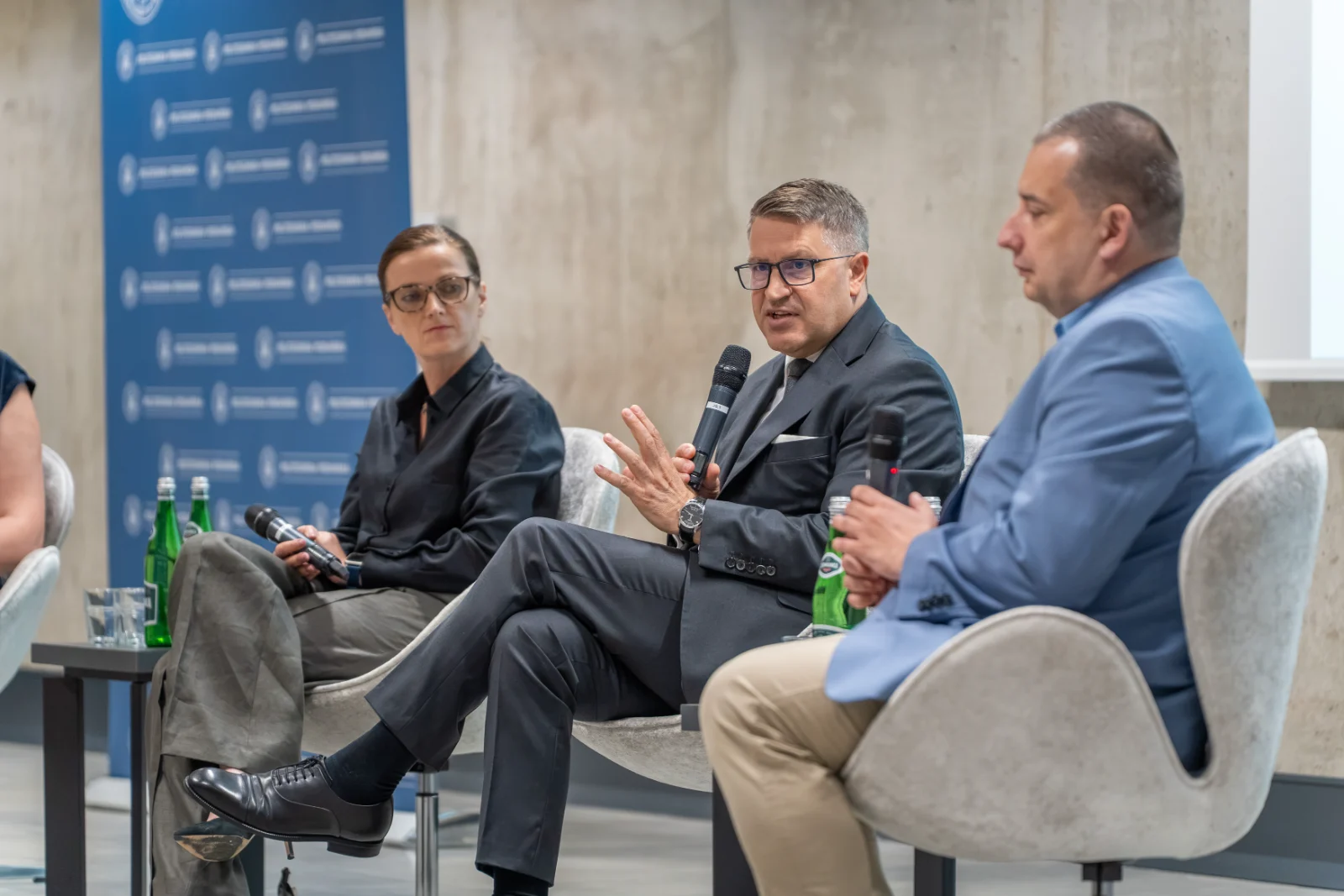
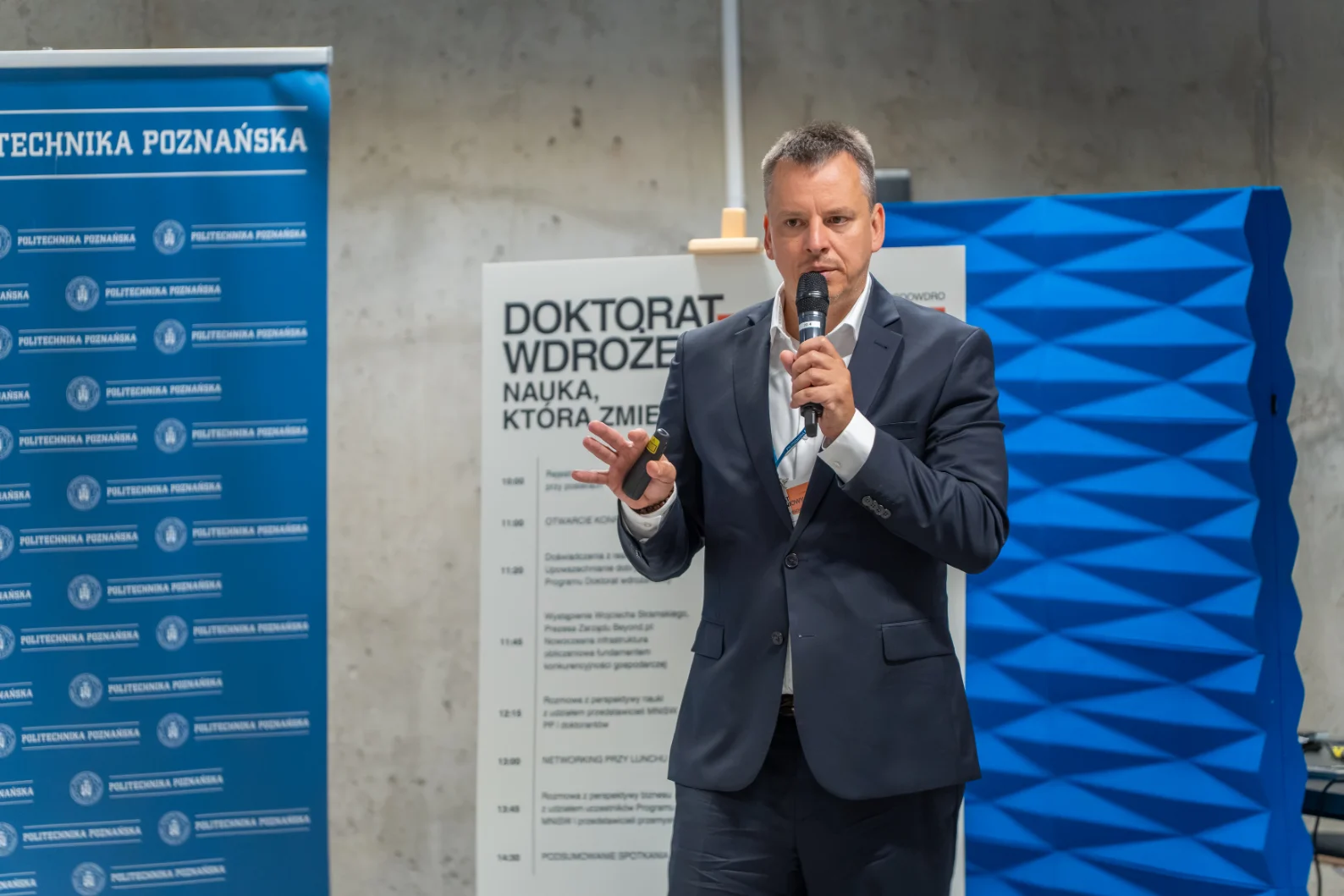
Promotional activities comprised presentations at conferences and industry events and project meetings with companies and business representatives; information on the progress of the project, the results obtained and the goals achieved on websites; and popularisation of the project results and the knowledge gained on social media and via Radio Afera, the academic radio station of Poznan University of Technology, and the podcast “Polipodkast – człowiek, nauka, biznes” (Human, Science, Business). A dedicated promotional event (a science–business event) was also organised, at which the results of the project were presented (talks by the authors of the report and by representatives of employing entities, doctoral schools and doctoral candidates themselves). This report contains informational and educational promotional materials popularising the Implementation Doctorate Programme, which will be disseminated following a positive decision by the Ministry of Science and Higher Education.
During the project, the doctoral candidate is required to publish the results of their work regularly in scientific journals, which is not generally accepted practice in industry [48]. This is a very important element of the project, in which the supervisor should teach the doctoral candidate to prepare valuable publications. The rule adopted is that the future doctor, regardless of the scientific field they represent, should have the ability and the will to publish the achievements developed in their company for the advancement of knowledge in the given field.
D
The report “Future Workforce – 5 Years of Implementation Doctorates”
It is worth referring here to the recent past. After the first five years of the Implementation Doctorate Programme, the report “Future Workforce – 5 Years of Implementation Doctorates” was published, prepared by Łukasiewicz Research Network [49]. Its aim was to summarise the results of the first five editions of the programme, assess the scale of its growth and show the impact of implementation doctorates on cooperation between science and the economy. The study shows the scale of the programme, its impact on the development of science–business cooperation and its role in building research and development staff for companies and public institutions in Poland. The report, whose most important elements we cite below together with our comments and remarks, presented data on the number of projects, their topics, the universities and companies involved, and the geographical distribution of the programme. Particular attention was paid to the role of implementation doctorates in building R&D staff for companies and in supporting the transfer of knowledge and innovation to the Polish economy. Analysing the content of the report, it could already be said with confidence at that time that the programme was a huge success for science, administration and business in Poland. In the first five editions of the programme, 2,293 implementation doctorate projects were approved, and a further 479 people qualified for the sixth edition. Detailed data are shown in the figure.
The programme developed dynamically despite the COVID-19 pandemic, which did not have even the slightest negative effect on the number of applications or projects. On the contrary — interest in participation grew in the following years. After these five years, implementation doctorates already accounted for more than 7% of all doctorates in Poland, which should be regarded as a significant success, all the more so given the relatively short time the programme had been running. The high durability of projects was also considered an important indicator of the programme’s effectiveness: for editions II–IV the share of projects still under way was 97%, 96% and 99% respectively, confirming the participants’ high stability and commitment.
Chart 1.1Number of accepted projects in successive editions
Accepted
Reserve list
386
463
372
591
481
I
II
III
IV
V
After the first five years, the gender split was such that men made up the larger group of participants (73.3% of projects), while the share of women was 26.7%. To some extent this resulted from the dominance of technical and engineering topics, traditionally chosen more often by men. And it was precisely this area, oriented towards the development of technology and industry, that dominated among the projects — and decisively so. As many as 63.7% of projects were in engineering and technical sciences, followed by natural and exact sciences (14.2%), social sciences (11.6%) and medical and health sciences (4.4%). These statistics are shown in the figure.
Chart 1.2Fields of science of the projects
Engineering and technical sciences
63.7%
Natural and exact sciences
14.2%
Social sciences
11.6%
Medical and health sciences
4.4%
Humanities
0.8%
Arts
0.2%
The most frequently represented disciplines included mechanical engineering, automation, electronics and electrical engineering, materials engineering, chemistry, and information and communication technology. Analysing the topics and keywords of the projects, we saw a strong focus on process optimisation, the development of new technologies, data analysis, artificial intelligence and machine learning, energy management and system security. This shows best that implementation doctorates are above all a tool for supporting the development of technology and industry.
Even then, the programme’s most important achievement was the successful building of R&D staff for companies. Almost 70% of implementation doctorates were carried out in the private sector, and of these almost 97% in companies. This made it clear that the programme effectively responded to the needs of business and supported the development of innovation in the economy. The most frequently represented industries at that time were machinery and electronics, the raw materials and metal industry, chemicals, IT, aviation and space, and pharmaceuticals and cosmetology.
Chart 1.3Main industries of companies participating in the programme
Machinery and electronics
10.3%
Raw materials and metal industry
10.1%
Chemicals and chemical products
7.4%
IT
6.5%
Aviation and space sector
6.1%
Pharmaceuticals and cosmetology
5.5%
Medicine and rehabilitation
5.2%
Automotive
4.8%
Land transport
4.2%
Energy
3.7%
The chart above shows how closely the whole idea was linked to the most innovative sectors of the economy. The programme also showed how interested large entities are in developing their staff. Among individual organisations, the largest numbers of projects were carried out by Łukasiewicz – Instytut Lotnictwa, PKN Orlen, Aptiv Services Poland, KGHM Polska Miedź and General Electric Company Polska. The clear leader in terms of the number of projects was Łukasiewicz Research Network, where doctoral candidates carried out as many as 189 projects, almost 10% of the total. The opportunity the Implementation Doctorate Programme has given these people therefore cannot be overestimated.
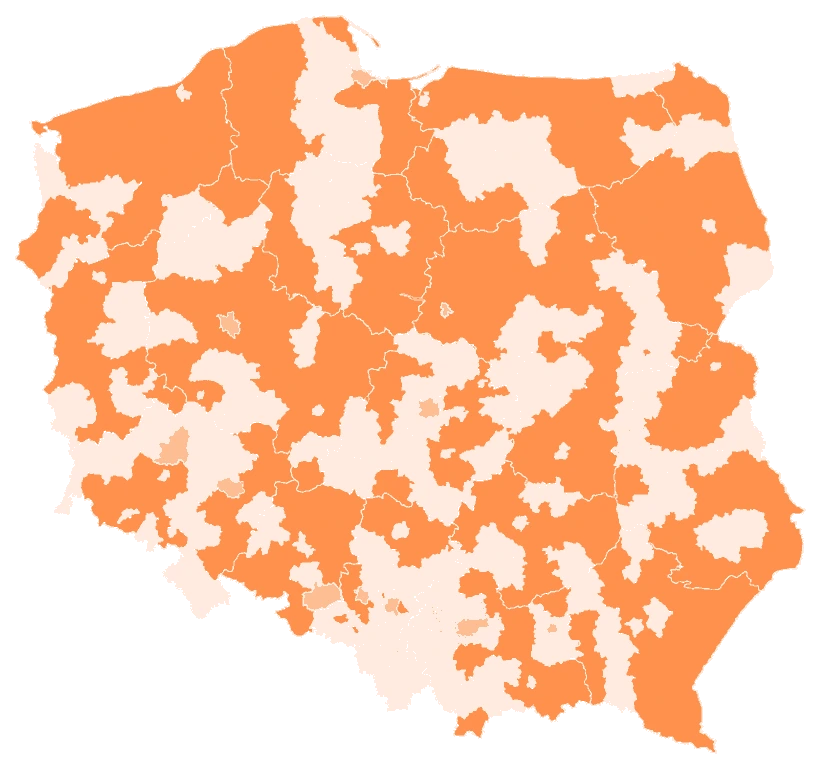
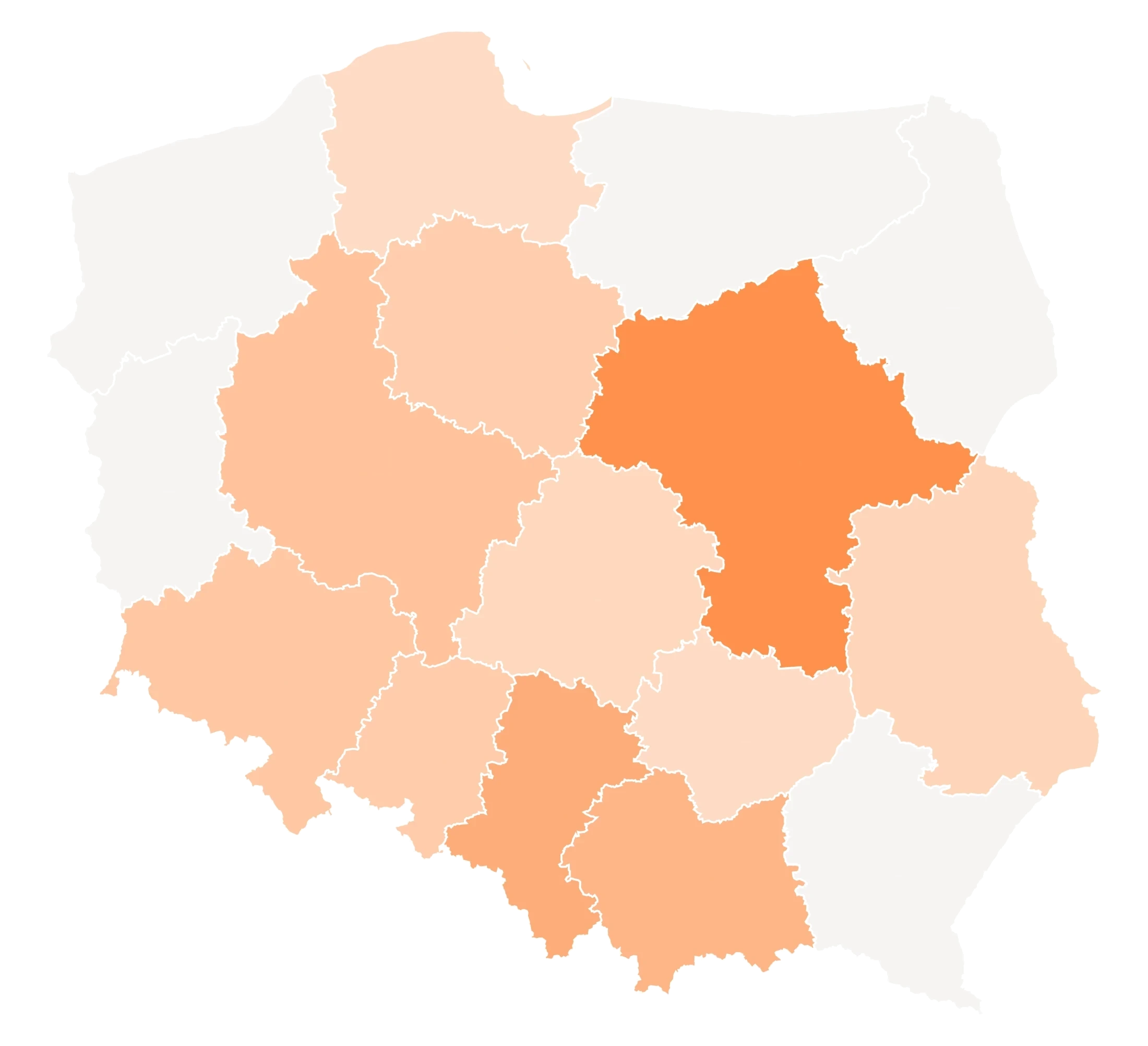
Interesting conclusions can also be drawn from an analysis of the programme’s regional significance. Although the largest number of projects were carried out in the largest academic and economic centres (Warszawa, Kraków, Wrocław, Katowice), the programme was clearly nationwide in character. Implementation doctorates were carried out in more than half of Polish counties and cities with county status. What is particularly interesting is that only 38% of projects were carried out in the same cities as the university running the doctorate, while as many as 61.6% were conducted outside the main academic centres. As is easy to see, this is the best proof of the effective transfer of knowledge and competences to smaller economic centres and of support for the development of local companies and institutions. The programme is not concentrated only in the largest cities — it supports the transfer of knowledge throughout Poland.
Map 1.1Implementation doctorates were carried out in more than half of Polish counties. Geographical distribution of projects — county map; the darker the colour, the more implementation doctorates.
more doctorates
fewer or none
Reading the report also led both its authors and us to some interesting key conclusions. Namely, after five years of operation, the Implementation Doctorate Programme proved to be an effective tool for supporting the innovativeness of the Polish economy. It successfully connected science with business, made it possible to build R&D staff for companies, actively supported the development of modern technologies, enabled the transfer of knowledge beyond the largest academic centres and, above all, responded to the real needs of companies and public institutions. The programme thus confirmed its great value as a mechanism supporting cooperation between science and the economy. It has given rise to competences, technologies and solutions that continue to strengthen the innovative potential of Polish companies and of the entire research and development system. Finally, it is worth adding that the authors of the report recommended further development and promotion of the programme, especially in the private sector, and a comprehensive evaluation once a larger number of projects had been completed. And this is exactly what our team undertook within the project Disseminating Best Practices in the Implementation of the Industrial Doctorate Program, funded under the Nauka dla Społeczeństwa programme.
E
The report “At the Interface of Science and Business”
Towards the end of our project, we received from MNiSW the report At the Interface of Science and Business – a Study of the Implementation Doctorate Programme. An Evaluation of the Programme’s Administrative Processes [50], prepared for the Ministry of Science and Higher Education by Ośrodek Przetwarzania Informacji – Państwowy Instytut Badawczy. The authors had much broader access to raw data, including data from applications and project reports; nevertheless, many of their observations are consistent with ours, and we present them below together with our comments and remarks. We have compiled detailed figures and present them in the fourth part of this publication.
The study conducted by OPI aimed at a comprehensive evaluation of the Implementation Doctorate Programme from the perspective of all the most important groups involved in its implementation. It focused on learning about the experiences of doctoral candidates, doctoral schools, cooperating entities, experts evaluating applications and reports, and ministry staff responsible for administering the programme. An important element was also identifying the problems, challenges, expectations and motivations of individual stakeholders. The process itself was carried out using several complementary methods, namely an analysis of data from the OSF system on the first seven editions of the programme, an analysis of the documentation and legal acts governing its operation, and qualitative and quantitative research, which made it possible to obtain a complete picture of how the programme works and to identify its strengths, organisational problems and areas requiring improvement. Individual in-depth interviews were conducted with doctoral candidates, supervisors, doctoral school coordinators, assistant supervisors and experts evaluating projects. In addition, a workshop was organised with MNiSW staff responsible for administering the programme. The online survey addressed to current and former participants asked, among other things, about their motivation for taking part, their sources of information about the programme, their level of satisfaction with its organisation and the results achieved through participation.
2795
doctoral candidates in the first seven editions
1300+
cooperating entities
65%
projects in engineering and technical sciences
32
median age of participants
Looking at the programme in figures, in 2017–2023, covering the first seven editions of the Implementation Doctorate Programme, a total of 2,795 doctoral candidates qualified to take part, which places the programme among the most important instruments supporting cooperation between science and the economy in Poland. The largest group of participants were doctoral candidates carrying out projects in engineering and technical sciences, who accounted for 65% of all implementation doctorates. Natural and exact sciences (14%) and social sciences (11%) had much smaller shares. Other fields were represented less often: medical and health sciences accounted for 5%, agricultural and veterinary sciences for 4%, and the humanities for only 1% of all projects. The programme is therefore used above all to solve technological and engineering problems directly related to the activities of companies and institutions conducting R&D.
Among the participants there is also a clear predominance of men: in the period analysed they made up 71% of doctoral candidates, while women accounted for 29%. This structure reflects the dominance of technical and engineering fields, traditionally chosen more often by men. However, the share of women grew steadily — from around 24–30% in the first editions to 36% in the seventh. Women more often completed doctorates in medical, agricultural, veterinary and humanities fields, and much less often in technical sciences. Participants varied in age, but their profile differed from that of a typical doctoral candidate starting a research career straight after graduation. The median age was 32, so many participants already had several years of professional experience before starting their doctorate.
The youngest participant was 23 and the oldest as many as 77, which shows the programme’s great openness to people at different stages of their professional and academic careers. On the academic side, 80 research institutions located in 24 cities were involved in the programme. The vast majority were public universities (94%), while PAN institutes accounted for 4%, non-public universities for 2%, and research institutes had a marginal share (0.1%). These data show that public academic universities remain the main pillar of the programme. Cooperation with the socio-economic environment is an important element of the programme. More than 1,300 cooperating entities took part in the first seven editions, employing doctoral candidates while they carried out their research. Most of them represented the private sector (68%), while 29% were public sector entities.
This shows that the programme is above all a tool for supporting innovation in companies, although public institutions engaging in R&D are also playing an increasingly important role. The scale of the programme and the number of entities involved confirm its important role in building lasting links between science and the economy.
By the seventh edition, a total of 2,795 people had qualified. The largest number of participants was admitted in the fourth edition (584) and the smallest in the seventh (171), which was related to changes in the rules and a limit on the number of projects submitted by a single doctoral school. In addition, specialised modules were launched in subsequent editions, including on artificial intelligence, quantum technologies and metrology. The interviews show that implementation doctoral candidates are perceived as ambitious, motivated, hard-working and focused on the practical use of knowledge. Unlike doctoral candidates following the traditional academic path, they usually have richer professional experience, clearly defined research goals and a strong link between their research and their employer’s needs. At the same time, they more often have to reconcile research duties with their job and family life, which is an additional challenge for them.
The most important motivations for taking part in the programme were the desire to obtain a doctoral degree, the development of research competences, deepening specialist knowledge, pursuing their own research interests and the opportunity to solve a specific problem in the company. The possibility of simultaneous professional and academic development without having to give up work was also very important. For some participants the doctoral scholarship was another significant factor. Doctoral candidates expected above all to broaden their knowledge and competences, to increase their competitiveness on the labour market and to develop solutions that meet employers’ needs. They also hoped to develop research skills, gain experience in implementing research results in practice and establish new professional and academic contacts.
Younger participants more often had career-related expectations, while older doctoral candidates attached greater importance to solving practical problems and developing their network of contacts. For most participants, the programme was the only realistic route to a doctoral degree. More than two thirds of those who had not previously attempted a doctorate declared that without the programme they would not have decided to undertake doctoral studies. The programme’s key advantage over the traditional path was the opportunity to conduct research as part of their job, the employer’s support, access to research infrastructure and funding in the form of a scholarship. Before starting the programme, doctoral candidates often felt uncertain about whether they could combine work with a doctorate, about future cooperation with their supervisor and about the funding conditions.
During the programme, they most often pointed to being overloaded with duties, having to reconcile their job with the requirements of the doctoral school, the long wait for report evaluations and uncertainty about the continuity of funding. At the same time, they expected greater flexibility from doctoral schools, smoother communication and more predictable administrative procedures.
Cooperating entities, i.e. companies and institutions employing doctoral candidates for the duration of the project, are among the key participants in the Implementation Doctorate Programme. Their role is not only to provide the doctoral candidate with a job but also to create conditions for research that addresses the organisation’s real needs and for implementing its results in practice. In successive editions the share of the public sector gradually increased, mainly thanks to the active participation of the institutes of Łukasiewicz Research Network. In the seventh edition the share of private entities fell to 54%, while that of public entities rose to 40%. Among public institutions, the largest number of doctoral candidates were employed by units of Łukasiewicz Research Network, above all Instytut Lotnictwa, Instytut Metali Nieżelaznych, Poznański Instytut Technologiczny and PORT Polski Ośrodek Rozwoju Technologii. In the private sector, the most active entities included
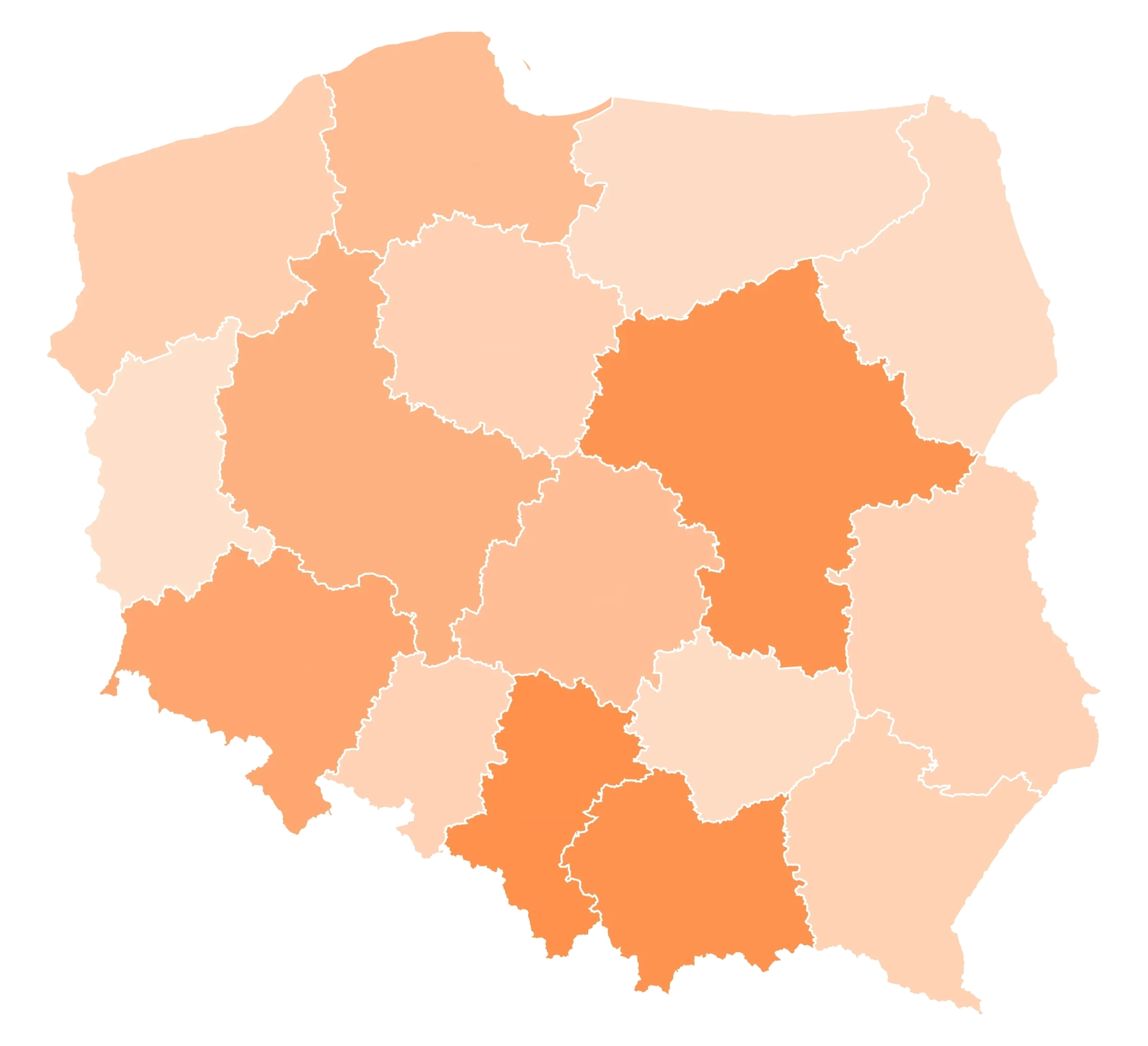
Orlen, GE Aerospace Poland, KGHM Polska Miedź, Aptiv Services Poland, Nokia Solutions and Networks and Grupa Azoty. Geographically, the programme was concentrated above all in the Masovian (27%), Silesian (17%), Lesser Poland (14%) and Lower Silesian (10%) voivodeships, which have the largest numbers of companies and institutions conducting R&D. The smallest shares were recorded in the Lubusz, Podlaskie and Świętokrzyskie voivodeships. Cooperating entities joined the programme for three main reasons. The first was the desire to develop employees, raise their qualifications and increase their motivation to work. The second was to strengthen the organisation’s research potential, develop cooperation with universities and gain access to expert knowledge. The third area of benefits was strictly business goals, related to increasing the organisation’s competitiveness by developing and implementing new technological, organisational or product solutions.
An important role in the doctorate is played by the assistant supervisor representing the cooperating entity. These are usually people holding a doctoral degree or with extensive R&D experience, often having previously worked with academia. Their task is to monitor the doctoral candidate’s progress and support them in carrying out the project on the company’s or institution’s side. In practice, the scope of assistant supervisors’ duties is much wider than the programme’s formal provisions suggest. They take part in preparing applications, help organise research, provide access to the company’s resources, support the solving of substantive and organisational problems and monitor the possibility of implementing the research results. The supervisors’ involvement depends on the number of doctoral candidates they supervise, the stage of the project and the degree of the participants’ independence.
Entities running doctoral schools are responsible for educating doctoral candidates, providing academic supervision, organising the doctoral process and the formal implementation of the programme on the academic side. Public universities accounted for 94% of implementation doctorates, with the remainder carried out by institutes of the Polish Academy of Sciences, non-public universities and research institutes. In terms of the number of projects, technical universities dominated. The centres with the largest numbers of doctoral candidates were above all Warszawa, Kraków, Gliwice, Wrocław and Poznań. One of the most important aspects of doctoral schools’ participation in the programme is cooperation with entities from the socio-economic environment. In many cases, relations between universities and companies already existed, and participation in the programme was a natural extension and deepening of existing cooperation. But there were also situations in which implementation doctorates were the first form of cooperation between a university and a company, opening the way to further joint research and implementation activities. The programme is seen not only as a tool for educating doctoral candidates but also as a mechanism supporting the transfer of knowledge and technology to the economy, and cooperation with companies that have their own R&D facilities and laboratories is particularly valuable.
With the launch of the programme, coordinators of the Implementation Doctorate Programme appeared in the structures of some universities. Their main areas of activity are communication (with the ministry, doctoral candidates and applicants, supervisors and companies), administration (applications, recruitment, compiling documentation) and coordination (tripartite agreements, funding, tracking the programme’s results and doctoral candidates’ progress). In practice, coordinators act as advisers, mediators and problem-solvers at the interface between the university, the company and the doctoral candidate. Supervisors, referred to as academic supervisors, are responsible for substantive oversight of the doctorate, directing the research and supporting the doctoral candidate in preparing the thesis. They include both experienced professors and recently appointed habilitated doctors. Supervisors stress that implementation doctoral candidates differ from traditional doctoral candidates: they are usually older, have professional experience and often have clearly defined research goals arising from the company’s needs. At the same time, they need more support in functioning in the academic environment and in conducting research that meets the requirements of doctoral schools.
The duties of the MNiSW staff administering the programme cover practically every stage of its operation: preparing announcements, handling applications and reports, preparing and amending agreements, settling projects and ongoing communication with programme participants. Each staff member performs many tasks at once and handles numerous processes in parallel. The main problem is being overloaded with duties. A team of just a few people is responsible for a large number of diverse activities, which often makes it difficult to complete all tasks on time and has a negative effect on staff well-being. An additional burden is the large number of changes submitted by doctoral schools, often sent at short intervals for the same agreements. Communication with the programme’s stakeholders is another significant challenge. Queries arrive through many channels at once, and not infrequently the same question appears in several places in parallel, which disrupts the team’s work. Although formally the party to the agreement with the Ministry is the doctoral school, it is not only doctoral school coordinators who get in touch, but also doctoral candidates and supervisors. A large proportion of the questions concern matters already described in the programme documentation, such as the rules for funding research infrastructure, how to fill in applications or procedures for reporting changes.
In most cases the initiative to join the programme arose from earlier cooperation between the doctoral candidate, the employer and the university. Applicants were often already employed in companies or research institutions and, together with their superiors, identified problems that could become the subject of a doctoral thesis. Supervisors and programme coordinators on the university side also played an important role, helping to refine the project concept and prepare the documentation. The recruitment process was usually assessed positively; it is particularly important (as we always stress) for all parties to develop a shared vision of the project beforehand. Finding an issue that meets both the scientific requirements and the company’s needs is not always easy. The topic must have adequate research value and at the same time lead to solving a specific practical problem and implementing the research results.
Preparing the application itself requires gathering a lot of information and presenting it correctly within a limited number of characters. The quality of the project’s preparation and the level of the partners’ commitment at this stage largely determine how the implementation doctorate will later proceed and how effective it will be. With successive editions, universities and companies gained experience, which made it easier to prepare applications. For a project to succeed, what matters greatly already at the application stage is the company’s real commitment, the employer’s willingness to provide time for research, access to research infrastructure and a good relationship between the doctoral candidate and the supervisor.
The project begins with establishing the relationship between the doctoral candidate, the supervisor and the assistant supervisor. This is where the difficulties of reconciling professional and family duties with the requirements of the doctoral school begin. At first it is hard to estimate the real workload required to carry out all these tasks simultaneously. The attitude of the cooperating entity (the employer) is important, as it can provide flexible working conditions, the possibility of conducting research during working hours and access to research infrastructure. The beginning of participation in the programme is crucial in this respect, although reconciling duties remains demanding throughout the project. Participants have to carry out part of their research outside working hours, often at the expense of their private time. If, in addition, the employer treats the doctorate as an employee’s side activity or even a whim, problems arise with completing the research on time.
Cooperation between the academic supervisor and the assistant supervisor also plays an important role. The supervisor is responsible for the scientific level of the work, while the assistant supervisor is responsible for its practical dimension and the possibility of implementing the results. During an implementation doctorate, participants must also fulfil the obligations arising from the doctoral school, such as attending classes and seminars, preparing scientific publications or completing professional placements. In the first editions, some doctoral school requirements were designed mainly with academic doctoral candidates in mind and did not always take into account the specific nature of an implementation doctorate (compulsory internships or placements in other entities); in subsequent editions we have seen a clear improvement here. It is therefore important that, usually at times when reporting deadlines, university obligations and intensive work tasks overlap, the doctoral candidate shows adequate mental resilience.
Another important element of the programme is the possibility of using funds earmarked for research infrastructure. For many projects this funding was important support, enabling the purchase of tools, equipment, software, research materials or services needed to conduct research. The procedures for spending the funds have also evolved over successive editions; in our view, the period of excessive formalities is now behind us (here, according to superstition, it is worth touching wood). Despite all these difficulties, participants stress that an implementation doctorate offers the opportunity to conduct research with a direct impact on the functioning of a company or institution, and that the results of the work are used in practice, which increases the sense of purpose of the research and the motivation to continue it.
Despite the many burdens, the programme is therefore seen as valuable, offering the opportunity to conduct research of real practical significance that combines scientific development with business practice.
During the project, participants prepare an annual report after each year, which from MNiSW’s point of view is one of the most important elements of progress monitoring. This process includes both a formal evaluation by the Ministry and a substantive evaluation by a team of experts (it was agreed internally that the expert who evaluated a given application remains responsible for the reports prepared under it). The evaluation of the report determines whether the year has been accepted and settled and whether it is justified to continue the project. The reporting stage is one of the most problematic elements of the programme because of the long wait for report evaluations. This wait (for reports not requiring corrections, the median waiting time is about half a year) causes uncertainty about further funding for the project and makes it difficult to plan the next stages of research.
If a report is returned for correction at the formal or substantive evaluation stage, the process takes even longer. Among the causes of this situation, we note in particular the limited staff resources at the Ministry, the quality of the reports submitted (some documents require corrections already at the formal evaluation stage, which means they must be processed again and prolongs the whole process), and changes to agreements and projects (a change of supervisor, company or topic), which make it necessary to prepare annexes and cause additional delays in evaluating reports. However — based on many years of experience working in the evaluation team — we do not believe that delays on the part of the experts evaluating reports are a significant cause. It rarely happens that the two-week deadline for evaluation is not met.
The reports themselves play a very important role as a tool for monitoring the progress of implementation doctoral candidates, requiring them to document the progress of their work systematically, plan further activities and maintain regular contact with their supervisor and assistant supervisor.
Finis coronat opus — every (well, almost every) project reaches its final phase: preparing the doctoral thesis and formal settlement. Doctoral candidates regard the period before submitting the final report as the most difficult, since most of their time was taken up by writing the thesis and publications and preparing for the defence. The final report itself, after the experience of three annual reports, was sometimes treated rather as a formality. However, the long wait for evaluation remains a problem — comments on the final report have sometimes arrived more than a year after the defence. Although the programme assumes a four-year implementation period, for many participants this proves insufficient to complete all research activities and prepare the doctoral thesis. According to OPI, more than half (51%) of the graduates who took part in the programme reported that they had used the option of extending the deadline for completing their doctorate.
This applied slightly more often to women. These results show that an implementation doctorate often requires more time than the programme’s standard schedule provides. Under the law, doctoral candidates employed outside the university are entitled to an additional 28 days of leave to prepare their doctoral thesis or prepare for the defence. More than half of the participants made use of this entitlement: 38% used the whole leave and 20% part of it. Leave was taken more often by women than by men, and more often by people employed in public than in private entities. The most frequently cited reasons for delays are the difficulty of simultaneously performing professional duties, conducting research and meeting the requirements of the doctoral school, as well as the longer time needed to carry out research, verify results or implement the solutions developed in the company.
Other reasons include the COVID-19 pandemic, which made access to infrastructure, raw materials and reagents difficult and disrupted the functioning of companies; the wish to refine the results; professional duties; lack of time; problems with publications, health or family situation; and various changes on the employer’s side. Despite these difficulties, however, most participants complete the programme successfully — among participants in the first three editions who have already finished the programme, as many as 85% completed it successfully, submitting a final report accepted by the Ministry. This is a huge success for the programme and certainly deserves wider publicity. Completing the programme brings tangible results both for doctoral candidates and for their organisations. These include the development of research competences, promotions, greater recognition as an expert, and the implementation of new technologies, products or organisational solutions in companies and institutions.
The remaining 15% of cases are withdrawals, which most often occur in the second and third years of the doctorate. The reasons are: a change in professional situation, problems with reconciling duties, loss of motivation, organisational difficulties or a change in life priorities. No significant differences in withdrawal rates were observed between women and men or between individual fields of science.
As mentioned, the benefits of participation do not end with the submission of the doctoral thesis or the end of funding, but often translate into participants’ further professional development, the development of organisations and continued cooperation between science and the economy. One of the programme’s most important effects is the growth of participants’ competences. Taking part in a doctorate makes it possible to develop research, analytical and project skills and to gain experience in conducting research and implementing its results in practice. For graduates, the doctorate has become an important element of their further careers, strengthening their position as experts and their promotion prospects both in academia and in companies. Participation in the programme also has a positive effect on relations between universities and cooperating entities.
The contacts established during the doctorate do not end with the defence of the thesis but lead to further joint R&D projects, expert cooperation or further implementation doctorates. The programme therefore serves as a mechanism for building lasting partnerships between science and the economy, which has been one of its goals from the start. The implementation outcomes are also important. A large proportion of projects have led to the development of new technologies, improved production processes, the implementation of new organisational solutions or an increase in companies’ R&D potential. The practical nature of the research is one of the programme’s greatest strengths, although not all implementation results are easy to capture immediately after the programme ends — sometimes the full effects only appear after several years, when the results are implemented on a larger scale or used in further projects.
This means that the programme’s real impact may be greater than current monitoring indicators suggest. The experience gained during the doctorate also changes the way cooperation between science and business is perceived — doctoral candidates, company representatives and university staff more often see opportunities for solving problems together and the benefits of conducting research geared towards practical applications.
Evaluation of the programme
The evaluation is clearly positive in all groups surveyed.
For universities the programme strengthens cooperation with the socio-economic environment, for companies it is a tool for developing R&D staff, and for doctoral candidates — a real route to a doctoral degree.
The OPI report shows that the overall evaluation of the Implementation Doctorate Programme is clearly positive in all stakeholder groups surveyed. Among graduates, as many as 83% rate their experience positively, and the share of those dissatisfied does not exceed 4%. The benefits of the programme become particularly visible after completion, when participants can assess the results of their work from a broader perspective. The Implementation Doctorate Programme benefits all groups involved in its implementation — doctoral candidates, companies, universities and the whole system of science and the economy. For doctoral candidates, the greatest benefit is naturally the opportunity to obtain a doctoral degree without having to give up their job.
Many participants also cite as a benefit the financial support of the doctoral scholarship, which provides additional help while carrying out research, as well as the opportunity to work on problems of practical significance and to see the real effects of their own research. For companies, the programme is above all a way of developing the organisation’s R&D potential and gaining access to up-to-date scientific knowledge, research methods and academic competences that can be used to solve specific technological, organisational or product problems. Entities gain highly qualified specialists who remain in the organisation after the programme and use the experience gained in their further work. Another important benefit is the opportunity to implement innovative solutions and build a competitive advantage on the market.
For universities, the programme helps to strengthen cooperation with the socio-economic environment, makes it possible to establish new partnerships with companies and to develop existing R&D relationships. The programme has also made research more practical, strengthening the importance of applied research and the transfer of knowledge into practice. In a much broader perspective, the programme supports the building of lasting relations between the worlds of science and business, helping to break down barriers between these communities, making it easier to understand each other’s needs and creating conditions for long-term cooperation. The development of innovation and the transfer of knowledge and technology to the economy are also important. As a result, the programme achieves goals that go beyond the individual development of participants, contributing to the growth of the competitiveness and innovativeness of the Polish economy. It can therefore be said that the broad range of benefits for all participants means that the programme is regarded as one of the most important tools supporting cooperation between science and business in Poland.
Naturally, as in any programme, some areas requiring improvement can be identified here too, despite the very positive assessment of the programme’s idea itself. Everything should certainly be done to shorten the time taken to evaluate annual and final reports. This element probably lowers the assessment of the programme’s functioning the most. It is necessary to improve the quality of the reports submitted (this publication, among other things, is meant to contribute to this by showing model practice) and to increase staff resources at the Ministry. The latter task in particular is very important: at present a small team simultaneously handles many processes related to report evaluation, contract administration, project changes and communication with participants. It is also worth considering greater automation of administrative processes, including by developing the functionality of the OSF system, so that more processes can be handled electronically.
Linked to the staffing issue is the need to streamline communication channels, make information materials more accessible and provide training for doctoral school coordinators, experts and other programme participants, which would reduce the number of recurring questions and improve the flow of information. This publication is one of the important elements that will allow the working time of those running the programme to be used much more effectively. Doctoral schools will also benefit from this document, which should in turn reduce the very large number of project changes submitted. And while we are on the subject of schools, their greater flexibility in education and requirements should be continued — without, of course, compromising the doctorate itself.
Finally — as analyses and experience show — the monitoring of cooperating entities should continue, as there are situations in which companies do not provide doctoral candidates with adequate conditions for research or are not interested in implementing the project results. Of course, so as not to throw the baby out with the bathwater, formal requirements should not be multiplied; instead, solutions should be sought that encourage employers to provide conditions enabling the doctorate to be completed or — as a last resort — to withdraw from the project early. As can be seen, most of the recommendations do not concern the purpose, the assumptions or the nature of the programme, but the improvement of organisation, communication and administrative procedures.
F
Summary
Science is often associated with laboratories, complex formulas and scientific papers. Industry, in turn, is seen as a world of production, deadlines and everyday problems requiring quick solutions. The Implementation Doctorate Programme shows that these two worlds can complement each other and coexist in symbiosis. This is one of the reasons why it is regarded as a valuable and necessary tool supporting cooperation between science and the economy. The high level of satisfaction, especially among graduates, confirms the programme’s effectiveness in achieving its goals. At the same time, the results of the study point to the need for further improvement of selected organisational processes in order to increase its efficiency and the comfort of participants.
The Implementation Doctorate Programme, launched in 2017, is an instrument supporting cooperation between science and the socio-economic environment. Its essence is combining doctoral education with employment in a company or other organisation in which research is carried out to meet specific practical needs. The doctoral candidate thus operates simultaneously in the academic and professional environments, and the result of the work should be not only a doctoral thesis but also the implementation of the research results. The Polish model is in line with the concepts of industrial doctorates developed around the world, whose common goal is the transfer of knowledge, technology and competences between universities and the economy.
The programme has already reached a significant scale. In the first seven editions, covering 2017–2023, 2,795 doctoral candidates qualified, and the number of people who have studied or are studying within it now exceeds 3,000. The programme is clearly technical in character — around 65% of projects are in engineering and technical sciences. Men predominate among the participants (71%), although the share of women is gradually increasing. The median age is 32, indicating that the programme is often used by people who already have professional experience. The first seven editions involved 80 research institutions and more than 1,300 cooperating entities, with 68% of projects carried out in the private sector. Evaluation studies show that the programme’s main advantage is that it makes it possible to combine a professional career with academic development. For many participants, it is a path without which they would probably not have decided to do a doctorate.
Benefits are also gained by employers, who develop their employees’ competences, gain access to scientific knowledge and strengthen their own R&D potential, and by universities, for which the programme becomes a mechanism for building lasting cooperation with the economy. Implementation doctorates can lead to new technologies, products, process improvements and organisational solutions, and the relationships established during them often continue after the project ends. At the same time, the programme involves significant challenges. Doctoral candidates must reconcile professional duties, research, the requirements of the doctoral school and private life. The success of a project depends largely on the employer’s commitment, the provision of time and infrastructure for research and good cooperation between the doctoral candidate, the supervisor and the assistant supervisor. A particularly problematic element remains the long time taken to evaluate annual reports, resulting, among other things,
from the administrative burden, the quality of some of the documentation submitted and the number of changes that the Ministry has to handle. Delays in completing doctorates are also common, related, among other things, to the difficulty of reconciling professional and research duties, the course of the research, publications, and external and personal factors. Despite these problems, the overall evaluation of the programme is very positive. Graduates rate it particularly well — 83% of them report positive experiences of taking part. The high completion rate of projects also points to the durability of the programme. The most important recommendations therefore do not concern changing its basic assumptions but improving the way it operates: shortening the time taken to evaluate reports, reducing the administrative burden, increasing MNiSW’s staff resources, further developing the OSF system, improving communication and increasing the flexibility of doctoral schools.
The overall conclusion from the analyses to date is clear — the programme should be continued and developed, while its organisation and administration are improved at the same time.
02
Chapter
Implementation
One of the most important outcomes of a project carried out under the Implementation Doctorate Programme is the successful implementation of the solution developed. We define the concept of implementation, show its variants across fields and draw conclusions for interdisciplinary projects.
A–B
A universal definition
C
Eight variants
D–E
The threshold principle
Implementation Doctorate — science that changes business
A
Introduction
One of the most important outcomes of a project carried out under the Implementation Doctorate Programme is the successful implementation of the solution developed. Unlike classic research projects, whose results are above all scientific publications or new theoretical concepts — sometimes with practical elements but without concrete implementation plans — projects in this programme are geared towards delivering measurable practical results. This means that the research results must be applied in the real operating environment of a company or institution, meeting specific, defined needs and — ultimately — helping to improve processes, increase efficiency or solve a specific technological, organisational or social problem.
Analysing the project applications submitted to the Ministry of Science and Higher Education under the Implementation Doctorate Programme, however, one can see that implementation itself is not always given due attention and the right level of importance. Consider that the first criterion a project reviewer has to assess is: Does the project have a clearly defined implementation character? A negative answer to this question automatically eliminates the application from further substantive evaluation, so careful consideration of the subject and method of implementation is a critically important aspect of the project. It is also worth noting that the implementation character must be clearly defined; projects — even very good ones scientifically — that end with the enigmatic statement “the results of the project will be implemented in the future” may be rejected already at this stage.
Moreover, looking at this issue from the company’s point of view, it is becoming clearer year by year that the Implementation Doctorate Programme contributes to building competitive advantages in the economy, and that it gives employees of companies and public administration the chance to develop their professional careers while conducting research of real value to their organisation. Cooperation with a university, access to research facilities, the opportunity to consult experts and work on a topic with a direct impact on innovation in the company — these are the elements that make this path exceptionally attractive for employees and, at the same time, extremely beneficial for their employers. And employers pay much less attention to the science; what they are really interested in is a concrete implementation in their organisation and its effects.
To avoid a situation in which a project has no defined implementation, this chapter sets out to define implementation, to describe its character in different fields and disciplines, and to distinguish between what is and what is not an implementation. We present the assumptions and guidelines for implementing the solution developed, also analysing how it is implemented by the implementing entity. Particular attention is paid to the elements that confirm the practical application of the research results and their impact on the functioning of the organisation. The study is conceptual in nature, but it is based on the authors’ practical experience of supervising implementation doctorates.
Turning to the substance, the concept of implementation is widely used in research, applied projects and interdisciplinary activities. It appears in the technical and medical sciences as well as in the social sciences, the humanities and the arts. Despite its frequent use, the term implementation remains ambiguous, and its meaning depends on the disciplinary context. What one discipline regards as full implementation, another may treat as merely an intermediate stage. The lack of a clear understanding of the concept of implementation becomes particularly problematic in interdisciplinary research and in applied projects. Differences in the interpretation of the term affect how research is designed, how its goals are formulated and how its results are evaluated. As a consequence, this may lead to diverging expectations between researchers, stakeholders and funding institutions.
In individual fields of science, the concept of implementation often refers to entirely different activities and aspects. In the technical sciences it means putting a solution into operation in a working technical system; in the medical and pharmaceutical sciences — introducing a solution into clinical practice or onto the market; and in the humanities and social sciences — the practical application of research results in activities related to education, administration or culture. These differences are rarely defined, although they are important for assessing the maturity and usefulness of research results. The lack of a common, unambiguous conceptual framework makes it difficult to compare projects in different disciplines and to assess the extent of their implementation. This also applies — at least — to some interdisciplinary projects, especially where different fields of science are combined.
The aim of this chapter is also to propose an approach to the concept of implementation that is coherent and at the same time takes into account the specifics of each field. We present a universal definition of implementation based on the idea of applying research results in real systems specific to a given field. We then present interpretative variants of this concept in selected areas of science, together with a comparison showing the differences in implementation thresholds between disciplines. The final part discusses the implications of the proposed approach for interdisciplinary research and implementation projects.
B
The conceptual problem and a universal definition of implementation
In the scientific literature and in research practice, the concept of implementation functions as a seemingly intuitive but in fact ambiguous term [51]. Its meaning is rarely defined explicitly, and the way it is used depends heavily on the disciplinary context. As a result, the term is used very broadly: to describe the completion of development work, the launch of a solution and the achievement of real impact outside academia alike [52]. Such a range of meanings leads to conceptual ambiguity and makes it difficult to compare research results. One of the main sources of the conceptual problem is that implementation is often equated with, and confused with, other categories such as technical implementation, project delivery, commercialisation or the dissemination of research results [53]. These categories, however, describe different stages of a solution’s life cycle and relate to different criteria of its maturity. Technical implementation may, for example, mean that the solution has been built correctly according to specification, without determining whether it is actually used. Commercialisation, in turn, concerns bringing the solution to market, which is not always the goal of applied research in the public, social or cultural spheres.
A further source of ambiguity is the field-specific nature of the systems in which implementation is to take place [54]. In the technical sciences, such a system is usually infrastructure or a technical device; in the medical sciences — clinical practice or the healthcare system [55, 56]; in the social sciences and humanities — institutional, educational or cultural practices. Because of these differences, the threshold for considering a solution implemented is defined by different criteria, such as technical operation, regulatory approval, the routinisation of practice or a lasting change in behaviour. In the health sciences, a separate field known as implementation science has developed, focusing on the processes of introducing interventions into practice and on ways of measuring implementation outcomes [57]. In this stream, taxonomies of implementation outcomes play an important role, covering, among other things,
acceptability, appropriateness, feasibility, adoption, fidelity, penetration into practice and sustainability [58]. In parallel, analytical frameworks are used to help identify barriers and facilitators of implementation (e.g. CFIR) [59], as well as frameworks for planning and evaluating interventions that take into account the individual and organisational levels (e.g. RE-AIM) [60]. An important complement is Normalization Process Theory, which explains the mechanisms by which new practices are “embedded” in the routine of an organisation [61]. A closely related, partly overlapping stream is research on translating knowledge and research into practice (knowledge translation and translational research). In this approach, implementation is understood as part of a broader cycle of moving from knowledge to action, as exemplified by the Knowledge-to-Action framework [62].
In addition, translational spectrum models set out the successive stages of moving from basic research to clinical practice and population impact, stressing that implementation thresholds change with the stage and type of target system [63]. In the social sciences and organisational research, implementation appears in the classic literature on the diffusion and adoption of innovation, in which implementation is a stage of the decision process leading to routine use of a solution. In public administration, the policy implementation stream is important: here implementation is understood as a distinct, complex stage of translating decisions into institutional practice, burdened with the risk of discrepancies between the intention of a policy and its actual execution. In technical and industrial fields, implementation is often linked to the assessment of technology maturity [64].
An example is the Technology Readiness Levels (TRL) scale, which indicates how ready a technology is for use in real conditions [65, 66]. In the humanities, social sciences and arts, by contrast, the emphasis is more often on the category of research impact and influence on the non-academic world, which is reflected, among other things, in evaluation practice. Models such as the Implementation Research Logic Model [67] point to the multidimensional nature of the benefits of research and to the need to analyse the mechanisms leading from scientific results to social and economic effects [68].
The conceptual problem of implementation becomes particularly apparent in interdisciplinary research [69]. Projects combining different disciplines often operate with a single term, “implementation”, even though individual project participants may attach different meanings to it [70]. As a consequence, implementation may be declared on the basis of criteria appropriate to one field, while from the perspective of another it remains incomplete or premature. The lack of a common conceptual framework then makes both communication within the research team and the evaluation of the project by reviewers from different areas of knowledge more difficult. The vagueness of the concept of implementation also has an institutional dimension. In the context of publicly funded projects and implementation doctorates, the lack of precise criteria leads to differing interpretations between applicants, funding institutions and evaluating bodies.
Implementation is then treated as a declared goal of the project, without a clear indication of the system in which, and the criteria by which, it is to be achieved [71]. At the same time, the literature rarely offers a synthetic, cross-cutting approach that would make it possible to compare implementation thresholds across disciplines and support communication in interdisciplinary projects. These problems point to the need to structure the concept of implementation in a way that, on the one hand, preserves its field-specific character and, on the other, makes it possible to compare and communicate the degree of implementation in interdisciplinary research. This gap motivates the proposal in this study of a unified yet field-aware definition of implementation, together with a comparative framework. Later in the chapter we also propose a universal approach to implementation and a set of interpretative variants of the concept in different areas of science.
The starting point for a universal definition of implementation is therefore the assumption that the common denominator of all forms of implementation is the application of research results in a real system specific to the given field. For the purposes of the discussion that follows, implementation can be defined as the process of practically applying research results, concepts or solutions in a real system specific to the given field, leading to their actual, lasting and responsible use, including outside the environment in which they were developed. The proposed definition emphasises several important elements that distinguish implementation from related concepts. First, implementation is understood as a process rather than a one-off event, which stresses its dynamic and staged nature. Second, the definition points to the need for practical application, not merely the formal completion of research or development work.
Third, a central role is played by the category of the real system, which makes it possible to capture the field-specific nature of implementation without reducing it to a single, universal technical criterion. Another important element of the definition is the requirement that the solution is actually used. This means that implementation does not occur when a solution has only been developed, installed or declared ready for use, but only when it is actually applied in the target system. This requirement makes it possible to distinguish implementation from technical implementation, a pilot or a test phase, which may — but need not — lead to the actual use of the specific solution developed. Another distinguishing feature of implementation is its durability. Implementation cannot be equated with a one-off application or a short-lived experiment; it assumes a certain degree of stability and repeatability of use.
Depending on the field, this durability may take different forms, from the continuous operation of a technical system, through a kind of routinisation of organisational practices, to the permanent presence of a work in cultural circulation. Finally, the definition stresses an aspect that could be described as responsibility for the consequences of use. Implementation implies taking responsibility for the consequences of using the solution in a real system, including its technical, social, health or cultural impact — here, too, this depends on the research area. This element distinguishes implementation from purely experimental activities and is particularly important in regulated fields and in research with potentially significant social consequences. Importantly, the proposed approach does not eliminate field-specific differences in the understanding of implementation, but provides a conceptual framework that makes it easy to compare them.
Implementation defined in this way may have different interpretative variants in selected areas of science, taking different forms depending on the type of real system and the criteria for considering the process complete.
A universal definition
Implementation is a process, not an event.
Implementation can be defined as the process of practically applying research results, concepts or solutions in a real system specific to the given field, leading to their actual, lasting and responsible use, including outside the environment in which they were developed.
C
Field-specific variants of implementation
Applying the universal definition of implementation proposed above requires, however, taking into account that in individual areas of science the concept refers to different types of real systems and to different conditions for closing the process. Let us now look at field-specific variants of implementation to illustrate how the same conceptual category can take on different operational meanings.
C.1
Engineering and technology
Let us begin with the area that seems most obvious, namely the technical and engineering sciences. Here implementation has a strictly defined, pragmatic meaning, clearly different from mere technical implementation or the publication of research results: it means applying a solution in a working technical system and operating it under operational conditions [72, 73]. It is thus the final result of the process of transferring the results of research or development work into practical use, in which the solution works in a real technical environment and meets user, production or operational requirements. The key technical criterion of implementation here is that the solution works outside the laboratory, in a real context of use (in a plant, system, network, production line or IT infrastructure).
It must also be operated (not just launched, but actually used), meet specific technical requirements and standards (safety, reliability, compatibility, scalability), and be repeatable and maintainable (capable of being maintained over a longer period, serviced and — depending on the situation — replicated, etc.) [74]. Prototypes, pilot installations or technology demonstrators may be stages preceding implementation, but as a rule they cannot be equated with it, unless of course the solution in question is actually used in the target system. If we analyse the successive stages of the research and implementation process — theoretical model, simulation, laboratory prototype, prototype in real conditions, installation in the operational environment and operation by the user — the threshold for implementation understood in this way is the prototype in real conditions.
Following this line of thought, we can determine what, for example, is and is not an implementation in individual engineering fields. In mechanical engineering, an implementation is, for example, a newly built machine or device working on a production line [75], based on a new pre-implementation design and a laboratory prototype. It is also a new component or item produced in series and working in a specific application, after the development of a new geometry and technology, a prototype made under research conditions (e.g. in a laboratory) and a prototype tested under near-production conditions. In automation, before implementation a control algorithm may be developed for a system simulation, followed by a system tested under field conditions as the threshold for implementation, i.e. a specific control system operating in an industrial installation (integration of the control algorithm or automation system with a real technical object).
Similarly in computer science: first an algorithm and code (or even a demo application) are developed, while the implementation will be a system running in a production environment and used by users, i.e. the actual launch of an IT system in a production environment and its actual use. Energy engineering will also begin with a model of the energy system and a test installation, followed by a pilot installation and, on that basis, connection (to the system) and operation of the solution in existing energy infrastructure — the implementation. Materials engineering will approach the subject analogously: a newly developed alloy and its laboratory samples will undergo application tests, followed by the actual use of the new material or materials technology in a real product (the implementation being precisely the material used in a product on the market).
Finally, environmental engineering, where a treatment concept, a pilot installation and a test phase lead to an implementation in the form of an installation operating at a wastewater treatment plant.
C.2
Biology
Let us now turn to the biological sciences. In this area implementation has a different character than in the classic engineering sciences, but it retains the same core: the transition from knowledge to practical application. The difference is that the “real system” is not a machine but an organism, a population or a biological process [76]. Implementation in the biological sciences therefore means applying the results of biological research in clinical, environmental, agricultural or industrial practice, leading to a measurable biological effect outside laboratory conditions. It may include the use of organisms, biological processes or biotechnological solutions on an environmental, production or clinical scale. The criterion of implementation here is achieving a measurable and repeatable biological effect in real conditions, taking into account biological variability and regulatory constraints (if any).
Again using examples, and without straying too far from environmental engineering: in ecology, the period before implementation will cover the population model and ecosystem simulations, up to a pilot programme as the threshold for implementing a working species or habitat protection programme. In molecular biology, research will include identifying a gene or metabolic pathway and in vitro tests, followed by pilot tests as the threshold, and we will regard the production of a protein or enzyme on an industrial scale as the implementation. Microbiology will first isolate a strain in the laboratory and carry out fermentation on a laboratory and pilot scale, and then implement a fermentation process operating under industrial conditions, i.e. the use of microorganisms or biological processes in production.
Applied biology for agriculture will deal with the selection of a genotype under greenhouse conditions and laboratory tests, followed by experimental plots as a prelude to implementing a specific variety grown by farmers or fruit growers, i.e. the application of the results of biological research in agricultural production.
C.3
Food research
Another field is food science. Here implementation has a meaning very close to that in the engineering and biological sciences, but with a key emphasis on food safety, production scale and, to some extent, consumer acceptance [77]. It is very clear that the product or technology must actually go into production and onto the market, not just work properly in the laboratory. Implementation therefore means introducing a new food product, ingredient, recipe or processing technology into industrial production and onto the market, in compliance with safety, quality and food law requirements, or the practical application of research results in the production or trade of food, leading to a safe and lawful product or technology being put into real market use. In this area, what matters in particular (apart from industrial scale and repeatability) is consumer health safety and compliance with food law.
To take an example from food processing: as in biology, we start with a recipe developed in the laboratory and technological trials up to pilot scale, after which the implementation is the launch of the technology in a real production plant and the resulting series production of food. If we consider bringing a new food product to market, the first stage will be the product concept itself, followed by a sensory prototype which, as the threshold, will have to pass consumer tests, and the implementation will mean placing the product on the market and making it available in retail. When analysing food safety, we will start by developing a method for detecting a pathogen in the laboratory and, through the validation of this method, arrive at the implementation, i.e. a way of carrying out routine quality control in the plant, as the application of safety assurance methods in production practice.
In food packaging and logistics, the successive phases are a new packaging material and its laboratory testing, storage-related tests and, as the implementation, packaging used in market distribution, i.e. the application of a new packaging or logistics solution in the supply chain. In this area, therefore, the following will not be an implementation: a recipe “on paper”, laboratory samples and the tests carried out on them and their interpretation, technological trials, or even a one-off trial batch without continuity (i.e. further batches), if the solution does not function in a real production and distribution chain. For the purposes of an implementation doctorate, of course, there is no need to demonstrate consumer acceptance; the risk in this respect lies entirely with the implementing entity.
C.4
Medicine
In the medical sciences, implementation is much more formal and regulated in character and is closely linked to patient safety, clinical effectiveness and formal procedures [78]. It means introducing a specific medical solution (e.g. a therapy) into clinical practice or the healthcare system after meeting the requirements of efficacy and safety and obtaining the relevant institutional approvals. Clinical trials themselves, even at advanced stages, are not yet an implementation, which actually takes place only when the solution is used routinely in patient care. In pharmacy, in turn, implementation means bringing a medicinal product or pharmaceutical technology to the stage of marketing authorisation and its everyday use in accordance with the law. Implementation is thus closely linked to registration processes, quality control and post-authorisation surveillance.
Research and development work, validation or pilot production are stages preceding implementation but are not equated with it. Again using concrete examples: in the biomedical sciences — as in areas related to biology — the work will begin with the discovery of a biomarker and, through laboratory validation and preclinical tests, reach the clinical trial phase, and the concrete implementation will be a diagnostic test or therapy used in patients. Similarly, in clinical medicine (diagnostics and therapy), where the goal is the approval and use of a diagnostic or therapeutic method in patients, the starting point will be the discovery of a disease mechanism, followed by preclinical and clinical studies, and only their result — as the implementation — will be a method incorporated into treatment standards and used in practice.
When considering public health and the healthcare system, focused on applying research results in health policy or in the organisation of healthcare, the work will begin with an epidemiological analysis and expert recommendations, leading to a pilot programme, and a regional, national or international prevention programme will be regarded as the implementation. In pharmacy, where the end result should be bringing an active substance, medicinal product or pharmaceutical technology to the stage of marketing authorisation and routine use (the authorisation of a medicine and its use in therapy), after the identification of a molecule and in vitro, in vivo and clinical studies, the implementation phase covers a specific medicine that is registered and prescribed to patients. If we are talking about introducing a technology, the implementation will be the use of the manufacturing technology in industrial production.
The work as a whole should include laboratory-scale formulation, pilot stability studies, process validation and semi-industrial scale, ultimately leading to stable series production of medicines (e.g. tablets). Implementation may also be the application of pharmaceutical knowledge in clinical practice, where the development of guidelines and recommendations is followed by a pilot programme ending with the introduction of pharmacotherapy procedures used in a hospital. In this area it is most clearly visible that there is no such thing as “partial implementation” — either the method meets all the criteria or it is not implemented. Moreover, as a rule, introducing a research result into clinical practice or the healthcare system is possible only after its efficacy and safety have been demonstrated and the required regulatory approvals obtained. In this arrangement it is not the researcher’s decision but a systemic process — a decision of the regulatory body.
Because this whole process takes many years, for the purposes of implementation doctorates we limit ourselves to reaching the stage at which the solution is admitted to formal procedures.
C.5
Administration and management
But implementation also exists outside the strictly material sciences. In public administration, it means the institutional introduction of regulations, public policies or organisational systems into the everyday practice of public bodies [79]. The key criterion of implementation here is not a product but the actual use of new solutions by institutions, offices or the state in general, and their availability to citizens. The mere adoption of a decision or the launch of an IT system (which perhaps nobody uses) is not an implementation if it does not lead to a real change in administrative practice. Implementation therefore means the practical introduction of a legal act, public policy, programme or organisational system into the everyday functioning of an institution, together with ensuring that it is applied by officials and citizens. Taking an example from law, the process begins with a new procedure or draft law, its adoption and the so-called
vacatio legis, while the implementation is the entry into force and actual application of the provisions — for example by an office in the administrative decisions it issues — or a line of case law or a change in the practice of public bodies. It may also be the translation of legal doctrine or case law into court practice, procedures or the interpretation of law, bearing in mind that implementation means application, not adoption. In public policies and government programmes, where implementation means the launch of a programme and its real functioning, the process begins with a strategy, followed by a government resolution and a pilot, and the result is only the situation in which beneficiaries submit applications and receive benefits. A similar situation occurs in the implementation of European Union law in a member state, where an EU directive and its analysis are followed by transposition into national law and institutional preparation, and as a result — as the implementation — public bodies apply the new provisions in line with the purpose of the directive.
In this entire area of science, the condition for implementation is therefore not only a formal legal basis but also the readiness of institutions and, above all, application in practice and availability to citizens. Classic management, by contrast, regards as implementation the application of models, strategies or tools in a real organisation, as well as an actual change of processes in a company, regardless of its line of business [80]. The research will cover above all the creation and theoretical verification of the management model itself. It should be noted that the effect of implementation will be measured here much more by financial results from a business perspective than by theoretical correctness.
C.6
Humanities and social sciences
In the humanities, the concept of “implementation” has the “softest” but still precise meaning. It is not about a machine or a biological organism, but about social practice and the real application of ideas, interpretative models or tools in the educational, cultural, social or organisational activities of people and institutions [81]. Implementation here often manifests itself in a change in the practices, interpretations, norms or ways of acting of institutions and social groups. A model developed or the popularisation of knowledge is not equivalent to implementation unless it leads to lasting change outside academia. Referring again to examples: in the educational sciences, implementation is the application of a teaching concept or curriculum in a real educational process, as well as a change in curricula, assessment methods or the organisation of the learning process.
Research work here begins with a theory of learning or an innovative teaching method, followed by lesson plans and a pilot in one class or school, and finally, for example, a curriculum implemented system-wide. In linguistics, implementation can be taken to mean the application of the results of linguistic research in communicative or technological practice. The result — a dictionary, a language standard or a translation system used in practice — will then follow from the research part: a description of a linguistic phenomenon, a theoretical model and a pilot tool. In history and cultural studies, one can start with an analysis of an artist or an event and, through an exhibition concept and a temporary display, arrive at implementation in the form of a permanent museum exhibition or a history education programme.
Moving on to philosophy and ethics, in which implementation may mean the application of philosophical reflection in norms, procedures or public debate, the pre-implementation phase will include ethical or philosophical analysis, theoretical recommendations and expert consultations, and finally a code of ethics applied in a specific institution, corporation or system will be introduced. Implementation in sociology is seen as the application of the results of social research in public policies or practices. It will be preceded, for example, by a research report, surveys and recommendations and a pilot project, resulting in a set of procedures or a change to them, a social campaign or new regulations. In this area of science — as before — what matters is going beyond research, i.e. the university sphere, and the durability and repeatability of the effect, but also the creation or modification of a certain practice, interpretation or decision, and above all contact with a real audience.
By contrast, popularisation without an impact on practice and one-off events without continuity are not implementations.
C.7
Arts
In the arts, implementation works differently than in the exact sciences or medicine, but it is not merely a metaphor: it means rather the transition from an artistic concept to real artistic or institutional practice in which the work begins to exist and have an effect. It occurs when the work ceases to be a vision and functions in a social, institutional or performative space, becoming the object of the audience’s real experience [82]. The idea itself, the documentation or the conceptual design, or the technical production, therefore do not constitute an implementation [83]. In the visual arts (painting, sculpture, installation), implementation is, quite generally, the realisation of an artistic concept and making it available to an audience. Naturally, before a work is exhibited in a gallery or public space (the implementation), it needs, for example, an idea (e.g. sketches), conceptual documentation and a prototype or model. For the performing arts (e.g.
theatre, dance, performance), implementation will mean launching the work in time and space. Here too, before a play or performance is presented publicly (the implementation), preceding stages are necessary — a script or score, rehearsals (including the dress rehearsal) or a work-in-progress showing. Similarly in music, implementation is the performance or publication of a piece in artistic circulation. First the score has to be written, then after rehearsals a working recording is made, and finally we have a concert, a released album or a public broadcast of the piece. If art appears in public space, the implementation will be the presence of the given artistic project in real social space — a realisation involving the community. For this to happen, there must be a concept for a participatory project and a pilot, in whatever form.
The common elements of implementation in the arts are the transition from idea to experience, i.e. a kind of materialisation of the idea, but also the presence of an audience and functioning in cultural circulation. The idea or concept itself, documentation without realisation, or any project that has not left the studio are not treated as implementations. It should also be added that in artistic practice people more often speak of realisation, launching a project or presentation, and the word implementation appears mainly in grant-type projects, interdisciplinary programmes or — in line with the subject of this chapter — implementation doctorates in the arts.
C.8
Sport
In the sport sciences, implementation has a practical and operational meaning: it is the direct translation of scientific knowledge into real training, organisational (the efficiency of the sport system) or rehabilitation activity [84]. The criterion of implementation is the actual use of methods, programmes or tools in the training cycle and the achievement of measurable sporting or health outcomes. The effect must therefore be applied in a real sporting environment, not merely described or tested in the laboratory. One-off tests or pilot interventions do not meet this criterion either. For example, in the theory and methodology of sports training, we will regard as implementation the real application of a training programme or method in the training cycle.
These will naturally be preceded by the research part, i.e. a theoretical model of exercise adaptation, a training programme “on paper” and pilot tests, and the result will be a specific programme carried out by the coach and athletes during the competition season. For physiology or biomechanics, implementation is the application of physiological or biomechanical knowledge in sporting practice. The work will begin with laboratory tests and biomechanical motion analysis, followed by specific training recommendations, and the result will be a change in running, jumping or throwing technique, etc., or in the athletes’ training load. The same applies to sport psychology — here implementation can be taken to mean the application of a psychological intervention in the real training or competition process.
The implementation will therefore be prepared and regular mental training with athletes during the season, preceded, for example, by an analysis of the situation, a motivation concept, a mental training programme described in a publication and pilot workshops. For rehabilitation, implementation will be the application of a diagnostic, therapeutic or rehabilitation procedure in sporting practice. Here too the starting point will be a thorough analysis of the current state, after which a rehabilitation model will be developed together with clinical tests, and the final solution will be a therapy or protocol used routinely in a sports club. Looking at sport management and training systems, we will regard as implementation the application of organisational or systemic models in a real sporting environment.
This can start with a talent management model and the development of a training strategy, leading through a pilot in one section or club to a training system operating in a specific area or sports federation. The common denominator of implementation in sport is thus direct translation into practice and action in a real sporting environment and the durability of the solution; a measurable sporting or health effect is also important, as is the involvement of coaches and athletes. By contrast, laboratory tests without translation into training, recommendations that are not applied and — as in other sciences — one-off interventions without continuity are not implementations.
Eight fields, eight thresholds
The same threshold means something different in every discipline.
What one discipline regards as full implementation is only an intermediate stage in another.
D
Implications for interdisciplinary research and implementation projects
A great many activities and projects today are interdisciplinary in nature [85, 86]. Areas worth mentioning here include medtech, edtech, foodtech, govtech and art & science. It is very often here, at the boundary of two or more areas of science, that the most interesting inventions and implementations emerge. Rigidly assigning a project to just one specific discipline and never going beyond it is by no means positive or beneficial from a holistic point of view. Science as a whole knows no boundaries between its disciplines and fields; they have been defined — often quite artificially — by people. All interdisciplinarity and the ability to use knowledge from one area in another, sometimes quite distant, should therefore be seen very positively. Implementation in an interdisciplinary approach, following logical conjunction, means reaching the most restrictive implementation threshold among the fields combined.
Implementation combining a specific discipline with digital technologies is becoming increasingly common [87, 88]. For example, digital medicine will regard as implementation the launch and use of a digital medical technology in the healthcare system, for instance certified software used by doctors. Its starting point will be an artificial intelligence algorithm for diagnostic purposes, which will undergo technical validation and clinical studies. For digital administration (e-government), in turn, implementation will be the launch and real use of an IT system that is actually used by citizens and officials. Work in this area will begin with the design of the system and proceed through testing to technical launch. Similarly, in the rapidly developing field of digital art, implementation is a working interactive installation or online project, i.e. launching the work in a working technological environment.
Before this happens, there will be a concept, source code and a test version.
Interdisciplinary premises make it possible to attempt a more universal definition of implementation that would be flexible enough to be adapted to different areas of science. Let us therefore assume that implementation means the process of practically applying research results, concepts or solutions in a real system specific to the given field, leading to their actual, lasting and responsible use outside the research environment in which they were developed. The essential elements of this concept of implementation are going beyond theory, the laboratory or the concept and coming into contact with a real system (technical, biological, social, cultural, etc.), and the awareness that it consists not merely in creating a solution but in taking responsibility for it in a real system specific to the given field.
The conceptual framework of implementation proposed in this chapter has important implications for the design, conduct and evaluation of interdisciplinary and applied research. The key consequence of adopting a universal yet field-differentiated definition of implementation is the possibility of defining research goals and the criteria for achieving them more precisely in projects combining different areas of knowledge. In interdisciplinary research, the question of a shared understanding of implementation among project participants becomes particularly important. As shown in the previous section, individual disciplines use different criteria for considering a process implemented. Failure to agree on them explicitly may lead to a situation in which implementation is declared on the basis of criteria appropriate to one field, even though from the perspective of another it remains incomplete.
The proposed conceptual framework makes it possible to identify these differences at an early stage of the project and supports the development of a common language of communication. An important implication for interdisciplinary projects is the principle that implementation in such a project should be considered achieved only once the most restrictive implementation threshold among the fields involved has been met. This principle does not impose a uniform standard of implementation, but reflects responsibility for the functioning of the solution in the most demanding real system. Applying it can prevent implementation from being announced prematurely and make it easier to assess honestly how mature the research results are.
The proposed approach is also relevant to implementation projects, including implementation doctorates. A clear distinction between the stages of research, technical implementation, piloting and actual implementation makes it possible to define the doctoral candidate’s responsibilities and the real goals of the project more precisely. In particular, it makes it possible to separate scientific results from implementation outcomes without devaluing either dimension. From the perspective of funding institutions and evaluating bodies, the proposed framework can serve as a tool for more consistent evaluation of applied projects. Relating implementation to a specific real system and to field-specific criteria for recognising it allows expectations to be formulated more transparently and reduces the risk of differing interpretations between applicants and reviewers.
Finally, the proposed approach is relevant to communicating research results outside academia. Defining precisely what implementation consists of in a given context makes dialogue with external stakeholders — such as industrial partners, public institutions or social organisations — easier. In the longer term, this may encourage more realistic planning of implementation projects and increase trust in applied research.
A common language
Not one definition for all. One common language.
The value of the conceptual framework lies in providing a common language between disciplines — so that every project participant knows what “implemented” means to the others.
E
Conclusions
This chapter has focused on structuring the concept of implementation which, despite its widespread use in research and development projects, remains ambiguous and highly dependent on the disciplinary context. The analysis showed that the lack of a clearly defined understanding of implementation can be a significant source of misunderstanding in interdisciplinary research and in projects oriented towards practical application — in other words, implementation projects. As a result, a universal definition of implementation was proposed, based on the premise of applying research results in a real system specific to the given field. This approach preserves the field-specific nature of implementation while making it possible to compare it across different areas of science. The variants presented for different areas of science show that implementation is not a uniform stage of the research process but a phenomenon with differing thresholds and criteria for recognition.
An important conclusion of this work is the need to consciously define the real system in which implementation is to take place and the criteria for considering the process complete. This is particularly important in interdisciplinary research, where the proposed principle of the most restrictive implementation threshold can be a useful tool for structuring research and evaluation expectations. The proposed conceptual framework can be applied both in the design and evaluation of applied research and in the context of implementation doctorates and other forms of practice-oriented research. Its value lies not in imposing a uniform definition of implementation, but in providing a common language that enables more precise communication between disciplines. Of course, the examples presented here do not exhaust the possibilities either of individual disciplines or of the interdisciplinary area. They can, however, serve as a guide to the premises for assessing implementation activity and its potential.
The implementation process is also important from the point of view of the durability of the project’s results. Incorporating the solution developed into the everyday activities of the organisation demonstrates its technological and organisational maturity and confirms that it can be used in the long term. At the same time, it is evidence of effective cooperation between the research institution and the implementing partner, which is one of the fundamental assumptions of the Implementation Doctorate Programme.
03
Chapter
Model implementation doctorates
Despite the many years the programme has been running, the documents and the whole process of carrying out a project under the Implementation Doctorate Programme still seem rather complicated to businesses. These entities and the people involved in them are not used to writing applications and carrying out research. Doctoral candidates themselves, and even their supervisors, do not always know what content to include in individual documents for them to be accepted by the evaluation team. To help in such situations, we have prepared a set of model implementation doctorates as templates for those interested in taking part in the programme who work day to day in different areas of science and of the economic and social environment.
A
Introduction
B–E
Four models
F
Summary
Implementation Doctorate — science that changes business
A
Introduction
From the outset, the Implementation Doctorate Programme has covered a very wide range of projects in different fields and disciplines of science, sectors of the economy and types of organisation. It combines basic and applied research, development work and activities leading directly to the implementation of new technologies, products, services or organisational improvements. Such diversity means that individual doctorates differ significantly in the scope of research, the way cooperation is organised, the role of the business partner and the path leading to implementation outcomes.
An analysis of the experience gathered in successive editions of the programme shows, however, that despite this diversity, characteristic project patterns can be identified. Individual doctorates often follow a similar logic: they begin with the identification of a practical problem or a company need, then comprise the stages of research, development of a solution, its verification and implementation, and end with measurable benefits both for the business partner and for the development of scientific knowledge. The differences concern above all the nature of the problem, the way the research is conducted, the degree of the partners’ involvement and the type of expected results.
For this reason, four models of implementation doctorates have been developed, representing very different areas of activity. They describe imaginary cases, but are rather generalised reference models developed on the basis of an analysis of real projects and the experience above all of reviewers, but also of doctoral candidates, supervisors, entrepreneurs and institutions involved in the programme. The main aim of the models is to organise knowledge about how implementation doctorates are carried out and to create a practical tool to support the preparation of new projects. They can help future doctoral candidates better understand the whole process and plan the successive stages of work properly. For supervisors and company mentors, they make it easier to define the responsibilities of each party, plan cooperation and identify potential risks already at the project preparation stage. For entrepreneurs, the models show how to make effective use of the potential of cooperation with a research institution and how to link research activities to the real needs of the organisation.
The models presented can also be used in training, workshops and information activities on the Implementation Doctorate Programme. They can also serve as a point of reference in evaluating projects under preparation, facilitate the exchange of experience between programme participants and support the dissemination of good practice developed in successive editions. Their use increases the transparency of the implementation doctorate process, makes communication between all stakeholders easier and helps to build common standards for research and implementation projects.
It should be stressed that the models presented are neither a closed catalogue nor mandatory procedures. The Implementation Doctorate Programme remains flexible and allows the way a project is carried out to be adapted to the specifics of the scientific discipline, the company and the research problem. The models are auxiliary in nature: they show proven solutions, identify the key elements of the process and point to the relationships between the individual stages of the project. As a result, they can reduce the risk of organisational errors, make planning easier and increase the likelihood of successfully implementing research results in business practice.
B
Model: mechanical engineering
1
Introduction
One of the basic disciplines of engineering is mechanical engineering, which covers the design, analysis, manufacture and operation of machines and equipment. From the point of view of an industrial plant, its interests include design, manufacturing technologies and metrology — the three basic elements necessary for production. Metrology, the science of measurement, permeates practically all areas of mechanical engineering, supporting design, verifying technology and assessing the quality of workmanship in production. A particular area is the metrology of geometrical quantities, which deals with the measurement of shape, dimensions and surface texture, making it possible to assess whether real components correspond to design assumptions. In an age of advanced technologies such as the aerospace, automotive or medical industries, even minimal geometrical deviations can have serious consequences, which is why accurate measurements are essential at every stage of production and quality control.
Surface metrology is of particular importance: it deals with the analysis of the geometrical structure of surfaces, including roughness, waviness and topography. The surface of a component determines its functional properties, such as friction, wear, tightness or load-bearing capacity. In mechanical systems, for example, the right surface roughness affects durability and efficiency, while in medicine it affects the integration of implants with tissue. The development of modern measurement methods makes ever more accurate and comprehensive surface examination possible. This makes it possible not only to detect defects but also to optimise technological processes. Surface metrology therefore supports innovation, increases production efficiency and helps to raise quality standards.
2
Analysing the idea
Let us now imagine how an idea for a project in the Implementation Doctorate Programme comes about. For the purposes of the model, a hypothetical, non-existent company and university were invented. The people mentioned in the project are also purely hypothetical, and any resemblance to real persons or entities is coincidental and entirely unintentional.
Topo-Lab, located in a small town (about 40,000 inhabitants) in south-western Poland, is a medium-sized company producing instruments for measuring surface topography at the micro and nano scale. It tries to keep up with the latest trends in its industry, including the Industry 4.0 and Metrology 4.0 strategies. It produces instruments using non-contact techniques, analyses various competing solutions and follows the most modern trends using computed tomography. It developed its business on the basis of the automotive industry and the need to measure surface irregularities after plateau honing, without forgetting single-process surfaces and areal assessment in manufacturing processes. The company offers both hardware and control software for its instruments, which prepares the measurement conditions and calculates the values of surface topography parameters. It has developed its instruments with an awareness of measurement errors and reliability in surface irregularity measurements. The company decided to upgrade its instruments using artificial intelligence, which is ultimately meant to make the operator’s work easier and support the selection of measurement conditions and filters for specific applications. This approach requires research into various artificial intelligence techniques and the preparation of an implementation in the form of an algorithm and a program performing these tasks. The problem is therefore not trivial or easy to address, and there is no ready-made commercial solution on the market that could be bought and implemented. Such work was considered excellent material for a doctorate. It was therefore decided to join the Implementation Doctorate Programme and to find a doctoral candidate and a university to take on the topic. It is worth mentioning here that in Poland academic degrees (e.g. the doctorate) may be awarded only by universities, research institutes, institutes of the Polish Academy of Sciences and international research institutes operating in Poland that hold a sufficient scientific category (at least B+) in the given discipline. To simplify for the purposes of the example, the doctoral degree itself is awarded on the basis of a successful defence of the doctoral thesis, as proof of the candidate’s ability to conduct research independently. The subject of the doctoral thesis, in turn, is an original solution to a scientific problem or an original solution to the problem of applying research results in the socio-economic sphere.
After discussions, Topo-Lab decided to cooperate with a university — the Academy of Metrology, which has a well-functioning Doctoral School. Its staff include Professor Marek Berg, who has been working on surface topography measurement for years and also publishes on the use of artificial intelligence in the metrology of geometrical quantities. The company, for its part, proposed Stefan Nowak, MSc Eng., head of the Measurement Software Department, as assistant supervisor (an assistant supervisor does not need to hold a doctoral degree, but if they do not, they must have a significant record of implementation activity — implementations, patents — or at least five years of research experience). His department had recently hired a young mechanical engineer, Anna Kowal, MSc Eng., who is also interested in computer science and has expressed a wish to carry out research and implementation work. Together, the team prepared an application for an implementation doctorate.
Table 3.1Basic data for an application under the Implementation Doctorate Programme
Application module
Implementation Doctorate I
Field of science of the project
Engineering and technical sciences
Scientific discipline of the project
Mechanical engineering
Title of the doctoral thesis
Surface topography supported by artificial intelligence
Company (cooperating entity)
Topo-Lab
University (applicant)
Academy of Metrology
*Doctoral candidate
Anna Kowal
Academic supervisor
Marek Berg
Assistant supervisor
Stefan Nowak
*usually, at the application stage, the company has already chosen the doctoral candidate, but formally they do not appear in the application. They are added only after the application has been approved for funding by MNiSW and after successful admission to the Doctoral School. Only then are they formally registered in the project.
The Implementation Doctorate I module covers general doctoral topics, as opposed to special topics that the Ministry may define in a specific research area. No conflict of interest was found between the parties involved. The parties agree that the doctoral candidate will have access to research equipment at the university and to production and measuring equipment at the company. It was also agreed that intellectual property created as a result of the project will be managed as follows: if it is created on the company’s side, it will belong to the company; if it is created as a result of work at the university, it will belong to the university; if it is created as a result of joint work, the team will assess each party’s percentage share on a case-by-case basis. The university grants the company a right of first refusal on its share of the intellectual property.
3
Preparing the documentation
The idea is then turned into an application based on the form created by the advisory team to the Minister of Science and Higher Education for evaluating applications and reports under the Implementation Doctorate Programme mentioned earlier. Each section of the application has a maximum number of characters — the aim being to keep applications concise and full of substance. The application describes the following elements in turn:
1 · The entity’s experience
Description of the cooperating entity’s experience in cooperation with higher education, science or R&D entities, with particular emphasis on the last 5 years (up to 1,000 characters including spaces)
Topo-Lab has a Measurement Software Department employing 9 people, specialists in mechanical engineering and computer science. They develop control and measurement software, within which the department conducts R&D. The department cooperates with universities on projects: over the last 5 years it has completed 4 implementation-oriented research and development projects, including: Cybersecurity in measurement software, Calculation of surface irregularity parameters based on ISO 21920, Possibilities of using robust filters, and Elimination of spikes in surface topography signals. The company also takes part in a dual education programme at two technical universities in Poland. It provides placements for students from Poland and neighbouring countries. It conducts research with research institutes, including those of the Polish Academy of Sciences. The company also carries out projects under regional operational programmes related to the development of measurement techniques and employee competences.
2 · The entity’s potential
The cooperating entity’s potential for carrying out the project (research equipment, industry experience, etc.) and information on the support offered by the entity employing the doctoral candidate, including a description of the assistant supervisor and their R&D experience (up to 1,500 characters including spaces).
Topo-Lab has been on the market since 1985 and employs 76 people. It has a range of machines for precision machining (milling machines, lathes, grinders) and 3D printers, enabling it to manufacture hardware components for measuring instruments. It also has an Electronics Department that designs and partly produces printed circuit boards. The Measurement Software Department is equipped with modern workstations and software for writing source code. The laboratory has measuring equipment for geometrical quantities, materials testing and electronics, including coordinate measuring machines, topography measuring instruments, a scanning electron microscope, a computed tomography scanner, a coating measurement system, a hardness tester and a universal testing machine. The assistant supervisor of the planned work will be Stefan Nowak, MSc Eng., a participant in many implementation-oriented projects with a background in computer science, who has specialised for 20 years in measurement and control software for measuring instruments (for the last 5 years as head of department). The company offers the doctoral candidate support with the implementation.
3 · Scientific goal of the project
The aim of the doctorate is to analyse the possibilities of using artificial intelligence methods in surface metrology. This concerns, on the one hand, image analysis in optical measuring systems — determining the phase in measurement images by comparison with images previously generated on the basis of known wave phase shifts — and, on the other, the selection of the measurement technique based on detection parameters (measurement speed, sampling density, etc.) and data analysis stages (type and degree of data filtering). The work will lead to the development of a system supporting surface irregularity measurement. Part of this will be support in choosing the measurement technique — contact or non-contact. A more reliable selection of the measuring instrument will be possible on the basis of the implemented database. The algorithms and procedures created will make it possible to obtain unique research results on artificial intelligence methods and their use in surface metrology.
4 · Keywords
A maximum of seven (7) expressions separated by commas. Each expression may consist of several words.
Length and angle metrology is developing constantly. New measuring instruments are being created, together with new approaches to measurement algorithms and practical work. We are now using augmented or virtual reality and artificial intelligence. In the near future, the use of artificial intelligence methods in metrology will become a necessity. The costs of employing a worker and the time needed to prepare them to work on modern instruments are significant. The growing number of options in measurement software makes a good choice essential. Suggestions in this respect, or even just the existence of default options, will make the work much easier.
Over the years, a great many different types of instruments for measuring surface irregularities have been created. Support for the operator is very important, since even a change in lighting can produce completely different measurement results. The measurement process begins with entering data about the surface: how it was made, its function, material, etc. On this basis, the system can suggest a specific measurement technique or rule it out as unsuitable for the application. In the next step, measurement conditions relating to styli or objectives and lighting are prepared. Another important element is data filtering, to reveal the functional features of the surface, and the calculation of parameters. Measurement and data analysis systems currently in use do not have such capabilities. Modern measuring systems generate large data sets, whose analysis is becoming increasingly time-consuming. Implementing AI solutions in the analysis of large measurement data sets, obtained among other things with optical measuring systems, is today fully justified. In the era of the digitalisation of industry, solutions based on artificial intelligence and machine learning are a key driving force in the development of surface irregularity metrology worldwide.
6 · Practical significance and implementation potential of the project
The scope for implementing the results of the proposed research in practice is extremely wide. The goal of the project is to develop ready-to-use solutions for applying artificial intelligence methods, which can be used in various branches of the Polish and global economy. Surface irregularity measurements are used in a wide variety of applications, from the machine-building and mechanical industries, through automotive and aerospace, to the cosmetics, clothing and sports industries. In all applications in these areas, surface irregularities have an important functional significance, determining whether the products work properly.
At the same time, surface irregularity measurements are becoming increasingly complex and require ever greater knowledge from the operators of measuring instruments. On the one hand, we are increasingly keen to see 3D measurement as a valuable alternative to 2D measurement that provides much more information. On the other hand, the multitude of instrument designs using different physical principles makes this area of length and angle metrology difficult for many people to understand. Procedures related to measurement uncertainty are also the least understood here and far from implementation. To counteract this situation and ensure metrological reliability, artificial intelligence methods can be used. As a result, regardless of the branch of industry, it will be possible to make reliable surface irregularity measurements, regardless of how advanced the operator and the measuring instrument are.
The company is aware that abandoning development towards the use of artificial intelligence would ultimately lead to much lower customer interest in its products, which could eventually drive it out of the market. The implementation will take place in the company’s day-to-day operations, in the software it offers.
7 · Concept and plan of research and implementation work
The research and implementation work planned in the project will be divided into 3 main areas, each of which is also a milestone. They are:
—obtaining preliminary measurement data collected with contact and non-contact measuring systems,
—analysing measurement data using procedures commonly used in metrology to assess the irregularities of the surfaces examined,
—developing AI algorithms for analysing measurement data and supporting decisions on the selection of measurement parameters and technique.
Each area of research and implementation work will be carried out using a specific, differentiated research methodology. All areas will use the following research methods:
—literature review (known AI solutions in surface metrology),
—statistical methods of analysing measurement data, including the assessment of the basic parameters of surface metrology,
—developing artificial intelligence algorithms based on supervised machine learning for data analysis and decision support in selecting measurement parameters and technique.
—implementing the AI solutions developed in the existing metrology equipment infrastructure at Topo-Lab and at the university.
The risk analysis carried out at this stage makes it possible to identify threats in the following areas:
—technical area – a medium risk was identified of failing to achieve satisfactory performance of the novel AI solutions developed for surface metrology.
—external area – a risk was identified related to the availability of test objects with different degrees of surface irregularity — low level. This area also includes access to a wide range of contact and non-contact measuring systems — low level.
—organisational area – a risk was identified mainly in connection with the scenario of the employment relationship ending during the doctorate. This risk is assessed as low.
8 · Schedule
Preliminary schedule of research and implementation work in the project
Scientific aspects (including publication plans) and aspects related to preparing the implementation must be clearly separated. Each semester should include both research activity and activity preparing for implementation. The version of the schedule in the form of the individual research plan (IRP), valid for the duration of the project, will be submitted in the report after the first year of the doctorate.
Table 3.2Schedule of research and implementation activities in the doctorate
Semester
Planned research tasks
Planned implementation tasks
I
Literature review of applications of artificial intelligence in surface metrology. Defining requirements for solutions in individual measuring systems. Report on the review.
First preliminary algorithms for implementing AI solutions in surface metrology. Selection of programming language and libraries.
II
Preparation of test samples: objects with different surface irregularities.
Implementation of procedures for selecting research materials in preparing machine learning databases.
III
Selection of available contact and non-contact measurement techniques in the process of creating machine learning databases.
Implementation of procedures for selecting measurement techniques in preparing machine learning databases.
IV
Analysis of selected metrological features from the data obtained, identified for the machine learning process.
Implementation of procedures for selecting metrological features.
V
Implementation of the measurement parameters used in the process of creating the machine learning database
Implementation of a proprietary set of measurement parameters in creating artificial intelligence databases.
VI
Development of an AI algorithm for analysing large data sets obtained with many measurement techniques, including optical measuring systems.
Preliminary implementation of the algorithms.
VII
Development of an AI algorithm for selecting the measurement technique depending on measurement parameters, degree of data filtering and type of surface.
Implementation of the algorithms developed
VIII
Assessment of the reliability of the algorithms. Preparation of the doctoral thesis.
Validation of the implemented AI algorithms.
Three publications are also planned: after the second semester on artificial intelligence methods in surface irregularity metrology, after the fourth on feature selection and preparation for artificial intelligence, and after the sixth on the AI algorithm developed.
9 · Scientific or artistic competences of the academic supervisor
Description of the scientific or artistic competences of the academic supervisor in the subject area of the project, with a description of the supervisor’s scientific or artistic achievements in this area, with particular emphasis on the last 5 years (the description should include the most important publications and/or artistic works on the subject of the project) (up to 1,000 characters including spaces)
Prof. Marek Berg holds the position of professor at the Faculty of Geometrical Quantities of the Academy of Metrology. He is a specialist in length and angle metrology, with particular emphasis on surface irregularity metrology, coordinate measuring technology, computed tomography, nanometrology, reverse engineering and tribology. Over the last 5 years he has authored 2 books and 4 chapters, more than 20 journal articles and 12 congress and conference papers. In total he has more than 1,000 citations and an h-index of 15 (Scopus). He has reviewed 15 doctorates, 5 habilitations, 12 books, about 200 articles in Scopus-listed journals and more than 100 in other journals (about a third of these in the last 5 years). He is active in the Metrology Committee of the Polish Academy of Sciences.
10 · The academic supervisor’s experience
Description of the academic supervisor’s experience in cooperation with the socio-economic environment, with particular emphasis on the subject of the project and the last 10 years (the description should include experience in supervising work, including doctoral theses, design, engineering, technological, implementation or artistic work, and R&D projects) (up to 1,000 characters including spaces).
Prof. Marek Berg has supervised 10 doctoral theses (including 5 by people from industry) and reviewed 15 (including 3 from industry) in length and angle metrology. He holds 4 patents in this area. He has led and taken part in 15 research projects, 5 implementation projects and 10 industrial implementation commissions in the metrology of geometrical quantities (most of them in the last 10 years). Expert of the National Centre for Research and Development. Most important recent publications (publications are listed here).
11 · Adapting the education programme
Information on adapting the doctoral school’s education programme to the assumptions of the Implementation Doctorate 2024 Programme (methods of working with the doctoral candidate, the possibility of combining the education programme with professional activity, alignment of the education schedule with the project tasks planned, the possibility of an individual study path, tutoring, crediting learning outcomes through exams/summer schools/certificates, choice of courses, reduced professional placement requirements, hybrid learning, etc.) (up to 500 characters including spaces)
The education programme comprises 600 hours over 4 years, which makes it easy to carry out the research tasks of an implementation doctorate. It also prepares doctoral candidates to achieve the basic learning outcomes. Classes at the Doctoral School take place in the afternoon, so they do not conflict with professional work, and the school also provides remote classes. Professional placements comprise 50 hours over the 4 years of study.
12 · Support offered to the doctoral candidate
Information on the support offered to the doctoral candidate by the applicant, including the use of resources for the project (infrastructure, materials, methodological assistance, funding) (up to 500 characters including spaces)
The Academy of Metrology has measurement laboratories with a range of top-class instruments for surface topography measurement and machining. It also provides substantive, financial, IT and library support. It has specialists in many fields who will support the doctoral candidate in her research. The university’s experience is reflected in the national and international projects it conducts.
4
Evaluating the application
The application prepared in this way is evaluated by the advisory team for the Implementation Doctorate Programme. The individual evaluation criteria are discussed below; the precondition for evaluation is the implementation character of the project. If this criterion is not met, the application is rejected and not evaluated further. The reviewer therefore assesses:
Does the project have a clearly defined implementation character? (Yes/No)
After the research part, the project aims to implement a ready-made solution for a surface topography measurement application using artificial intelligence. It will make the operator’s work easier, supporting the selection of measurement conditions and filters. Since surface irregularity measurements are used in a wide variety of industries, the scope for implementing the results of the proposed research in practice is very wide.
Criterion 1.
Scientific or artistic achievements of the supervisor in the subject area of the project (Maximum points 15 / Points awarded 15)
Justification: The doctorate is being prepared in the discipline of mechanical engineering and concerns the metrology of geometrical quantities. The supervisor is a recognised specialist in length and angle metrology, including surface irregularity metrology, coordinate measuring technology, computed tomography, nanometrology, reverse engineering and tribology (i.e. the subject of the doctorate), not only in Poland but also abroad. He has numerous publications (more than 100 articles and as many conference presentations) and a good bibliometric record. Reviewer of many works, member of the Metrology Committee of the Polish Academy of Sciences.
Criterion 2.
The supervisor’s achievements in cooperation with the socio-economic environment (Maximum points 10 / Points awarded 10)
Justification: The academic supervisor readily cooperates with the socio-economic environment. He has taken part in many research and implementation projects and has also carried out industrial implementations as commissioned work. He also has experience as a supervisor and reviewer of doctoral theses.
Criterion 3.
Scientific or artistic significance of the project (Maximum points 15 / Points awarded 15)
Justification: The project relates to length and angle metrology, which is developing dynamically. Surface characterisation is an important aspect from both a functional and a manufacturing point of view. Procedures and solutions using artificial intelligence, which is itself the subject of intensive research, are increasingly used in metrology. All of this is present in the project, so its scientific value is high. The planned research will also contribute to the development of the discipline and lay the foundations for the use of AI in surface metrology.
Criterion 4.
Definition of the scientific problem and the implementation project, methodology of the project (Maximum points 20 / Points awarded 20)
Justification: The scientific problem has been defined correctly; it concerns artificial intelligence in the metrology of geometrical quantities, with particular emphasis on the micro and nano scale. The methodology starts with a literature review and proceeds through the preparation of research methods and samples to the development and implementation of a ready-made solution. The implementation proposed is software — not only for measurement, but supporting the user during measurement preparation and the steps leading to the result — using artificial intelligence procedures.
Criterion 5.
Scope of support for the doctoral candidate from the applicant and the cooperating entity — the future doctoral candidate’s employer (Maximum points 10 / Points awarded 10)
Justification: The applicant has measurement laboratories equipped with modern instruments and has declared that they can be used for work related to the doctorate. It also provides substantive support from specialists in many different fields and the necessary funding. The cooperating entity has also declared that its well-equipped laboratories and modern machinery can be used.
Criterion 6.
The applicant’s experience in implementation activity, with particular emphasis on previous participation in the Implementation Doctorate Programme (Maximum points 5 / Points awarded 5)
Justification: The Academy of Metrology has already taken part in the programme and fulfilled all its obligations very well and on time. The reports submitted were of an appropriate substantive and formal standard.
Criterion 7.
Impact of implementing the project on selected sectors of the economy or on society, including the significance of the implementation for the cooperating entity (Maximum points 15 / Points awarded 15)
Justification: Artificial intelligence is developing applications for practically every area of human life. Supporting day-to-day activities with its help seems indispensable, given the shortage of measurement staff and the increasing complexity and sophistication of measurement procedures. Filtering is a good example here. The company plans to implement the solution in its own production activities, which will allow it to strengthen its position on the domestic market and enter the international market more boldly. On this basis, the impact of the implementation can be assessed as high.
Criterion 8.
The cooperating entity’s experience in cooperation with higher education and science entities and the R&D sector (Maximum points 10 / Points awarded 10)
Justification: The cooperating entity, Topo-Lab, has experience of cooperating with universities — including technical universities with which it runs dual education and student placements. Together with the academic world it has completed 4 implementation projects. The entity also cooperates with research institutes.
Summary of the evaluation
Total (100 / 100)
Recommendation: Positive
Recommended for funding: Yes
Justification: A well-written project on a topic that is current and important for the development of science. An academic supervisor with a very good research record and a record of cooperation with the socio-economic environment. A very well-equipped university providing an appropriate level of education and staff supporting the doctoral process. A cooperating entity providing modern equipment and ready to implement the research results.
5
Individual Research Plan
The Individual Research Plan (IRP) — as the name suggests — is a document with a certain degree of individuality. This means, among other things, that each Doctoral School has its own idea of it, and the differences between individual institutions — from our observations — are sometimes very large and distinct. Without judging this, we would simply like to point out that the IRP for a doctorate under the Implementation Doctorate Programme must include an implementation part. Below we present a sample Individual Research Plan containing the necessary elements — these may be extended, especially in the section on basic data about the student or the university. It is also worth being aware that at most universities individual sections may have character or word limits, and the IRP itself is prepared in both Polish and English.
Surface topography supported by artificial intelligence
b) research hypothesis
Progress in measurement methods used in surface irregularity metrology increases the complexity of selecting the right technique and its parameters, which requires specialist knowledge and experience from the operator. The measurement result remains highly dependent on many variables. At the same time, the development of artificial intelligence methods makes it possible to develop effective decision-support tools, including systems that help define measurement conditions. It is therefore possible to create a system supporting surface topography measurement.
c) rationale for the choice of topic, research aim and methodology
The dynamic development of measurement methods used in surface irregularity metrology is making the selection of the right measurement technique and its conditions increasingly complex. In practice, this means that obtaining reliable results requires a high level of specialist knowledge and experience from the operator, and the measurement result itself depends on many interrelated factors. At the same time, the intensive development of artificial intelligence methods makes it possible to develop tools supporting decision-making in complex measurement tasks. In particular, it seems reasonable to use AI methods to support the operator in defining optimal measurement conditions in surface metrology.
The aim of the planned research is a thorough exploration of the possibilities of implementing artificial intelligence methods in surface metrology, the development of a database concept supporting AI solutions, an assessment of the relationship between surface functionality and measurement conditions for selected methods of surface preparation, and the development, implementation and deployment of an AI-based advisory system supporting the user in selecting the measurement method and its settings. These goals will be achieved in stages. In the first stage, samples will be prepared as the basis for building data sets for implementing machine learning algorithms. They will include both technological surfaces representing different manufacturing techniques and roughness standards. The prepared samples will then be measured using different measurement techniques — both contact and optical, allowing analysis in two and three dimensions — in order to determine the optimal measurement methods and parameters for each type of surface. The results will be processed into numerical data sets forming the basis for implementing artificial intelligence methods. These data will include information on the measurement method used, the characteristics of the surface (including type of machining, material and purpose) and a set of roughness parameters. The use of measurement data from Topo-Lab, the Academy of Metrology and other research institutions is also planned. The data collected will be subjected to statistical analysis to identify significant features describing the surface and the relationships between them. On this basis, using expert knowledge and the guidelines of standards, optimal measurement conditions will be determined for each measurement case, including the choice of technique, settings and roughness parameters. The next stage will be the development and implementation of artificial intelligence algorithms using available environments. As part of the implementation activities, the machine learning system will be trained on the prepared data set and will be used to select measurement conditions automatically for a given surface. Its performance will be verified on an independent test data set, which will make it possible to assess its effectiveness and estimate errors.
An important element of the work will also be the development of dedicated software implementing the artificial intelligence models in the form of a practical user tool, as an implementation task. The software will be designed as an advisory system allowing the user to enter data describing the surface under examination and to obtain recommendations on the choice of measurement method and its parameters. The solution is expected to be integrated with the existing measurement infrastructure and to be usable in laboratory and industrial conditions. The work will culminate in an analysis of the effectiveness of the solution and its implementation in the existing metrology infrastructure of Topo-Lab. The implementation will include both the implementation of the AI software and its validation under real measurement conditions, enabling the system to be used in practice as a tool supporting the user in the measurement process.
d) expected results and their significance and impact for science and society
The research will make it possible to achieve the scientific goals of the project, in particular the development of a comprehensive database of measurement data linked to recommended methods and conditions for carrying out measurements. In the course of the work, a set of experimental data will be collected, comprising the results of surface geometry measurements for different types of samples, obtained using many measurement techniques, together with an assessment of their suitability for specific applications. These data will form the basis for building a knowledge base that allows the right measurement method to be selected depending on the nature of the measurement task. One of the key results of the project will be the development of an expert system based on artificial intelligence. Using the database collected, this system will be trained through machine learning to select the optimal measurement method and its parameters automatically for a given surface and measurement purpose. Another important element will be the implementation of the algorithms in the form of dedicated user software, deployed at Topo-Lab with the possibility of licensing it to external entities. It will make it possible to significantly simplify measurement decision-making, shorten measurement preparation time and reduce the risk of errors resulting from an inappropriate choice of method or measurement parameters.
The significance of the proposed research for the development of science lies above all in integrating artificial intelligence methods with the field of metrology, which has so far made only limited use of such solutions. The database and AI models developed can form the basis for further research on the automation of measurement processes, the analysis of measurement uncertainty and the digitalisation of metrology. The project thus fits in with current trends in the development of intelligent measuring systems and the Industry 4.0 and 5.0 concepts. The project’s impact on the economy and society will be multidimensional. Surface irregularity measurements are used in many industrial sectors, such as machine building, automotive and aerospace, as well as in less obvious industries such as cosmetics, clothing and sports. In each of these fields, proper surface characterisation is crucial for the functionality, durability and quality of products. Making available a tool supporting the selection of measurement methods will help to increase the reliability of measurement results, improve product quality and optimise technological processes. In addition, given the growing complexity of measuring systems and the increasing competence requirements for operators, the use of artificial intelligence can significantly lower the barriers to entry into advanced metrology. The advisory system will make it possible to carry out metrologically correct measurements regardless of the user’s level of experience, which will make advanced measurement techniques more accessible. In the context of rising labour costs and the time needed to train specialists, solutions of this kind are an important support for industry. As a result of the project, it will be possible to create a tool that not only meets the current needs of surface metrology but also sets the direction for its further development, leading to greater automation, standardisation and digitalisation of measurement processes.
3 · Schedule for preparing the thesis
Table 3.3
Semester
Planned research tasks
Planned implementation tasks
I
Literature review of applications of artificial intelligence in surface metrology. Defining requirements for solutions in individual measuring systems. Report on the review.
First preliminary algorithms for implementing AI solutions in surface metrology. Selection of programming language and libraries.
II
Preparation of test samples: objects with different surface irregularities.
Implementation of procedures for selecting research materials in preparing machine learning databases.
III
Selection of available contact and non-contact measurement techniques in the process of creating machine learning databases.
Implementation of procedures for selecting measurement techniques in preparing machine learning databases.
IV
Analysis of selected metrological features from the data obtained, identified for the machine learning process.
Implementation of procedures for selecting metrological features.
V
Implementation of the measurement parameters used in the process of creating the machine learning database
Implementation of a proprietary set of measurement parameters in creating artificial intelligence databases.
VI
Development of an AI algorithm for analysing large data sets obtained with many measurement techniques, including optical measuring systems.
Preliminary implementation of the algorithm.
VII
Development of an AI algorithm for selecting the measurement technique depending on measurement parameters, degree of data filtering and type of surface.
Implementation of the algorithms developed.
VIII
Assessment of the reliability of the algorithms. Preparation of the doctoral thesis.
Validation of the implemented algorithms.
4 · Dissemination of research results
Dissemination will include the publication of three scientific articles in scored journals on the MNiSW list. Participation in two scientific conferences with posters or papers is also planned.
5 · Date of submission of the doctoral thesis
The doctoral thesis is planned to be submitted in September 2028.
6 · Other
Not applicable
6
Annual reports and their evaluation
The doctoral candidate is required to prepare a report on their work after each year of the project. Each report is evaluated by the advisory team for the Implementation Doctorate Programme on the basis of an assessment prepared by the reviewer. The documents presented below are examples and show essentially which elements are necessary in the reports. The content of the reports presented in this publication is also illustrative and may differ from the scientific views of other researchers.
The doctoral candidate’s report after year I
During the first year, all research and implementation tasks were completed. The research part was carried out at the university, and the implementation at the cooperating entity. Cooperation between the doctoral candidate and her supervisors went well and was based, among other things, on regular meetings and consultations.
1 · Research part — year I
In the research part, all planned research tasks were completed. A literature review of the applications of artificial intelligence in surface metrology was carried out. The analysis drew on, among others, the following sources:
1) Johnson, A., AI and surface filtering, Metrology in science, 23, 2025, 3487.
2) Stevenson, F., Berg, M., Surface analysis with machine learning procedures, Topography letters, 2, 2024, 6-18.
3) Makowski, J., Nakamoto, S., Enhancing metrology with IT, Journal of Internet Technology Applications, 7, 2024, paper 5512.
Analysing the literature, it is clear that in recent years artificial intelligence has become one of the most important tools developing surface metrology, in a way transforming it from a classic set of measurement techniques into an area of intensive data analysis. The review of the scientific literature shows that this change is not merely technological but concerns the very essence of what surface metrology is and what it is for. Traditionally, surface metrology focused on the precise measurement of topography and the determination of descriptive parameters such as Ra, Rz or Sa. These parameters were the basis for assessing surface quality in industry. However, with the development of measurement techniques — especially 3D methods — the amount of available data has increased significantly, revealing the limitations of the classic parametric approach. In this context, artificial intelligence is beginning to serve as a tool for analysing complex, extensive data sets (big data), shifting the centre of gravity from measurement itself to its interpretation.
One of the most important areas of application of AI in surface metrology is the classification and recognition of surface structures. Machine learning models, in particular convolutional neural networks (CNNs), are used to identify the technological processes responsible for creating a given surface, such as turning, milling or additive manufacturing. They are also used in defect detection — from microcracks to structural irregularities — and in surface segmentation, which allows local analysis of its properties. In many cases these methods outperform classic approaches, which rely on a limited number of statistical parameters and lose information about the spatial organisation of the structure. The literature clearly indicates that standard roughness parameters are insufficient for a full functional description of a surface. Different technological processes can lead to similar values of parameters such as Ra, even though their tribological, adhesive or lubricating properties are completely different. By analysing full 2D and 3D topography maps, artificial intelligence makes it possible to capture patterns and relationships that remain invisible to classic interpretation methods, extending the possibilities of interpretation. An interesting direction of research is the use of AI to predict the functional properties of surfaces. Models trained on topographic data are able to predict features such as the coefficient of friction, wear resistance or lubricant retention. This links surface metrology even more closely with tribology and materials engineering, creating “structure–function” models that are very practical in the design of machine parts. Artificial intelligence is also used at earlier stages of processing measurement data. The literature describes its use for noise filtering, separation of surface components (e.g. roughness and waviness), reconstruction of missing data (filling in unmeasured points) and improving measurement resolution. Here AI intervenes not only in the final analysis but also in the data preparation process itself, which further increases its importance in the entire metrology chain.
The literature also presents the limitations of the development of these methods. One of the main ones is — understandably — the availability of data. Unlike classic computer vision applications, surface metrology does not have large, publicly available data sets. The data available in the literature are often very limited, heterogeneous and dependent on a specific measurement method, which makes it difficult to compare results and to train universal models. The algorithm itself is therefore less of a problem than its training. Another issue for further development is the interpretability of models. In industrial applications, high predictive accuracy is not enough — it is also necessary to understand the mechanisms that lead to a given result. Deep learning models, although effective, often function as “black boxes”, which limits their acceptance in the engineering community. In response to this problem, explainable artificial intelligence (XAI) methods are being developed, as well as hybrid approaches combining physical models with machine learning. And it is precisely such hybrid models that are currently one of the most promising directions of development. Combining physical knowledge — e.g. contact models or wear theory — with the flexibility of AI makes it possible to obtain systems that are more reliable and generalise better. Rather than replacing classic models, artificial intelligence is beginning to act as their extension. At the same time, there is growing integration of AI with industrial systems within the Industry 4.0 and 5.0 concepts. Surface metrology (as part of Metrology 4.0 and 5.0) is ceasing to be an offline process and is becoming part of real-time quality monitoring systems, digital twins and predictive maintenance systems. As a result, surface analysis can be linked directly to the production process and its optimisation.
As the literature review shows, artificial intelligence therefore supports surface metrology while at the same time changing its character. This shift — from parameters to meaning — is the most important paradigm change currently taking place in the field. The full analysis is presented in the article: Kowal, A., Berg, M., Nowak S., Artificial Intelligence procedures in surface topography — a review, accepted for publication by Topography Letters (it is worth attaching the article to the report).
The work carried out in the current year of the project also defined requirements for solutions in individual measuring systems. They concern, on the one hand, classic aspects such as resolution, error and repeatability of measurement and, on the other, the system’s ability to generate data suitable for advanced algorithmic analysis and for integration with AI-based tools. In the traditional approach, the aim was to obtain reliable roughness parameters in line with standards. If, however, the data are to be used in machine learning models, it becomes important to ensure that they are representative, consistent and rich in information. This means taking into account features such as adequate sampling density, preservation of the full 3D topography and minimisation of measurement artefacts that could disrupt model training. Data standardisation is also important: different measuring systems — e.g. contact profilometers, optical interferometers or confocal microscopes — generate data with different properties (e.g. different lateral and vertical resolution, different noise characteristics). In the context of AI, a lack of consistency between data will lead to problems with the generalisation of the models developed. Requirements for measuring systems should therefore cover not only technical parameters but also the compatibility of data formats, filtering procedures and calibration methods, so that comparable, combinable data sets can be created. Some support here is provided by the ISO 25178 series of standards, which are aimed precisely at standardisation, regardless of the measurement technique used. Another important aspect is the quality of the measurement signal. In systems designed with AI analysis in mind, noise, systematic errors and missing data must be particularly limited. It would also be interesting to be able to record raw data, before any modifications, eliminations, filters or transformations are applied, since it is precisely such data that are often the most valuable material for learning models capable of identifying relevant features on their own. Unfortunately, practically no manufacturer of measuring equipment offers this option, as it is assumed that a customer seeing the raw data might not be convinced of the reliability of measurement with that particular system. In the context of industrial applications, requirements related to the integration of measuring systems with digital infrastructure are also becoming more important. These systems should allow automatic data processing, communication with databases and cooperation with production process control systems. In practice, this means providing appropriate interfaces, compatibility with Industry 4.0 platforms and the ability to work online or quasi-online. The interpretability and validation of results cannot be overlooked either. If data from the measuring system are to be used in AI models making technological decisions, the requirements should include traceability of data, assessment of measurement uncertainty and integration with explainable artificial intelligence methods. Finally, attention should be paid to the need for flexibility and scalability of measuring systems. AI models often require large and diverse data sets, which implies the need to design systems capable of working in different conditions, for different materials and technological processes. Requirements should therefore take into account the possibility of adapting measurement parameters and the ease of extending the system’s functionality. The analysis was also presented at the institution’s seminar.
In the second part of the work, test samples were prepared from objects with different surface irregularities. The irregularities were both more periodic and random in nature. Samples made of aluminium, bronze, brass, cast iron, carbon steel and austenitic steel were selected for the research, machined in various ways: rough face milling, finish face milling, grinding, turning, sandblasting, electrical discharge machining and plateau honing. Each combination of material and machining resulted from what was possible and appropriate to machine. For all samples, varying machining conditions were defined, particularly with regard to feed and cutting speed. In this way, 256 samples with different patterns and values of surface irregularity parameters were obtained. Example samples are shown in the figure.
SAMPLES
Example samples made for the research
The samples made in this way are the research material for further work.
2 · Implementation part — year I
In the implementation part, all planned tasks were also completed. The first preliminary algorithms for implementing AI solutions in surface metrology were developed. A concept was developed for a system for extracting measurement data (coordinates of measurement points) from the signals obtained from measuring systems. The essential element of this concept is the separation of information related to the instrument and measurement conditions from the data themselves. Its diagram is shown in the figure.
DIAGRAM
Diagram of the separation of data obtained from measuring systems
In this part of the work, existing programming languages and libraries were also analysed (list those analysed here). The AVX language was chosen because of its widespread use and availability, and because it meets the criteria set out in the research part. The cooperating entity provided access to computing machines and measuring instruments.
In the first year, the research materials for preparing machine learning databases were also analysed at the cooperating entity with a view to implementation. On the basis of data from the last 10 years, the basic materials that Topo-Lab’s customers work with and on which they measure surface irregularity parameters were identified. They include aluminium, bronze, brass, cast iron, carbon steel and austenitic steel. For these materials, the lower and upper limits of the expected variability of selected topography parameters (Sa, Sq, St, Sdq, Ssk, Sku, Sk, Spk, Svk) were determined, which in turn translated into machining parameters. For the set selected in this way, samples were made for the next tasks in the research part.
3 · Opinion of the academic supervisor
I assess the first year of cooperation with the doctoral candidate very positively. She is extremely committed to the subject, seeks answers to the research questions that interest her and is very hard-working. She attends consultations regularly and, as far as possible, also takes part in the academic life of the institution. She is very active at seminars and has presented the results of her work to date, which was received with appreciation by the team.
I confirm that the doctoral candidate has correctly completed the tasks related to the literature analysis of the applications of artificial intelligence in surface metrology. The literature review covers current research directions and clearly shows the growing role of AI methods in surface topography analysis. The doctoral candidate correctly identifies the main areas of application, such as the classification of surface structures, defect detection and the prediction of functional properties. She also shows an understanding of the change in the nature of surface metrology — from a parametric approach to one based on data analysis and functional interpretation. The research also identified and took into account significant limitations and challenges associated with the use of artificial intelligence, in particular the problem of data availability and model interpretability, which demonstrates a comprehensive approach to the subject.
I also confirm that, as part of the work, the doctoral candidate defined requirements for solutions in individual measuring systems. These requirements cover both classic metrological aspects, such as accuracy, resolution and repeatability of measurement, and elements arising from the use of artificial intelligence methods. In particular, they take into account the need to ensure adequate quality of measurement data, their representativeness, standardisation and the possibility of integration with digital systems and algorithmic analysis tools. Ms Kowal also pointed to the importance of issues such as the quality of the measurement signal, the possibility of analysing raw data, the interoperability of systems and their integration with Industry 4.0/5.0 concepts. The work undertaken confirms a proper understanding of both the theoretical and practical aspects of using artificial intelligence in surface metrology.
On the basis of the analysis and data from the cooperating entity, the doctoral candidate has defined a range of test samples corresponding to different materials and machining methods. These samples will be used in the following years to prepare the surface database.
In summary, I confirm that the doctoral candidate has completed the planned tasks correctly and that the report she has prepared provides a coherent and substantive basis for further research.
4 · Opinion of the assistant supervisor
My impressions after the first year of supervising the doctoral candidate from Topo-Lab’s point of view are very positive. The doctoral candidate is creative and hard-working, often spending afternoons and evenings on our premises. She uses the resources made available to her and is keen to discuss scientific and implementation problems. She has become a valuable employee of the company, and her knowledge is increasingly appreciated by the whole team.
In the implementation part, the doctoral candidate completed all planned tasks in line with the assumptions adopted, achieving results of significant cognitive and applied importance, particularly from the point of view of our company — the cooperating entity. As part of the work, preliminary algorithms for implementing artificial intelligence solutions in surface metrology were developed. The proposed approach is an important step towards the practical use of AI methods in the analysis of measurement data, enabling their use in real industrial conditions. This is of particular importance for Topo-Lab, as our customers increasingly need to automate surface quality analysis and shorten the time needed to make technological decisions. Making the work of measuring system operators easier is also important.
The doctoral candidate also developed a concept for a measurement data extraction system, covering the acquisition of measurement point coordinates directly from the signals generated by measuring systems. The key element of this concept is the separation of information related to the properties of the instrument and the measurement conditions from the actual data describing the surface. This approach is of significant practical importance, as it makes it possible to increase the universality and comparability of data from the different measuring systems used in the company. As a consequence, it lays the foundations for building consistent databases and developing AI models capable of working in varied production conditions.
In the course of the work, the available programming languages and computing libraries were analysed for their suitability for implementing the solutions being developed. The choice of programming environment takes into account criteria related to performance, availability and the possibility of further developing the system. This is also of direct importance for our company, as it makes it possible to implement and scale the solutions developed in the existing IT infrastructure. On our side, it was also important to provide adequate technical infrastructure. We made computing resources and measuring equipment available, so that the solutions being developed are directly geared towards future implementation.
The results obtained are of particular importance for Topo-Lab in the context of developing modern quality control systems. The concepts and algorithms developed are expected to help increase the automation of measurement processes, improve the repeatability of surface assessment and make use of measurement data in decision-making. They are also an important step towards implementing solutions in line with the Industry 4.0/5.0 concept.
Another task completed by the doctoral candidate in the first year of the project was the selection of research material for preparing the surface database. On the basis of many conversations and analyses of our customers’ needs, materials and methods of subtractive machining were selected, for which appropriate samples were made. An impressive number of samples was obtained — 256 — which will be examined using various measurement techniques in the next stage.
In summary, I confirm the correct and comprehensive completion of the implementation part of the project. The results obtained have significant application potential and provide a solid basis for further development and future implementation of the solutions being developed in an industrial environment.
5 · Substantive evaluation of the annual report for the first year submitted under the Implementation Doctorate Programme
Name of entity: Academy of Metrology
Name of the doctoral candidate taking part in the programme: Anna Kowal
Project topic: Surface topography supported by artificial intelligence
Discipline(s) to which the project has been assigned: Engineering and technical sciences / mechanical engineering
Project period in the reporting year: full year / 12 months
Does the annual report under review confirm the implementation character of the project? yes
Does the annual report under review require a significant change or update of the IRP as a condition of its evaluation? no
Evaluation criteria
1. The doctoral candidate’s progress in the scientific discipline(s) related to the project topic; in the justification, indicate:
1.1. Knowledge and critical analysis of the literature and other sources related to the project topic: satisfactory
1.2. Publications on the project topic (e.g. scientific articles, monographs or chapters, scientific communications, working papers) prepared as a result of the doctoral candidate’s research: satisfactory
1.3. Activities aimed at obtaining patents for inventions, securing protection rights for utility models, and implementations related to or arising from the project: no information
1.4. Popularisation or promotion of the research results obtained in the project (e.g. conference presentations, participation in knowledge dissemination, grant applications, prizes, awards, workshops, summer schools): satisfactory
1.5. Originality and scientific potential of the project at the current stage: satisfactory
1.6. Substantive value of the academic supervisor’s opinion: satisfactory
Maximum points: 35
Points awarded: 35
Justification:
The doctoral candidate demonstrates knowledge and critical evaluation of the literature and other sources related to the project topic. She presented her achievements at the institution’s seminar. A publication will soon appear in Topography Letters, in which she is the first author. There are no other forms of popularisation yet, but at this stage of the project this raises no concerns. The project has good scientific potential. A very good and substantive opinion from the academic supervisor.
2. The doctoral candidate’s progress in research and implementation skills; in the justification, indicate:
2.1. Research methodology and methods and the ability to apply them to solve scientific, technological or design problems related to the project: satisfactory
2.2. Acquisition and use of the resources (e.g. information, data, materials, apparatus, equipment) needed for the project: satisfactory
2.3. Implementation potential of the project in the light of the results at the current stage of research: satisfactory
2.4. Clarity and editorial quality of the description of the doctoral candidate’s progress: satisfactory
Maximum points: 30
Points awarded: 30
Justification:
The doctoral candidate has correctly adopted and is applying the research methodology, and has the skills to apply it to solve scientific problems. She acquires resources correctly. The project has implementation potential that can be disseminated. A very good and clear description of the doctoral candidate’s progress.
3. The doctoral candidate’s progress in work related to implementing the results, taking into account the opinions of the supervisor and the assistant supervisor; in the justification, indicate:
3.1. Development of the doctoral candidate’s qualifications/competences necessary to develop the implementation version of the project in the reporting period: satisfactory
3.2. Use of the cooperating entity’s resources by the doctoral candidate to carry out the IRP in the reporting period: satisfactory
3.3. Involvement of the cooperating entity in the project: satisfactory
3.4. Substantive value of the assistant supervisor’s opinion: satisfactory
3.5. Originality and implementation potential of the work carried out in the project at the current stage: satisfactory
3.6. The cooperating entity’s potential to implement the project results: satisfactory
3.7. Likely impact of the doctoral candidate’s activities on the socio-economic environment: satisfactory
Maximum points: 30
Points awarded: 30
Justification:
Implementation qualifications are already developing at the current stage. The cooperating entity is interested in and committed to the project, and the doctoral candidate uses its resources properly. A very good and substantive opinion from the assistant supervisor. Satisfactory originality and implementation potential of the work carried out in the project. The entity certainly has good potential to implement the project results. The likely impact of the doctoral candidate’s activities on the socio-economic environment may be quite broad if the research results are made available.
4. Assessment of the progress of research and implementation work compared with the IRP; in the justification, indicate:
4.1. Is the IRP being carried out according to schedule? Yes
4.2. Assessment of the degree of completion of the IRP as at the date of the annual report: 25%
4.3. Have any threats to the completion of the IRP been identified? No
Justification:
The IRP is being carried out according to schedule. I assess the degree of completion at 25%. No threats to the completion of the IRP have been identified.
Total 100 out of 100
Summary of the evaluation
Does the annual report require additions? no
Is the report recommended for acceptance? yes
Should the project continue to be funded? yes
Reviewer’s summary opinion
Scientifically well-conducted work with very interesting implementation potential, which is already clearly visible and being developed at this stage. A good publication is in press; a very good, substantive description of progress and opinions from the supervisors.
This set of reports and the evaluation close the doctoral candidate’s first year. The evaluation of progress after the second and third years looks the same. After the fourth year, a final report is prepared — presented below together with the other necessary documents. One of its elements is a declaration that the doctoral thesis has been submitted, so at this stage it must be ready and submitted.
7
Confirmation of submission of the doctoral thesis
The doctoral thesis was submitted by the required deadline. A scan of the first page of the thesis is shown below.
SCAN OF THE FIRST PAGE OF THE DISSERTATION
Scan of the first page of the thesis
8
The doctoral candidate’s final report and its evaluation
During the doctorate, all research and implementation tasks were completed successfully. The research part was carried out at the university and the implementation at the cooperating entity, although the two types of work often overlapped very closely. A positive mid-term evaluation was obtained, which allowed the work to continue. Cooperation between the doctoral candidate and her supervisors went well and was based, among other things, on regular meetings and consultations.
1 · Research part
As part of the research part of the project, a cycle of scientific work was carried out covering all the stages provided for in the schedule. The research was sequential and systemic in nature — from an analysis of the state of knowledge, through the preparation of experimental infrastructure and databases, to the development and validation of advanced artificial intelligence algorithms supporting surface metrology.
The first stage of work comprised a detailed literature review of the applications of artificial intelligence in surface metrology. This analysis made it possible to identify key development trends, of which the following proved particularly important: the use of deep learning methods to analyse surface topography, the development of approaches based on full 2D and 3D data, and the growing importance of predictive models linking surface structure with its functional properties. On this basis, the main limitations of existing solutions were also formulated, such as the lack of large, homogeneous data sets, problems with model interpretability and the limited possibility of implementing them in an industrial environment. In parallel with the literature review, requirements were defined for measuring systems intended to work with artificial intelligence algorithms. Unlike the classic approach, focused on determining parameters in line with standards, a perspective oriented towards the quality of input data for machine learning models was adopted. This meant ensuring high spatial resolution, data consistency, noise reduction and the ability to record the full surface topography. A significant problem of heterogeneity of data from different measuring systems was also identified, which made it necessary to develop procedures for standardising and integrating them. A set of test samples with varied geometrical structure and surface properties was also prepared.
IMAGE OF THE SAMPLES
Characteristics of the samples prepared for the research
These samples included surfaces produced by different technological processes, such as machining, abrasive processes and additive techniques. The aim of this stage was to obtain a representative data set enabling learning models to be trained on a wide range of cases. The preparation of the samples also took into account the possibility of measuring them repeatedly with different techniques, which was important for the subsequent comparative analysis.
The next stage involved selecting and analysing the measurement techniques used to acquire data. Both contact and non-contact methods were considered, with particular emphasis on optical measuring systems.
MEASUREMENT TECHNIQUES USED
Overview of the measurement techniques used
Their suitability for building databases for machine learning was assessed, analysing among other things resolution, noise characteristics, sampling density and susceptibility to measurement artefacts. The results of this analysis showed that different techniques generate data with different statistical and structural properties, which has a direct impact on model training and the models’ ability to generalise. The metrological features of the data obtained were also analysed. Example measurement results are shown in the figure.
MEASUREMENT RESULTS
Example results of surface irregularity measurements
In addition to classic roughness parameters, more advanced descriptors of surface structure were also considered, including areal parameters and representations based on full topography maps. It was shown that surfaces with similar values of parameters such as Sa can differ significantly in their functional properties, which confirmed the limitations of the classic parametric approach. An approach based on analysing full topographic data was therefore adopted as the basis for artificial intelligence methods. An important element of the work was the development of procedures for creating a database for machine learning. This process included integrating data from different sources, standardising, filtering and preparing them for analysis. Particular attention was paid to ensuring the representativeness of the data set, eliminating measurement artefacts and retaining information relevant to learning models. Procedures were also introduced to combine data from different measurement techniques in a way that allows them to be analysed together. This area — sometimes called data fusion — is entirely new, appearing only occasionally in publications and completely absent from practical software implementations.
DATA FUSION PROCEDURE
Fusion of data from different measurement techniques
The core stage of the research was the development of artificial intelligence algorithms for analysing large metrological data sets. Machine learning methods, including deep learning models, were used for tasks such as surface classification, identification of the technological process and defect detection. These models worked on full topographic data, which made it possible to capture complex spatial relationships. The results showed a clear advantage of these methods over classic approaches based on a limited number of parameters. They also made it possible to develop an algorithm supporting the selection of the measurement technique depending on the characteristics of the surface and the measurement parameters. This algorithm took into account, among other things, the type of surface, accuracy requirements and the degree of data filtering.
ALGORITHM SUPPORTING THE SELECTION OF A MEASUREMENT TECHNIQUE
Part of the algorithm supporting the selection of the measurement technique
It is a step towards intelligent metrology systems capable of adapting automatically to measurement conditions and application requirements.
After the algorithm had been developed, the reliability of the models was assessed and they were validated. Tests were carried out using independent data, analysing the models’ effectiveness, stability and ability to generalise. Particular attention was paid to the problem of model interpretability, which is crucial in engineering applications. In this context, hybrid approaches combining physical models with artificial intelligence methods were also considered, which make it possible to increase the reliability and usefulness of the solutions developed.
The results show that the use of artificial intelligence in surface metrology leads to a significant paradigm shift in the field — from an approach based on analysing individual parameters towards the analysis of complex data structures and their functional significance. The integration of AI methods with measuring systems is in line with the development of the Industry 4.0 and 5.0 concepts, where metrology becomes part of real-time quality monitoring systems, digital twins and predictive maintenance systems. As planned, the research led to the development of a comprehensive approach to surface analysis using artificial intelligence, covering the entire data processing chain — from acquisition, through preparation and analysis, to the interpretation of results. The methods and algorithms developed form the basis of the doctoral thesis being prepared and will be used in modern metrology and industrial systems. They have been introduced into Topo-Lab’s software.
Three publications were published during the doctorate:
1) Kowal, A., Berg, M., Nowak S., Artificial Inteligence procedures in surface topography — a review, Topography Letters, 2, 4, 2025, 45-56.
2) Kowal, A., Berg, M., Nowak S., Svenson I., Algorithm to assist operator in surface topography analysis, Artificial Intelligence, 7, 2026, 32-46.
3) Kowal, A., Berg, M., Nowak S., Implementation of AI for surface topography analysis, Journal of Mechanical Engineering, 28, 2027, 1206-1230.
2 · Implementation part
In the implementation part of the project, all planned tasks in the work schedule were also completed. The activities were iterative and integrative, covering both the development and implementation of IT tools and their gradual deployment in a real environment, using the cooperating entity’s infrastructure.
In the first stage of work, preliminary algorithms for implementing artificial intelligence solutions in surface metrology were developed. In parallel, the available programming languages and computing libraries were analysed, taking into account criteria such as computational performance, the availability of data processing tools and the possibility of integration with measuring systems. On this basis, a programming environment was chosen that provides adequate scalability and implementation flexibility. A concept was also developed for a measurement data extraction system, based on separating information related to the instrument and measurement conditions from the actual topographic data.
SYSTEM CONCEPT
Concept of the measurement data extraction system
This approach was the foundation for further implementation work, making it possible to build universal data structures independent of a specific measurement technique. In the second stage, procedures were implemented for selecting the research materials used in creating machine learning databases. Using historical data from the activities of the cooperating entity (Topo-Lab), the most frequently examined materials and the ranges of variation of their surface parameters were analysed. On this basis, a representative set of materials was defined, including aluminium alloys, bronze, brass, cast iron and various grades of steel. For these materials, ranges of values of key topography parameters were defined, which made it possible to prepare samples corresponding to real industrial conditions and ensured high-quality input data for the artificial intelligence models.
The next stage involved implementing procedures for selecting the measurement techniques used in building databases. A methodology was developed for choosing appropriate measuring systems depending on the characteristics of the surface, taking into account both contact and non-contact techniques. As part of the implementation, it was made possible to integrate data from different instruments and unify them within a common data structure. An important element of this stage was the development of interfaces enabling automatic import and processing of measurement data, which significantly streamlined the creation of databases. Next, procedures were implemented for selecting the metrological features used in data analysis. In addition to classic roughness parameters, an extended set of descriptors of surface structure was introduced, including both statistical and areal parameters. The solutions developed made it possible to extract features automatically from measurement data and prepare them for further processing in machine learning models. This stage was an important link between the research and implementation parts of the project.
The next step was to implement a proprietary set of measurement parameters used in creating artificial intelligence databases (Fig. 7). These parameters were developed on the basis of earlier analyses and included both classic roughness measures and newly defined indicators describing complex surface features.
PARAMETER SET
Set of parameters for creating artificial intelligence databases
Implementing this set made it possible to standardise the data and increased their usefulness in model training. A preliminary implementation of the artificial intelligence algorithms developed was also carried out in the cooperating entity’s computing environment. The implementation included integrating the algorithms with the existing IT infrastructure and adapting them to work on real measurement data. At this stage, particular attention was paid to computational performance and the ability to process large data sets.
After this preparation, the algorithms were fully implemented, including their integration with measuring systems and databases. The solutions developed made it possible to analyse topographic data automatically, classify surfaces and support decisions on the choice of measurement technique. The system was designed in a modular way, which allows it to be extended further and adapted to different industrial applications. The implementation of the system in a Topo-Lab measuring instrument is shown in the figure.
INSTRUMENT WITH THE SYSTEM
Measuring instrument with the system developed
The final stage of work involved validating the artificial intelligence algorithms implemented. Tests were carried out under near-real conditions, analysing the effectiveness of the system, its stability and its robustness to variability in input data. The validation results confirmed the correctness of the assumptions adopted and the high effectiveness of the solutions developed. Particular attention was paid to the compliance of the results with industrial requirements and the possibility of using the system in practice.
The results show that the implementation work led to the creation of a coherent system supporting surface analysis using artificial intelligence. The system covers the entire data processing chain — from acquisition and standardisation, through feature extraction, to analysis and interpretation of results. The integration of the solutions developed with industrial infrastructure is in line with the Industry 4.0 and 5.0 concept, enabling the automation of metrology processes and linking them to production management systems. The implementation part of the project thus led to the practical implementation of the methods and algorithms developed, forming a bridge between scientific research and its application in an industrial environment. The system developed can serve as the basis for further development of tools supporting surface metrology and their commercial use.
3 · Opinion of the academic supervisor
The doctoral candidate carried out the research in accordance with the schedule adopted. The work covers a full research cycle — from an analysis of the literature, through the preparation of research material and databases, to the development, implementation and validation of advanced artificial intelligence algorithms supporting surface metrology. In the literature review, the doctoral candidate did not limit herself to an overview of existing solutions but analysed them critically, identifying key directions of development such as the use of deep learning methods, the analysis of full 2D and 3D topographic data and the development of predictive models linking surface structure with its functional properties. At the same time, she aptly pointed out significant limitations of current approaches, including problems with data availability and homogeneity, model interpretability and implementation difficulties in an industrial environment. This shows that the doctoral candidate is very well acquainted with the current state of knowledge and able to formulate research problems of high scientific and practical importance. An important element of the work was also the proper definition of requirements for measuring systems working with artificial intelligence algorithms. The doctoral candidate adopted a modern perspective, focusing not on classic metrological parameters but on the quality of input data for machine learning models, taking into account aspects such as spatial resolution, data consistency and noise reduction. This approach should be regarded as particularly valuable in the context of the development of intelligent measuring systems. She also prepared a representative set of test samples, including surfaces produced with different technologies. Making it possible to measure them repeatedly with different methods provides a solid basis for further comparative analyses and for building reliable learning models. Another important achievement is the comprehensive analysis of measurement techniques and their impact on the properties of the data used in model training. The doctoral candidate demonstrated that different measurement methods generate data with different statistical and structural characteristics, which translates directly into the effectiveness and generalisation ability of artificial intelligence models. The move away from the classic parametric approach towards the analysis of full surface topography maps is particularly valuable and is confirmed by the results presented. She developed procedures for creating, integrating and standardising metrological databases. The introduction of methods for combining data from different measurement techniques (so-called data fusion) is a novel element, rarely encountered in previous work, both in publications and in implementations. This area has great potential for further development and is one of the significant contributions of the doctoral thesis. The use of machine learning methods, including deep learning, for tasks such as surface classification, identification of technological processes and defect detection made it possible to obtain results superior to classic approaches based on a limited set of parameters. The work has also produced an algorithm supporting the selection of the measurement technique, which is in line with the development of adaptive metrology systems. The models developed were validated using independent data, and their stability and ability to generalise were analysed. Attention was paid to the problem of model interpretability, and the inclusion of hybrid approaches combining physical models with artificial intelligence methods should be regarded as a particularly promising direction.
The doctoral thesis is modern and interdisciplinary, combining issues of metrology, data analysis and artificial intelligence. The research is in line with current trends related to the development of Industry 4.0 and 5.0, in particular in the context of intelligent measuring systems, digital twins and real-time quality monitoring systems. Another important asset is the application potential of the solutions developed, confirmed by their implementation in industrial software. In my assessment, the doctoral candidate shows very good research independence, the ability to carry out complex analyses and the ability to synthesise results and draw conclusions of scientific and practical importance. The doctoral thesis presented is very valuable, which also bodes very well for her future development. It is also worth noting the very good publications prepared during the research, to which the doctoral candidate made a major contribution.
4 · Opinion of the assistant supervisor
The doctoral candidate carried out the research and implemented a ready-made solution in industrial practice at our company. She successfully translated the theoretical and algorithmic concepts developed into working application solutions, which is an important part of the achievements of the work. Particularly noteworthy is the comprehensive approach to the implementation process, covering the entire data chain, from acquisition from different measuring systems, through integration, to analysis using artificial intelligence methods and interpretation of results. This approach shows a very good knowledge of both the theoretical and practical aspects of implementing systems based on metrological data. A significant achievement is the implementation of procedures for integrating and fusing data from different measurement techniques. This solution addresses one of the key problems of modern surface metrology: the heterogeneity of data and the difficulty of analysing them together. The approach developed is innovative and has great application potential, especially in the context of building integrated measurement and analytical systems.
The artificial intelligence algorithms implemented, including machine learning and deep learning models, were adapted to work on real industrial data, which was a particular implementation challenge. Analytical methods were adapted to practical constraints such as data quality, the presence of noise and variability of measurement conditions. Full topographic data were used instead of a limited set of parameters, which allows more precise analysis and increases the usefulness of the system in industrial applications. It is also worth noting the development and implementation of an algorithm supporting the selection of the measurement technique depending on the characteristics of the surface and the measurement requirements. This solution is in line with the concept of intelligent, adaptive metrology systems and can be an important tool supporting decision-making in industrial practice.
A very important element of the implementation part is the actual implementation of the solutions developed in industrial software (Topo-Lab), which confirms their technological maturity and readiness for practical use. This implementation is clear proof that the results obtained are not merely theoretical but can be used effectively in real metrology systems. I also assess positively the attention paid to model validation and interpretability in the context of engineering applications. Implementing solutions based on artificial intelligence in industrial practice requires not only high effectiveness but also understandable results, which the doctoral candidate rightly recognised. The solutions presented are in line with current directions of development of modern industry, in particular the Industry 4.0 and 5.0 concepts, where the integration of measuring systems with data analysis and artificial intelligence methods plays a key role in ensuring quality, automation and predictive maintenance. The system developed can form part of more complex environments, such as digital twins or real-time monitoring systems.
The doctoral candidate has demonstrated high competence in transferring knowledge from research to industrial practice. This ability significantly increases the value of the entire doctoral thesis. I assess the whole cooperation with the doctoral candidate very positively.
5 · Substantive evaluation of the final report submitted under the Implementation Doctorate Programme
Name of entity: Academy of Metrology
Name of the doctoral candidate taking part in the programme: Anna Kowal
Project topic: Surface topography supported by artificial intelligence
Discipline(s) to which the project has been assigned: Engineering and technical sciences / mechanical engineering
Does the final report under review confirm the implementation character of the project? Yes
Is the final report under review consistent with the IRP adopted? Yes
Evaluation criteria
1. The doctoral candidate’s activities in the scientific discipline(s) related to the project topic; in the justification, indicate:
1.1. Knowledge and critical analysis of the literature and other sources related to the project topic: satisfactory
1.2. Publications on the project topic (e.g. scientific articles, monographs or chapters, scientific communications, working papers) prepared as a result of the doctoral candidate’s research: (satisfactory / unsatisfactory)
satisfactory
1.3. Activities aimed at obtaining patents for inventions, securing protection rights for utility models, and implementations related to or arising from the project: documented
1.4. Popularisation or promotion of the research results obtained in the project (e.g. conference presentations, participation in knowledge dissemination, grant applications, prizes, awards, workshops, summer schools): satisfactory
1.5. Originality and scientific potential of the project from the perspective of its completion: satisfactory
Maximum points: 35
Points awarded: 35
Justification:
The doctoral candidate completed all the research tasks planned. She demonstrated knowledge of the literature, and the review raises no concerns. The project has original potential, and the research has contributed new scientific content. Certain elements may potentially qualify for protection rights. The results also include three publications in renowned journals — Topography Letters, Artificial Intelligence and the Journal of Mechanical Engineering — in which the doctoral candidate is the first author. The implementation has been documented. A very good and substantive opinion from the academic supervisor.
2. The doctoral candidate’s activities in research and implementation skills; in the justification, indicate:
2.1. Research methods and the ability to apply them to solve scientific, technological or design problems related to the project: satisfactory
2.2. Acquisition and use of the resources (e.g. information, data, materials, apparatus, equipment) needed for the project: satisfactory
2.3. Implementation potential of the project from the perspective of its completion: satisfactory
2.4. Clarity and editorial quality of the description in the report: satisfactory
Maximum points: 30
Points awarded: 30
Justification:
Throughout the doctorate, the doctoral candidate demonstrated knowledge of research methods and the ability to apply them to solve scientific and technological problems. She correctly acquired the resources needed for the project. I assess the implementation potential of the project from the perspective of its completion positively. The clarity and editorial quality of the description in the report are very good; she clearly writes with ease, which I naturally assess positively.
3. The doctoral candidate’s activities in work related to implementing the results, taking into account the opinions of the supervisor and the assistant supervisor; in the justification, indicate:
3.1. Development of the doctoral candidate’s qualifications/competences necessary to develop the implementation version of the project: satisfactory
3.2. Involvement of the cooperating entity in the project: satisfactory
3.3. Substantive value of the assistant supervisor’s opinion: satisfactory
3.4. Originality and implementation potential of the work carried out in the project: satisfactory
3.5. The cooperating entity’s potential to implement the project results: satisfactory
3.6. Likely impact of the doctoral candidate’s activities on the socio-economic environment: satisfactory
Maximum points: 30
Points awarded: 30
Justification:
I assess positively the development of the doctoral candidate’s qualifications and competences necessary to prepare the implementation version of a project carried out as an implementation doctorate. The same applies to the cooperating entity’s involvement in the project. The assistant supervisor’s opinion is very good. The project is original, with implementation potential. I assess positively not only the possibility of the cooperating entity implementing the project results, but also — perhaps even especially — the fact that the implementation has already taken place. The impact of the doctoral candidate’s activities on the socio-economic environment is considerable for everyone potentially interested in surface topography measurement.
Total 100 out of 100
Summary of the evaluation
Does the final report require additions? No
Is the report recommended for acceptance? Yes
Recommendation on the scope of additions, or acceptance or rejection of the final report: I recommend accepting the final report. The doctoral candidate achieved the goals of the work and brought about the implementation of the proposed solution at her workplace (the cooperating entity). She published three articles in renowned journals. The doctoral thesis is ready for defence.
This set of reports and the evaluation close the doctoral candidate’s entire period of activity. It also marks the end of the work of the expert from the advisory team for the Implementation Doctorate Programme on this particular project. The team does not evaluate doctoral theses; the appointment of reviewers and the rest of the procedure are the responsibility of the relevant Discipline Councils.
C
Model: materials engineering
1
Introduction
A very important area of the engineering and technical sciences is materials engineering, including foundry engineering, which covers the design, preparation and manufacture of metal products by pouring molten alloy into moulds. From the point of view of an industrial plant, its most important areas include alloy preparation, mould and core technology and casting quality control — the activities necessary to obtain products with the required functional and dimensional properties. An important role in this process is played by the control of technological and quality parameters, since foundry engineering is a field in which even small deviations in chemical composition, pouring temperature, solidification conditions or mould quality can significantly affect the final properties of the product. Proper supervision makes it possible not only to ensure that the process is correct but also to limit casting defects and increase production efficiency.
The quality of the surface and internal structure of castings is of particular importance, as they largely determine their durability, strength and suitability for service. In foundry practice, both the geometrical and dimensional assessment of the product and the analysis of its surface and any internal discontinuities, such as blowholes, shrinkage cavities, porosity or inclusions, are important. In modern automotive, machine-building and aerospace industries, castings must meet ever higher quality requirements, as they are often critical structural components. The development of modern foundry technologies, solidification simulation methods and modern testing techniques makes it possible to predict product quality more accurately and to optimise the entire production process. As a result, foundry engineering remains one of the key branches of industry, supporting the development of modern structures, increasing manufacturing efficiency and raising quality standards. In the context of foundry technology, methods that make it possible to analyse the relationships between technological process parameters and the quality of the materials obtained, including the identification of factors contributing to casting defects, are particularly important.
2
Analysing the idea
Below is a model example of a solution based on cooperation between a company and a university under the Implementation Doctorate Programme. For the purposes of the model, a hypothetical, non-existent company and university were invented. The people mentioned in the project are also purely hypothetical, and any resemblance to real persons or entities is coincidental and entirely unintentional.
CastMat Solutions, located in a small town (about 40,000 inhabitants) in south-western Poland, is a medium-sized company operating in metal casting and materials engineering. The company specialises in the design and manufacture of metal castings for the automotive and machine-building industries. In its activities, it tries to keep up with the latest trends in foundry technology and solutions related to the Industry 4.0 and Industry 5.0 concepts. The core of its business is the production of cast components from light metal alloys. These components are used in structural machine parts, engine subassemblies and other elements requiring adequate strength and operational reliability. In response to the growing quality requirements for industrial components, the company is developing its competences in material microstructure analysis, mechanical property testing and foundry process optimisation. It also places strong emphasis on quality control based on coordinate spatial scanning and data processing software. One of the most important technological challenges in casting production is ensuring highly repeatable material quality and limiting the occurrence of casting defects. These phenomena depend strongly on technological process parameters, which is why the company conducts R&D aimed at improving the mechanical properties of the castings obtained. Particular attention is paid to the possibilities of using modern methods of analysing production data and the results of materials testing.
In recent years, the company has become interested in using machine learning methods and artificial intelligence procedures to analyse process data. Its staff are considering the possibility of developing tools for predicting casting quality, in particular with regard to the occurrence of material defects, and linking it to technological process parameters. The rapid development of digital technologies and the growing availability of production data in industrial companies create new opportunities for analysing technological processes.
CastMat Solutions collects extensive data on the production process and the results of quality tests of the components it manufactures. These data are a potential source of information for identifying relationships between technological process parameters and the properties of the materials obtained. One of the key challenges, however, remains the development of methods for analysing these data in a way that allows reliable forecasting of casting quality and identification of the factors contributing to material defects. This gave rise to the idea of a research project aimed at developing analytical and predictive models for forecasting casting quality on the basis of process data. Such a project requires combining knowledge of foundry technology, materials engineering and data analysis methods.
Given the complexity of the issues analysed, covering elements of materials engineering, foundry technology and data analysis, the inadequacy of commercial casting process modelling software and the interdisciplinary nature of the problem, the company decided to cooperate with a technical university. This cooperation is intended to enable a research and implementation project under the Implementation Doctorate Programme, aimed at developing predictive models supporting the optimisation of foundry processes and improving the quality of the components manufactured. The expected result of the research would be tools supporting the optimisation of technological parameters and limiting the occurrence of casting defects in industrial production. The company also hopes to develop the competences of its staff, not only of the person running the project who wishes to obtain a doctoral degree.
After discussions, CastMat Solutions decided to cooperate with a university — the Technical University, which has a well-functioning Doctoral School. Its staff include Professor Marek Zieliński, who has been working on materials engineering for years, with particular emphasis on foundry engineering, and who also publishes on the use of artificial intelligence in materials engineering. The company, for its part, proposed Jan Sawicki, MSc Eng., head of the Research and Development Department, as assistant supervisor (an assistant supervisor does not need to hold a doctoral degree, but if they do not, they must have a significant record of implementation activity — implementations, patents — or at least five years of research experience). His department has for several years employed Roman Marzec, MSc Eng., a graduate of a technical university where he obtained a master’s degree in a programme assigned to the discipline of materials engineering. He is interested in further personal development and readily takes on research challenges. For this reason he was very happy to accept the proposal to take on a research topic that will result in an implementation at his home company. Together, the team prepared an application for an implementation doctorate (Table 1).
Table 3.4Basic data for an application under the Implementation Doctorate Programme
Application module
Implementation Doctorate I
Field of science of the project
Engineering and technical sciences
Scientific discipline of the project
Materials engineering
Title of the doctoral thesis
Forecasting casting quality on the basis of technological process parameters
Company (cooperating entity)
CastMat Solutions
University (applicant)
Technical University
*Doctoral candidate
Roman Marzec
Academic supervisor
Marek Zieliński
Assistant supervisor
Jan Sawicki
*usually, at the application stage, the company has already chosen the doctoral candidate, but formally they do not appear in the application. They are added only after the application has been approved for funding by MNiSW and after successful admission to the Doctoral School. Only then are they formally registered in the project.
The Implementation Doctorate I module covers general doctoral topics, as opposed to special topics that the Ministry may define in a specific research area. No conflict of interest was found between the parties involved. The parties agree that the doctoral candidate will have access to research equipment at the university and to production and measuring equipment at the company. It was also agreed that intellectual property created as a result of the project will be managed as follows: if it is created on the company’s side, it will belong to the company; if it is created as a result of work at the university, it will belong to the university; if it is created as a result of joint work, the team will assess each party’s percentage share on a case-by-case basis. The university grants the company a right of first refusal on its share of the intellectual property.
3
Preparing the documentation
The idea is then turned into a formal application, prepared on the basis of the form developed by the advisory team to the Minister of Science and Higher Education for evaluating applications and reports under the Implementation Doctorate Programme. Each section of the form concerns aspects that are important from the point of view of the topic and the people and entities applying for the project. The form also has a maximum number of characters, to ensure that the information presented is concise and clear. It is possible to add an attachment if data need to be supplemented, but a good application can certainly be prepared without one. The elements described in the application are presented below.
1) Description of the entity’s experience in cooperation with higher education, science or R&D entities, with particular emphasis on the last 5 years (up to 1,000 characters including spaces)
CastMat Solutions has an R&D department employing 12 specialists in materials engineering, foundry technology and data analysis. The team develops methods for optimising foundry processes and analyses the properties of the materials used in casting production. The department carries out projects related to the analysis of the microstructure of metal alloys, the optimisation of solidification parameters and limiting the occurrence of casting defects. Over the last 5 years, the company has completed several R&D projects in cooperation with research institutions, concerning among other things the effect of casting process parameters on material microstructure and the improvement of foundry technologies. The results have improved the stability of the production process. The company also carries out regionally funded projects related to the development of casting production technology and raising employee competences. The company takes part in cooperation programmes with several technical universities.
2) The cooperating entity’s potential for carrying out the project — research equipment, industry experience, infrastructure (up to 1,500 characters including spaces)
CastMat Solutions was founded in 1994. It employs 118 people and has relatively modern technological facilities, including a production line for metal castings, a materials testing laboratory and a laboratory for measuring geometrical quantities. The laboratory is equipped, among other things, with instruments for analysing material microstructure, stations for testing mechanical properties and surface scanning and analysis systems. It also has software for statistical data analysis. The company also collects process data related to casting production, including technological parameters of the casting process, the chemical composition of alloys, solidification temperatures and quality control results. These data are an important basis for analysing the relationships between process parameters and material properties. Thanks to its technological facilities and experience in industrial production, the company has adequate potential to carry out R&D projects related to the optimisation of foundry processes.
3 · Scientific goal of the project — description of the problem to be solved (up to 1,000 characters including spaces)
The aim of the project is to develop methods for analysing process data and to build predictive models that make it possible to forecast casting quality on the basis of technological process parameters. The result will be tools supporting the optimisation of technological parameters and limiting the occurrence of casting defects in industrial production. The formation of non-conformities such as porosity, cracks or non-metallic inclusions depends strongly on technological process parameters. The company collects production data and materials test results, which will be used to identify relationships between process parameters and casting quality. The research problem consists in developing methods for analysing these data and creating predictive models for forecasting casting quality and identifying the factors contributing to material defects.
4 · Keywords (maximum 7)
foundry engineering, casting defects, production process, quality, data analysis, prediction
5) Scientific significance of the project — state of knowledge, rationale for addressing the problem, significance of the project results for the development of the field and discipline (up to 2,000 characters including spaces)
The project is of significant scientific importance in materials engineering and foundry technology, as it concerns the analysis of the relationships between technological process parameters, material microstructure and the mechanical properties of castings. Understanding these relationships is one of the key issues in contemporary research on metallic materials and their manufacturing technologies. The project plans to develop methods for analysing process data and materials test results in order to identify the factors contributing to casting defects. Particular attention will be paid to the possibilities of using machine learning methods to model complex relationships between casting process parameters and the quality of the materials obtained. The project will contribute to the development of data analysis methods used in materials research and to deepening knowledge of the mechanisms by which material non-conformities form in casting processes. The research results may form the basis for new approaches to predicting material properties and identifying defects in manufacturing processes. The project is also in line with current directions of research related to the Industry 4.0 concept, in which the integration of materials engineering methods with advanced data analysis and artificial intelligence techniques is playing an increasingly important role.
6) Practical significance and implementation potential of the project — name and method of implementation, significance of the project for the cooperating entity and the Polish economy (up to 2,000 characters including spaces)
The project is of significant practical importance for CastMat Solutions and for the foundry industry. Developing methods for analysing production data and predictive models for forecasting casting quality will help to increase the stability of technological processes and improve the quality of the components manufactured. Implementing the project results in the company will allow earlier identification of the factors contributing to casting defects such as porosity, hot tears or non-metallic inclusions. This will make it possible to respond more quickly to unfavourable changes in process parameters and take corrective action while production is still under way. The use of predictive models can also support the optimisation of technological parameters such as pouring temperature, cooling conditions or alloy chemical composition. As a result, it will be possible to reduce the number of defective castings, cut material losses and lower production costs. Another important aspect of the project is the possibility of using the tools developed in production planning and technological decision support. Data analysis systems can form part of the company’s digital infrastructure in line with the Industry 4.0 concept, in which the integration of production data with advanced analytical methods plays a key role. From CastMat Solutions’ perspective, the project results can help to increase the company’s competitiveness by raising the quality of its products, improving the efficiency of production processes and developing its own R&D competences in modern foundry technologies. Implementing such a technology in Poland will also help to strengthen Poland’s role as a supplier of castings (cast components).
7) Concept and plan of research and implementation work — research plan and methodology, risk analysis, milestones (up to 2,500 characters including spaces)
The project concept involves developing methods for analysing process data and building predictive models for forecasting casting quality on the basis of technological process parameters. The first stage will involve an analysis of the current state of knowledge on the relationships between casting process parameters, material microstructure and the mechanical properties of castings. At this stage, the production data available in the company will also be analysed. The result (milestone) will be a set of baseline (production) data. The next stage will be the identification of key technological process parameters and the development of methods for preparing and processing production data (organising the data, preliminary statistical analysis and identifying relationships between process parameters and the occurrence of casting defects). The planned milestone is a set of process parameters and relationships. Later, models using machine learning methods will be developed (milestone). The final stage is the verification of the models under industrial conditions and an assessment of their usefulness in optimising technological parameters (final milestone). A number of potential risks have been identified in the project. The technological risks are:
a) insufficient data (especially on defects). High impact, low probability; a preliminary data audit and, if necessary, additional measurements as mitigation.
b) no clear relationships in the data. High impact, low probability; extending the set of variables and using expert knowledge (process engineers) as mitigation.
Organisational risks:
a) diverging expectations of the partners (company–science cooperation). Low impact, low probability; regular progress reviews as mitigation.
b) underestimating the time needed to prepare data. Low impact, low probability; an iterative approach and hybrid modelling as mitigation.
Personal and financial risks:
a) a change in the doctoral candidate’s life plans. Low impact, low probability; regular meetings with the supervisor and monitoring of the situation as mitigation.
b) a poor economic situation of the cooperating entity. Low impact, low probability; regular monitoring of the situation is planned as mitigation.
8 · Research and implementation schedule
The research and implementation project is planned to last four years. During this time, successive stages of research are planned, covering a literature review, data preparation, the development of predictive models and their verification under industrial conditions.
Year 1
In the first year of the project, the research part will involve a detailed review of the scientific literature on foundry technology, the microstructure of cast materials and data analysis methods used in materials research. At this stage, the implementation part will analyse the production data available at CastMat Solutions, covering casting process parameters, the chemical composition of alloys and casting quality control results. The aim of this stage will be to identify the most important technological process parameters affecting material quality.
Year 2
In the research part, the second year of the project will be devoted to preparing and analysing process data and developing methods for processing them. Preliminary analytical models will be developed to assess the effect of individual technological parameters on material properties. In the implementation part, statistical analyses are planned, together with the identification of relationships between technological process parameters and the occurrence of casting defects, from the point of view of the entity’s machinery
Year 3
In the third year of the project, the research part will involve developing and refining predictive models using machine learning methods. These models will be used to forecast casting quality and identify the factors contributing to material defects. At this stage, the implementation part will involve testing the models developed on data from real production processes.
Year 4
In the research part, the final year of the project will cover modifications of the models based on tests under industrial conditions and an assessment of their usefulness in optimising technological parameters. In the implementation part, preparations are planned for implementing the analytical tools developed at CastMat Solutions. The final stage of the project will be the preparation of the doctoral thesis. At every stage of the doctorate, the publication of research results in scientific journals is also planned.
9) Scientific competences of the academic supervisor, with a description of scientific achievements in the subject area of the project, with particular emphasis on the last 5 years (up to 1,000 characters including spaces)
The academic supervisor of the project is Marek Zieliński, DSc Eng., associate professor at the Department of Foundry Engineering, Faculty of Materials Engineering, Technical University. His research focuses on foundry technology, the microstructure of metallic materials and the analysis of the properties of materials used in industry. His record includes more than 80 publications in indexed journals, concerning among other things the microstructure of iron and aluminium alloys, the mechanisms by which casting defects form and methods for optimising technological processes in foundry engineering. The results of his research have been presented at numerous scientific conferences. He has more than 600 citations and an h-index of 12. He has reviewed several doctorates and habilitations. He is active in the Polish Foundrymen’s Association. In recent years his research interests have also included machine learning techniques in materials research.
10) Description of the academic supervisor’s experience in cooperation with the socio-economic environment, with particular emphasis on the last 10 years (up to 1,000 characters including spaces)
Marek Zieliński, DSc Eng., has many years of experience in conducting research and R&D projects related to materials engineering and foundry technology. He has taken part in numerous nationally and EU-funded projects concerning the development of new structural materials, the improvement of foundry technologies and the analysis of the mechanical properties of castings for the automotive and machine-building industries. He has taken part in several projects carried out jointly with foundries and metal component manufacturers on the optimisation of foundry processes and material quality analysis, and has also carried out a number of commissions and expert opinions. He has served as supervisor and auxiliary supervisor in several doctoral proceedings and has supervised numerous master’s and engineering theses in materials engineering and manufacturing technology.
11) Information on adapting the doctoral school’s education programme to the assumptions of the Implementation Doctorate Programme (up to 500 characters including spaces)
The Technical University’s education programme comprises 600 hours over 4 years, which allows the research tasks to be carried out freely. Classes take place in the afternoons, on Fridays and Saturdays, and some can be taken remotely. The school uses flexible teaching methods, including an individual study path and tutoring.
12) Information on the support offered to the doctoral candidate by the applicant, including the use of resources for the project (up to 500 characters including spaces)
The Technical University has research laboratories equipped with modern apparatus and software related to the subject of the project. University staff (not only the academic supervisor) provide substantive consultations. The university has a modern library that also makes its resources available to doctoral candidates in digital form. It has extensive experience in carrying out projects, including under the Implementation Doctorate Programme.
4
Evaluating the application
Once submitted to the Ministry, the application is evaluated by the advisory team for the Implementation Doctorate Programme. The individual evaluation criteria are discussed below; the precondition for evaluation is the implementation character of the project. If this criterion is not met, the application is rejected and not evaluated further.
The reviewer therefore assesses:
Does the project have a clearly defined implementation character? (Yes/No)
The project aims to implement a solution supporting the prediction of casting quality and the identification of casting defects using machine learning methods. The tool developed will analyse process data related to casting technology, such as pouring temperature parameters, solidification conditions or alloy chemical composition, and then support technological decision-making in the company. The solution can be used in optimising technological parameters and in decision support systems in casting production. Given the wide use of foundry technologies in many industrial sectors, the potential scope for implementing the project results in practice is very wide.
Criterion 1 — Scientific achievements of the supervisor in the subject area of the project
The doctorate is being prepared in the discipline of materials engineering, and its subject concerns foundry technology and the analysis of the properties of metallic materials using data analysis methods. The supervisor, Marek Zieliński, DSc Eng., is a recognised specialist in the microstructure of metallic materials, foundry technology and the analysis of the properties of structural materials. He has an extensive research record, including numerous publications in Polish and international journals and conference presentations. His research concerns, among other things, the mechanisms by which casting defects form, the analysis of the microstructure of metal alloys and the optimisation of technological processes in casting production. The supervisor’s research record and his activity in the scientific community provide significant support for the project.
Criterion 2 — The supervisor’s achievements in cooperation with the socio-economic environment
The academic supervisor has extensive experience in carrying out R&D projects in cooperation with industrial companies. He has taken part in numerous projects concerning material quality analysis, the optimisation of technological processes and the implementation of new technological solutions in manufacturing companies. He also has experience in supervising doctoral work and cooperating with industrial entities, which is an important element in carrying out projects as implementation doctorates.
Criterion 3 — Scientific significance of the project
The project concerns foundry technology and the analysis of the properties of metallic materials, which are an important area of research in materials engineering. Understanding the relationships between technological process parameters and the microstructure and mechanical properties of materials is crucial for the development of modern manufacturing technologies. The project plans to use artificial intelligence methods to analyse process data and identify relationships between casting process parameters and the quality of the castings obtained. The use of machine learning methods in materials research is currently one of the fastest-developing research directions, which underlines the high scientific value of the proposed project.
Criterion 4 — Definition of the scientific problem and the implementation project, methodology of the project
The scientific problem has been defined correctly and concerns the development of methods for predicting casting quality on the basis of process data and materials test results. The research methodology includes a review of the scientific literature, the preparation and analysis of production data, the development of analytical and predictive models and their verification under industrial conditions. The implementation result proposed is an IT tool supporting the analysis of process data and the forecasting of casting quality. This tool will support the user in making technological decisions related to the optimisation of casting process parameters.
Criterion 5 — Scope of support for the doctoral candidate from the applicant and the cooperating entity
The applicant has research laboratories equipped with modern apparatus for analysing material properties and examining the microstructure of metal alloys, and has declared that they can be used during the project. The cooperating entity — CastMat Solutions — provides access to production infrastructure, materials testing laboratories and process data related to casting technology. The company also declares substantive support from specialists in foundry technology and data analysis.
Criterion 6 — The applicant’s experience in implementation activity
The research institution has experience in carrying out research and implementation projects and in taking part in the Implementation Doctorate Programme. The projects carried out so far have proceeded according to schedule and achieved the planned research and implementation results.
Criterion 7 — Impact of implementing the project on selected sectors of the economy or on society
Foundry technologies are used in many sectors of the economy, in particular in the automotive, machine-building and energy industries. Implementing tools that make it possible to predict casting quality can help to improve the efficiency of production processes and reduce material losses. CastMat Solutions plans to implement the solution developed in its production activities, which will improve the stability of technological processes and increase the company’s competitiveness on the domestic and international markets.
Criterion 8 — The cooperating entity’s experience in cooperation with research institutions
The cooperating entity — CastMat Solutions — has experience of cooperating with technical universities and research institutes. The cooperation includes R&D projects, student placements and joint initiatives related to the development of casting production technology.
Summary of the evaluation
Recommended for funding: Yes
The project is well prepared and concerns a topical subject related to the use of data analysis and artificial intelligence methods in foundry technology. The academic supervisor has a significant research record and experience of cooperation with industry. The research institution has adequate research infrastructure, while CastMat Solutions provides access to process data and an industrial environment enabling the project results to be implemented.
Forecasting casting quality on the basis of technological process parameters
b) research hypothesis
The microstructure and mechanical properties of castings are the result of casting process parameters. With a large data set containing enough information to identify patterns associated with material defects, machine learning methods can be used to forecast casting quality effectively. The research hypothesis is that it is possible to develop reliable analytical and predictive models based on machine learning methods which, on the basis of process data and materials test results, will make it possible to forecast casting quality and identify the key technological parameters contributing to casting defects.
c) rationale for the choice of topic, research aim and methodology
The choice of research topic is justified both by current industrial challenges and by the directions of development of contemporary science and technology. The rapid development of the automotive and machine-building sectors brings growing requirements for the quality, reliability and repeatability of the material properties of components. In metal casting in particular, ensuring high casting quality while optimising production costs is one of the key technological challenges. The casting process is highly complex because of the large number of interrelated technological parameters, such as pouring temperature, alloy chemical composition, cooling conditions and mould parameters. The relationships between these parameters and the microstructure and mechanical properties of the material are often non-linear and difficult to describe unambiguously with classic analytical methods.
At the same time, the development of the Industry 4.0 and 5.0 concepts and the growing availability of production data in industrial companies create new opportunities for using advanced data analysis methods, including machine learning. CastMat Solutions collects extensive data on the course of the technological process and the results of quality tests of the components it manufactures, including microstructure analysis, porosity and mechanical properties. These data are a valuable but so far insufficiently used source of information that can serve to identify relationships between process parameters and the quality of the castings obtained. Research aimed at developing predictive models of casting quality is therefore justified both from a scientific perspective, related to the development of data analysis methods in materials engineering, and from an application perspective, arising from the possibility of implementing the results directly in the company. The interdisciplinary nature of the issue, combining elements of foundry technology, materials engineering and artificial intelligence, further justifies carrying out the research as an implementation doctorate, in cooperation between the company and a research institution.
The main aim of the research is to develop and verify analytical and predictive models using machine learning methods that make it possible to forecast casting quality and identify the key technological process parameters contributing to material defects. Achieving this aim requires achieving a number of specific objectives, beginning with an analysis of the state of knowledge on the relationships between casting process parameters, microstructure and the mechanical properties of materials. Next, it will be necessary to identify and characterise the production data and quality test results available in the company and to develop methods for preparing, cleaning and processing them. The next step will be to identify the key technological parameters affecting casting quality and to develop analytical and predictive models using machine learning methods. An important element of the research will also be the validation of the models under industrial conditions and an assessment of their usefulness in optimising technological parameters and improving production quality.
The research methodology will be interdisciplinary, covering both research methods specific to materials engineering and methods of data analysis and machine learning. In the first stage of work, a review of the scientific and technical literature and an analysis of the technological processes used in the company will be carried out. In parallel, an inventory of the available production data will be made, including an assessment of their quality, completeness and usefulness for further analysis. At this stage, methods of literature analysis, descriptive statistics and exploratory data analysis will be used. The next stage will cover data preparation and preliminary analysis. This work will include data cleaning — removing errors, filling in gaps, and standardising and transforming variables. Next, the relationships between technological process parameters and casting quality will be analysed using statistical methods. An important element of this stage will also be feature selection, making it possible to identify the parameters with the greatest influence on product quality. Later in the research, predictive models will be developed using selected machine learning algorithms. Depending on the nature of the problem analysed, regression and classification methods will be used. Where justified, the use of neural networks will also be considered. The models will be trained, and their effectiveness will be assessed using appropriate tools. An important stage of the research will be the validation of the models under real conditions. At this stage, tests will be carried out on industrial data to assess the models’ ability to forecast casting quality in production practice. At the same time, the interpretability of the models will be analysed, which will make it possible to identify the key technological factors contributing to defects. The final stage of the research will cover verifying the possibility of implementing the solutions developed at CastMat Solutions. Tests will be carried out under production conditions, together with an analysis of the effect of using the models on the quality of the castings produced and the stability of the technological process. The research results will be used to develop recommendations for optimising process parameters and implementing technological decision support tools. The project will contribute both to the development of scientific knowledge on the use of artificial intelligence methods in materials engineering and to increasing the company’s competitiveness by improving the quality and efficiency of production processes.
d) expected results and their significance and impact for science and society
The research project will produce a number of significant results of both a scientific and an applied nature. The most important expected results include the development of methods for analysing process data and the creation of analytical and predictive models that make it possible to forecast casting quality on the basis of technological process parameters. These models will make it possible to identify the key factors contributing to material defects and to determine the relationships between casting process parameters, material microstructure and mechanical properties. Another important result of the project will be the development of procedures for preparing and processing production data, which may be a universal solution applicable in other industrial companies. The research will also produce an organised, verified set of production data, which will form the basis for further analyses and for the development of technological decision support tools. If the models are verified positively under industrial conditions, they are expected to be implemented at CastMat Solutions as part of a decision support system enabling the optimisation of casting process parameters and a reduction in the number of material non-conformities.
The scientific significance of the project stems above all from its interdisciplinary nature, combining materials engineering, foundry technology and artificial intelligence methods. The results will contribute to the development of knowledge on modelling the relationships between technological process parameters and material properties, particularly in the context of using machine learning methods in materials engineering. The research results can be disseminated in scientific publications and form the basis for further research on the digitalisation of production processes and the development of intelligent decision support systems. The project also has significant applied and economic importance. Implementing the solutions developed in the company will make it possible to improve the quality of the castings produced, increase the repeatability of the technological process and reduce the number of rejects. This will in turn help to lower production costs, reduce raw material and energy consumption and increase the company’s competitiveness on the domestic and international markets. Developing employees’ competences in data analysis and the use of artificial intelligence methods will also increase the organisation’s innovativeness.
The project’s impact on society manifests itself above all in supporting the transformation of industry towards the Industry 4.0 and 5.0 concepts, which involve the integration of modern digital technologies with production processes. Reducing the number of defective products and using resources more efficiently will help to reduce the negative environmental impact of industrial production, in line with the principles of sustainable development. In addition, carrying out the project as an implementation doctorate fosters the development of highly qualified staff combining engineering competences with data analysis skills, which is particularly important given the growing needs of the labour market.
In summary, the expected results of the project include both the development of new analytical methods and tools and their practical application in an industrial environment, which represents a significant contribution to the development of science, the economy and a knowledge-based society.
3 · Schedule for preparing the thesis
Table 3.5
Semester
Planned research tasks
Planned implementation tasks
I
Literature review on foundry technology, the microstructure of cast materials and data analysis methods used in materials research.
Analysis of the production data available in the company, covering casting process parameters, the chemical composition of alloys and casting quality control results.
II
Development of methods for collecting process data. Validation of available commercial software.
Identification of the most important technological process parameters affecting material quality.
III
Preparation and analysis of process data; development of methods for processing them.
Statistical analyses of casting defects in the company.
IV
Development of preliminary analytical models for assessing the effect of technological parameters on material properties.
Practical identification of relationships between technological process parameters and the occurrence of casting defects, from the point of view of the entity’s machinery.
V
Development of predictive models using machine learning methods.
Testing the models developed on data from real production processes — part I. Comparison of the results with those obtained using commercial software.
VI
Refinement of predictive models using machine learning methods.
Testing the models developed on data from real production processes — part II. Comparison of the results with those obtained using commercial software.
VII
Modifications of the models based on tests under industrial conditions.
Preparation for implementing the analytical tools developed in the company.
VIII
Assessment of the usefulness of the models in optimising technological parameters. Preparation of the doctoral thesis manuscript.
Implementation and validation of the analytical tools implemented.
The final stage of the project will be the preparation of the doctoral thesis. At every stage of the doctorate, the dissemination of research results in scientific journals is also planned.
4 · Dissemination of research results
Dissemination will include the publication of three scientific articles in scored journals on the MNiSW list. Participation in two scientific conferences with posters or papers is also planned.
5 · Date of submission of the doctoral thesis
The doctoral thesis is planned to be submitted in September 2028.
6 · Other
Not applicable.
6
Annual reports and their evaluation
The programme provides for annual reporting, so each doctoral candidate is required to prepare a report on their work after each successive year of the project. The report is evaluated by the advisory team for the Implementation Doctorate Programme on the basis of an assessment prepared by the reviewer. Sample documents are included at the end of the model prepared for mechanical engineering. They should be treated as illustrative, showing which elements are necessary in the reports. The content of the reports presented in this publication is also illustrative and may differ from the scientific views of other researchers.
The first, second and third years of the doctoral candidate’s work end with a set of documents comprising the report and the supervisors’ opinions, and an evaluation of this material. After the fourth year, a final report is prepared — also presented at the end of the model prepared for mechanical engineering. Here, the declaration that the doctoral thesis has been submitted is particularly important.
7
Confirmation of submission of the doctoral thesis
The doctoral thesis was submitted by the required deadline. A scan of the first page of the thesis is shown below.
SCAN OF THE FIRST PAGE OF THE DISSERTATION
Scan of the first page of the thesis
8
The doctoral candidate’s final report and its evaluation
The final report is the last report prepared by the doctoral candidate and submitted together with the supervisors’ opinions. It covers the entire project (all years), not just the last year. This report is also evaluated by the advisory team for the Implementation Doctorate Programme on the basis of an assessment prepared by the reviewer. Sample documents are included at the end of the model prepared for mechanical engineering. They should be treated as illustrative, showing which elements are necessary in the reports. The content of the reports presented in this publication is also illustrative and may differ from the scientific views of other researchers.
This set of reports and the evaluation close the doctoral candidate’s entire period of activity. It also marks the end of the work of the expert from the advisory team for the Implementation Doctorate Programme on this particular project. The team does not evaluate doctoral theses; the appointment of reviewers and the rest of the procedure are the responsibility of the relevant Discipline Councils.
D
Model: medical sciences
1
Introduction
Motion sickness (kinetosis) is a common health problem affecting a significant part of the population when travelling by various means of transport. Its pathophysiology is complex and linked to a conflict of sensory stimuli between the vestibular, visual and proprioceptive systems. Symptoms include nausea, dizziness, balance disorders and vomiting, which significantly reduce patients’ quality of life and limit their functioning in everyday and professional life. In recent years the problem has become more important with the development of new forms of transport and digital technologies such as virtual reality (VR) and simulators, which can also cause symptoms of kinetosis (so-called cybersickness). At the same time, there is a growing need for effective and well-tolerated methods of preventing and treating these disorders.
Existing therapeutic approaches include both pharmacological treatment (e.g. antihistamines, anticholinergics) and non-pharmacological methods such as adaptation training, behavioural techniques and vestibular rehabilitation. In recent years, modern therapeutic strategies have also been developing. They include the use of virtual environments for controlled exposure to symptom-provoking stimuli, training programmes aimed at vestibular adaptation, multimodal approaches combining different treatment methods and attempts to use neuromodulation methods to regulate the processing of sensory stimuli. Despite such efforts and significant scientific progress, the effectiveness of therapy remains variable and depends largely on individual patient characteristics such as vestibular sensitivity, susceptibility to sensory conflict, psychological factors and previous experience of exposure to symptom-provoking stimuli.
In clinical practice, the choice of therapy is still often empirical, and the lack of clearly defined principles for personalising treatment is a significant limitation on the effectiveness of therapy. There is a particularly noticeable shortage of tools for selecting the optimal combination of therapeutic methods for a specific patient. As a result, this is often done by trial and error, which naturally prolongs treatment and increases the risk of adverse effects. The contemporary development of data analysis and artificial intelligence methods creates new opportunities for personalising medical therapies. Collecting clinical, behavioural and environmental data makes it possible to identify relationships between patient characteristics and the effectiveness of specific treatment methods. In this context, solutions that make it possible to develop personalised therapy for motion sickness are particularly important. There is also a need to deepen knowledge of the factors determining the response to treatment and to develop a modern, individualised therapeutic approach that takes into account both classic and new methods of treating motion sickness.
2
Analysing the idea
Below is a model example of a research and implementation project under the Implementation Doctorate Programme, involving cooperation between a medical entity and a university. Hypothetical entities have been used for the model; any resemblance to real persons or organisations is coincidental and entirely unintentional.
The “MedTravel” Travel Medicine Centre, located in a large Polish city with a population of more than 200,000, specialises in the diagnosis and treatment of travel-related disorders, including motion sickness. The centre also conducts clinical activity and collects data on the course of patients’ treatment, including clinical information, lifestyle data and the effectiveness of the therapies used. The centre is interested in new technologies, including the use of data analysis and artificial intelligence methods. In recent years, the centre has noticed that the methods used to treat motion sickness vary in effectiveness. Clinical observations indicate that different groups of patients respond differently to pharmacological and non-pharmacological therapy. The possibility of developing tools for selecting therapy tailored to individual patient characteristics is therefore being considered.
The centre collects data on the course of patients’ treatment, including the characteristics of symptoms, triggering factors, the therapeutic methods used and an assessment of the effectiveness of treatment. These data can form the basis for a clinical analysis aimed at identifying relationships between patient characteristics and the effectiveness of therapy. One of the key challenges is to determine which clinical factors are most important for choosing effective treatment and whether it is possible to identify groups of patients requiring different therapeutic management. The company also has information on patients, including demographic data, history of motion sickness and the occurrence of adverse effects. These data, in turn, can be a potential source of information for identifying relationships between patient characteristics and the effectiveness of therapy. This gave rise to the idea of a research project aimed at identifying the factors affecting the effectiveness of motion sickness therapy and developing principles of personalised therapeutic management. Given the interdisciplinary nature of the problem, covering elements of the medical sciences, data analysis and artificial intelligence, it was decided to cooperate with a medical university. The scientific partner of the project is the Medical University, where Professor Joanna Szymańska works, specialising in neurology and transport medicine, as well as in the use of data analysis methods in medicine. The cooperating entity proposed Piotr Majchrzak, MD, PhD, as assistant supervisor; he has more than ten years of clinical experience in treating patients with motion sickness (an assistant supervisor does not need to hold a doctoral degree, but if they do not, they must have a significant record of implementation activity — implementations, patents — or at least five years of research experience). Dr Majchrzak has also taken part in projects related to the use of specific medical preparations reducing travel discomfort. The doctoral candidate is Marta Stachowiak, a graduate in medicine who, apart from medicine, is also interested in information technology. Together, the team prepared the concept of a research and implementation project, which will result in an application submitted under the Implementation Doctorate Programme.
Table 3.6Basic data for an application under the Implementation Doctorate Programme
Application module
Implementation Doctorate I
Field of science of the project
Medical and health sciences
Scientific discipline of the project
Medical sciences
Title of the doctoral thesis
Personalised therapy of motion sickness
Company (cooperating entity)
MedTravel
University (applicant)
Medical University
*Doctoral candidate
Marta Stachowiak
Academic supervisor
Prof. Joanna Szymańska
Assistant supervisor
Dr Piotr Majchrzak
*usually, at the application stage, the company has already chosen the doctoral candidate, but formally they do not appear in the application. They are added only after the application has been approved for funding by MNiSW and after successful admission to the Doctoral School. Only then are they formally registered in the project.
No conflict of interest was found between the parties involved. The parties agree that the doctoral candidate will have access to research equipment at the university and to patients, medicines and infrastructure at the company. It was also agreed that intellectual property created as a result of the project will be managed as follows: if it is created on the company’s side, it will belong to the company; if it is created as a result of work at the university, it will belong to the university; if it is created as a result of joint work, the team will assess each party’s percentage share on a case-by-case basis. The university grants the company a right of first refusal on its share of the intellectual property.
3
Preparing the documentation
The concept is then translated into a formal application, prepared on the basis of the form developed by the advisory team to the Minister of Science and Higher Education mentioned earlier, responsible for evaluating applications and reports under the Implementation Doctorate Programme. The form has a strictly defined structure, and each section has a character limit that sets the maximum length of the answer. This limit is intended to enforce concision, clarity and a focus on the most important information, so that applications are both synthetic and rich in content. The application describes the following elements in detail, among others:
1 · The entity’s experience
Description of the cooperating entity’s experience in cooperation with higher education, science or R&D entities, with particular emphasis on the last 5 years (up to 1,000 characters including spaces)
The “MedTravel” Travel Medicine Centre conducts clinical and diagnostic activity in travel-related disorders, including motion sickness. As part of its activities, the centre provides health services and keeps patients’ medical records, covering the course of the disease, the therapeutic methods used and an assessment of their effectiveness. Over the last five years, the centre has cooperated with research institutions on research into various aspects of human well-being and methods of assessing it. Three research and implementation projects have been carried out in this area, concerning sleep disorders, the diagnosis and treatment of degenerative spinal diseases, and relaxation therapy. The company also takes medical students for summer placements and internships. Specialists employed at MedTravel also give guest lectures at several universities in Poland.
2 · The entity’s potential
The cooperating entity’s potential for carrying out the project (research equipment, industry experience, etc.) and information on the support offered by the entity employing the doctoral candidate, including a description of the assistant supervisor and their R&D experience (up to 1,500 characters including spaces).
MedTravel has been on the market since 2003. It employs 22 people and also has contracts with several specialists who see patients for 3 to 6 hours a week. The centre has clinical and diagnostic facilities, access to a population of patients with motion sickness and a medical records system that makes it possible to analyse the course of treatment. In terms of infrastructure, it is equipped with systems for diagnosing the vestibular system, including videonystagmography (VNG) systems, caloric tests and devices for assessing the vestibulo-ocular reflex. The centre is also equipped with stations for assessing balance and motor coordination, including stabilometric platforms and posture analysis systems. For therapy, vestibular rehabilitation stations and training programmes aimed at sensory adaptation are available. Another important element of the infrastructure is systems enabling controlled exposure to stimuli that provoke motion sickness symptoms, including motion simulators and virtual reality (VR) stations, which make it possible to conduct research under near-real conditions while precisely controlling stimulus parameters. The assistant supervisor will be Dr Piotr Majchrzak, a participant in implementation-oriented projects who has specialised in the treatment of motion sickness for 10 years. The company offers the doctoral candidate support in implementing the project results.
3 · Scientific goal of the project
The aim of the project is to identify the factors affecting the effectiveness of motion sickness therapy and to develop principles of personalised therapeutic management. The research problem arises from the variability of patients’ responses to treatment methods observed in clinical practice. Despite the availability of various forms of therapy, there are no clear guidelines for selecting the optimal treatment method for a specific patient. Motion sickness has a complex pathophysiology, and its course depends on many factors, including individual vestibular sensitivity, psychological factors, the type of stimuli provoking symptoms and the patient’s previous experience. The scientific problem consists in determining which of these factors are crucial for the effectiveness of treatment and whether it is possible to identify groups of patients requiring different therapeutic management.
4 · Keywords
A maximum of seven (7) expressions separated by commas. Each expression may consist of several words.
Motion sickness (kinetosis) is a disorder resulting from a sensory conflict between information from the vestibular, visual and proprioceptive systems. It occurs most often when travelling by various means of transport, but also in virtual environments (so-called cybersickness). It manifests itself as nausea, dizziness, pallor, excessive sweating and vomiting. It is caused by abnormal processing of motion stimuli in the central nervous system. The state of knowledge indicates that susceptibility to motion sickness varies between individuals and depends, among other things, on age, sex, genetic factors and adaptive experience. Children and women are more sensitive. Treatment uses pharmacotherapy and non-pharmacological methods, but their effectiveness varies. Contemporary research focuses on the mechanisms of vestibular adaptation and the possibilities of individualising therapy.
The project is of significant importance for the development of the medical sciences, in particular neurology, otolaryngology and transport medicine. Understanding the relationships between patient characteristics and the effectiveness of therapy is one of the key issues of contemporary medicine, especially given the growing importance of personalised medicine. The project will help to deepen knowledge of the mechanisms of the body’s response to stimuli causing motion sickness, to identify the factors determining the effectiveness of treatment and to develop an approach that allows therapy to be individualised. The research results will form the basis for new clinical recommendations for the treatment of motion sickness.
6 · Practical significance and implementation potential of the project
The scope for implementing the project results is very wide, and the effect of the project will concern a large part of society. Motion sickness affects 20–40% of the population; as many as one in three people are susceptible to it, and in unfavourable conditions symptoms can appear in most of the population (in extreme situations almost anyone can experience it). The project is of significant practical importance for the activities of the cooperating entity and for the healthcare system. Developing principles of personalised treatment will help to increase the effectiveness of therapy, shorten the time needed to select therapy, limit adverse effects and improve patients’ quality of life. The implementation of the project results will take the form of clinical management schemes, therapeutic recommendations for doctors and tools supporting decision-making in clinical practice.
The project is of significant economic importance given the growing mobility of society and the rapid development of the transport sector and digital technologies. Motion sickness matters, among other things, in industries such as transport, logistics, tourism, aviation and shipping. It also matters for the tourism sector, where more effective treatment can make tourist services accessible to a wider group of customers. As for the development of digital technologies, including virtual reality (VR) systems and simulators, reducing cybersickness will increase the safety and effectiveness of these solutions. From the perspective of the healthcare system, the project can help to optimise treatment costs by shortening the time needed to select effective therapy and limiting the use of ineffective treatment methods. Implementing the project results will also help to optimise treatment costs (shorter time to select therapy) and will lay the foundations for the development of medical services and therapeutic programmes, which will have a positive effect on the development and innovativeness of the medical sector.
7 · Concept and plan of research and implementation work
The project will be carried out in several stages. Stage 1 is an analysis of the state of knowledge and preparation of the study: a literature review, development of the study protocol and obtaining bioethics committee approval. The milestone is an approved study protocol. Stage 2 is the collection and preparation of clinical data: patient recruitment, collection of data on symptoms and therapy, and verification of data quality. The milestone is a database of patients and their complaints. Stage 3 is an analysis of the factors affecting the effectiveness of therapy: analysis of the relationships between patient characteristics and treatment outcomes, and identification of key clinical factors. The milestone is a set of factors affecting the effectiveness of therapy. Stage 4 is the development of principles for personalising treatment: identifying groups of patients, developing therapeutic schemes and verifying them in clinical practice (testing the recommendations developed and assessing their effectiveness). The milestone is a ready clinical management model, confirmed in operation and ready for full implementation.
The risk analysis identified several areas. Scientific risks are an insufficient number of patients, a lack of significant clinical relationships and high variability of response to treatment. The mitigation measures adopted are increasing the number of centres collecting data and extending the analysis criteria. Organisational risks are difficulties in recruiting patients and delays in the research. The mitigation measures assumed are staged recruitment and progress monitoring. Ethical and legal risks are delays in obtaining bioethics approval and restrictions on access to medical data. The mitigation measures defined are proper preparation of documentation and full anonymisation of data.
8 · Schedule
Scientific aspects (including publication plans) and aspects related to preparing the implementation must be clearly separated. Each semester should include both research activity and activity preparing for implementation. The version of the schedule in the form of the individual research plan (IRP), valid for the duration of the project, will be submitted in the report after the first year of the doctorate.
Table 3.7Schedule of research and implementation activities in the doctorate
Year
Planned research tasks
Planned implementation tasks
I
Literature review on motion sickness and its treatment.
Preparation of the study protocol, bioethics approval.
II
Patient recruitment, data collection, collection of data on symptoms and therapy.
Verification of data quality.
III
Analysis of the results, identification of clinical factors, analysis of the relationships between patient characteristics and treatment outcomes.
Identification of key clinical factors.
IV
Development of principles for personalising treatment, identification of patient groups.
development of therapeutic schemes and their verification in clinical practice.
Publication of the results in three journals is also planned, after the second, fourth and seventh semesters respectively. The publications will concern methods of collecting and analysing medical data and the treatment of motion sickness.
9 · Scientific or artistic competences of the academic supervisor
Description of the scientific or artistic competences of the academic supervisor in the subject area of the project, with a description of the supervisor’s scientific or artistic achievements in this area, with particular emphasis on the last 5 years (the description should include the most important publications and/or artistic works on the subject of the project) (up to 1,000 characters including spaces)
Professor Joanna Szymańska works at the Department of Neurology and Otolaryngology, Faculty of Medicine, Medical University. Her research focuses on the functioning of the vestibular system, balance disorders and the mechanisms of motion sickness. Her record includes more than 170 publications in indexed journals, concerning among other things the pathophysiology of vestibular disorders, sensory adaptation, personalised medicine and the effectiveness of various therapeutic methods used in the treatment of dizziness and kinetosis. The results of her research have been presented at numerous national and international conferences in neurology, otolaryngology and transport medicine. In total she has more than 2,000 citations and an h-index of 32 (Scopus). She has a significant record of reviewing scientific papers and research projects. She has taken part in research projects and has cooperated with clinical centres on research into balance disorders.
10 · The academic supervisor’s experience
Description of the academic supervisor’s experience in cooperation with the socio-economic environment, with particular emphasis on the subject of the project and the last 10 years (the description should include experience in supervising work, including doctoral theses, design, engineering, technological, implementation or artistic work, and R&D projects) (up to 1,000 characters including spaces).
Prof. Szymańska has supervised 9 doctoral theses. She has many years of experience in research projects carried out in cooperation with healthcare entities and the socio-economic environment. She has led more than a dozen projects, including: Assessment of the effectiveness of vestibular rehabilitation in patients with chronic dizziness, Use of virtual reality in the treatment of vestibular disorders, and a Programme for the prevention of balance disorders in occupational groups exposed to motion stimuli. She cooperates with healthcare providers, medical technology companies (development of therapeutic and diagnostic tools) and transport-related institutions. As part of this cooperation, clinical studies have been carried out and new therapeutic methods implemented. She is involved in educational activities, including training for medical staff.
11 · Adapting the education programme
Information on adapting the doctoral school’s education programme to the assumptions of the Implementation Doctorate 2024 Programme (methods of working with the doctoral candidate, the possibility of combining the education programme with professional activity, alignment of the education schedule with the project tasks planned, the possibility of an individual study path, tutoring, crediting learning outcomes through exams/summer schools/certificates, choice of courses, reduced professional placement requirements, hybrid learning, etc.) (up to 500 characters including spaces)
The education programme comprises 600 hours over four years, which makes it easy to conduct research as part of an implementation doctorate. Classes at the Doctoral School are held in the afternoon, so they can be combined with professional work; remote participation is also possible. Professional placements last 50 hours and take place throughout the period of study.
12 · Support offered to the doctoral candidate
Information on the support offered to the doctoral candidate by the applicant, including the use of resources for the project (infrastructure, materials, methodological assistance, funding) (up to 500 characters including spaces)
The Medical University has modern research infrastructure, including specialist equipment for biomedical analyses and the development of personalised therapies. It provides comprehensive substantive, financial, IT and library support. Experts in various fields will support the doctoral candidate in her research. The institution’s extensive experience is confirmed by numerous national and international projects, including projects on innovative therapeutic solutions.
4
Evaluating the application
The application prepared in this way is evaluated by the advisory team for the Implementation Doctorate Programme. The individual evaluation criteria are discussed below; the precondition for evaluation is the implementation character of the project. If this criterion is not met, the application is rejected and not evaluated further. The reviewer therefore assesses:
Does the project have a clearly defined implementation character? (Yes/No)
After the research stage, the project envisages implementing the solution developed in the area of personalised therapy, using artificial intelligence algorithms. The system will support specialists in making therapeutic decisions, among other things by analysing patient data and selecting optimal treatment methods. Given the growing importance of personalised medicine and its use in many areas of healthcare, the implementation potential of the project results is very wide and covers various areas of clinical practice.
Criterion 1.
Scientific or artistic achievements of the supervisor in the subject area of the project (15 / 15)
Justification: The doctorate is being carried out in the biomedical sciences and biomedical engineering, with particular emphasis on the development of personalised therapeutic strategies. The academic supervisor is a recognised expert in modern methods of medical data analysis, modelling of biological processes and applications of artificial intelligence in medicine. Her record includes numerous scientific publications and presentations at national and international conferences. She also reviews scientific papers and is active in expert bodies, which confirms her established position in the scientific community.
Criterion 2.
The supervisor’s achievements in cooperation with the socio-economic environment (10 / 10)
Justification: The academic supervisor actively cooperates with the socio-economic environment, particularly in implementing innovative solutions in healthcare. She has taken part in numerous research and implementation projects, including those related to the development of modern therapeutic methods and their implementation in practice. She has also served as supervisor and reviewer of doctoral theses, which confirms her competence in training research staff.
Criterion 3.
Scientific or artistic significance of the project (15 / 15)
Justification: The project concerns the rapidly developing area of personalised medicine, in which precise analysis of patient data and individualisation of therapy are crucial. The characterisation of biological processes and the body’s response to treatment is an important element from both a clinical and an implementation perspective. Solutions based on artificial intelligence, which are also the subject of intensive research, are playing an increasingly important role here. All these aspects have been taken into account in the project, which determines its high scientific value. The planned research will contribute to the development of the discipline and lay the foundations for wider use of interdisciplinary tools in personalised therapy.
Criterion 4.
Definition of the scientific problem and the implementation project, methodology of the project (20 / 20)
Justification: The scientific problem has been formulated correctly and concerns the development of personalised therapy, with particular emphasis on data analysis at the molecular and cellular level. The research methodology takes a comprehensive approach — from a literature review, through the development of research methods and data preparation, to the creation and implementation of a ready-made solution. The implementation stage provides for the development of software supporting specialists in planning and optimising therapy which — thanks to the use of artificial intelligence algorithms — will support clinical decision-making and increase the effectiveness of treatment.
Criterion 5.
Scope of support for the doctoral candidate from the applicant and the cooperating entity — the future doctoral candidate’s employer (10 / 10)
Justification: The applicant has modern research infrastructure, including advanced laboratories equipped with specialist apparatus for biomedical research, and has declared that it will be used for the doctorate. It also provides substantive support from experts in various fields and appropriate funding for the project. The cooperating entity also offers access to well-equipped laboratories and modern technological infrastructure, which significantly strengthens the research and implementation potential of the undertaking.
Criterion 6.
The applicant’s experience in implementation activity, with particular emphasis on previous participation in the Implementation Doctorate Programme (5 / 5)
Justification: The Medical University already has experience of taking part in the programme. Cooperation so far has been positive, and all the university’s obligations have been fulfilled on time. The reports submitted by the university have also been of a high formal and substantive standard.
Criterion 7.
Impact of implementing the project on selected sectors of the economy or on society, including the significance of the implementation for the cooperating entity (15 / 15)
Justification: Implementing the project results will have a significant impact on the healthcare system and on society. More effective treatment of motion sickness will improve patients’ quality of life and mobility, which matters in the context of growing professional and social activity. In the healthcare sector, the project will improve the effectiveness of treatment by introducing more structured principles of therapeutic management, which will help to reduce treatment costs and the number of ineffective therapies. The project is also relevant to the transport, tourism and simulation training sectors, where reducing motion sickness symptoms will improve travel comfort and the effectiveness of simulation technologies. From the cooperating entity’s perspective, implementing the project will enable the development of modern, personalised medical services, increasing its competitiveness and attractiveness to patients.
Criterion 8.
The cooperating entity’s experience in cooperation with higher education and science entities and the R&D sector (10 / 10)
Justification: The cooperating entity, MedTravel, has experience of cooperating with universities, with which it has carried out 3 research and implementation projects. The centre is also involved in training future medical staff, offering medical students placements and internships. In addition, specialists working at MedTravel are active in teaching, giving classes and lectures at selected universities in Poland.
Summary of the evaluation
Total (100 / 100)
Recommendation: Positive
Recommended for funding: Yes
Justification: The project has been prepared coherently and concerns an important and topical clinical problem of both scientific and practical significance. The research concept presented is in line with the development of personalised medicine and responds to real needs related to improving the effectiveness of motion sickness treatment. The academic supervisor has an appropriate research record and experience in conducting research and cooperating with healthcare entities, which provides a solid substantive basis for the project. The research institution has adequate infrastructure and staff, providing conditions conducive to high-quality research. The cooperating entity offers access to clinical facilities and an environment enabling the results to be verified and implemented in practice. The project as a whole has high implementation potential and a real chance of achieving the planned results.
Additional information: Assistant supervisor — Piotr Majchrzak, cooperating entity — “MedTravel” Travel Medicine Centre
Discipline: Medical sciences
2 · Doctoral thesis
a) thesis title
Personalised therapy of motion sickness
b) research hypothesis
The varying effectiveness of the therapeutic methods used to treat motion sickness results from the complex pathophysiology of the disorder and the high inter-individual variability of patients. The choice of appropriate therapeutic management in clinical practice often still depends on the doctor’s experience, and its effectiveness is determined by many factors, such as vestibular sensitivity, the nature of the stimuli provoking symptoms and psychological factors. At the same time, the development of knowledge about vestibular disorders and therapeutic methods makes it possible to better understand the mechanisms of response to treatment and to identify the factors that determine its effectiveness. It is therefore possible to develop a personalised therapeutic approach to motion sickness, supporting the selection of the optimal treatment method for a specific patient.
c) rationale for the choice of topic, research aim and methodology
The complex nature of motion sickness and the varied response of patients to the therapeutic methods used make it difficult to choose the optimal clinical management. In practice, this means that the effectiveness of treatment depends largely on the doctor’s experience, and the effect of therapy itself is determined by many interrelated factors, such as vestibular sensitivity, the nature of the stimuli provoking symptoms, psychological factors and the patient’s previous experience. At the same time, the development of knowledge about the pathophysiology of vestibular disorders and therapeutic methods makes it possible to determine more precisely the factors affecting the effectiveness of treatment. In particular, it seems reasonable to develop an approach that makes it possible to select therapy tailored to the individual patient’s characteristics, taking into account both pharmacological and non-pharmacological methods.
The aim of the planned research is a detailed identification of the factors determining the effectiveness of motion sickness therapy, the development of principles of personalised therapeutic management and an assessment of the possibility of implementing them in clinical practice. These goals will be achieved in stages. In the first stage, a literature review will be carried out and a study protocol developed, covering the selection of clinical variables and methods for assessing the effectiveness of therapy. Next, patients will be recruited and data collected on the course of the disease, the characteristics of symptoms, triggering factors and the treatment methods used. The data collected will be analysed to identify relationships between patient characteristics and the effectiveness of therapy and to identify the key factors affecting the response to treatment. On this basis, using clinical knowledge and current guidelines, principles for selecting therapy for selected groups of patients will be developed.
The next stage will be the verification of the therapeutic schemes developed under clinical conditions, by applying them in practice and assessing their effectiveness compared with standard management. An important element of the work will also be the development of recommendations enabling the research results to be used in doctors’ everyday work. The work will culminate in an analysis of the effectiveness of the approach developed and its implementation in the activities of the cooperating entity, which will make it possible to use personalised methods of treating motion sickness under real conditions.
d) expected results and their significance and impact for science and society
The research will make it possible to achieve the scientific goals of the project, in particular those related to identifying the factors affecting the effectiveness of motion sickness therapy and developing principles of personalised therapeutic management. In the course of the work, a set of clinical data will be collected, covering patient characteristics, the course of the disease, factors triggering symptoms and the results of the treatment methods used, together with an assessment of their effectiveness in different groups of patients. These data will form the basis for building a structured knowledge base enabling the selection of an appropriate therapeutic strategy depending on the patient’s individual characteristics. One of the key results of the project will be the development of clinical management schemes that take into account the diversity of patients and the specific course of the disease. The approach developed will allow a more informed and structured choice of therapy, both pharmacological and non-pharmacological. Another important element will be the preparation of recommendations enabling the research results to be used in doctors’ everyday work and implemented in the activities of the cooperating entity. This will make it possible to increase the effectiveness of treatment, shorten the time needed to select the right therapy and reduce the risk of using ineffective therapeutic methods.
The significance of the proposed research for the development of science lies above all in deepening knowledge of the mechanisms of motion sickness and of the relationships between patients’ clinical characteristics and their response to treatment. The database and the results of the analyses can form the basis for further research on personalising therapy in vestibular disorders and on the development of individualised approaches in medicine. The project thus fits in with current directions in the development of medicine focused on the individual needs of the patient. The project’s impact on the economy and society will be multidimensional. Motion sickness affects the functioning of many sectors, in particular transport, tourism and areas using simulation technologies. Developing more effective treatment methods will help to improve patients’ quality of life and increase their professional and social activity. Implementing the principles of personalised therapy can also improve the efficiency of the healthcare system through more rational use of the available treatment methods. In the context of growing mobility and the development of new technologies such as virtual reality, solutions of this kind are important support both for clinical practice and for the development of modern medical services. As a result of the project, it will be possible to create a therapeutic approach that not only meets current clinical needs but also sets the direction for the further development of motion sickness treatment towards greater personalisation and effectiveness.
3 · Schedule for preparing the thesis
Table 3.8
Year
Planned research tasks
Planned implementation tasks
I
Literature review on motion sickness and its treatment.
Preparation of the study protocol, bioethics approval.
II
Patient recruitment, data collection, collection of data on symptoms and therapy.
Verification of data quality.
III
Analysis of the results, identification of clinical factors, analysis of the relationships between patient characteristics and treatment outcomes.
Identification of key clinical factors.
IV
Development of principles for personalising treatment, identification of patient groups. Preparation of the doctoral thesis manuscript.
Development of therapeutic schemes and their verification in clinical practice.
Publication of the results in three journals is also planned, after the second, fourth and seventh semesters respectively. The publications will concern methods of collecting and analysing medical data and the treatment of motion sickness.
4 · Dissemination of research results
The project provides for the publication of three scientific articles in scored journals on the MNiSW list (at least 70 points), after the second, fourth and seventh semesters respectively. Participation in two scientific conferences with posters or papers is also planned.
5 · Date of submission of the doctoral thesis
The doctoral thesis is planned to be submitted in September 2028.
6 · Other
Not applicable
6
Annual reports and their evaluation
The programme provides for annual reporting, so each doctoral candidate is required to prepare a report on their work after each successive year of the project. The report is evaluated by the advisory team for the Implementation Doctorate Programme on the basis of an assessment prepared by the reviewer. Sample documents are included at the end of the model prepared for mechanical engineering. They should be treated as illustrative, showing which elements are necessary in the reports. The content of the reports presented in this publication is also illustrative and may differ from the scientific views of other researchers.
The first, second and third years of the doctoral candidate’s work end with a set of documents comprising the report and the supervisors’ opinions, and an evaluation of this material. After the fourth year, a final report is prepared — also presented at the end of the model prepared for mechanical engineering. Here, the declaration that the doctoral thesis has been submitted is particularly important.
7
Confirmation of submission of the doctoral thesis
The doctoral thesis was submitted by the required deadline. A scan of the first page of the thesis is shown below.
SCAN OF THE FIRST PAGE OF THE DISSERTATION
Scan of the first page of the thesis
8
The doctoral candidate’s final report and its evaluation
The final report is the last report prepared by the doctoral candidate and submitted together with the supervisors’ opinions. It covers the entire project (all years), not just the last year. This report is also evaluated by the advisory team for the Implementation Doctorate Programme on the basis of an assessment prepared by the reviewer. Sample documents are included at the end of the model prepared for mechanical engineering. They should be treated as illustrative, showing which elements are necessary in the reports. The content of the reports presented in this publication is also illustrative and may differ from the scientific views of other researchers.
This set of reports and the evaluation close the doctoral candidate’s entire period of activity. It also marks the end of the work of the expert from the advisory team for the Implementation Doctorate Programme on this particular project. The team does not evaluate doctoral theses; the appointment of reviewers and the rest of the procedure are the responsibility of the relevant Discipline Councils.
E
Model: social sciences
1
Introduction
A very important area of contemporary social sciences is the energy transition and social adaptation to new technologies. The transformation processes currently taking place in the global economy include not only technological and industrial changes but also profound social, cultural and economic changes affecting the functioning of contemporary societies. The growing importance of climate policy, the need to reduce greenhouse gas emissions and the drive to increase energy security mean that states and international organisations are intensifying efforts to develop modern energy sources and low-emission technologies. The energy transition is thus becoming not only a technological and economic challenge but also a process requiring the active participation of society, the building of new civic competences and the shaping of attitudes conducive to accepting change. In recent years, hydrogen technologies have become particularly important; they are seen as one of the key elements of the transition of the economy towards climate neutrality and of increasing the energy security of countries and regions. Hydrogen is increasingly regarded as a strategic energy carrier of the future that can be used in power generation, industry, transport and energy storage. Looking further ahead, its use in nuclear fusion is also becoming increasingly apparent. The development of the hydrogen economy is also part of climate policies pursued at national and international level, in line with the European Green Deal, climate neutrality strategies and sustainable development efforts.
The development of hydrogen technologies covers not only technical and industrial aspects but also social, educational and communication issues. Implementing new energy technologies requires social acceptance, an understanding of their importance and the building of citizens’ competences in the informed use of modern energy solutions. In practice, this means conducting educational, information and social activities aimed at residents, companies, public administration and the education sector. A particular issue at present is the level of public knowledge about hydrogen as an energy carrier. There are numerous barriers in society related to a lack of knowledge, stereotypes about the safety of hydrogen technologies and an insufficient understanding of their importance for the economy and the environment. At the same time, the rapid development of digital technologies and social media creates new opportunities for social communication, education and shaping civic attitudes. The development of tools based on artificial intelligence also makes it possible to analyse social attitudes, identify sources of disinformation and design more effective models of social communication supporting the energy transition.
The contemporary energy transition requires not only the development of technological infrastructure but also building society’s readiness to take part in economic, environmental and technological change. This readiness includes citizens’ level of knowledge, acceptance of new technologies, the ability to adapt to change and social resilience to disinformation and messages questioning the legitimacy of the energy transition. In this context, activities aimed at building an informed society using hydrogen technologies, capable of active and responsible participation in the development of a low-emission economy, are becoming particularly important.
2
Analysing the idea
Below is a model example of a solution based on cooperation between an industry organisation and a university under the Implementation Doctorate Programme. For the purposes of the model, an illustrative project carried out jointly by an organisation from the hydrogen economy sector and a research institution working in the social sciences has been assumed.
Polska Izba Wodoru (the Polish Hydrogen Chamber) is an industry organisation bringing together about 130 businesses working in hydrogen technologies, the energy transition and modern low-emission technologies. The Chamber operates under the Act on Chambers of Commerce and its Statute and has legal personality. It operates in the Republic of Poland and also abroad; it may undertake and take part in business ventures and conduct business activity. Its members are industrial companies, technology firms, energy sector entities, R&D institutions and organisations supporting the development of the hydrogen economy in Poland. The Chamber’s activities focus on supporting the development of hydrogen technologies, integrating the business and academic communities, conducting educational activities and popularising knowledge about the energy transition.
In recent years, the organisation has observed the growing importance of the social aspects of the energy transition. Despite the rapid development of hydrogen technologies and a growing number of infrastructure and investment projects, a noticeable problem remains the low level of public awareness of hydrogen as an energy carrier and a limited understanding of the role of the hydrogen economy in the energy transition. There are also numerous stereotypes and fears in the public sphere about the safety of hydrogen technologies, as well as disinformation affecting the level of social acceptance of new energy technologies. Polska Izba Wodoru conducts information, educational and popularisation activities aimed at companies, public administration, the academic community and society at large. It organises conferences, training courses, social campaigns and events promoting the development of the hydrogen economy. As part of these activities, data are collected on the level of interest in hydrogen, social attitudes towards new energy technologies and the effectiveness of individual forms of social communication. At the same time, the rapid development of digital technologies, social media and tools based on artificial intelligence creates new opportunities for analysing social attitudes, monitoring public opinion and designing more effective models of social communication. The organisation sees the need to develop tools for diagnosing the level of social readiness for the energy transition and identifying the factors affecting the acceptance of hydrogen technologies. The expected result of the research would be a model for analysing social readiness for the energy transition, including mechanisms for diagnosing the level of public knowledge, analysing the acceptance of hydrogen technologies, identifying disinformation and recommending educational and communication activities. Polska Izba Wodoru also hopes to develop the organisation’s competences in using modern analytical tools and artificial intelligence to support social communication and energy education.
Given the interdisciplinary nature of the issue, covering elements of sociology, social communication, the energy transition and data analysis, Polska Izba Wodoru decided to cooperate with a university with experience in social research and projects analysing transformation processes. This cooperation is intended to enable a research and implementation project under the Implementation Doctorate Programme, which will result in the development and implementation of tools supporting the building of an informed society prepared to take an active part in the energy transition. The University of Social Sciences and Technology was therefore chosen, as it works on social analysis and has extensive research experience in this area. It employs Professor Robert Andrzejewski, who specialises in the sociology of technological transformation, social communication and the social aspects of the development of modern energy technologies. His research focuses on processes of social adaptation to technological change, building public awareness of the energy transition and analysing the influence of digital media and artificial intelligence on civic attitudes. In recent years his research interests have also included social readiness for the energy transition and the role of social and business organisations in building civic awareness of the low-emission economy and hydrogen technologies. Professor Robert Andrzejewski is the author of numerous publications on the sociology of new technologies, social communication and the digital aspects of social transformation. He has also taken part in research and implementation projects carried out in cooperation with industry organisations, local government units and energy sector entities. He will be supported by Dr Joanna Małecka, who works in the same department and specialises in analytical methods used in social communication. The cooperating entity proposed Jerzy Zaremba, MA. He has many years of experience in activities related to the development of energy technologies, cross-sector cooperation and projects supporting the energy transition and the development of the hydrogen economy. As part of his work at Polska Izba Wodoru, he helps to coordinate initiatives integrating the academic, business and administrative communities in hydrogen technologies and modern energy solutions. His competences include cooperation with energy and technology companies and the coordination of educational and social projects aimed at implementing activities to popularise the hydrogen economy, which fits the subject of the project perfectly. On behalf of the Chamber he has led a number of projects and initiatives related to the development of the hydrogen economy and the energy transition, including popularising hydrogen technologies among local government units, educational initiatives building public awareness of the energy transition, cooperation between science, business and public administration, developing recommendations and strategies for hydrogen technologies, and promoting modern low-emission technologies and sustainable development (e.g. Hydrogen Valley, regional hydrogen strategies, ESG projects, activities related to the European Green Deal). He also organises conferences and business forums on the hydrogen economy, supports the development of regional hydrogen valleys and handles communication on the social aspects of the energy transition. He also takes part in preparing analyses, recommendations and projects supporting the development of the hydrogen economy in Poland. It is worth noting here that an assistant supervisor does not need to hold a doctoral degree, but if they do not, they must have a significant record of implementation activity — implementations, patents — or at least five years of research experience. In the project, Jerzy Zaremba will act as assistant supervisor responsible for implementation support and for providing access to the organisational and expert environment of Polska Izba Wodoru. The doctoral candidate is Wojciech Kozłowski, MA, a graduate of a master’s programme in sociology specialising in social communication and socio-technological transformation processes. During his studies, his research interests centred on the impact of new technologies on society, social communication in the digital environment and the social aspects of the energy transition and sustainable development. In his thesis he analysed the influence of digital media on shaping social attitudes towards technological and environmental change, with particular emphasis on the role of social media in building civic awareness. His research interests also include social communication, building public awareness, social acceptance of technological innovation, social resilience to disinformation, the use of artificial intelligence and data analysis in social research, and the influence of digital media on shaping public opinion. Given the interdisciplinary nature of his interests and his wish to combine social research with practical implementation, Wojciech Kozłowski decided to carry out his project as an implementation doctorate in cooperation with Polska Izba Wodoru, which will employ him if the application setting out the concept of the research and implementation project, submitted under the Implementation Doctorate Programme, is assessed positively.
Table 3.9Basic data for an application under the Implementation Doctorate Programme
Application module
Implementation Doctorate I
Field of science of the project
Social sciences
Scientific discipline of the project
Sociology
Title of the doctoral thesis
A model for building public awareness supporting the development of hydrogen technologies
Company (cooperating entity)
Polska Izba Wodoru
University (applicant)
University of Social Sciences and Technology
*Doctoral candidate
Wojciech Kozłowski
Academic supervisor
Prof. Robert Andrzejewski
Assistant supervisor
Jerzy Zaremba
*usually, at the application stage, the company has already chosen the doctoral candidate, but formally they do not appear in the application. They are added only after the application has been approved for funding by MNiSW and after successful admission to the Doctoral School. Only then are they formally registered in the project.
No conflict of interest was found between the parties involved. The parties agree that the doctoral candidate will have access to research equipment at the university and infrastructure at the company. It was also agreed that intellectual property created as a result of the project will be managed as follows: if it is created on the company’s side, it will belong to the company; if it is created as a result of work at the university, it will belong to the university; if it is created as a result of joint
3
Preparing the documentation
The concept is then translated into a formal application, prepared on the basis of the form developed by the advisory team to the Minister of Science and Higher Education mentioned earlier, responsible for evaluating applications and reports under the Implementation Doctorate Programme. The form has a strictly defined structure, and each section has a character limit that sets the maximum length of the answer. This limit is intended to enforce concision, clarity and a focus on the most important information, so that applications are both synthetic and rich in content. The application describes the following elements in detail, among others:
1 · The entity’s experience
Description of the cooperating entity’s experience in cooperation with higher education, science or R&D entities, with particular emphasis on the last 5 years (up to 1,000 characters including spaces)
Polska Izba Wodoru is an industry organisation bringing together about 130 businesses working in hydrogen technologies, the energy transition and modern low-emission technologies. The Chamber works for the development of the hydrogen economy, the integration of the business and academic communities and the popularisation of knowledge about the energy transition. As part of its activities, it organises conferences, training courses, social campaigns and educational activities aimed at companies, public administration and society. In recent years, the Chamber has cooperated with research and business entities on initiatives related to the development of regional hydrogen valleys, energy education and social communication on the energy transition. The organisation also supports the analysis of social attitudes towards new energy technologies.
2 · The entity’s potential
The cooperating entity’s potential for carrying out the project (research equipment, industry experience, etc.) and information on the support offered by the entity employing the doctoral candidate, including a description of the assistant supervisor and their R&D experience (up to 1,500 characters including spaces).
Polska Izba Wodoru has been operating since 2024. It employs 15 people and cooperates with numerous industry specialists in energy, new technologies and the energy transition. The organisation has experience in activities related to the development of the hydrogen economy, social communication on new energy technologies and cooperation between science, business and public administration. The Chamber brings together entities from the energy, industrial, technology and R&D sectors, which provides access to a broad expert community and practical implementation facilities. It conducts educational, information and analytical activities to popularise hydrogen technologies and organises conferences, training courses and social campaigns. As part of its activities, it collects data on social attitudes towards the energy transition and the effectiveness of communication and educational activities. The entity provides the doctoral candidate with organisational and substantive support, access to analytical materials, industry events and the hydrogen economy expert community. The assistant supervisor will be Jerzy Zaremba, who has experience in projects related to energy education, social communication and the popularisation of low-emission technologies.
3 · Scientific goal of the project
The scientific goal of the project is to develop a model for building public awareness supporting the development of hydrogen technologies and for diagnosing social readiness for the energy transition. The research problem concerns identifying the factors affecting the level of public knowledge, the acceptance of hydrogen technologies and society’s resilience to disinformation about the energy transition. The project involves analysing the influence of social communication, civic education and digital media on social attitudes towards the hydrogen economy. Another important element of the research will be an assessment of the possibilities of using artificial intelligence tools to analyse social attitudes and support educational activities. The research hypothesis is that it is possible to develop an integrated model of social communication and education that increases the level of social readiness for the energy transition and acceptance of hydrogen technologies.
4 · Keywords
A maximum of seven (7) expressions separated by commas. Each expression may consist of several words.
Keywords:
hydrogen technologies, energy transition, public awareness, social communication, social readiness for transition, artificial intelligence, disinformation
5 · Scientific significance of the project
The project is of great scientific importance in sociology, as it concerns the social aspects of the energy transition and the processes by which society adapts to new technologies. Research to date has focused mainly on the technical and economic aspects of the development of the hydrogen economy, while issues related to the level of public awareness and the influence of social communication on the acceptance of hydrogen technologies remain insufficiently understood. Knowledge of the influence of digital media, disinformation and artificial intelligence tools on social attitudes towards new energy technologies is particularly limited. The rationale for addressing the research problem is also the growing importance of hydrogen technologies in the energy transition and the need to build social acceptance for a low-emission economy. A significant challenge remains the identification of the factors affecting the level of public knowledge, trust in technology and social resilience to disinformation about the energy transition.
The novelty of the project lies in combining sociological research on public awareness and social communication with the analysis of digital data and the use of artificial intelligence tools to monitor and analyse social attitudes. The project involves developing a model of social readiness for the energy transition and tools supporting the building of public awareness of hydrogen technologies. The results will contribute to the development of knowledge in the sociology of new technologies, social communication and the social aspects of the energy transition. The research results will also form the basis for further analyses of social adaptation to technological change, the influence of digital media on the formation of public opinion and the use of artificial intelligence in social research and social communication.
6 · Practical significance and implementation potential of the project
The project is of practical importance not only for Polska Izba Wodoru but for all entities involved in the energy transition. Its result will be the development and implementation of a system supporting social readiness for the energy transition, comprising a model for analysing public awareness of hydrogen technologies, tools for monitoring social attitudes and recommendations on social communication and energy education. The system will use elements of digital data analysis and artificial intelligence tools to help identify social attitudes, the level of acceptance of hydrogen technologies and disinformation related to the energy transition. The place of implementation will be Polska Izba Wodoru, which will use the solutions developed in educational, information and analytical activities carried out in cooperation with energy companies, local government units and the academic community. The model developed will support the planning of social campaigns, educational activities and initiatives to popularise the hydrogen economy and build social acceptance for the energy transition. The significance of the project for the cooperating entity lies in the possibility of developing the organisation’s competences in using modern methods of social data analysis, social communication and artificial intelligence.
The project is also of significant importance for the Polish economy, as it can support the development of social conditions for the energy transition and increase social acceptance of low-emission technologies. The research results can be used by companies, public administration and industry organisations in designing activities related to the energy transition, social education and countering disinformation about new energy technologies.
7 · Concept and plan of research and implementation work
The project will be carried out in stages. Stage 1 covers an analysis of the state of knowledge on the social aspects of the energy transition, hydrogen technologies, social communication and the use of artificial intelligence in social research. A literature review, an analysis of social communication models and the development of the research methodology will be carried out. Milestone — preparation of the research model and research tools.
Stage 2 covers the collection and preparation of social data. Surveys, interviews and an analysis of data from digital and social media will be carried out. The aim of this stage will be to identify the level of public awareness of hydrogen technologies, attitudes towards the energy transition and the factors affecting the acceptance of new energy technologies. Milestone — a database of social readiness for the energy transition.
Stage 3 covers an analysis of the factors affecting social readiness for the energy transition. The relationships between the level of public knowledge, social communication, disinformation and attitudes towards hydrogen technologies will be analysed. Artificial intelligence tools will also be used to analyse digital data and monitor social attitudes. Milestone — a set of factors affecting the level of social acceptance of hydrogen technologies.
Stage 4 covers the development and verification of a system supporting social readiness for the energy transition. Recommendations on social communication, energy education and countering disinformation will be prepared. The model developed will be verified in the activities of Polska Izba Wodoru. Milestone — a ready model of social communication and education prepared for implementation.
The risk analysis identified scientific risks — insufficient social data and difficulties in identifying relationships between the factors analysed. Mitigation — extending the research groups and using different data analysis methods. Organisational risks — delays in carrying out social research and collecting data. Mitigation — staged research and monitoring of project progress. Technological risks — limitations related to digital data analysis and the use of AI tools. Mitigation — cooperation with data analysis specialists and the use of verified analytical methods.
8 · Schedule
Scientific aspects (including publication plans) and aspects related to preparing the implementation must be clearly separated. Each semester should include both research activity and activity preparing for implementation. The version of the schedule in the form of the individual research plan (IRP), valid for the duration of the project, will be submitted in the report after the first year of the doctorate.
Table 3.10Schedule of research and implementation activities in the doctorate
Semester
Planned research tasks
Planned implementation tasks
I
Literature review on the social aspects of the energy transition, hydrogen technologies, social communication and the use of artificial intelligence in social research.
Analysis of the educational and communication activities carried out by Polska Izba Wodoru. Identification of the organisation’s needs in monitoring social readiness for the energy transition.
II
Development of research tools: questionnaires, interview scenarios and methods for analysing digital and social media data.
Preparation of procedures for collecting social data and rules for cooperation with the entities taking part in the research.
III
Social research on the level of public awareness and acceptance of hydrogen technologies.
Building a preliminary database on social readiness for the energy transition.
IV
Analysis of the relationships between the level of public knowledge, social communication and attitudes towards hydrogen technologies.
Implementation of procedures for social data analysis and monitoring of social attitudes.
V
Development of models for analysing social readiness for the energy transition. Analysis of the influence of disinformation and digital media on social attitudes.
Preparation of preliminary recommendations on social communication and energy education.
VI
Development of tools using artificial intelligence to analyse social data and monitor attitudes towards the energy transition.
Preliminary implementation of analytical tools supporting the educational and communication activities of Polska Izba Wodoru.
VII
Analysis of the effectiveness of the models of social communication and energy education developed.
Implementation of the system developed for supporting social readiness for the energy transition.
VIII
Assessment of the effectiveness of the model developed, validation of the research results and preparation of the doctoral thesis.
Validation of the solutions implemented and preparation of recommendations for entities in the hydrogen economy sector.
Three scientific publications are also planned: after the second semester on the social aspects of the energy transition and hydrogen technologies, after the fourth on social communication and the analysis of attitudes towards new energy technologies, and after the sixth on the use of artificial intelligence in analysing social readiness for the energy transition.
9 · Scientific or artistic competences of the academic supervisor
Description of the scientific or artistic competences of the academic supervisor in the subject area of the project, with particular emphasis on the last 5 years (the description should include the most important publications and/or artistic works on the subject of the project) (up to 1,000 characters including spaces)
Professor Robert Andrzejewski works at the Department of Sociology and Social Communication, Faculty of Social Sciences, University of Social Sciences and Technology. His research focuses on the social aspects of technological transformation, social communication and the processes by which society adapts to changes related to the development of new technologies. His particular interests are the social determinants of the energy transition, the acceptance of technological innovation, resilience to disinformation and the use of artificial intelligence in social research. His record includes more than 140 publications on the sociology of new technologies and social communication. He has more than 1,500 citations and an h-index of 24. He has taken part in numerous research and implementation projects carried out in cooperation with public administration, industry organisations and companies. He has extensive experience in reviewing scientific papers and training young researchers.
10 · The academic supervisor’s experience
Description of the academic supervisor’s experience in cooperation with the socio-economic environment, with particular emphasis on the subject of the project and the last 10 years (the description should include experience in supervising work, including doctoral theses, design, engineering, technological, implementation or artistic work, and R&D projects) (up to 1,000 characters including spaces).
Prof. Robert Andrzejewski has supervised 6 doctoral theses. He has many years of experience in research and research-and-implementation projects carried out in cooperation with public administration, industry organisations and new technology companies. He has led or taken part in projects including those on the social aspects of the energy transition, the development of society’s digital competences, countering disinformation and the use of artificial intelligence in analysing social processes. He cooperates with local government units, non-governmental organisations, businesses and research institutions. The projects have produced models of social communication, educational strategies and tools supporting transformation processes. He is also involved in expert and training activities related to social communication, the energy transition and the development of the information society.
11 · Adapting the education programme
Information on adapting the doctoral school’s education programme to the assumptions of the Implementation Doctorate Programme (methods of working with the doctoral candidate, the possibility of combining the education programme with professional activity, alignment of the education schedule with the project tasks planned, the possibility of an individual study path, tutoring, crediting learning outcomes through exams/summer schools/certificates, choice of courses, reduced professional placement requirements, hybrid learning, etc.) (up to 500 characters including spaces)
The DS programme comprises 600 hours (including electives), which allows research to be carried out freely. Classes are held on Friday afternoons and Saturdays, so they can be combined with professional work (remote option). An individual study path and credit for summer schools are possible. The DS also provides tutoring. Professional placements last 50 hours and can be reduced on the basis of certificates.
12 · Support offered to the doctoral candidate
Information on the support offered to the doctoral candidate by the applicant, including the use of resources for the project (infrastructure, materials, methodological assistance, funding) (up to 500 characters including spaces)
The university has modern research infrastructure supporting social research, including software for statistical and qualitative analysis and access to scientific databases and digital resources. It provides the doctoral candidate with substantive, methodological, organisational and IT support. Experts in sociology, social communication and data analysis will support the project, drawing on the university’s experience from numerous national and international projects.
4
Evaluating the application
The application prepared in this way is evaluated by the advisory team for the Implementation Doctorate Programme. The individual evaluation criteria are discussed below; the precondition for evaluation is the implementation character of the project. If this criterion is not met, the application is rejected and not evaluated further. The reviewer therefore assesses:
Does the project have a clearly defined implementation character? (Yes/No)
After the research stage, the project envisages implementing the “System supporting social readiness for the energy transition” at Polska Izba Wodoru. The system will include a model for diagnosing the level of public awareness of hydrogen technologies, tools for monitoring social attitudes and recommendations supporting educational and communication activities. The solution will use social data analysis methods, including artificial intelligence tools for identifying social attitudes, sentiment analysis and recognising disinformation related to the energy transition. The system will also support entities cooperating with Polska Izba Wodoru in planning educational campaigns, information activities and initiatives to build social acceptance for hydrogen technologies. Given the growing importance of the energy transition and the need to increase public awareness of new energy technologies, the implementation potential of the project results is wide and covers industry organisations, energy companies, local government units and public institutions responsible for energy and climate policies.
Criterion 1.
Scientific or artistic achievements of the supervisor in the subject area of the project (15 / 15)
Justification: The doctorate is being carried out in the discipline of sociology and concerns the social aspects of the energy transition, building public awareness and the acceptance of hydrogen technologies. The academic supervisor, Prof. Robert Andrzejewski, is a recognised specialist in the sociology of new technologies, social communication and socio-technological transformation processes. His research interests include social adaptation to technological change, social communication, resilience to disinformation and the use of modern data analysis methods in social research. The supervisor’s record includes numerous scientific publications and presentations at national and international conferences on the energy transition, the information society and social communication. The professor is actively involved in research and implementation projects and reviews scientific papers and research projects, which confirms his established position in the scientific community.
Criterion 2.
The supervisor’s achievements in cooperation with the socio-economic environment (10 / 10)
Justification: The academic supervisor actively cooperates with the socio-economic environment, particularly in the energy transition, social communication and the social aspects of implementing new technologies. He has taken part in numerous research and implementation projects carried out in cooperation with public administration, industry organisations, local government units and new technology companies. These projects concerned, among other things, the social acceptance of technological innovation, the development of digital competences, countering disinformation and social communication in transformation processes. He has also served as supervisor and reviewer of doctoral theses and contributed to expert opinions and recommendations for public institutions and business organisations, which confirms his experience in cooperating with the socio-economic environment and in training research staff.
Criterion 3.
Scientific or artistic significance of the project (15 / 15)
Justification: The project concerns research on the social aspects of the energy transition, in which public awareness, acceptance of new technologies and society’s readiness to take part in transformation processes are crucial. Hydrogen technologies, one of the pillars of the low-emission economy and climate policy, are becoming particularly important. Despite intensive technological development, the social determinants of implementing hydrogen technologies, the influence of social communication on their acceptance and the impact of disinformation on citizens’ attitudes remain insufficiently understood. The novelty of the project lies in combining classic sociological research methods with digital data analysis and the use of artificial intelligence tools to monitor and interpret social attitudes. The project fits in with current research directions on the energy transition, the information society and the use of AI in the social sciences. The planned research will contribute to knowledge in the sociology of new technologies, social communication and social readiness for the energy transition, and its results may form the basis for further interdisciplinary research and practical activities supporting the implementation of innovative energy technologies.
Criterion 4.
Definition of the scientific problem and the implementation project, methodology of the project (20 / 20)
Justification: The scientific problem has been formulated correctly and concerns the identification of the factors affecting the level of public awareness, the acceptance of hydrogen technologies and social readiness for the energy transition. The project takes into account current challenges related to implementing new energy technologies, including the influence of social communication, digital media and disinformation on social attitudes. At the same time, the implementation goal is clearly defined: developing and implementing the “System supporting social readiness for the energy transition” at Polska Izba Wodoru. The research methodology takes a comprehensive approach, from a literature review and the development of research tools, through surveys, interviews and the analysis of digital media data, to the development and validation of the implementation model. The project provides for the use of both classic social research methods and modern data analysis tools, including solutions based on artificial intelligence. In the implementation stage, a system will be developed to support the diagnosis of the level of public awareness, the monitoring of attitudes towards hydrogen technologies and the planning of educational and communication activities. The proposed methodology is coherent, appropriate to the goals set and offers a real chance of achieving both research and implementation results.
Criterion 5.
Scope of support for the doctoral candidate from the applicant and the cooperating entity — the future doctoral candidate’s employer (10 / 10)
Justification: The applicant has adequate research infrastructure supporting social research, including specialist software for statistical and qualitative analysis and access to the scientific databases and digital resources needed for research in the social sciences. It has also declared substantive support from experts in sociology, social communication and data analysis, as well as organisational conditions enabling the project to be carried out. The cooperating entity — Polska Izba Wodoru — offers the doctoral candidate access to a broad expert community of representatives of the energy, industrial, technology and R&D sectors. It also provides access to analytical materials, data on social attitudes, industry events and contacts with hydrogen economy stakeholders. The Chamber’s organisational and substantive support, combined with the applicant’s scientific potential, creates very good conditions for carrying out both the research and the implementation parts of the project.
Criterion 6.
The applicant’s experience in implementation activity, with particular emphasis on previous participation in the Implementation Doctorate Programme (5 / 5)
Justification: The University of Social Sciences and Technology has experience of taking part in the programme. Cooperation so far has been positive, and all the university’s obligations have been fulfilled on time. The reports submitted by the university have also been of an appropriately high formal and substantive standard.
Criterion 7.
Impact of implementing the project on selected sectors of the economy or on society, including the significance of the implementation for the cooperating entity (15 / 15)
Justification: Implementing the project results will have a significant impact on the energy transition and the development of the hydrogen economy in Poland. The “System supporting social readiness for the energy transition” will enable a more effective diagnosis of the level of public awareness, the identification of barriers to the acceptance of new technologies and the planning of educational and communication activities supporting the development of hydrogen technologies. The project will help to increase society’s knowledge of the energy transition, limit the impact of disinformation and increase social acceptance of low-emission solutions. The significance of the project goes beyond the hydrogen economy sector and may also cover public administration, the energy sector, local government units and organisations responsible for climate and energy policies. The research results can support the design of effective communication strategies and educational activities related to the energy transition and the country’s energy security. From the perspective of Polska Izba Wodoru, implementing the project will enable the development of modern analytical tools supporting the organisation’s educational and expert activities. It will also make information activities and cooperation with companies, public administration and the academic community more effective, strengthening the Chamber’s position as an important participant in the energy transition in Poland.
Criterion 8.
The cooperating entity’s experience in cooperation with higher education and science entities and the R&D sector (10 / 10)
Justification: The cooperating entity, Polska Izba Wodoru, has experience of cooperating with universities, research institutions and R&D entities. As part of its activities, the Chamber cooperates with Polish and foreign research centres, supporting initiatives related to the development of hydrogen technologies, the energy transition and social education. The organisation takes part in undertakings integrating science, business and public administration, including conferences, expert projects, educational activities and initiatives related to the development of regional hydrogen valleys. Polska Izba Wodoru is also involved in disseminating research results and transferring knowledge into business practice. Representatives of the Chamber actively take part in scientific and industry events, cooperating with universities and research institutions on activities related to the hydrogen economy, the energy transition and the development of innovative technologies.
Summary of the evaluation
Total (100 / 100)
Recommendation: Positive
Recommended for funding: Yes
Justification: The project is well prepared and concerns a topical and important social problem related to the energy transition and the development of hydrogen technologies. The research concept presented is in line with strategic directions for the development of the low-emission economy and responds to the growing need to build social readiness for technological and energy change. The project combines a classic sociological approach with modern data analysis methods and the use of artificial intelligence tools, which gives it an interdisciplinary and innovative character. The academic supervisor has an appropriate research record and experience in research and implementation projects related to social communication, technological transformation and the analysis of social processes. The research institution has adequate organisational, methodological and staff potential, providing conditions for high-quality research. The cooperating entity — Polska Izba Wodoru — provides access to an expert community, a wide network of stakeholders and practical conditions enabling the project results to be verified and implemented. The system developed for supporting social readiness for the energy transition has high implementation potential and can be used by industry organisations as well as energy companies, public administration and local government units. The project as a whole has high scientific and practical value and a real chance of achieving the planned research and implementation results.
5
Individual Research Plan
1 · Basic data
Name: Wojciech Kozłowski
University: University of Social Sciences and Technology
Faculty: Social Sciences
Department: Sociology and Social Communication
Supervisor (academic supervisor): Prof. Robert Andrzejewski
Auxiliary supervisor: Dr Joanna Małecka
Additional information: Assistant supervisor — Jerzy Zaremba, cooperating entity — Polska Izba Wodoru
Discipline: Sociology
2 · Doctoral thesis
a) thesis title
A model for building public awareness supporting the development of hydrogen technologies
b) research hypothesis
The level of social acceptance of hydrogen technologies and readiness to take part in the energy transition varies and results from the complex interaction of social, educational, communication and technological factors. The shaping of social attitudes towards new energy technologies remains largely dependent on citizens’ level of knowledge, the quality of social communication, trust in public institutions and the influence of digital media and disinformation. At the same time, progress in hydrogen technologies and the growing importance of the energy transition create a need to better understand the mechanisms affecting social readiness for technological and energy change. In parallel, the development of social data analysis methods and artificial intelligence tools makes it possible to identify the factors determining the level of public awareness, acceptance of new technologies and resilience to disinformation. It is therefore possible to develop a model for building public awareness supporting the development of hydrogen technologies and a system supporting social readiness for the energy transition, enabling more effective planning of educational, information and communication activities.
c) rationale for the choice of topic, research aim and methodology
The energy transition is one of the most important social, economic and technological challenges of the 21st century. In the face of climate change, the need to reduce greenhouse gas emissions and the need to increase the energy security of countries and regions, the development of technologies enabling a low-emission economy is becoming particularly important. Among them, hydrogen technologies play an important role and are seen as one of the key elements supporting the decarbonisation of industry, energy and transport. The rapid development of the hydrogen economy means that not only technical and economic issues but also the social determinants of implementing new technologies are becoming increasingly important. Experience with implementing technological innovations shows that the success of the energy transition depends not only on the availability of technical solutions but also on the level of social acceptance, trust in institutions and citizens’ readiness to take part in processes of change. In the case of hydrogen technologies, significant differences are observed in the level of public knowledge, perceptions of the safety of the technology and readiness to accept investments related to the hydrogen economy. A further challenge is the growing influence of digital media and disinformation, which can shape social attitudes regardless of the actual level of knowledge about new energy technologies. Despite the growing importance of the social aspects of the energy transition, there is still a lack of tools for comprehensively diagnosing the level of social readiness for the energy transition and for effectively planning educational and communication activities supporting the development of the hydrogen economy. Research to date has focused mainly on technological and economic aspects, while issues related to building public awareness, resilience to disinformation and the use of modern analytical tools remain insufficiently understood. There seems to be a particularly important need to develop solutions for monitoring social attitudes and identifying the factors affecting the level of acceptance of hydrogen technologies.
The aim of the planned research is to identify the factors determining the level of public awareness and acceptance of hydrogen technologies, to develop a model for building public awareness supporting the development of hydrogen technologies and to create a system supporting social readiness for the energy transition. The project also involves assessing the possibilities of using data analysis methods and artificial intelligence tools in diagnosing social attitudes and designing educational and communication activities.
These goals will be achieved in stages. In the first stage, a review of the Polish and international scientific literature on the energy transition, social acceptance of new technologies, social communication and the use of artificial intelligence in social research will be carried out. At the same time, a research methodology will be developed, including the selection of research variables and indicators of social readiness for the energy transition.
The next stage will involve empirical research using quantitative and qualitative methods. Surveys, in-depth interviews and an analysis of data from digital and social media will be carried out. The data collected will make it possible to identify the level of public knowledge about hydrogen technologies, assess the degree of acceptance of new energy technologies and determine the influence of social, educational and communication factors on transformation processes.
The data collected will then be analysed using statistical methods and artificial intelligence tools supporting sentiment analysis, the identification of dominant social narratives and the recognition of disinformation. On the basis of the results, a model of social readiness for the energy transition will be developed, together with a set of recommendations on educational, information and communication activities.
The final stage of the project will involve developing, implementing and verifying the “System supporting social readiness for the energy transition” in the activities of Polska Izba Wodoru. The system will support the monitoring of social attitudes, the planning of educational campaigns and the evaluation of the effectiveness of the organisation’s communication activities. The project will culminate in an assessment of the effectiveness of the solution developed and the preparation of recommendations enabling its use by industry organisations, energy companies, public administration and other entities involved in the energy transition.
d) expected results and their significance and impact for science and society
The research will make it possible to achieve the scientific goals of the project, in particular those related to identifying the factors affecting the level of public awareness of hydrogen technologies and social readiness for the energy transition. In the course of the work, a data set will be collected comprising the results of surveys, interviews and analyses of data from digital and social media. These data will make it possible to determine the level of public knowledge about the hydrogen economy, identify the factors affecting the acceptance of hydrogen technologies and assess the influence of social communication and disinformation on citizens’ attitudes. One of the key results of the project will be the development of a model of social readiness for the energy transition and the creation of the “System supporting social readiness for the energy transition”. This solution will make it possible to monitor changes in social attitudes, identify areas requiring educational activities and support communication processes related to the implementation of hydrogen technologies. Another important element of the project will be the development of recommendations for industry organisations, companies, public administration and educational institutions on building public awareness and countering disinformation in the energy transition. The significance of the proposed research for the development of science lies above all in deepening knowledge of the social determinants of the energy transition, the acceptance of new technologies and the processes by which social attitudes towards technological innovation are formed. The model of social readiness for the energy transition may form the basis for further research in the sociology of new technologies, social communication and the use of artificial intelligence in social research. The project thus fits in with current directions in the social sciences related to the analysis of transformation processes and the relationship between society and new technologies.
The project’s impact on the economy and society will be multidimensional. The research results can be used by industry organisations, energy companies, local government units and public administration in planning activities related to the energy transition. The solutions developed will help to increase the effectiveness of social communication, raise citizens’ level of knowledge and build social acceptance for low-emission technologies. As a result of the project, it will be possible to create a model supporting society’s informed participation in the energy transition and to increase the effectiveness of activities related to the development of the hydrogen economy in Poland.
3 · Schedule for preparing the thesis
Table 3.11
Semester
Planned research tasks
Planned implementation tasks
I
Literature review on the social aspects of the energy transition, hydrogen technologies, social communication and the use of artificial intelligence in social research.
Analysis of the educational and communication activities carried out by Polska Izba Wodoru. Identification of the organisation’s needs in monitoring social readiness for the energy transition.
II
Development of research tools: questionnaires, interview scenarios and methods for analysing digital and social media data.
Preparation of procedures for collecting social data and rules for cooperation with the entities taking part in the research.
III
Social research on the level of public awareness and acceptance of hydrogen technologies.
Building a preliminary database on social readiness for the energy transition.
IV
Analysis of the relationships between the level of public knowledge, social communication and attitudes towards hydrogen technologies.
Implementation of procedures for social data analysis and monitoring of social attitudes.
V
Development of models for analysing social readiness for the energy transition. Analysis of the influence of disinformation and digital media on social attitudes.
Preparation of preliminary recommendations on social communication and energy education.
VI
Development of tools using artificial intelligence to analyse social data and monitor attitudes towards the energy transition.
Preliminary implementation of analytical tools supporting the educational and communication activities of Polska Izba Wodoru.
VII
Analysis of the effectiveness of the models of social communication and energy education developed.
Implementation of the system developed for supporting social readiness for the energy transition.
VIII
Assessment of the effectiveness of the model developed, validation of the research results and preparation of the doctoral thesis.
Validation of the solutions implemented and preparation of recommendations for entities in the hydrogen economy sector.
Three scientific publications are also planned: after the second semester on the social aspects of the energy transition and hydrogen technologies, after the fourth on social communication and the analysis of attitudes towards new energy technologies, and after the sixth on the use of artificial intelligence in analysing social readiness for the energy transition.
4 · Dissemination of research results
The project provides for the publication of three scientific articles in scored journals on the MNiSW list (at least 70 points), after the second, fourth and sixth semesters respectively. Participation in three scientific conferences with posters or papers is also planned.
5 · Date of submission of the doctoral thesis
The doctoral thesis is planned to be submitted in September 2028.
6 · Other
Not applicable.
6
Annual reports and their evaluation
The programme provides for annual reporting, so each doctoral candidate is required to prepare a report on their work after each successive year of the project. The report is evaluated by the advisory team for the Implementation Doctorate Programme on the basis of an assessment prepared by the reviewer. Sample documents are included at the end of the model prepared for mechanical engineering. They should be treated as illustrative, showing which elements are necessary in the reports. The content of the reports presented in this publication is also illustrative and may differ from the scientific views of other researchers.
The first, second and third years of the doctoral candidate’s work end with a set of documents comprising the report and the supervisors’ opinions, and an evaluation of this material. After the fourth year, a final report is prepared — also presented at the end of the model prepared for mechanical engineering. Here, the declaration that the doctoral thesis has been submitted is particularly important.
7
Confirmation of submission of the doctoral thesis
The doctoral thesis was submitted by the required deadline. A scan of the first page of the thesis is shown below.
SCAN OF THE FIRST PAGE OF THE DISSERTATION
Scan of the first page of the thesis
8
The doctoral candidate’s final report and its evaluation
The final report is the last report prepared by the doctoral candidate and submitted together with the supervisors’ opinions. It covers the entire project (all years), not just the last year. This report is also evaluated by the advisory team for the Implementation Doctorate Programme on the basis of an assessment prepared by the reviewer. Sample documents are included at the end of the model prepared for mechanical engineering. They should be treated as illustrative, showing which elements are necessary in the reports. The content of the reports presented in this publication is also illustrative and may differ from the scientific views of other researchers.
This set of reports and the evaluation close the doctoral candidate’s entire period of activity. It also marks the end of the work of the expert from the advisory team for the Implementation Doctorate Programme on this particular project. The team does not evaluate doctoral theses; the appointment of reviewers and the rest of the procedure are the responsibility of the relevant Discipline Councils.
F
Summary
As mentioned, this set is intended to help in preparing the application and reports and to show which elements are evaluated and how. It also responds to the objection repeatedly raised by applicants that the number of characters allowed is too small and that it is impossible to fit within it. The number is adequate when thoughts are expressed concisely and synthetically, which it in a way enforces, for the comfort of the team’s work. The application form does have an Attachments option, but it should be used only in exceptional situations, for example if someone wishes to support science–industry cooperation with a letter of intent (though in general this is not necessary). Treating the attachment as a place to add what does not fit in the form should be avoided. This rule was adopted, among other things, so that every applicant has an equal chance, which is why everyone must fit within the character limit — as in many other applications, e.g. for funding.
Of course, every application and report written is a little different. Each contains a unique idea for research and implementation, and each also reflects the different character of the person preparing it. Moreover — although the team evaluates applications and reports jointly on the basis of a presentation by a specific reviewer — every person (including every reviewer) is a little different and may pay attention to different aspects of the project. That is why the models presented can and should serve as templates, allowing the uninitiated to better understand the nature and requirements of the programme.
Of the models presented, the most extensive is the one for mechanical engineering. The others have less developed sections on annual and final reports. This is because most problems and non-conformities with the programme’s requirements are observed at the application stage, which is why we have paid particular attention to it. As for reports, if the application is handled correctly there are generally no disputes or doubtful situations; the most common comment on the first annual reports is that they are too brief, which improves in subsequent years.
04
Chapter
Statistical data analysis
The methodological assumptions underlying the statistical analysis are presented below. The analysis was based on raw project data obtained from the National Information Processing Institute – National Research Institute (OPI PIB). The data set from the Implementation Doctorate Programme contains information on the projects carried out under the programme.
A
Introduction
B–J
Nine indicators
Annex
Full tables
Implementation Doctorate — science that changes business
A
Introduction
The methodological assumptions underlying the statistical analysis are presented below. The analysis was based on raw project data obtained from the National Information Processing Institute – National Research Institute (OPI PIB). The data set from the Implementation Doctorate Programme contains information on the projects carried out under the programme. It includes detailed data on the number of projects accepted in each edition and analyses which universities and PAN institutes run the largest numbers of these projects. It also contains geographical information, such as the location of universities and of the entities cooperating on the projects, the industries represented by these entities, and data on the leaders in carrying out projects and the companies involved in the programme. The data set also covers the gender of applicants and an analysis of the fields and disciplines of science to which the projects belong. In addition, it contains details of the most frequently recurring keywords associated with the projects. Data for editions 1–7 were obtained from OPI in a single file, and data for edition 8 alone were then received in a somewhat different format, so not all analyses could be carried out jointly, and some data are presented for editions 1–7 only. The indicators and the sections in which they are presented:
1Number of projects accepted by edition: the table shows the number of projects accepted in each edition (section B).
2Universities and PAN institutes carrying out the most projects: the table shows the number of projects accepted by edition and by the institutions carrying them out, for subgroups of at least 3 participants in a given edition of the programme (section C).
3Geographical data for universities (registered office): the table shows the number of projects accepted by edition, by the institutions carrying them out and by their registered office, for subgroups of at least 3 participants in a given edition of the programme (section C).
4Projects by gender: the table shows the number of projects accepted by gender and edition. Where the PESEL number was invalid or missing, the category “unknown gender” was assigned (section D).
5Fields of science of the projects: the table shows the number of qualified participants assigned to a given field, by edition. A participant may be assigned to more than one field and has therefore been counted twice if assigned to two fields (section E).
6Fields of science of the projects, by edition: the table shows the number of qualified participants assigned to a given field, by edition. A participant may be assigned to more than one field and has therefore been counted twice if assigned to two fields (section E).
7Fields of science of the projects and the gender of applicants: the table shows the number of qualified participants assigned to a field, by edition. A participant may be assigned to more than one field and has therefore been counted twice if assigned to two fields. The data are broken down by gender. Where the PESEL number was invalid or missing, the category “unknown gender” was assigned (section E).
8Scientific disciplines of the projects: the table shows the number of qualified participants assigned to a given discipline, by edition. A participant may be assigned to more than one discipline and has therefore been counted twice if assigned to two disciplines (section F).
9Project keywords (and the number of repetitions) across all editions and in each edition: the table shows the number of keywords of the doctoral theses of all qualified participants and by edition (section G).
10Entities (employers) in which implementation doctorates are carried out, with the number of repetitions of these entities, by edition: the table lists the entities in which implementation doctorates are carried out, by edition, together with the number of repetitions (for subgroups of at least 3 participants in a given edition of the programme). Throughout the programme, the vast majority of entities were indicated by individual participants only, which made it impossible to build indicator 10 for editions 1–4. Because of differences in the form of entries, such as extra spaces, special characters or different address formats, entity names were standardised on the basis of registered office data and the NIP tax number, and in case of doubt the POL-on and GUS registers were consulted (section H).
11“Leaders” in terms of the number of projects carried out by a given employer: the table ranks the entities (employers) cooperating with the largest numbers of participants qualified for the programme (for subgroups of at least 3 participants in a given edition), by edition. Throughout the programme, the vast majority of entities were indicated by individual participants only, which made it impossible to build indicator 11 for editions 1–4. Because of differences in the form of entries, such as extra spaces, special characters or different address formats, entity names were standardised on the basis of registered office data and the NIP tax number, and in case of doubt the POL-on and GUS registers were consulted (section H).
12Industries (by PKD code) represented by employers, by edition: the table shows the industries (by PKD code) represented by employers (for subgroups of at least 3 participants in a given edition of the programme), by edition. Throughout the programme, the vast majority of entities were indicated by individual participants only, which made it impossible to build indicator 12 for editions 1–4. Because of differences in the form of entries, such as extra spaces, special characters or different address formats, entity names were standardised on the basis of registered office data and the NIP tax number, and in case of doubt the POL-on and GUS registers were consulted (section I).
13Geographical data for employers (by registered office). The way data on cooperating entities were collected in editions 1–4 made aggregation impossible. Because of the way employer data were collected in editions 1–4, providing individual data would have revealed personal data. To protect personal data, only data for editions 5–8 could be provided (section J).
B
Number of projects accepted by edition
Indicator name
Number of projects accepted by edition
Precise definition of the indicator
Number of participants qualified for the Implementation Doctorate Programme in 2017–2024, by edition
Notes on personal data
To protect personal data, data can be provided only for subgroups of at least 3 persons in a given edition of the programme
The table below shows the number of projects accepted by the Ministry of Science and Higher Education in successive editions of the Implementation Doctorate Programme.
Table 4.1Number of projects accepted by edition
Edition
Number of projects accepted
1 (2017 call)
385
2 (2018 r.)
461
3 (2019 r.)
364
4 (2020 r.)
588
5 (2021 r.)
476
6 (2022 r.)
440
7 (2023 r.)
167
8 (2024 r.)
171
Summary
3052
Chart 4.1Number of projects accepted by edition
385
461
364
588
476
440
167
171
1<br>(2017)
2 (2018)
3 (2019)
4 (2020)
5 (2021)
6 (2022)
7 (2023)
8 (2024)
The table shows the number of projects accepted under the programme in each edition from 2017 to 2024. In total, 3,052 projects were approved over the eight years. The number of accepted projects varied, but until 2020 it remained at a relatively high level. The programme started in 2017 with 385 approved projects, and in 2018 there was a clear increase to 461. In 2019 the number fell to 364, but in 2020 the highest number of accepted projects in the entire period was recorded — 588. A downward trend began in 2021. In 2021, 476 projects were accepted, in 2022 — 440, and in 2023 — just 167, the lowest result of all editions. This last drop is particularly significant, as it represents an almost threefold decrease compared with the record year 2020. In the most recent year, 2024, 171 projects were accepted.
C
Universities and PAN institutes carrying out the most projects, and geographical data for universities
Indicator name
Universities and PAN institutes carrying out the most projects. Geographical data for universities (registered office)
Precise definition of the indicator
Universities and PAN institutes with the largest numbers of participants qualified for the Implementation Doctorate Programme in 2017–2024
Methodological notes
Institution data from the application
Notes on personal data
To protect personal data, data can be provided only for subgroups of at least 3 persons in editions 1–7 and at least 3 persons in edition 8
The table below shows the universities and programme participants.
Table 4.2Number of participants by university and registered office
No.
Institution
Registered office
Number of participants, editions 1–8
1
Silesian University of Technology
Gliwice
470
2
AGH University of Krakow
Kraków
387
3
Warsaw University of Technology
Warsaw
372
4
Wrocław University of Science and Technology
Wrocław
199
5
Gdańsk University of Technology
Gdańsk
126
6
Poznan University of Technology
Poznań
124
7
Cracow University of Technology
Kraków
99
8
Lodz University of Technology
Łódź
94
9
Wroclaw University of Economics and Business
Wrocław
60
10
Jagiellonian University in Kraków
Kraków
56
11
Adam Mickiewicz University, Poznań
Poznań
53
12
Medical University of Silesia in Katowice
Katowice
52
13
University of Silesia in Katowice
Katowice
52
14
West Pomeranian University of Technology in Szczecin
Szczecin
49
15
Rzeszow University of Technology
Rzeszów
49
16
University of Warsaw
Warsaw
49
17
Opole University of Technology
Opole
43
18
Wrocław University of Environmental and Life Sciences
Wrocław
42
19
University of Lodz
Łódź
42
20
SGH Warsaw School of Economics
Warsaw
41
21
Poznań University of Life Sciences
Poznań
34
22
Nicolaus Copernicus University in Toruń
Toruń
33
23
WSB University
Dąbrowa Górnicza
28
24
Robert Szewalski Institute of Fluid-Flow Machinery, Polish Academy of Sciences
Gdańsk
25
25
Military University of Technology
Warsaw
25
26
University of Life Sciences in Lublin
Lublin
24
27
Włodzimierz Trzebiatowski Institute of Low Temperature and Structure Research, Polish Academy of Sciences
Wrocław
23
28
Poznań University of Economics and Business
Poznań
23
29
University of Wrocław
Wrocław
23
30
Bialystok University of Technology
Białystok
19
31
Poznan University of Medical Sciences
Poznań
19
32
Medical University of Lodz
Łódź
19
33
Institute of Fundamental Technological Research, Polish Academy of Sciences
Warsaw
16
34
University of Warmia and Mazury in Olsztyn
Olsztyn
15
35
Kielce University of Technology
Kielce
14
36
University of Szczecin
Szczecin
14
37
Medical University of Warsaw
Warsaw
14
38
University of Agriculture in Krakow
Kraków
14
39
Kozminski University
Warsaw
11
40
Warsaw University of Life Sciences
Warsaw
11
41
Bydgoszcz University of Science and Technology
Bydgoszcz
10
42
University of Gdańsk
Gdańsk
10
43
Medical University of Gdańsk
Gdańsk
9
44
Bohdan Dobrzański Institute of Agrophysics, Polish Academy of Sciences
Lublin
9
45
Henryk Niewodniczański Institute of Nuclear Physics, Polish Academy of Sciences
Kraków
9
46
Aleksander Krupkowski Institute of Metallurgy and Materials Science, Polish Academy of Sciences
Kraków
9
47
Polish-Japanese Academy of Information Technology
Warsaw
9
48
SWPS University
Warsaw
8
49
Kazimierz Wielki University in Bydgoszcz
Bydgoszcz
7
50
Ludwik Hirszfeld Institute of Immunology and Experimental Therapy, Polish Academy of Sciences
Wrocław
5
51
University of Zielona Góra
Zielona Góra
5
52
Eugeniusz Geppert Academy of Art and Design in Wrocław
Wrocław
4
53
Systems Research Institute, Polish Academy of Sciences
Warsaw
4
54
Institute of Human Genetics, Polish Academy of Sciences
Poznań
4
55
Lublin University of Technology
Lublin
4
56
Maria Curie-Skłodowska University in Lublin
Lublin
4
57
Wroclaw Medical University
Wrocław
4
58
Medical University of Lublin
Lublin
4
59
Czestochowa University of Technology
Częstochowa
3
60
Jan Kochanowski University of Kielce
Kielce
3
61
Institute of Physical Chemistry, Polish Academy of Sciences
Warsaw
3
The chart below shows the number of programme participants by university, including only those with more than 50 participants. In total, data are presented for 13 universities, among which technical universities clearly dominate. The largest number of programme participants came from the Silesian University of Technology, with 470 participants. Next were AGH University of Krakow — 387 participants — and Warsaw University of Technology — 372 participants. High participation was also recorded at Wrocław University of Science and Technology (199), Gdańsk University of Technology (126) and Poznan University of Technology (124). Next, a significant number of participants came from Cracow University of Technology (99) and Lodz University of Technology (94). Classic universities were at the end of the list — Wroclaw University of Economics and Business (60), Jagiellonian University in Kraków (56), Adam Mickiewicz University, Poznań (53), and the Medical University of Silesia in Katowice and the University of Silesia in Katowice (52).
Chart 4.2Number of participants by university, for universities with more than 50 participants
Silesian University of Technology
470
AGH University of Krakow
387
Warsaw University of Technology
372
Wrocław University of Science and Technology
199
Gdańsk University of Technology
126
Poznan University of Technology
124
Cracow University of Technology
99
Lodz University of Technology
94
Wroclaw University of Economics and Business
60
Jagiellonian University in Kraków
56
Adam Mickiewicz University, Poznań
53
Medical University of Silesia in Katowice
52
University of Silesia in Katowice
52
Chart 4.3Number of participants by university, for universities with 21 to 49 participants
West Pomeranian University of Technology in Szczecin
49
Rzeszow University of Technology
49
University of Warsaw
49
Opole University of Technology
43
Wrocław University of Environmental and Life Sciences
42
University of Lodz
42
SGH Warsaw School of Economics
41
Poznań University of Life Sciences
34
Nicolaus Copernicus University in Toruń
33
WSB University
28
Robert Szewalski Institute of Fluid-Flow Machinery, Polish Academy of Sciences
25
Military University of Technology
25
University of Life Sciences in Lublin
24
Włodzimierz Trzebiatowski Institute of Low Temperature and Structure Research, Polish Academy of Sciences
23
Poznań University of Economics and Business
23
University of Wrocław
23
The chart shows the number of programme participants by university and research institution, for those with 21 to 49 participants.
The list includes 16 entities, including universities, technical universities and research institutes. The largest numbers of participants in this group came from the West Pomeranian University of Technology in Szczecin, Rzeszow University of Technology and the University of Warsaw — 49 each. Four universities have 41–43 participants: Opole University of Technology, Wrocław University of Environmental and Life Sciences, the University of Lodz and SGH Warsaw School of Economics. Slightly fewer participants came from Poznań University of Life Sciences (34) and Nicolaus Copernicus University in Toruń (33). Next, WSB University has 28 participants.
Chart 4.4Number of participants by university, for universities with 1 to 20 participants
Bialystok University of Technology
19
Poznan University of Medical Sciences
19
Medical University of Lodz
19
Institute of Fundamental Technological Research, Polish Academy of Sciences
16
University of Warmia and Mazury in Olsztyn
15
Kielce University of Technology
14
University of Szczecin
14
Medical University of Warsaw
14
University of Agriculture in Krakow
14
Kozminski University
11
Warsaw University of Life Sciences
11
Bydgoszcz University of Science and Technology
10
University of Gdańsk
10
Medical University of Gdańsk
9
Bohdan Dobrzański Institute of Agrophysics, Polish Academy of Sciences
9
Henryk Niewodniczański Institute of Nuclear Physics, Polish Academy of Sciences
9
Aleksander Krupkowski Institute of Metallurgy and Materials Science, Polish Academy of Sciences
9
Polish-Japanese Academy of Information Technology
9
SWPS University
8
Kazimierz Wielki University in Bydgoszcz
7
Ludwik Hirszfeld Institute of Immunology and Experimental Therapy, Polish Academy of Sciences
5
University of Zielona Góra
5
Eugeniusz Geppert Academy of Art and Design in Wrocław
4
Systems Research Institute, Polish Academy of Sciences
4
Institute of Human Genetics, Polish Academy of Sciences
4
Lublin University of Technology
4
Maria Curie-Skłodowska University in Lublin
4
Wroclaw Medical University
4
Medical University of Lublin
4
Czestochowa University of Technology
3
Jan Kochanowski University of Kielce
3
Institute of Physical Chemistry, Polish Academy of Sciences
3
The group with 23 to 25 participants includes institutions such as the Military University of Technology, Instytut Maszyn Przepływowych PAN, the University of Life Sciences in Lublin, Instytut Niskich Temperatur i Badań Strukturalnych, Instytut Chemii Fizycznej Polskiej Akademii Nauk, Poznań University of Economics and Business and the University of Wrocław. The largest representation (19 participants each) came from Bialystok University of Technology, Poznan University of Medical Sciences and the Medical University of Lodz. Instytut Podstawowych Problemów Techniki PAN has 16 participants. High participation was also recorded at the University of Warmia and Mazury in Olsztyn (15) and at several universities with 14 participants each, including the University of Szczecin, the Medical University of Warsaw, the University of Agriculture in Krakow and Kielce University of Technology. The group of 9–11 includes, among others, the University of Gdańsk, the Medical University of Gdańsk, Warsaw University of Life Sciences, Kozminski University and several institutes of the Polish Academy of Sciences. The smallest numbers of participants (3–5) were recorded at, among others, Instytut Chemii Fizycznej PAN, Jan Kochanowski University of Kielce, Czestochowa University of Technology and the University of Zielona Góra.
In summary, the Implementation Doctorate Programme attracted the greatest interest among students of technical universities — which is directly related to its practical and engineering profile. Medical, life sciences and economics universities also showed significant involvement, though to a lesser extent. The presence of PAN research institutes and art academies shows that the programme is interdisciplinary and open. The presence of institutions from almost all of Poland (from large academic cities to smaller centres) proves that the programme has a wide geographical reach and is not limited to the leading universities.
The breakdown of universities and numbers of participants by voivodeship is presented below.
Table 4.3Universities and numbers of participants by voivodeship
Voivodeship
Institution (by voivodeship)
Registered office
Number of participants
Lower Silesian
Wrocław University of Science and Technology
Wrocław
199
Wroclaw University of Economics and Business
Wrocław
60
Wrocław University of Environmental and Life Sciences
Wrocław
42
Włodzimierz Trzebiatowski Institute of Low Temperature and Structure Research, Polish Academy of Sciences
Wrocław
23
University of Wrocław
Wrocław
23
Ludwik Hirszfeld Institute of Immunology and Experimental Therapy, Polish Academy of Sciences
Wrocław
5
Eugeniusz Geppert Academy of Art and Design in Wrocław
Wrocław
4
Wroclaw Medical University
Wrocław
4
total
360
Kuyavian-Pomeranian
Nicolaus Copernicus University in Toruń
Toruń
33
Kazimierz Wielki University in Bydgoszcz
Bydgoszcz
7
Bydgoszcz University of Science and Technology
Bydgoszcz
10
total
50
Lublin
Lublin University of Technology
Lublin
4
Maria Curie-Skłodowska University in Lublin
Lublin
4
Bohdan Dobrzański Institute of Agrophysics, Polish Academy of Sciences
Lublin
9
Medical University of Lublin
Lublin
4
University of Life Sciences in Lublin
Lublin
24
total
45
Lubusz
University of Zielona Góra
Zielona Góra
5
total
5
Łódź
University of Lodz
Łódź
42
Medical University of Lodz
Łódź
19
Lodz University of Technology
Łódź
94
total
155
Lesser Poland
AGH University of Krakow
Kraków
387
Cracow University of Technology
Kraków
99
Jagiellonian University in Kraków
Kraków
56
Henryk Niewodniczański Institute of Nuclear Physics, Polish Academy of Sciences
Kraków
9
Aleksander Krupkowski Institute of Metallurgy and Materials Science, Polish Academy of Sciences
Kraków
9
University of Agriculture in Krakow
Kraków
14
total
574
Masovian
Warsaw University of Technology
Warsaw
372
University of Warsaw
Warsaw
49
SGH Warsaw School of Economics
Warsaw
41
Military University of Technology
Warsaw
25
Medical University of Warsaw
Warsaw
14
Kozminski University
Warsaw
11
Warsaw University of Life Sciences
Warsaw
11
Polish-Japanese Academy of Information Technology
Warsaw
9
SWPS University
Warsaw
8
Institute of Fundamental Technological Research, Polish Academy of Sciences
Warsaw
16
Systems Research Institute, Polish Academy of Sciences
Warsaw
4
Institute of Physical Chemistry, Polish Academy of Sciences
Warsaw
3
total
563
Opole
Opole University of Technology
Opole
43
total
43
Subcarpathian
Rzeszow University of Technology
Rzeszów
49
total
49
Podlaskie
Bialystok University of Technology
Białystok
19
total
19
Pomeranian
University of Gdańsk
Gdańsk
10
Medical University of Gdańsk
Gdańsk
9
Robert Szewalski Institute of Fluid-Flow Machinery, Polish Academy of Sciences
Gdańsk
25
Gdańsk University of Technology
Gdańsk
126
total
170
Silesian
Silesian University of Technology
Gliwice
470
University of Silesia in Katowice
Katowice
52
WSB University
Dąbrowa Górnicza
28
Medical University of Silesia in Katowice
Katowice
52
Czestochowa University of Technology
Częstochowa
3
total
605
Świętokrzyskie
Jan Kochanowski University of Kielce
Kielce
3
Kielce University of Technology
Kielce
14
total
17
Warmian-Masurian
University of Warmia and Mazury in Olsztyn
Olsztyn
15
total
15
Greater Poland
Poznan University of Technology
Poznań
124
Adam Mickiewicz University, Poznań
Poznań
53
Poznań University of Life Sciences
Poznań
34
Poznań University of Economics and Business
Poznań
23
Poznan University of Medical Sciences
Poznań
19
Institute of Human Genetics, Polish Academy of Sciences
Poznań
4
total
257
West Pomeranian
West Pomeranian University of Technology in Szczecin
Szczecin
49
University of Szczecin
Szczecin
14
total
63
Chart 4.5Universities and PAN institutes carrying out the most projects
Silesian
605
Lesser Poland
574
Masovian
563
Lower Silesian
360
Greater Poland
257
Pomeranian
170
Łódź
155
West Pomeranian
63
Kuyavian-Pomeranian
50
Subcarpathian
49
Lublin
45
Opole
43
Podlaskie
19
Świętokrzyskie
17
Warmian-Masurian
15
Lubusz
5
Map 4.1Universities and PAN institutes carrying out the most projects
0
0
0
0
0
0
0
0
0
0
0
0
0
0
0
0
The data show the number of programme participants by voivodeship, revealing considerable regional variation. The largest number of participants came from the Silesian Voivodeship, with 605. Slightly fewer took part from the Lesser Poland (574) and Masovian (563) voivodeships, which indicates particularly high activity in these regions. Significant participation was also recorded in the Lower Silesian (360) and Greater Poland (257) voivodeships. The Pomeranian (170) and Łódź (155) voivodeships were in the middle range, while fewer than 100 participants were recorded in voivodeships such as West Pomeranian (63), Kuyavian-Pomeranian (50), Subcarpathian (49), Lublin (45) and Opole (43). The lowest involvement was shown by the Podlaskie (19), Świętokrzyskie (17) and Warmian-Masurian (15) voivodeships and by Lubusz, which, with 5 participants, came last. This distribution suggests that the programme attracted the greatest interest in regions with large academic and industrial centres, while smaller voivodeships, especially in the east and north of the country, showed lower activity. This may be due to differences in educational potential, access to information or the specific character of local universities.
The distribution of programme participants by voivodeship — from very high in regions such as Silesian, Lesser Poland and Masovian to very low in voivodeships such as Lubusz, Warmian-Masurian and Świętokrzyskie — is not accidental. Several key reasons can be identified that may explain these differences:
1. Number and size of universities
The voivodeships with the highest shares (Silesian, Lesser Poland, Masovian, Greater Poland, Lower Silesian) are the regions with the largest and most developed academic centres in Poland. They are home to technical, medical and general universities with large numbers of students and academic staff. For example:
–Silesian: Silesian University of Technology, University of Silesia,
–Lesser Poland: AGH, Jagiellonian University,
–Masovian: Warsaw University of Technology, University of Warsaw,
–Lower Silesian: Wrocław University of Science and Technology, University of Wrocław,
–Greater Poland: Poznan University of Technology, Adam Mickiewicz University.
These institutions naturally generate a larger number of potential programme participants.
2. The nature of the programme — likely technical or practical
The Implementation Doctorate Programme is geared towards developing engineering, technological, digital or entrepreneurial competences, so it naturally resonated more strongly with technical universities, which dominate precisely in the largest centres. Smaller voivodeships often have universities with a more regional profile or specialising in the social sciences and education, which may not match the programme’s subject matter.
3. Access to information and academic networks
Large academic centres have better information structures, careers offices, project promotion departments, student unions and organisations that effectively spread information about available initiatives. At smaller universities, these channels may be weaker and the promotion of the programme less intensive or not a priority.
4. Activity of local staff and institutions
Nationwide programmes often rely on cooperation with partner universities. Where local academic staff were more involved in promoting it, the results were greater. The lack of a strong local project leader in smaller voivodeships may have translated into low participant numbers.
5. Socio-economic factors
Regions with higher levels of urbanisation, investment in education and a knowledge-based economy (e.g. Warszawa, Kraków, Wrocław, Poznań, Katowice) take part in development projects more often. Eastern and north-western voivodeships (e.g. Lubusz, Warmian-Masurian, Świętokrzyskie) have a lower density of universities, smaller academic cities and less access to social capital, which may affect their lower level of involvement.
6. The effect of recommendations and networks
If the programme was rated highly by participants from leading universities in the first editions, this may have created a snowball effect — recommendations, growing interest and a larger inflow of applicants from the same universities and regions in subsequent years.
The distribution of participants reflects above all the availability and institutional potential of universities in a given region, the thematic profile of the programme, the strength of promotion and local involvement, as well as demographic and economic factors. This points to the need for a more differentiated information and recruitment strategy if the programme is to reach students from all over Poland more evenly.
D
Projects by gender
Indicator name
Projects by gender
Precise definition of the indicator
Number of participants qualified for the Implementation Doctorate Programme in 2017–2024, by gender
Methodological notes
Gender based on the participant’s PESEL number; data may be missing
Notes on personal data
To protect personal data, data can be provided only for subgroups of at least 3 persons in editions 1–7 and 8
The table below shows the number of qualified participants by edition and gender.
Table 4.4Number of participants qualified for the programme by gender and edition
Edition
Number of participants
Women
Men
Unknown gender
1
385
115
270
0
2
461
110
350
1
3
364
93
269
2
4
588
156
429
3
5
476
140
335
1
6
440
148
292
0
7
167
59
108
0
8
171
57
114
0
Table 4.5Number of participants qualified for the programme by gender and edition (excluding missing gender data)
Edition
Number of participants
Women
Men
Total
1 (2017 call)
385
115
270
385
2 (2018 r.)
461
110
350
460
3 (2019 r.)
364
93
269
362
4 (2020 r.)
588
156
429
585
5 (2021 r.)
476
140
335
475
6 (2022 r.)
440
148
292
440
7 (2023 r.)
167
59
108
167
8 (2024 r.)
171
57
114
171
Summary
3052
878
2167
3045
Chart 4.6Number of participants qualified for the programme by gender and edition (excluding missing gender data)
115
270
110
350
93
269
156
429
140
335
148
292
59
108
57
114
1<br>(2017)
2 (2018)
3 (2019)
4 (2020)
5 (2021)
6 (2022)
7 (2023)
8 (2024)
Table 4.6Number of participants qualified for the programme by gender and edition (excluding missing gender data)
Edition
Number of participants
Women
Men
Total
1 (2017 call)
385
29.87%
70.13%
100.00%
2 (2018 r.)
461
23.91%
76.09%
100.00%
3 (2019 r.)
364
25.69%
74.31%
100.00%
4 (2020 r.)
588
26.67%
73.33%
100.00%
5 (2021 r.)
476
29.47%
70.53%
100.00%
6 (2022 r.)
440
33.64%
66.36%
100.00%
7 (2023 r.)
167
35.33%
64.67%
100.00%
8 (2024 r.)
171
33.33%
66.67%
100.00%
Summary
3052
Chart 4.7Number of participants qualified for the programme by gender and edition (excluding missing gender data)
1 · 2017
30%
70%
2 (2018
24%
76%
3 (2019
26%
74%
4 (2020
27%
73%
5 (2021
29%
71%
6 (2022
34%
66%
7 (2023
35%
65%
8 (2024
33%
67%
The data on the number of programme participants by gender in 2017–2024 show clear differences between the participation of women and men. In every year, men made up the majority of participants. In 2017 there were 115 women and 270 men. In subsequent editions the difference remained at a similar level — in 2018 the number of women fell slightly to 110, while the number of men rose to 350. In 2019 there were 93 women and 269 men. The year 2020 brought an increase both in the total number of participants and in the number of women — to 156 — but men still dominated (429). In 2021 and 2022 the number of women was 140 and 148 respectively, and the number of men 335 and 292. The 2023 edition had only 59 women and 108 men, a significant drop for both groups but particularly noticeable among men. The situation was similar the following year: 57 women and 114 men. In total, 878 women and 2,167 men took part in the programme in 2017–2023, meaning that women made up about 30% of participants and men 70%. This distribution suggests a clear predominance of men in all editions of the programme and may be the basis for further analysis of barriers or differences in interest in the programme between the sexes.
The chart shows several important elements, among which the following are worth noting:
–an increase in participants to a peak in 2020 (588),
–followed by a gradual decline to the lowest number in 2023 (167).
Chart 4.8Trend in the number of programme participants in successive years
The line chart above shows the trend in the number of participants in 2017–2024.
In summary, the number of programme participants changed dynamically in 2017–2024. The programme started in 2017 with 385 participants, and in 2018 the number had already risen to 461. The following year, 2019, it fell to 364. In 2020 the programme reached its peak popularity, attracting as many as 588 people — the most in the entire period analysed. In 2021 and 2022 the number of participants gradually decreased, to 476 and 440 respectively. In 2023, however, there was a drastic drop to 167, the lowest result in the entire seven-year period. The following year there were only slightly more participants — 171.
It is also worth mentioning that the decrease in the annual number of doctorates awarded resulted from the total amount of funding that the Ministry of Science and Higher Education decided to allocate to new applications. This decision raised the score threshold that applications must reach to obtain funding.
E
Fields of science of the projects, by edition and by gender of applicants
Indicator name
Fields of science of the projects
Precise definition of the indicator
Number of participants qualified for the Implementation Doctorate Programme in 2017–2024, by field of science of the doctoral thesis
Indicator name
Fields of science of the projects, by edition
Precise definition of the indicator
Number of participants qualified for the Implementation Doctorate Programme in 2017–2024, by field of science of the doctoral thesis and programme edition
Indicator name
Fields of science of the projects and the gender of applicants
Precise definition of the indicator
Number of participants qualified for the Implementation Doctorate Programme in 2017–2024, by field of science of the doctoral thesis and gender
Methodological notes
Classification of fields and scientific/artistic disciplines in force at the time the call was announced. Applicants could indicate more than one discipline. Gender based on the participant’s PESEL number; gender data may be missing
Notes on personal data
To protect personal data, data can be provided for editions 1–8
The table below shows the fields of science with the number of projects in editions 1–8, by edition.
Table 4.7Fields of science, number of participants and programme editions, in ascending order
Field of science
Number of participants
Editions
Arts
4
5,6,8
Legal sciences
3
2
Fine arts
4
2
Mathematical sciences
6
2
Biological sciences
12
1.2
Pharmaceutical sciences
13
1.2
Earth sciences
17
1.2
Physical sciences
20
1.2
Humanities
26
2,3,4,5,6,7,8
Medical sciences
37
1.2
Chemical sciences
65
1.2
Economic sciences
70
1.2
Medical and health sciences
100
3,4,5,6,7,8
Agricultural sciences
130
1,2,3,4,5,6,7,8
Social sciences
267
2,3,4,5,6,7,8
Natural and exact sciences
311
3,4,5,6,7,8
Technical sciences
564
1.2
Engineering and technical sciences
1418
3,4,5,6,7,8
no data
2
1
Summary
3069
Chart 4.9Number of participants by field of science (excluding “no data”)
Engineering and technical sciences
1,418
Technical sciences
564
Natural and exact sciences
311
Social sciences
267
Agricultural sciences
130
Medical and health sciences
100
Economic sciences
70
Chemical sciences
65
Medical sciences
37
Humanities
26
Physical sciences
20
Earth sciences
17
Pharmaceutical sciences
13
Biological sciences
12
Mathematical sciences
6
Arts
4
Fine arts
4
Legal sciences
3
Below, the areas are grouped according to the current division into fields.
Chart 4.10Number of participants by field of science (excluding “no data”)
Engineering and technical sciences (including technical sciences up to edition 2)
1,978
Natural and exact sciences (Earth, mathematical, physical, chemical and biological sciences up to edition 2)
429
Social sciences (including legal and economic sciences up to edition 2)
339
Medical and health sciences (including medical and pharmaceutical sciences up to edition 2)
150
Agricultural sciences
130
Humanities
26
Arts (fine arts up to edition 2)
8
The data show the number of programme participants by field of science and reveal a clear dominance of technical and exact fields. The largest group were participants from engineering and technical sciences — as many as 1,978, a clear majority, which confirms the dominance of practical and technological fields. Natural and exact sciences (429 participants) and social sciences (339) also had large shares, the latter being the only non-engineering field to exceed 200 participants. Agricultural sciences (130) and medical and health sciences (150) also had significant shares, indicating interest in areas related to biotechnology, health and nature. The least represented were the humanities (26) and the arts (4). Number of participants by field of science (excluding “no data”)
Table 4.8Number of participants by field of science (excluding “no data”)
Field of science
Women
Men
Total
Arts (fine arts up to edition 2)
6
2
8
Humanities
16
10
26
Agricultural sciences
72
58
130
Medical and health sciences (including medical and pharmaceutical sciences up to edition 2)
88
62
150
Social sciences (including legal and economic sciences up to edition 2)
131
208
339
Natural and exact sciences (Earth, mathematical, physical, chemical and biological sciences up to edition 2)
184
245
429
Engineering and technical sciences (including technical sciences up to edition 2)
384
1594
1978
Table 4.9Number of participants by field of science (excluding “no data”) — percentage breakdown
Field of science
Women
Men
Total
Arts (fine arts up to edition 2)
75.00%
25.00%
100%
Humanities
61.54%
38.46%
100%
Agricultural sciences
55.38%
44.62%
100%
Medical and health sciences (including medical and pharmaceutical sciences up to edition 2)
58.67%
41.33%
100%
Social sciences (including legal and economic sciences up to edition 2)
38.64%
61.36%
100%
Natural and exact sciences (Earth, mathematical, physical, chemical and biological sciences up to edition 2)
42.89%
57.11%
100%
Engineering and technical sciences (including technical sciences up to edition 2)
19.41%
80.59%
100%
Table 4.10Number of women by field of science (excluding “no data”) — percentage breakdown in descending order
Field of science
Women
Arts (fine arts up to edition 2)
75.00%
Humanities
61.54%
Medical and health sciences (including medical and pharmaceutical sciences up to edition 2)
55.38%
Agricultural sciences
58.67%
Natural and exact sciences (Earth, mathematical, physical, chemical and biological sciences up to edition 2)
38.64%
Social sciences (including legal and economic sciences up to edition 2)
42.89%
Engineering and technical sciences (including technical sciences up to edition 2)
19.41%
Table 4.11Number of men by field of science (excluding “no data”) — percentage breakdown in descending order
Field of science
Men
Engineering and technical sciences (including technical sciences up to edition 2)
80.59%
Social sciences (including legal and economic sciences up to edition 2)
61.36%
Natural and exact sciences (Earth, mathematical, physical, chemical and biological sciences up to edition 2)
57.11%
Agricultural sciences
44.62%
Medical and health sciences (including medical and pharmaceutical sciences up to edition 2)
41.33%
Humanities
38.46%
Arts (fine arts up to edition 2)
25.00%
Chart 4.11Fields of science of the doctorates and the gender of applicants
Engineering and technical sciences (including technical sciences up to edition 2)
384
1,594
Natural and exact sciences (Earth, mathematical, physical, chemical and biological sciences up to edition 2)
184
245
Social sciences (including legal and economic sciences up to edition 2)
131
208
Medical and health sciences (including medical and pharmaceutical sciences up to edition 2)
88
62
Agricultural sciences
72
58
Humanities
16
10
Arts (fine arts up to edition 2)
6
2
The data show that men dominated in every field, although the share of women was significant in several areas. The largest number of participants was recorded in engineering and technical sciences (also including technical sciences in the first editions), with a total of 1,978 participants, including 1,594 men and 384 women. Despite the clear predominance of men, the number of women in this field was also significant. The second largest field was natural and exact sciences, with 429 participants — 245 men and 184 women. This group had one of the highest relative shares of women. In the social sciences (including legal and economic sciences up to edition 2) there were 339 participants, of whom 131 were women and 208 men. Medical and health sciences (including the medical and pharmaceutical sciences of the first editions) had a total of 150 participants — 88 women and 62 men — making this the only field in which women outnumbered men. Agricultural sciences also showed a strong share of women: 72 women compared with 58 men, the second field with a majority of women. In the humanities and the arts (including fine arts), the participation of women was moderate (16 and 6 women respectively) but still higher than that of men (10 and 2).
Conclusions
–Most participants represented technical and exact fields, but only about 19% of participants in engineering and technical sciences were women, which indicates a large gender imbalance.
–Fields such as medicine, agriculture, the humanities and the arts have a relatively higher share of women.
–It is clear that the structure of participants reflects the classic patterns of women’s and men’s choice of fields of study, but it also shows that women are increasingly involved in exact and technical fields.
F
Scientific disciplines of the projects
Indicator name
Scientific disciplines of the projects
Precise definition of the indicator
Number of participants qualified for the Implementation Doctorate Programme in 2017–2024, by scientific and artistic discipline of the doctoral thesis
Methodological notes
Classification of fields and scientific/artistic disciplines in force at the time the call was announced. Applicants could indicate more than one discipline. Gender based on the participant’s PESEL number; gender data may be missing.
Notes on personal data
To protect personal data, data can be provided for editions 1–8
The table below shows the disciplines of the participants in successive editions of the programme.
Table 4.12Disciplines with the number of participants and edition
Discipline
Number of participants
Editions
Agronomy
5
1.2
Archaeology
1
4
Architecture and urban planning
18
3,4,5,6,8
Astronomy
2
2
Automation, electronics, electrical engineering and space technologies
27
7.8
Automation, electronics and electrical engineering
159
3,4,5,6
Automation and robotics
52
1.2
Biochemistry
3
1
Biocybernetics and biomedical engineering
4
1.2
Biology
1
2
Medical biology
21
1.2
Biotechnology
18
1,2,7,8
Machine construction and operation
78
1.2
Civil engineering
4
2
Chemistry
60
1.2
Economics
38
1.2
Economics and finance
24
3,4,5,6,7,8
Electronics
28
1.2
Electrical engineering
7
1.2
Power engineering
41
1.2
Ethnology and cultural anthropology
1
8
Philosophy
1
4
Finance
9
1.2
Physics
18
1.2
Geophysics
3
1
Geography
2
1.2
Socio-economic geography and spatial management
5
4,6,7
Geology
10
1.2
Mining and engineering geology
27
1.2
History
2
4
Computer science
104
1,2,3,4,5,6,7,8
Information and communication technology
167
3,4,5,6,7,8
Biomedical engineering
33
3,4,5,6,7,8
Chemical engineering
130
1,2,3,4,5,6,7,8
Civil engineering, geodesy and transport
19
7.8
Civil engineering and transport
75
3,4,5,6
Materials engineering
290
1,2,3,4,5,6,7,8
Mechanical engineering
343
3,4,5,6,7,8
Production engineering
10
1.2
Environmental engineering
21
1.2
Environmental engineering, mining and energy
229
3,4,5,6,7,8
Linguistics
3
5,6,7
Cultural studies
1
2
Literary studies
3
5.6
Mathematics
4
2,4,6
Mechanics
34
1.2
Medicine
16
1.2
Metallurgy
20
1.2
Biological sciences
33
4,5,6,7,8
Chemical sciences
187
3,4,5,6,7,8
Pharmaceutical sciences
31
3,4,5,6,8
Physical sciences
37
3,4,5,6,7,8
Forest sciences
10
4,5,6,7
Medical sciences
63
3,4,5,6,7,8
Security studies
8
4.5
Social communication and media studies
2
6
Physical culture sciences
1
6
Culture and religion studies
6
3,4,5,7
Political science and public administration
9
4,5,6,8
Art studies
8
2,5,7,8
Management sciences
23
1.2
Management and quality studies
187
3,4,5,6,7,8
Health sciences
5
5.6
Earth and environmental sciences
31
3,4,5,6,7,8
Legal sciences
18
4,5,6,7,8
Sociological sciences
8
5,6,7,8
Oceanology
2
1.2
Horticulture
2
2
Pedagogy
2
4.8
Law
3
2
Psychology
8
2,3,4,5,6
Agriculture and horticulture
24
3,4,5,7,8
Sociology
2
2
Film and theatre arts
1
6
Fine arts
2
2
Fine arts and conservation of works of art
3
5.8
Design arts
2
2
Chemical technology
69
1.2
Food and nutrition technology
56
1,2,3,4,5,6,7,8
Telecommunications
21
1.2
Transport
6
2
Veterinary medicine
13
4,5,6
Animal science and fisheries
17
3,4,5,6,7,8
B.D.
15
1,2,8
Summary
3086
The breakdown of participants for editions 1 to 8 is presented below, reflecting the new names of disciplines from 2022 and taking into account the divisions and names in force in 2011–2018 and 2018–2022. The Regulation of the Minister of Education and Science of 11 October 2022 on fields of science, scientific disciplines and artistic disciplines retained the two-level division into fields and disciplines. The regulation entered into force on 11 November 2022. It introduced a new field and discipline of family studies and the discipline of biblical studies. Veterinary sciences again became a separate field, and in engineering and technical sciences “space technologies” were added to the group “automation, electronics and electrical engineering”.
1. Humanities
–archaeology
–ethnology and cultural anthropology
–philosophy
–history
–linguistics
–literary studies
–cultural and religious studies
–arts studies
–Polish studies
2. Engineering and technical sciences
–architecture and urban planning
–automation, electronics, electrical engineering and space technologies
–information and communication technology
–safety engineering
–biomedical engineering
–chemical engineering
–civil engineering, geodesy and transport
–materials engineering
–mechanical engineering
–environmental engineering, mining and energy
–heritage protection and conservation of monuments
3. Medical and health sciences
–medical biology
–pharmaceutical sciences
–medical sciences
–physical culture sciences
–health sciences
4. Family studies
–family studies
5. Agricultural sciences
–forestry sciences
–agriculture and horticulture
–food and nutrition technology
–animal science and fisheries
6. Social sciences
–economics and finance
–socio-economic geography and spatial management
–security studies
–social communication and media studies
–political science and public administration
–management and quality studies
–legal sciences
–sociology
–pedagogy
–canon law
–psychology
–international relations
7. Natural and exact sciences
–astronomy
–biotechnology
–computer science
–mathematics
–biological sciences
–chemical sciences
–physical sciences
–Earth and environmental sciences
8. Theology
–biblical studies
–theology
9. Veterinary sciences
–veterinary medicine
10. Arts
–film and theatre arts
–musical arts
–fine arts and conservation of works of art
1. Humanities
–archaeology
–philosophy
–history
–linguistics
–literary studies
–cultural and religious studies
–arts studies
2. Engineering and technical sciences
–architecture and urban planning
–automation, electronics and electrical engineering
–information and communication technology
–biomedical engineering
–chemical engineering
–civil engineering and transport
–materials engineering
–mechanical engineering
–environmental engineering, mining and energy
3. Medical and health sciences
–pharmaceutical sciences
–medical sciences
–physical culture sciences
–health sciences
4. Agricultural sciences
–forestry sciences
–agriculture and horticulture
–food and nutrition technology
–veterinary medicine
–animal science and fisheries
5. Social sciences
–economics and finance
–socio-economic geography and spatial management
–security studies
–social communication and media studies
–political science and public administration
–management and quality studies
–legal sciences
–sociology
–pedagogy
–canon law
–psychology
6. Natural and exact sciences
–astronomy
–computer science
–mathematics
–biological sciences
–chemical sciences
–physical sciences
–Earth and environmental sciences
7. Theology
–theology
8. Arts
–film and theatre arts
–musical arts
–fine arts and conservation of works of art
1. Humanities area
Humanities
–archaeology
–library and information science
–ethnology
–philosophy
–history
–art history
–linguistics
–cultural studies
–literary studies
–family studies
–arts studies
–management science
–religious studies
Theology
2. Social sciences area
Social sciences
–security studies
–defence studies
–media studies
–political science
–public policy
–cognitive science and social communication
–pedagogy
–psychology
–sociology
Economic sciences
–economics
–finance
–management science
–commodity science
Legal sciences
–public administration
–law
–canon law
3. Exact sciences area
Mathematical sciences
–mathematics
–computer science
Physical sciences
–astronomy
–biophysics
–physics
–geophysics
Chemical sciences
–biochemistry
–biotechnology
–chemistry
–environmental protection
–chemical technology
4. Natural sciences area
Biological sciences
–biochemistry
–biophysics
–biology
–biotechnology
–ecology
–microbiology
–environmental protection
Earth sciences
–geophysics
–geography
–geology
–oceanology
5. Technical sciences area
Technical sciences
–architecture and urban planning
–automation and robotics
–biocybernetics and biomedical engineering
–biotechnology
–machine construction and operation
–civil engineering
–power engineering
–geodesy and cartography
–mining and engineering geology
–computer science
–chemical engineering
–materials engineering
–production engineering
–agricultural engineering
–environmental engineering
–mechanics
–metallurgy
–chemical technology
–telecommunications
–transport
–textile engineering
6. Agricultural, forestry and veterinary sciences area
Agricultural sciences
–agronomy
–biotechnology
–agricultural engineering
–environmental protection and management
–horticulture
–fisheries
–food and nutrition technology
–animal science
Forestry sciences
–wood technology
–forestry
Veterinary sciences
7. Medical and health sciences area
–medical biology
–medicine
–dentistry
Pharmaceutical sciences
Health sciences
Physical culture sciences
8. Arts area
Film arts
Musical arts
–conducting
–instrumental performance
–composition and music theory
–sound engineering
–eurhythmics and dance
–vocal performance
Fine arts
–fine arts
–design
–conservation and restoration of works of art
Theatre arts
Names of disciplines with the assigned field of science
Table 4.13Names of disciplines with the assigned field of science
Field of science
Discipline
Number of participants
Editions
Agricultural sciences
Agronomy
5
1.2
Humanities
Archaeology
1
4
Engineering and technical sciences
Architecture and urban planning
18
3,4,5,6,8
Natural and exact sciences
Astronomy
2
2
Engineering and technical sciences
Automation, electronics, electrical engineering and space technologies
27
7.8
Engineering and technical sciences
Automation, electronics and electrical engineering
159
3,4,5,6
Technical sciences
Automation and robotics
52
1.2
exact sciences area
Biochemistry
3
1
technical sciences area
Biocybernetics and biomedical engineering
4
1.2
natural sciences area
Biology
1
2
Medical and health sciences
Medical biology
21
1.2
Natural and exact sciences
Biotechnology
18
1,2,7,8
Technical sciences
Machine construction and operation
78
1.2
Technical sciences
Civil engineering
4
2
Natural and exact sciences
Chemistry
60
1.2
social sciences area
Economics
38
1.2
Social sciences
Economics and finance
24
3,4,5,6,7,8
Technical sciences
Electronics
28
1.2
Technical sciences
Electrical engineering
7
1.2
Technical sciences
Power engineering
41
1.2
Humanities
Ethnology and cultural anthropology
1
8
Humanities
Philosophy
1
4
social sciences area
Finance
9
1.2
exact sciences area
Physics
18
1.2
exact sciences area
Geophysics
3
1
exact sciences area
Geography
2
1.2
Social sciences
Socio-economic geography and spatial management
5
4,6,7
exact sciences area
Geology
10
1.2
technical sciences area
Mining and engineering geology
27
1.2
Humanities
History
2
4
Natural and exact sciences
Computer science
104
1,2,3,4,5,6,7, 8
Engineering and technical sciences
Information and communication technology
167
3,4,5,6,7,8
Engineering and technical sciences
Biomedical engineering
33
3,4,5,6,7,8
Engineering and technical sciences
Chemical engineering
130
1,2,3,4,5,6,7, 8
Engineering and technical sciences
Civil engineering, geodesy and transport
19
7.8
Engineering and technical sciences
Civil engineering and transport
75
3,4,5,6
Engineering and technical sciences
Materials engineering
290
1,2,3,4,5,6,7, 8
Engineering and technical sciences
Mechanical engineering
343
3,4,5,6,7,8
technical sciences area
Production engineering
10
1.2
technical sciences area
Environmental engineering
21
1.2
Engineering and technical sciences
Environmental engineering, mining and energy
229
3,4,5,6,7,8
humanities
Linguistics
3
5,6,7
Cultural studies
1
2
Humanities
Literary studies
3
5.6
Natural and exact sciences
Mathematics
4
2,4,6
technical sciences area
Mechanics
34
1.2
medical and health sciences area
Medicine
16
1.2
Technical sciences
Metallurgy
20
1.2
Natural and exact sciences
Biological sciences
33
4,5,6,7,8
Natural and exact sciences
Chemical sciences
187
3,4,5,6,7,8
Medical and health sciences
Pharmaceutical sciences
31
3,4,5,6,8
Natural and exact sciences
Physical sciences
37
3,4,5,6,7,8
Agricultural sciences
Forest sciences
10
4,5,6,7
Medical and health sciences
Medical sciences
63
3,4,5,6,7,8
Social sciences
Security studies
8
4.5
Social sciences
Social communication and media studies
2
6
Medical and health sciences
Physical culture sciences
1
6
Humanities
Culture and religion studies
6
3,4,5,7
Social sciences
Political science and public administration
9
4,5,6,8
Humanities
Art studies
8
2,5,7,8
social sciences area
Management sciences
23
1.2
Social sciences
Management and quality studies
187
3,4,5,6,7,8
Medical and health sciences
Health sciences
5
5.6
Natural and exact sciences
Earth and environmental sciences
31
3,4,5,6,7,8
Social sciences
Legal sciences
18
4,5,6,7,8
Social sciences
Sociological sciences
8
5,6,7,8
natural sciences area
Oceanology
2
1.2
Agricultural sciences
Horticulture
2
2
Social sciences
Pedagogy
2
4.8
social sciences area
Law
3
2
Social sciences
Psychology
8
2,3,4,5,6
Agricultural sciences
Agriculture and horticulture
24
3,4,5,7,8
social sciences area
Sociology
2
2
Arts
Film and theatre arts
1
6
arts area
Fine arts
2
2
Arts
Fine arts and conservation of works of art
3
5.8
arts area
Design arts
2
2
technical sciences area
Chemical technology
69
1.2
Agricultural sciences
Food and nutrition technology
56
1,2,3,4,5,6,7, 8
technical sciences area
Telecommunications
21
1.2
technical sciences area
Transport
6
2
Veterinary sciences
Veterinary medicine
13
4,5,6
Agricultural sciences
Animal science and fisheries
17
3,4,5,6,7,8
3071
The breakdown and number of participants for individual fields of science are presented below.
Table 4.14Disciplines in the humanities (editions 2–8)
Discipline
Number of participants
Editions
Archaeology
1
4
Philosophy
1
4
Cultural studies
1
2
Ethnology and cultural anthropology
1
8
History
2
4
Linguistics
3
5,6,7
Literary studies
3
5.6
Culture and religion studies
6
3,4,5,7
Art studies
8
2,5,7,8
26
Chart 4.12Number of participants in the humanities (editions 2–8)
Arts
8
Cultural and religious studies
6
Linguistics
3
Literary studies
3
History
2
Archaeology
1
Philosophy
1
Cultural studies
1
Ethnology and cultural anthropology
1
In the humanities, participants are unevenly distributed across disciplines. The least interest was shown in archaeology, philosophy, ethnology and cultural anthropology, and cultural studies, each attracting only 1 participant. History attracted slightly more interest, with 2 participants. Linguistics and literary studies attracted a medium level of interest, with 3 participants each. Slightly more participants chose cultural and religious studies and arts studies — 6 in each of these disciplines — which indicates their relatively high popularity compared with the other humanities disciplines. Arts studies are represented by 8 participants.
Table 4.15Disciplines in engineering and technical sciences (including technical sciences) — editions 1–8
Discipline
Number of participants
Editions
Biocybernetics and biomedical engineering
4
1.2
Civil engineering
4
2
Transport
6
2
Electrical engineering
7
1.2
Production engineering
10
1.2
Architecture and urban planning
18
3,4,5,6,8
Civil engineering, geodesy and transport
19
7.8
Metallurgy
20
1.2
Environmental engineering
21
1.2
Telecommunications
21
1.2
Automation, electronics, electrical engineering and space technologies
27
7.8
Mining and engineering geology
27
1.2
Electronics
28
1.2
Biomedical engineering
33
3,4,5,6,7,8
Mechanics
34
1.2
Power engineering
41
1.2
Automation and robotics
52
1.2
Chemical technology
69
1.2
Civil engineering and transport
75
3,4,5,6
Machine construction and operation
78
1.2
Chemical engineering
130
1,2,3,4,5,6,7, 8
Automation, electronics and electrical engineering
159
3,4,5,6
Information and communication technology
167
3,4,5,6,7,8
Environmental engineering, mining and energy
229
3,4,5,6,7,8
Materials engineering
290
1,2,3,4,5,6,7, 8
Mechanical engineering
343
3,4,5,6,7,8
1912
Chart 4.13Number of participants in engineering and technical sciences (including technical sciences) — editions 1–8
Mechanical engineering
343
Materials engineering
290
Environmental engineering, mining and energy
229
Information and communication technology
167
Automation, electronics and electrical engineering
159
Chemical engineering
130
Machine construction and operation
78
Civil engineering and transport
75
Chemical technology
69
Automation and robotics
52
Energy
41
Mechanics
34
Biomedical engineering
33
Electronics
28
Automation, electronics, electrical engineering and space technologies
27
Mining and engineering geology
27
Environmental engineering
21
Telecommunications
21
Metallurgy
20
Civil engineering, geodesy and transport
19
Architecture and urban planning
18
Production engineering
10
Electrical engineering
7
Transport
6
Biocybernetics and biomedical engineering
4
Civil engineering
4
In engineering and technical sciences, the number of participants varied greatly depending on the discipline. In total, the list includes 1,912 participants representing 26 disciplines. The most represented discipline is mechanical engineering, with 343 participants. Next come materials engineering (290 participants) and environmental engineering, mining and energy (229 participants). Information and communication technology (167) and automation, electronics and electrical engineering (159) also have high numbers of participants, indicating strong interest in modern technologies and technical systems. Disciplines such as chemical engineering (130), machine construction and operation (78), civil engineering and transport (75) and chemical technology (69) are of medium size. This group makes up a significant part of all participants and reflects a stable interest in classic engineering fields. Disciplines such as automation and robotics (52), power engineering (41), mechanics (34) and biomedical engineering (33) are less represented. The smallest groups are in biocybernetics and biomedical engineering and civil engineering (4 each), as well as transport (6) and electrical engineering (7). These results show candidates’ clear preference for practical technical fields widely used in industry.
Table 4.16Disciplines in natural and exact sciences (including biological, chemical, physical, mathematical and Earth sciences) — editions 1–8
Discipline
Number of participants
Editions
Biology
1
2
Astronomy
2
2
Geography
2
1.2
Oceanology
2
1.2
Biochemistry
3
1
Geophysics
3
1
Mathematics
4
2,4,6
Geology
10
1.2
Biotechnology
18
1,2,7,8
Physics
18
1.2
Earth and environmental sciences
31
3,4,5,6,7,8
Biological sciences
33
4,5,6,7,8
Physical sciences
37
3,4,5,6,7,8
Chemistry
60
1.2
Computer science
104
1,2,3,4,5,6,7, 8
Chemical sciences
187
3,4,5,6,7,8
515
Chart 4.14Number of participants in natural and exact sciences (including biological, chemical, physical, mathematical and Earth sciences) — editions 1–8
Chemical sciences
187
Computer science
104
Chemistry
60
Physical sciences
37
Biological sciences
33
Earth and environmental sciences
31
Biotechnology
18
Physics
18
Geology
10
Mathematics
4
Biochemistry
3
Geophysics
3
Astronomy
2
Geography
2
Oceanology
2
Biology
1
The table shows the structure of participants by discipline within natural and exact sciences. Chemical sciences have the largest share, with 187 participants. Computer science (104) and chemistry (60) are also well represented, confirming strong interest in these fields. Physical sciences (37), biological sciences (33) and Earth and environmental sciences (31) have moderate numbers of participants. Smaller groups are formed by biotechnology and physics (18 each) and geology (10). The least represented are disciplines such as biology, astronomy, geography, oceanology, biochemistry, geophysics and mathematics, each with no more than a few participants. The data show clear disproportions in size between individual disciplines.
Table 4.17Disciplines in medical and health sciences (editions 1–8)
Discipline
Number of participants
Editions
Physical culture sciences
1
6
Health sciences
5
5.6
Medicine
16
1.2
Medical biology
21
1.2
Pharmaceutical sciences
31
3,4,5,6,8
Medical sciences
63
3,4,5,6,7,8
137
Chart 4.15Number of participants in medical and health sciences (editions 1–8)
Medical sciences
63
Pharmaceutical sciences
31
Medical biology
21
Medicine
16
Health sciences
5
Physical culture sciences
1
In medical and health sciences, the number of participants varied greatly between disciplines. The fewest chose physical culture sciences (only 1) and health sciences (5). Medical biology attracted more interest, with 21 participants. Pharmaceutical sciences attracted even more, with 31. The most popular in this group, however, were medical sciences, chosen by 63 participants, making them the most frequently chosen discipline within medical and health sciences.
Table 4.18Disciplines in agricultural sciences (editions 1–8)
Discipline
Number of participants
Editions
Horticulture
2
2
Agronomy
5
1.2
Forest sciences
10
4,5,6,7
Animal science and fisheries
17
3,4,5,6,7,8
Agriculture and horticulture
24
3,4,5,7,8
Food and nutrition technology
56
1,2,3,4,5,6,7, 8
114
Chart 4.16Number of participants in agricultural sciences (editions 1–8)
Food and nutrition technology
56
Agriculture and horticulture
24
Animal science and fisheries
17
Forestry sciences
10
Agronomy
5
Horticulture
2
In agricultural sciences, participants’ interest was unevenly distributed across disciplines. The fewest chose horticulture (2), agronomy (5) and forestry sciences (10), and slightly more animal science and fisheries (17). Agriculture and horticulture attracted more interest, with 24 participants. The most, however, chose food and nutrition technology — 56 participants — making it the most popular discipline in this group. These results show that fields related to food processing and quality currently attract the most attention within agricultural sciences.
Table 4.19Disciplines in social sciences (editions 1–8)
Discipline
Number of participants
Editions
Pedagogy
2
4.8
Social communication and media studies
2
6
Sociology
2
2
Law
3
2
Socio-economic geography and spatial management
5
4,6,7
Sociological sciences
8
5,6,7,8
Security studies
8
4.5
Psychology
8
2,3,4,5,6
Political science and public administration
9
4,5,6,8
Finance
9
1.2
Legal sciences
18
4,5,6,7,8
Management sciences
23
1.2
Economics and finance
24
3,4,5,6,7,8
Economics
38
1.2
Management and quality studies
187
3,4,5,6,7,8
346
Chart 4.17Number of participants in social sciences (editions 1–8)
Management and quality studies
187
Economics
38
Economics and finance
24
Management science
23
Legal sciences
18
Political science and public administration
9
Finance
9
Sociology
8
Security studies
8
Psychology
8
Socio-economic geography and spatial management
5
Law
3
Pedagogy
2
Social communication and media studies
2
Sociology
2
The data in the table show the distribution of participants across disciplines in the social, economic and legal sciences. The total number of people in the list is 346, with significant differences in the scale of representation of individual areas. The largest group are representatives of management and quality studies, numbering 187. This discipline clearly dominates the others. Next come economics (38 participants), economics and finance (24) and management science (23), which confirms the important role of economic and managerial issues. The remaining disciplines are much smaller. Legal sciences have 18 participants, while areas such as psychology, sociology, security studies, finance and political science and public administration are represented by groups of 8 to 9. The lowest values were recorded for pedagogy, sociology and social communication and media studies, as well as for law and socio-economic geography and spatial management.
Table 4.20Disciplines in veterinary sciences (editions 4–8)
Discipline
Number of participants
Editions
Veterinary medicine
13
4,5,6
Chart 4.18Number of participants in veterinary sciences (editions 4–8)
Number of participants
13
In veterinary sciences there are only 13 participants, from editions 3, 4 and 5.
Table 4.21Disciplines in the arts (editions 2, 5, 6, 8)
Discipline
Number of participants
Editions
Film and theatre arts
1
6
Fine arts
2
2
Design arts
2
2
Fine arts and conservation of works of art
3
5.8
8
Chart 4.19Number of participants in the arts (editions 2, 5, 6, 8)
Fine arts and conservation of works of art
3
Fine arts
2
Design
2
Film and theatre arts
1
In summary, the total number of participants across all fields is as follows:
Table 4.22Number of participants by area of science
Area
Number of participants
Engineering and technical sciences
1912
Natural and exact sciences
515
Social sciences
346
Medical and health sciences
137
Agricultural sciences
114
Humanities
26
Veterinary sciences
13
Arts
8
3071
Chart 4.20Most popular scientific disciplines, editions 1–8
Mechanical engineering
343
Materials engineering
290
Environmental engineering, mining and energy
229
Chemical sciences
187
Management and quality studies
187
Information and communication technology
167
Automation, electronics and electrical engineering
159
Chemical engineering
130
Computer science
104
Machine construction and operation
78
By far the largest share belongs to engineering and technical sciences, with 1,912 participants, confirming their dominant position. Next in size are natural and exact sciences (515 participants) and social sciences (346). Much smaller representation was recorded in medical and health sciences (137) and agricultural sciences (114). The remaining areas, such as the humanities, veterinary sciences and the arts, include only a small number of participants, not exceeding a few dozen. The data show a clear predominance of technical and exact areas over the other fields of science.
G
Project keywords
Indicator name
Project keywords across all editions and in each edition
Precise definition of the indicator
Number of occurrences of keywords of the doctoral theses of participants qualified for the Implementation Doctorate Programme in 2017–2024, by edition
Notes on personal data
The data do not contain personal data
The input data contain 15,437 keywords. Given the very large number of keywords, the table below presents 80 records showing the keywords that appeared in applications at least 10 times.
Table 4.23Keywords and number of occurrences (more than 10)
Keyword
Occurrences
Artificial intelligence
132
Machine learning
131
Optimisation
90
Recycling
38
Safety
36
Power engineering
36
Neural networks
35
Modelling
33
Data science
32
3D printing
32
Corrosion
31
Management
30
Composites
29
Sustainable development
29
Renewable energy sources
28
Data analysis
25
Automation
25
Diagnostics
25
Rail vehicles
24
Industry 4.0
24
Project management
24
Microstructure
23
Natural language processing
22
Energy efficiency
21
Polymers
21
Hydrogen
20
Aviation
19
Energy storage
19
OZE
19
Big data
18
Innovation
17
Mechanical properties
17
Cybersecurity
16
Deep neural networks
16
Mining
16
Finite element method
16
Deep learning
16
Biomass
15
Materials engineering
15
Quality
15
Design
15
Simulation
15
Natural gas
14
Monitoring
14
Heat treatment
14
Control
14
Aluminium alloys
14
Gas turbines
14
Heat transfer
14
CFD
13
Robotics
13
Efficiency
12
Numerical modelling
12
Synthesis
12
Risk management
12
Ecology
11
Photovoltaics
11
Internet of Things
11
Cogeneration
11
MES
11
Production
11
Crude oil
11
Mass spectrometry
11
Rapid prototyping
11
Telecommunications
11
AI
10
Biogas
10
Vibration
10
Extraction
10
Surface engineering
10
Composite
10
Mathematical modelling
10
Reliability
10
Environmental protection
10
Recovery
10
Forecasting
10
Simulations
10
Transport
10
Mechanical properties
10
Strategic management
10
Chart 4.21Most frequent keywords (20 or more)
Artificial intelligence
132
Machine learning
131
Optimisation
90
Recycling
38
Safety
36
Energy
36
Neural networks
35
Modelling
33
Data science
32
3D printing
32
Corrosion
31
Management
30
Composites
29
Sustainable development
29
Renewable energy sources
28
Data analysis
25
Automation
25
Diagnostics
25
Rail vehicles
24
Industry 4.0
24
Project management
24
Microstructure
23
Natural language processing
22
Energy efficiency
21
Polymers
21
Hydrogen
20
The most frequent keywords concern modern technologies and data processing. Machine learning (131 occurrences) and artificial intelligence (132) clearly dominate, indicating strong interest in AI and automation. In third place is optimisation (90), also widely used in engineering, computer science and process management. Next come topics related to sustainable development and modern industry, such as recycling (38), safety (36), energy (36), neural networks (35), modelling (33), data science (32) and corrosion (31). Industrial technologies are also gaining popularity, including 3D printing (32).
The rest of the list shows significant interest in management and environmental topics: management (30), sustainable development, composites (29) and renewable energy sources (28). At a similar level are technical concepts such as automation and Industry 4.0, as well as data analysis, diagnostics, rail vehicles and project management (24–25). The list closes with specialised topics, including microstructure (23), natural language processing (22) and energy efficiency (21), which, although less frequent, also show how topical the subjects are. Recently, topics related to polymers and hydrogen have been gaining importance.
Overall, this shows strong interest in modern technologies, the industry of the future, data analysis and sustainable development.
Looking at how often individual keywords appeared in successive editions, one can observe the interests of Implementation Doctorate Programme participants over time. The 10 most frequent keywords were used for the analysis.
Chart 4.22Occurrences of the keyword “artificial intelligence” in successive editions
7
5
12
34
21
28
12
13
Edition 1
Edition 2
Edition 3
Edition 4
Edition 5
Edition 6
Edition 7
Edition 8
Chart 4.23Occurrences of the keyword “machine learning” in successive editions
12
11
12
31
24
21
9
11
Edition 1
Edition 2
Edition 3
Edition 4
Edition 5
Edition 6
Edition 7
Edition 8
The number of implementation doctorates in artificial intelligence and machine learning (with the keywords “artificial intelligence” and “machine learning”) grew from the first editions of the programme, reaching its highest level in the fourth edition. After this peak there are fluctuations, but in subsequent editions interest in AI and machine learning remains at a clearly high level, confirming their growing importance in implementation doctorates.
Chart 4.24Occurrences of the keyword “recycling” in successive editions
1
2
0
11
9
8
6
1
Edition 1
Edition 2
Edition 3
Edition 4
Edition 5
Edition 6
Edition 7
Edition 8
Chart 4.25Occurrences of the keyword “safety” in successive editions
1
3
7
8
7
7
0
3
Edition 1
Edition 2
Edition 3
Edition 4
Edition 5
Edition 6
Edition 7
Edition 8
Chart 4.26Occurrences of the keyword “energy” in successive editions
10
8
4
10
4
0
0
0
Edition 1
Edition 2
Edition 3
Edition 4
Edition 5
Edition 6
Edition 7
Edition 8
Chart 4.27Occurrences of the keyword “neural networks” in successive editions
1
2
8
8
6
7
2
1
Edition 1
Edition 2
Edition 3
Edition 4
Edition 5
Edition 6
Edition 7
Edition 8
Chart 4.28Occurrences of the keyword “modelling” in successive editions
4
10
5
3
4
3
1
3
Edition 1
Edition 2
Edition 3
Edition 4
Edition 5
Edition 6
Edition 7
Edition 8
Chart 4.29Occurrences of the keyword “data science” in successive editions
18
10
0
3
1
0
0
0
Edition 1
Edition 2
Edition 3
Edition 4
Edition 5
Edition 6
Edition 7
Edition 8
Chart 4.30Occurrences of the keyword “3D printing” in successive editions
3
2
7
6
8
1
4
1
Edition 1
Edition 2
Edition 3
Edition 4
Edition 5
Edition 6
Edition 7
Edition 8
H
Entities (employers) in which implementation doctorates are carried out
Indicator name
Entities (employers) in which implementation doctorates are carried out
Precise definition of the indicator
Cooperating entities with the largest numbers of participants qualified for the Implementation Doctorate Programme in 2020–2023, by edition
Notes on personal data
Providing individual data from editions 1–4 would reveal personal data. To protect personal data, only data for editions 5–7 can be provided, for subgroups of at least 3 persons in a given edition of the programme
Throughout the programme, the vast majority of entities were indicated by individual participants only, which made it impossible to build indicator 10 for editions 1–4. Because of differences in the form of entries, such as extra spaces, special characters or different address formats, entity names were standardised on the basis of registered office data and the NIP tax number, and in case of doubt the POL-on and GUS registers were consulted.
The most active cooperating entities are shown in the table below.
Table 4.24The most active entities (employers) in which implementation doctorates are carried out
Entity (employer)
Registered office
Edition
Number of repetitions of the entity in the edition
APTIV SERVICES POLAND S.A.
Kraków
6, 7
3
Łukasiewicz Centre
Warsaw
5
3
FABRYKA ŁOŻYSK TOCZNYCH KRAŚNIK S.A.
Kraśnik
5
3
H. CEGIELSKI FABRYKA POJAZDÓW SZYNOWYCH SP. Z O.O.
Poznań
6
3
HENKEL POLSKA SP. Z O.O
Warsaw
5, 6
3
HITACHI ENERGY POLAND SP. Z O.O.
Warsaw
6, 7
3
Institute of Bioorganic Chemistry, Polish Academy of Sciences
Poznań
5, 6
3
Prof. Dr. Jan Sehn Institute of Forensic Research
Kraków
6, 7
3
KELVION SP. Z O.O.
Opole
5, 7
3
MABION S.A.
Konstantynów Łódzki
5, 7
3
MIEJSKIE PRZEDSIĘBIORSTWO KOMUNIKACYJNE S.A. W KRAKOWIE
Kraków
5, 6, 7
3
ORLEN ASFALT SP. Z. O.O.
Płock
5, 6
3
OŚRODEK BADAWCZO-ROZWOJOWY GÓRNICTWA SUROWCÓW CHEMICZNYCH CHEMKOP SP. Z O.O.
Kraków
6
3
PGNIG TERMIKA S.A.
Warsaw
6, 7
3
RFWW RAWAG SP. Z O.O.
Rawicz
5, 6, 7
3
SCANWAY SP. Z O.O.
Wrocław
5, 6
3
SELENA INDUSTRIAL TECHNOLOGIES SP. Z O.O.
Dzierżoniów
6
3
Łukasiewicz Research Network – Rail Vehicles Institute “TABOR”
Poznań
5
3
Łukasiewicz Research Network – Institute of Medical Technology and Equipment
Zabrze
6
3
Łukasiewicz Research Network – Tele and Radio Research Institute
Warsaw
5, 6, 7
3
Łukasiewicz Research Network – Łódź Institute of Technology
Łódź
6, 7
3
Łukasiewicz Research Network – Industrial Research Institute for Automation and Measurements PIAP
Warsaw
5, 6
3
Łukasiewicz Research Network – Automotive Industry Institute
Warsaw
5, 6
3
TELE-FONIKA KABLE S.A
Myślenice
7
3
Office of Technical Inspection (UDT)
Warsaw
5, 6, 7
3
VOLKSWAGEN POZNAŃ SP. Z O.O.
Poznań
7
3
WODOCIĄGI MIASTA KRAKOWA S.A.
Kraków
5, 6, 7
3
Wawel Royal Castle – State Art Collection
Kraków
5, 6, 7
3
AIUT SP. Z O.O.
Gliwice
5, 6
4
ALPHAMOON SP. Z O.O.
Wrocław
5, 6, 7
4
ARCELORMITTAL POLAND S. A.
Dąbrowa Górnicza
5, 6
4
CENTRUM BADAŃ I ROZWOJU TECHNOLOGII DLA PRZEMYSŁU S.A.
Warsaw
5, 7
4
Lower Silesian Oncology, Pulmonology and Haematology Centre
Wrocław
6
4
ENERGA WYTWARZANIE S.A.
Gdańsk
6
4
JASTRZĘBSKA SPÓŁKA WĘGLOWA S.A
Jastrzębie-Zdrój
5, 6
4
MESKO SPÓŁKA AKCYJNA
Skarżysko-Kamienna
5, 6
4
NANORES SP. Z O. O. SP. K.
Wrocław
5, 6
4
POLSKIE GÓRNICTWO NAFTOWE I GAZOWNICTWO S.A.
Warsaw
5, 6
4
Łukasiewicz Research Network – Metal Forming Institute
Poznań
5
4
Łukasiewicz Research Network – Institute of Welding
Gliwice
5, 6
4
Łukasiewicz Research Network – Institute of Innovative Technologies EMAG
Katowice
5, 6, 7
4
Łukasiewicz Research Network – Institute for Sustainable Technologies
Radom
6, 7
4
Prof. K. Gibiński University Clinical Centre of the Medical University of Silesia in Katowice
Katowice
5, 6
4
VIGO PHOTONICS S.A.
Ożarów Mazowiecki
5, 6, 7
4
Military Institute of Armament Technology
Zielonka
5, 6
4
ATMAT SP. Z O.O.
Libiąż
5, 6, 7
5
GRUPA AZOTY S.A.
Tarnów
5, 6, 7
5
Institute of Power Engineering – Research Institute
Warsaw
5, 6
5
Ministry of Finance
Warsaw
5, 6, 7
5
Łukasiewicz Research Network – Institute of Engineering of Polymer Materials and Dyes
Toruń
5, 6, 7
5
Łukasiewicz Research Network – New Chemical Syntheses Institute
Puławy
5, 6
5
ATOS POLAND GLOBAL SERVICES SP. Z O. O.
Bydgoszcz
6
6
ATOS POLAND R&D SP. Z O. O.
Bydgoszcz
5, 6
6
GENERAL ELECTRIC COMPANY POLSKA SP. Z O.O
Warsaw
5, 6
6
GRUPA AZOTY ZAKŁADY AZOTOWE KĘDZIERZYN S.A.
Kędzierzyn-Koźle
5, 6, 7
6
HUTCHINSON POLAND SP. Z O.O.
Żywiec
6
6
KOMAG Institute of Mining Technology
Gliwice
5, 7
6
NEXTEER AUTOMOTIVE POLAND SP. Z O.O.
Tychy
6
6
National Information Processing Institute – National Research Institute
Warsaw
5, 6, 7
6
PIT-RADWAR S.A.
Warsaw
5, 6
6
RYVU THERAPEUTICS S.A.
Kraków
5, 6, 7
6
Łukasiewicz Research Network – Institute of Ceramics and Building Materials
Kraków
5, 6
6
Łukasiewicz Research Network – Stanisław Staszic Institute for Ferrous Metallurgy
Gliwice
5, 6
6
NOKIA SOLUTIONS AND NETWORKS SP. Z O.O.
Warsaw
5, 6, 7
7
PONAR WADOWICE S.A.
Wadowice
6
7
Łukasiewicz Research Network – Krakow Institute of Technology
Kraków
5, 6, 7
8
CELON PHARMA S.A.
Łomianki/Kiełpin
5, 6, 7
9
Łukasiewicz Research Network – Institute of Heavy Organic Synthesis “Blachownia”
Kędzierzyn-Koźle
5, 6, 7
9
Łukasiewicz Research Network – PORT Polish Center for Technology Development
Wrocław
5, 6
10
Łukasiewicz Research Network – Institute of Aviation
Warsaw
5, 6, 7
13
Łukasiewicz Research Network – Institute of Microelectronics and Photonics
Warsaw
5, 6, 7
14
Łukasiewicz Research Network – Poznań Institute of Technology
Poznań
6, 7
14
POLSKI KONCERN NAFTOWY ORLEN SPÓŁKA AKCYJNA Z SIEDZIBĄ W PŁOCKU
Płock
5, 6, 7
15
Łukasiewicz Research Network – Institute of Non-Ferrous Metals
Gliwice/Skawina
5, 6, 7
18
Central Office of Measures (GUM)
Warsaw
5, 6, 7
21
Summary
399
Chart 4.31Entities (employers) with the most programme participants (more than 5)
Główny Urząd Miar
21
Łukasiewicz Research Network – Institute of Non-Ferrous Metals
18
Polski koncern naftowy orlen spółka akcyjna z siedzibą w płocku
15
Łukasiewicz Research Network – Institute of Microelectronics and Photonics
14
Łukasiewicz Research Network – Poznań Institute of Technology
14
Łukasiewicz Research Network – Institute of Aviation
13
Łukasiewicz Research Network – PORT Polski Ośrodek Rozwoju Technologii
10
Celon pharma s.a.
9
Łukasiewicz Research Network – Institute of Heavy Organic Synthesis “Blachownia”
9
Łukasiewicz Research Network – Krakow Institute of Technology
8
Nokia solutions and networks sp. z o.o.
7
Ponar wadowice s.a.
7
Atos poland global services sp. z o. o.
6
Atos poland r&d sp. z o. o.
6
General electric company polska sp. z o.o
6
Grupa azoty zakłady azotowe kędzierzyn s.a.
6
Hutchinson poland sp. z o.o.
6
KOMAG Institute of Mining Technology
6
Nexteer automotive poland sp. z o.o.
6
National Information Processing Institute – National Research Institute
6
Pit-radwar s.a.
6
Ryvu therapeutics s.a.
6
Łukasiewicz Research Network – Institute of Ceramics and Building Materials
6
Łukasiewicz Research Network – Stanisław Staszic Institute for Ferrous Metallurgy
6
The list of entities recurring more than 5 times is dominated by research institutes, especially those belonging to the Łukasiewicz Research Network, which shows their key role in the national R&D ecosystem. The most frequent are Główny Urząd Miar (21 doctoral candidates), Instytut Metali Nieżelaznych (18), PKN ORLEN (15), Instytut Mikroelektroniki i Fotoniki and Poznański Instytut Technologiczny (14 each) and Instytut Lotnictwa (13). Industrial entities such as ATOS, General Electric, Nokia, Nexteer and Grupa Azoty also have a significant share, reflecting the private sector’s strong commitment to innovation.
The list also shows strong representation of the technology, chemical, materials, automotive and energy industries. Centres in Warszawa, Kraków, Gliwice and Wrocław appear most often, indicating the concentration of R&D infrastructure there on a national scale.
Table 4.25Number of cooperating entities with more than 3 doctoral candidates, by voivodeship
Voivodeship
Total doctoral candidates
Number of entities with at least 3 doctoral candidates
Lubusz
0
0
Subcarpathian
0
0
Podlaskie
0
0
Warmian-Masurian
0
0
West Pomeranian
0
0
Pomeranian
4
1
Świętokrzyskie
4
1
Łódź
6
2
Lublin
8
2
Kuyavian-Pomeranian
17
3
Opole
18
3
Lower Silesian
25
5
Greater Poland
33
7
Lesser Poland
55
12
Silesian
75
14
Masovian
154
25
399
75
Map 4.2Total implementation doctorates in companies, editions 5–7, entities with at least 3 doctorates
0
0
0
0
0
0
0
0
0
0
0
0
0
0
0
0
In the breakdown of doctoral candidates (at least 3 doctorates per company) by voivodeship, the Masovian Voivodeship clearly dominates, with 154 doctoral candidates, far ahead of the other regions. Next come Silesian (75), Lesser Poland (55) and Greater Poland (33), indicating a strong concentration of doctoral education in the country’s largest academic and research centres. Lower Silesian (25), Opole (18), Kuyavian-Pomeranian (17), Lublin (8) and Łódź (6) have moderate values, while Pomeranian and Świętokrzyskie have only 4 doctoral candidates each. The Lubusz, Subcarpathian, Podlaskie, Warmian-Masurian and West Pomeranian voivodeships have no companies running at least 3 doctorates.
These data point to a strong polarisation of research activity in Poland, concentrated around large metropolitan areas.
Map 4.3Number of entities with at least 3 doctorates, editions 5–7
0
0
0
0
0
0
0
0
0
0
0
0
0
0
0
0
A clear concentration of doctoral activity in a few regions can be seen. Most such institutions are in the Masovian (25), Silesian (14) and Lesser Poland (12) voivodeships, which shows that research activity in these voivodeships is widely spread and that many different centres are involved in doctoral education. Greater Poland (7) and Lower Silesian (5) also have high values, even though they are not leaders in the total number of doctoral candidates. The Opole, Kuyavian-Pomeranian, Lublin, Łódź, Świętokrzyskie and Pomeranian voivodeships have 1–2 entities with at least 3 doctoral candidates each. Lubusz, Subcarpathian, Podlaskie, Warmian-Masurian and West Pomeranian have no such entity.
These data point to significant regional differences in the structure and distribution of doctoral candidates in Poland.
I
Industries (by PKD code) represented by employers
Indicator name
Industries (by PKD code) represented by employers, by edition
Methodological notes
Many codes for each employer, with no indication of the main line of business
Notes on personal data
The data do not contain personal data. To protect personal data, only data for editions 5–7 can be provided, for subgroups of at least 3 persons in a given edition of the programme
Throughout the programme, the vast majority of entities were indicated by individual participants only, which made it impossible to build indicator 12 for editions 1–4. Because of differences in the form of entries, such as extra spaces, special characters or different address formats, entity names were standardised on the basis of registered office data and the NIP tax number, and in case of doubt the POL-on and GUS registers were consulted.
The table below shows the industries (by PKD code) represented by employers in editions 5–7.
An analysis of the data assigning employers to industries by main PKD codes reveals several dominant areas of activity. The largest cluster of companies and institutions is in IT and R&D, covering codes 62 (computer programming and IT consultancy) and 72 (scientific research and development). These industries include companies such as AIUT, ATOS and ALPHAMOON, as well as numerous institutes of the Łukasiewicz Research Network.
Another important area is the electrical engineering and electronics industry, dominated by codes 26, 27 and 28, covering the manufacture of electronic equipment, machinery and parts. Representatives of this industry include APTIV SERVICES POLAND, ATMAT and PIT-RADWAR. A large number of entities also operate in the chemical and pharmaceutical industry, codes 20 and 21 — including GRUPA AZOTY, CELON PHARMA, HENKEL and ORLEN. Other prominent sectors include: – Energy (code 35), with companies such as ENERGA, PGNiG Termika, ORLEN and POLSKIE
GÓRNICTWO NAFTOWE I GAZOWNICTWO, – Górnictwo i przemysł surowcowy (kody 05, 06, 09) z podmiotami jak Jastrzębska Spółka Węglowa czy Chemkop, – Produkcja i inżynieria materiałowa (kody 24, 25, 33), z takimi firmami jak ArcelorMittal, H. Cegielski, Mesko.
The list also includes public institutions (e.g. the Ministry of Finance, Główny Urząd Miar, Urząd Dozoru Technicznego) as well as hospitals, universities and research institutes, often assigned to code 72.19.
In summary, the data show strong representation of modern, highly specialised industries — above all IT, research and development, energy, chemicals and electrical engineering. They form the technological, industrial and scientific foundation of the contemporary economy.
Polish Federation of Cattle Breeders and Dairy Farmers (PFHBiPM)
01.62, 94.11
8
Łukasiewicz Research Network – Poznań Institute of Technology
71.12, 71.20, 72.19, 72.20, 74.90
8
Łukasiewicz Research Network – Upper Silesian Institute of Technology
72.19
8
The list of PKD codes for edition 8 covers a very wide range of business activities, but its structure clearly shows the dominance of the industrial and technology sector, as in editions 5–7. The most strongly represented activities are scientific research and development, engineering and professional and technical activities, which shows the importance of R&D facilities, design and technical analysis for the entire economic ecosystem. At the same time, the IT and digital services sector is very prominent, covering software development, IT consultancy, data processing and telecommunications, which provide key technological support for other industries. A significant part of the set is also manufacturing, in particular chemicals, pharmaceuticals, metals, machinery, electrical equipment and medical and electronic equipment, which indicates
a predominance of medium- and high-technology production. This structure is complemented by extensive construction and infrastructure activity, carrying out building, installation and engineering projects, as well as wholesale and retail trade, which mainly plays a supporting role for industry and services. The energy, raw materials, water, wastewater and waste management sectors are also present, as are transport and logistics, which provide operational support for production and trade.
The picture is completed by services in healthcare, education, administration and social activities, which are complementary in nature. As a result, the PKD set analysed presents a coherent picture of a diversified economic ecosystem that is clearly oriented towards innovation, industry and technology, with R&D, IT and production at its core.
The list of PKD codes for entities from editions 5–8, sorted in ascending order by PKD code, is presented below.
Table 4.28Employers, PKD codes and industry descriptions
Employer (entity)
Industry (PKD code)
Industry (PKD description)
Plant Breeding and Acclimatization Institute – National Research Institute
01.11
Growing of non-perennial crops
Łukasiewicz Research Network – New Chemical Syntheses Institute
01.11
Growing of non-perennial crops
KRAJOWA GRUPA SPOŻYWCZA S.A.
01.13
Growing of non-perennial crops
SPÓŁKA AGRARNA AR SPÓŁKA Z OGRANICZONĄ ODPOWIEDZIALNOŚCIĄ
01.13
Growing of non-perennial crops
Plant Breeding and Acclimatization Institute – National Research Institute
01.19
Growing of non-perennial crops
Plant Breeding and Acclimatization Institute – National Research Institute
01.61
Support activities to agriculture and post-harvest crop activities
KRAJOWA GRUPA SPOŻYWCZA S.A.
01.61
Support activities to agriculture and post-harvest crop activities
KRAJOWA GRUPA SPOŻYWCZA S.A.
01.62
Support activities to agriculture and post-harvest crop activities
Polish Federation of Cattle Breeders and Dairy Farmers (PFHBiPM)
01.62
Support activities to agriculture and post-harvest crop activities
KRAJOWA GRUPA SPOŻYWCZA S.A.
01.63
Support activities to agriculture and post-harvest crop activities
Plant Breeding and Acclimatization Institute – National Research Institute
01.64
Support activities to agriculture and post-harvest crop activities
KRAJOWA GRUPA SPOŻYWCZA S.A.
01.64
Support activities to agriculture and post-harvest crop activities
KRAJOWA GRUPA SPOŻYWCZA S.A.
02.40
Support services to forestry
KRAJOWA GRUPA SPOŻYWCZA S.A.
03.22
Aquaculture
Polish Angling Association (PZW), Nowy Sącz District
03.22
Aquaculture
JASTRZĘBSKA SPÓŁKA WĘGLOWA S.A
05.10
Mining of hard coal
JASTRZĘBSKA SPÓŁKA WĘGLOWA S.A.
05.10
Mining of hard coal
LUBELSKI WĘGIEL BOGDANKA S.A.
05.10
Mining of hard coal
ODDZIAŁ GEOLOGII I EKSPLOATACJI PGNIG W WARSZAWIE ORLEN S.A.
06.10
Extraction of crude petroleum
POLSKI KONCERN NAFTOWY ORLEN SPÓŁKA AKCYJNA Z SIEDZIBĄ W PŁOCKU
06.10
Extraction of crude petroleum
POLSKIE GÓRNICTWO NAFTOWE I GAZOWNICTWO S.A.
06.10
Extraction of crude petroleum
JASTRZĘBSKA SPÓŁKA WĘGLOWA S.A
06.20
Extraction of natural gas
ODDZIAŁ GEOLOGII I EKSPLOATACJI PGNIG W WARSZAWIE ORLEN S.A.
06.20
Extraction of natural gas
POLSKI KONCERN NAFTOWY ORLEN SPÓŁKA AKCYJNA Z SIEDZIBĄ W PŁOCKU
06.20
Extraction of natural gas
POLSKIE GÓRNICTWO NAFTOWE I GAZOWNICTWO S.A.
06.20
Extraction of natural gas
JASTRZĘBSKA SPÓŁKA WĘGLOWA S.A
08.11
Quarrying of stone, sand and clay
KOPALNIE PORFIRU I DIABAZU SP. Z O.O.
08.11
Quarrying of stone, sand and clay
LUBELSKI WĘGIEL BOGDANKA S.A.
08.99
Mining and quarrying n.e.c.
‘’GOODRILL’’ SPÓŁKA Z OGRANICZONĄ ODPOWIEDZIALNOŚCIĄ, GRUPA UOS DRILLING S.A.
09.10
Support activities for petroleum and natural gas extraction
CENTRUM BADAŃ I ROZWOJU TECHNOLOGII DLA PRZEMYSŁU S.A.
09.10
Support activities for petroleum and natural gas extraction
Oil and Gas Institute – National Research Institute
09.10
Support activities for petroleum and natural gas extraction
ODDZIAŁ GEOLOGII I EKSPLOATACJI PGNIG W WARSZAWIE ORLEN S.A.
09.10
Support activities for petroleum and natural gas extraction
POLSKI KONCERN NAFTOWY ORLEN SPÓŁKA AKCYJNA Z SIEDZIBĄ W PŁOCKU
09.10
Support activities for petroleum and natural gas extraction
‘’GOODRILL’’ SPÓŁKA Z OGRANICZONĄ ODPOWIEDZIALNOŚCIĄ, GRUPA UOS DRILLING S.A.
09.90
Support activities for other mining and quarrying
CENTRUM BADAŃ I ROZWOJU TECHNOLOGII DLA PRZEMYSŁU S.A.
09.90
Support activities for other mining and quarrying
LUBELSKI WĘGIEL BOGDANKA S.A.
09.90
Support activities for other mining and quarrying
ODDZIAŁ GEOLOGII I EKSPLOATACJI PGNIG W WARSZAWIE ORLEN S.A.
09.90
Support activities for other mining and quarrying
OŚRODEK BADAWCZO-ROZWOJOWY GÓRNICTWA SUROWCÓW CHEMICZNYCH CHEMKOP SP. Z O.O.
09.90
Support activities for other mining and quarrying
KRAJOWA GRUPA SPOŻYWCZA S.A.
10.32
Processing and preserving of fruit and vegetables
KRAJOWA GRUPA SPOŻYWCZA S.A.
10.39
Processing and preserving of fruit and vegetables
PAULA INGREDIENTS SP. Z O.O.
10.39
Processing and preserving of fruit and vegetables
KRAJOWA GRUPA SPOŻYWCZA S.A.
10.41
Manufacture of vegetable and animal oils and fats
GOODMILLS POLSKA SPÓŁKA Z OGRANICZONĄ ODPOWIEDZIALNOŚCIĄ
10.61
Manufacture of grain mill products, starches and starch products
KRAJOWA GRUPA SPOŻYWCZA S.A.
10.62
Manufacture of grain mill products, starches and starch products
KRAJOWA GRUPA SPOŻYWCZA S.A.
10.81
Manufacture of other food products
KRAJOWA GRUPA SPOŻYWCZA S.A.
10.82
Manufacture of other food products
KRAJOWA GRUPA SPOŻYWCZA S.A.
10.84
Manufacture of other food products
KRAJOWA GRUPA SPOŻYWCZA S.A.
10.85
Manufacture of other food products
KRAJOWA GRUPA SPOŻYWCZA S.A.
10.86
Manufacture of other food products
KRAJOWA GRUPA SPOŻYWCZA S.A.
10.89
Manufacture of other food products
MAZURSKIE MIODY BOGDAN PIASECKI
10.89
Manufacture of other food products
EKOPLON SPÓŁKA Z OGRANICZONĄ ODPOWIEDZIALNOŚCIĄ SP.K.
10.91
Manufacture of prepared animal feeds
KRAJOWA GRUPA SPOŻYWCZA S.A.
10.91
Manufacture of prepared animal feeds
KRAJOWA GRUPA SPOŻYWCZA S.A.
11.01
Manufacture of beverages
MAZURSKIE MIODY BOGDAN PIASECKI
11.01
Manufacture of beverages
KRAJOWA GRUPA SPOŻYWCZA S.A.
11.02
Manufacture of beverages
MAZURSKIE MIODY BOGDAN PIASECKI
11.02
Manufacture of beverages
MAZURSKIE MIODY BOGDAN PIASECKI
11.03
Manufacture of beverages
MAZURSKIE MIODY BOGDAN PIASECKI
11.04
Manufacture of beverages
KRAJOWA GRUPA SPOŻYWCZA S.A.
11.06
Manufacture of beverages
KRAJOWA GRUPA SPOŻYWCZA S.A.
11.07
Manufacture of beverages
Łukasiewicz Research Network – Łódź Institute of Technology
13.10
Preparation and spinning of textile fibres
Łukasiewicz Research Network – Łódź Institute of Technology
13.20
Weaving of textiles
ENTIRE M SP. Z O.O.
13.92
Manufacture of other textiles
Łukasiewicz Research Network – Łódź Institute of Technology
13.99
Manufacture of other textiles
ENTIRE M SP. Z O.O.
15.12
Tanning and dressing of leather; dressing and dyeing of fur; manufacture of luggage, handbags, saddlery and harness
KRAJOWA GRUPA SPOŻYWCZA S.A.
16.10
Sawmilling products
KRAJOWA GRUPA SPOŻYWCZA S.A.
16.22
Manufacture of products of wood, cork, straw and plaiting materials
KRAJOWA GRUPA SPOŻYWCZA S.A.
16.23
Manufacture of products of wood, cork, straw and plaiting materials
ZPH KRZACZEK SP. Z O.O.
16.23
Manufacture of products of wood, cork, straw and plaiting materials
KRAJOWA GRUPA SPOŻYWCZA S.A.
16.24
Manufacture of products of wood, cork, straw and plaiting materials
KRAJOWA GRUPA SPOŻYWCZA S.A.
16.29
Manufacture of products of wood, cork, straw and plaiting materials
KRAJOWA GRUPA SPOŻYWCZA S.A.
17.21
Manufacture of articles of paper and paperboard
VELVET CARE SP. Z O.O.
17.22
Manufacture of articles of paper and paperboard
KRAJOWA GRUPA SPOŻYWCZA S.A.
17.23
Manufacture of articles of paper and paperboard
KRAJOWA GRUPA SPOŻYWCZA S.A.
18.12
Printing and service activities related to printing
KRAJOWA GRUPA SPOŻYWCZA S.A.
18.13
Printing and service activities related to printing
ARCELORMITTAL POLAND
19.10
Manufacture of coke oven products
GRUPA AZOTY ZAKŁADY AZOTOWE KĘDZIERZYN S.A.
19.10
Manufacture of coke oven products
JASTRZĘBSKA SPÓŁKA WĘGLOWA S.A
19.10
Manufacture of coke oven products
ORLEN ASFALT SP. Z. O.O.
19.20
Manufacture of refined petroleum products
POLSKI KONCERN NAFTOWY ORLEN SPÓŁKA AKCYJNA Z SIEDZIBĄ W PŁOCKU
19.20
Manufacture of refined petroleum products
GRUPA AZOTY S.A.
20.11
Manufacture of basic chemicals, fertilisers and nitrogen compounds, plastics and synthetic rubber in primary forms
POLSKI KONCERN NAFTOWY ORLEN SPÓŁKA AKCYJNA Z SIEDZIBĄ W PŁOCKU
20.11
Manufacture of basic chemicals, fertilisers and nitrogen compounds, plastics and synthetic rubber in primary forms
GRUPA AZOTY S.A.
20.12
Manufacture of basic chemicals, fertilisers and nitrogen compounds, plastics and synthetic rubber in primary forms
POLSKI KONCERN NAFTOWY ORLEN SPÓŁKA AKCYJNA Z SIEDZIBĄ W PŁOCKU
20.12
Manufacture of basic chemicals, fertilisers and nitrogen compounds, plastics and synthetic rubber in primary forms
QNA TECHNOLOGY S.A.
20.12
Manufacture of basic chemicals, fertilisers and nitrogen compounds, plastics and synthetic rubber in primary forms
Łukasiewicz Research Network – New Chemical Syntheses Institute
20.12
Manufacture of basic chemicals, fertilisers and nitrogen compounds, plastics and synthetic rubber in primary forms
GRUPA AZOTY S.A.
20.13
Manufacture of basic chemicals, fertilisers and nitrogen compounds, plastics and synthetic rubber in primary forms
GRUPA AZOTY ZAKŁADY AZOTOWE KĘDZIERZYN S.A.
20.13
Manufacture of basic chemicals, fertilisers and nitrogen compounds, plastics and synthetic rubber in primary forms
POLSKI KONCERN NAFTOWY ORLEN SPÓŁKA AKCYJNA Z SIEDZIBĄ W PŁOCKU
20.13
Manufacture of basic chemicals, fertilisers and nitrogen compounds, plastics and synthetic rubber in primary forms
QNA TECHNOLOGY S.A.
20.13
Manufacture of basic chemicals, fertilisers and nitrogen compounds, plastics and synthetic rubber in primary forms
Łukasiewicz Research Network – New Chemical Syntheses Institute
20.13
Manufacture of basic chemicals, fertilisers and nitrogen compounds, plastics and synthetic rubber in primary forms
A-SENSE SPÓŁKA Z OGRANICZONĄ ODPOWIEDZIALNOŚCIĄ
20.14
Manufacture of basic chemicals, fertilisers and nitrogen compounds, plastics and synthetic rubber in primary forms
GRUPA AZOTY S.A.
20.14
Manufacture of basic chemicals, fertilisers and nitrogen compounds, plastics and synthetic rubber in primary forms
GRUPA AZOTY ZAKŁADY AZOTOWE KĘDZIERZYN S.A.
20.14
Manufacture of basic chemicals, fertilisers and nitrogen compounds, plastics and synthetic rubber in primary forms
KRAJOWA GRUPA SPOŻYWCZA S.A.
20.14
Manufacture of basic chemicals, fertilisers and nitrogen compounds, plastics and synthetic rubber in primary forms
MAZURSKIE MIODY BOGDAN PIASECKI
20.14
Manufacture of basic chemicals, fertilisers and nitrogen compounds, plastics and synthetic rubber in primary forms
POLSKI KONCERN NAFTOWY ORLEN SPÓŁKA AKCYJNA Z SIEDZIBĄ W PŁOCKU
20.14
Manufacture of basic chemicals, fertilisers and nitrogen compounds, plastics and synthetic rubber in primary forms
ANWIL S.A.
20.15
Manufacture of basic chemicals, fertilisers and nitrogen compounds, plastics and synthetic rubber in primary forms
GRUPA AZOTY S.A.
20.15
Manufacture of basic chemicals, fertilisers and nitrogen compounds, plastics and synthetic rubber in primary forms
GRUPA AZOTY ZAKŁADY AZOTOWE KĘDZIERZYN S.A.
20.15
Manufacture of basic chemicals, fertilisers and nitrogen compounds, plastics and synthetic rubber in primary forms
KRAJOWA GRUPA SPOŻYWCZA S.A.
20.15
Manufacture of basic chemicals, fertilisers and nitrogen compounds, plastics and synthetic rubber in primary forms
POLSKI KONCERN NAFTOWY ORLEN SPÓŁKA AKCYJNA Z SIEDZIBĄ W PŁOCKU
20.15
Manufacture of basic chemicals, fertilisers and nitrogen compounds, plastics and synthetic rubber in primary forms
ANWIL S.A.
20.16
Manufacture of basic chemicals, fertilisers and nitrogen compounds, plastics and synthetic rubber in primary forms
ATLAS SP. Z O. O.
20.16
Manufacture of basic chemicals, fertilisers and nitrogen compounds, plastics and synthetic rubber in primary forms
POLSKI KONCERN NAFTOWY ORLEN SPÓŁKA AKCYJNA Z SIEDZIBĄ W PŁOCKU
20.16
Manufacture of basic chemicals, fertilisers and nitrogen compounds, plastics and synthetic rubber in primary forms
QNA TECHNOLOGY S.A.
20.16
Manufacture of basic chemicals, fertilisers and nitrogen compounds, plastics and synthetic rubber in primary forms
Łukasiewicz Research Network – Institute of Engineering of Polymer Materials and Dyes
20.16
Manufacture of basic chemicals, fertilisers and nitrogen compounds, plastics and synthetic rubber in primary forms
POLSKI KONCERN NAFTOWY ORLEN SPÓŁKA AKCYJNA Z SIEDZIBĄ W PŁOCKU
20.17
Manufacture of basic chemicals, fertilisers and nitrogen compounds, plastics and synthetic rubber in primary forms
ATLAS SP. Z O. O.
20.30
Manufacture of paints, varnishes and similar coatings, printing ink and mastics
Łukasiewicz Research Network – Institute of Engineering of Polymer Materials and Dyes
20.30
Manufacture of paints, varnishes and similar coatings, printing ink and mastics
GRUPA AZOTY ZAKŁADY AZOTOWE KĘDZIERZYN S.A.
20.41
Manufacture of soap and detergents, cleaning and polishing preparations, perfumes and toilet preparations
POLSKI KONCERN NAFTOWY ORLEN SPÓŁKA AKCYJNA Z SIEDZIBĄ W PŁOCKU
20.41
Manufacture of soap and detergents, cleaning and polishing preparations, perfumes and toilet preparations
MESKO S.A.
20.51
Manufacture of other chemical products
Military Institute of Armament Technology
20.51
Manufacture of other chemical products
ATLAS SP. Z O. O.
20.52
Manufacture of other chemical products
POLSKI KONCERN NAFTOWY ORLEN SPÓŁKA AKCYJNA Z SIEDZIBĄ W PŁOCKU
20.52
Manufacture of other chemical products
Łukasiewicz Research Network – New Chemical Syntheses Institute
20.53
Manufacture of other chemical products
ATLAS SP. Z O. O.
20.59
Manufacture of other chemical products
CELON PHARMA S.A.
20.59
Manufacture of other chemical products
EXPLORNA THERAPEUTICS SP. Z O.O.
20.59
Manufacture of other chemical products
GRUPA AZOTY ZAKŁADY AZOTOWE KĘDZIERZYN S.A.
20.59
Manufacture of other chemical products
JAGOPRO SP. Z O.O.
20.59
Manufacture of other chemical products
KRAJOWA GRUPA SPOŻYWCZA S.A.
20.59
Manufacture of other chemical products
ORLEN ASFALT SP. Z. O.O.
20.59
Manufacture of other chemical products
POLSKI KONCERN NAFTOWY ORLEN SPÓŁKA AKCYJNA Z SIEDZIBĄ W PŁOCKU
20.59
Manufacture of other chemical products
PZ CORMAY S.A.
20.59
Manufacture of other chemical products
QNA TECHNOLOGY S.A.
20.59
Manufacture of other chemical products
Łukasiewicz Research Network – Institute for Sustainable Technologies
20.59
Manufacture of other chemical products
CELON PHARMA S.A.
21.10
Manufacture of basic pharmaceutical products
EXPLORNA THERAPEUTICS SP. Z O.O.
21.10
Manufacture of basic pharmaceutical products
ROCHE POLSKA, POLSKI ODDZIAŁ FIRMY HOFFMANN-LA ROCHE
21.10
Manufacture of basic pharmaceutical products
Łukasiewicz Research Network – New Chemical Syntheses Institute
21.10
Manufacture of basic pharmaceutical products
ZAKŁADY FARMACEUTYCZNE POLPHARMA S.A.
21.10
Manufacture of basic pharmaceutical products
CELON PHARMA S.A.
21.20
Manufacture of pharmaceutical preparations
CELON PHARMA S.A.
21.20
Manufacture of pharmaceutical preparations
ICN POLFA RZESZÓW SPÓŁKA AKCYJNA
21.20
Manufacture of pharmaceutical preparations
MABION S.A.
21.20
Manufacture of pharmaceutical preparations
Łukasiewicz Research Network – New Chemical Syntheses Institute
21.20
Manufacture of pharmaceutical preparations
TARCHOMIŃSKIE ZAKŁADY FARMACEUTYCZNE POLFA S.A.
21.20
Manufacture of pharmaceutical preparations
HUTCHINSON POLAND SP. Z O.O.
22.19
Manufacture of rubber products
Łukasiewicz Research Network – Institute of Engineering of Polymer Materials and Dyes
22.21
Manufacture of plastic products
ZPH KRZACZEK SP. Z O.O.
22.23
Manufacture of plastic products
HUTCHINSON POLAND SP. Z O.O.
22.29
Manufacture of plastic products
GRUPA AZOTY ZAKŁADY AZOTOWE KĘDZIERZYN S.A.
23.19
Manufacture of glass and glass products
Łukasiewicz Research Network – Institute of Ceramics and Building Materials
23.31
Manufacture of clay building materials
Łukasiewicz Research Network – Institute of Ceramics and Building Materials
23.32
Manufacture of clay building materials
ATLAS SP. Z O. O.
23.43
Manufacture of other porcelain and ceramic products
NGK CERAMICS POLSKA SP. Z O.O.
23.43
Manufacture of other porcelain and ceramic products
NGK CERAMICS POLSKA SP. Z O.O.
23.44
Manufacture of other porcelain and ceramic products
NGK CERAMICS POLSKA SP. Z O.O.
23.49
Manufacture of other porcelain and ceramic products
KRAJOWA GRUPA SPOŻYWCZA S.A.
23.52
Manufacture of cement, lime and plaster
PGNIG TERMIKA S.A.
23.52
Manufacture of cement, lime and plaster
KRAJOWA GRUPA SPOŻYWCZA S.A.
23.61
Manufacture of articles of concrete, cement and plaster
PEKABEX BET S.A.
23.61
Manufacture of articles of concrete, cement and plaster
Łukasiewicz Research Network – Institute of Ceramics and Building Materials
23.61
Manufacture of articles of concrete, cement and plaster
ATLAS SP. Z O. O.
23.62
Manufacture of articles of concrete, cement and plaster
Łukasiewicz Research Network – Institute of Ceramics and Building Materials
23.62
Manufacture of articles of concrete, cement and plaster
Łukasiewicz Research Network – Institute of Ceramics and Building Materials
23.63
Manufacture of articles of concrete, cement and plaster
ATLAS SP. Z O. O.
23.64
Manufacture of articles of concrete, cement and plaster
HENKEL POLSKA SP. Z O.O
23.64
Manufacture of articles of concrete, cement and plaster
Łukasiewicz Research Network – Institute of Ceramics and Building Materials
23.64
Manufacture of articles of concrete, cement and plaster
Łukasiewicz Research Network – Institute of Ceramics and Building Materials
23.65
Manufacture of articles of concrete, cement and plaster
HENKEL POLSKA SP. Z O.O
23.69
Manufacture of articles of concrete, cement and plaster
Łukasiewicz Research Network – Institute of Ceramics and Building Materials
23.69
Manufacture of articles of concrete, cement and plaster
LUMAG SP. Z O.O.
23.99
Manufacture of abrasive products and non-metallic mineral products n.e.c.
ARCELORMITTAL POLAND
24.10
Manufacture of basic iron and steel and of ferro-alloys
ARCELORMITTAL POLAND S. A.
24.10
Manufacture of basic iron and steel and of ferro-alloys
ARCELORMITTAL WARSZAWA SPÓŁKA Z OGRANICZONĄ ODPOWIEDZIALNOŚCIĄ
24.10
Manufacture of basic iron and steel and of ferro-alloys
POLSKI KONCERN NAFTOWY ORLEN SPÓŁKA AKCYJNA Z SIEDZIBĄ W PŁOCKU
24.10
Manufacture of basic iron and steel and of ferro-alloys
Łukasiewicz Research Network – Krakow Institute of Technology
24.10
Manufacture of basic iron and steel and of ferro-alloys
CHEMAR RUROCIĄGI SP. Z O. O.
24.20
Manufacture of tubes, pipes, hollow profiles and related fittings, of steel
POLSKI KONCERN NAFTOWY ORLEN SPÓŁKA AKCYJNA Z SIEDZIBĄ W PŁOCKU
24.20
Manufacture of tubes, pipes, hollow profiles and related fittings, of steel
Łukasiewicz Research Network – Krakow Institute of Technology
24.20
Manufacture of tubes, pipes, hollow profiles and related fittings, of steel
POLSKI KONCERN NAFTOWY ORLEN SPÓŁKA AKCYJNA Z SIEDZIBĄ W PŁOCKU
24.31
Manufacture of other products of first processing of steel
PROTEA S.A.
24.32
Manufacture of other products of first processing of steel
Łukasiewicz Research Network – Krakow Institute of Technology
24.33
Manufacture of other products of first processing of steel
FENIX METALS SP. Z O.O.
24.41
Manufacture of basic precious and other non-ferrous metals
POLSKI KONCERN NAFTOWY ORLEN SPÓŁKA AKCYJNA Z SIEDZIBĄ W PŁOCKU
24.42
Manufacture of basic precious and other non-ferrous metals
Łukasiewicz Research Network – Institute of Non-Ferrous Metals
24.42
Manufacture of basic precious and other non-ferrous metals
Łukasiewicz Research Network – Institute of Non-Ferrous Metals
24.42
Manufacture of basic precious and other non-ferrous metals
FENIX METALS SP. Z O.O.
24.43
Manufacture of basic precious and other non-ferrous metals
Łukasiewicz Research Network – Institute of Non-Ferrous Metals
24.43
Manufacture of basic precious and other non-ferrous metals
FENIX METALS SP. Z O.O.
24.44
Manufacture of basic precious and other non-ferrous metals
FENIX METALS SP. Z O.O.
24.45
Manufacture of basic precious and other non-ferrous metals
Łukasiewicz Research Network – Krakow Institute of Technology
24.45
Manufacture of basic precious and other non-ferrous metals
HYDRO-VACUUM SPÓŁKA AKCYJNA
24.51
Casting of metals
POLSKI KONCERN NAFTOWY ORLEN SPÓŁKA AKCYJNA Z SIEDZIBĄ W PŁOCKU
24.51
Casting of metals
Łukasiewicz Research Network – Krakow Institute of Technology
24.51
Casting of metals
SPÓŁKA AKCYJNA ODLEWNIE POLSKIE
24.51
Casting of metals
Łukasiewicz Research Network – Krakow Institute of Technology
24.52
Casting of metals
POLSKI KONCERN NAFTOWY ORLEN SPÓŁKA AKCYJNA Z SIEDZIBĄ W PŁOCKU
24.53
Casting of metals
Łukasiewicz Research Network – Institute of Non-Ferrous Metals
24.53
Casting of metals
Łukasiewicz Research Network – Institute of Non-Ferrous Metals
24.53
Casting of metals
Łukasiewicz Research Network – Krakow Institute of Technology
24.53
Casting of metals
Łukasiewicz Research Network – Krakow Institute of Technology
24.54
Casting of metals
H. CEGIELSKI FABRYKA POJAZDÓW SZYNOWYCH SP. Z O.O.
25.11
Manufacture of structural metal products
INVENTMED SP. Z O.O.
25.11
Manufacture of structural metal products
PROTEA S.A.
25.11
Manufacture of structural metal products
PSM-METALLBAU SP. Z O.O. SP.K.
25.11
Manufacture of structural metal products
ZPH KRZACZEK SP. Z O.O.
25.11
Manufacture of structural metal products
ZPH KRZACZEK SP. Z O.O.
25.12
Manufacture of structural metal products
ISOL SP. Z O.O.
25.21
Manufacture of tanks, reservoirs and containers of metal
ZPH KRZACZEK SP. Z O.O.
25.21
Manufacture of tanks, reservoirs and containers of metal
KRIOSYSTEM SP. Z O.O.
25.29
Manufacture of tanks, reservoirs and containers of metal
CHEMAR RUROCIĄGI SP. Z O. O.
25.30
Manufacture of steam generators, except central heating hot water boilers
MESKO S.A.
25.40
Manufacture of weapons and ammunition
MESKO SPÓŁKA AKCYJNA
25.40
Manufacture of weapons and ammunition
PIT-RADWAR S.A.
25.40
Manufacture of weapons and ammunition
Military Institute of Armament Technology
25.40
Manufacture of weapons and ammunition
Łukasiewicz Research Network – Institute of Non-Ferrous Metals
25.50
Forging, pressing, stamping and roll-forming of metal; powder metallurgy
Łukasiewicz Research Network – Institute of Non-Ferrous Metals
25.50
Forging, pressing, stamping and roll-forming of metal; powder metallurgy
CHEMAR RUROCIĄGI SP. Z O. O.
25.61
Treatment and coating of metals; machining
H. CEGIELSKI FABRYKA POJAZDÓW SZYNOWYCH SP. Z O.O.
25.61
Treatment and coating of metals; machining
KRIOSYSTEM SP. Z O.O.
25.61
Treatment and coating of metals; machining
MESKO SPÓŁKA AKCYJNA
25.61
Treatment and coating of metals; machining
Łukasiewicz Research Network – Institute of Non-Ferrous Metals
25.61
Treatment and coating of metals; machining
Łukasiewicz Research Network – Krakow Institute of Technology
25.61
Treatment and coating of metals; machining
BULTEN POLSKA S.A.
25.62
Treatment and coating of metals; machining
CHEMAR RUROCIĄGI SP. Z O. O.
25.62
Treatment and coating of metals; machining
H. CEGIELSKI FABRYKA POJAZDÓW SZYNOWYCH SP. Z O.O.
25.62
Treatment and coating of metals; machining
HYDRO-VACUUM SPÓŁKA AKCYJNA
25.62
Treatment and coating of metals; machining
KRAJOWA GRUPA SPOŻYWCZA S.A.
25.62
Treatment and coating of metals; machining
MESKO SPÓŁKA AKCYJNA
25.62
Treatment and coating of metals; machining
Łukasiewicz Research Network – Krakow Institute of Technology
25.62
Treatment and coating of metals; machining
KRAJOWA GRUPA SPOŻYWCZA S.A.
25.73
Manufacture of cutlery, tools and general hardware
KRIOSYSTEM SP. Z O.O.
25.91
Manufacture of other fabricated metal products
BULTEN POLSKA S.A.
25.94
Manufacture of other fabricated metal products
INVENTMED SP. Z O.O.
25.99
Manufacture of other fabricated metal products
PROTEA S.A.
25.99
Manufacture of other fabricated metal products
APTIV SERVICES POLAND S.A.
26.11
Manufacture of electronic components and boards
KRAJOWA GRUPA SPOŻYWCZA S.A.
26.11
Manufacture of electronic components and boards
NEXTEER AUTOMOTIVE POLAND SP. Z O.O.
26.11
Manufacture of electronic components and boards
Łukasiewicz Research Network – Institute of Microelectronics and Photonics
26.11
Manufacture of electronic components and boards
Łukasiewicz Research Network – Institute of Microelectronics and Photonics (Łukasiewicz-IMiF)
26.11
Manufacture of electronic components and boards
TELE-FONIKA KABLE S.A
26.11
Manufacture of electronic components and boards
VIGO PHOTONICS S.A.
26.11
Manufacture of electronic components and boards
VIGO PHOTONICS S.A.
26.11
Manufacture of electronic components and boards
Łukasiewicz Research Network – Industrial Research Institute for Automation and Measurements PIAP
26.20
Manufacture of computers and peripheral equipment
WB ELECTRONICS S.A.
26.20
Manufacture of computers and peripheral equipment
NOKIA SOLUTIONS AND NETWORKS SP. Z O.O.
26.30
Manufacture of communication equipment
NOKIA SOLUTIONS AND NETWORKS SP. Z O.O.
26.30
Manufacture of communication equipment
PIT-RADWAR S.A.
26.30
Manufacture of communication equipment
PIT-RADWAR S.A.
26.30
Manufacture of communication equipment
CENTRUM BADAŃ I ROZWOJU TECHNOLOGII DLA PRZEMYSŁU S.A.
26.51
Manufacture of instruments and appliances for measuring, testing and navigation; watches and clocks
PIT-RADWAR S.A.
26.51
Manufacture of instruments and appliances for measuring, testing and navigation; watches and clocks
PIT-RADWAR S.A.
26.51
Manufacture of instruments and appliances for measuring, testing and navigation; watches and clocks
QNA TECHNOLOGY S.A.
26.51
Manufacture of instruments and appliances for measuring, testing and navigation; watches and clocks
SHM SYSTEM SP. Z O.O. SP. KOMANDYTOWA
26.51
Manufacture of instruments and appliances for measuring, testing and navigation; watches and clocks
Łukasiewicz Research Network – Institute of Engineering of Polymer Materials and Dyes
26.51
Manufacture of instruments and appliances for measuring, testing and navigation; watches and clocks
Łukasiewicz Research Network – Institute of Aviation
26.51
Manufacture of instruments and appliances for measuring, testing and navigation; watches and clocks
Łukasiewicz Research Network – Institute of Aviation
26.51
Manufacture of instruments and appliances for measuring, testing and navigation; watches and clocks
Łukasiewicz Research Network – Institute of Non-Ferrous Metals
26.51
Manufacture of instruments and appliances for measuring, testing and navigation; watches and clocks
Łukasiewicz Research Network – Poznań Institute of Technology
26.51
Manufacture of instruments and appliances for measuring, testing and navigation; watches and clocks
Łukasiewicz Research Network – Industrial Research Institute for Automation and Measurements PIAP
26.51
Manufacture of instruments and appliances for measuring, testing and navigation; watches and clocks
WB ELECTRONICS S.A.
26.51
Manufacture of instruments and appliances for measuring, testing and navigation; watches and clocks
Military Institute of Armament Technology
26.51
Manufacture of instruments and appliances for measuring, testing and navigation; watches and clocks
ZPH KRZACZEK SP. Z O.O.
26.51
Manufacture of instruments and appliances for measuring, testing and navigation; watches and clocks
FLUENCE SP. Z O.O.
26.60
Manufacture of irradiation, electromedical and electrotherapeutic equipment
INVENTMED SP. Z O.O.
26.60
Manufacture of irradiation, electromedical and electrotherapeutic equipment
APTIV SERVICES POLAND S.A.
26.70
Manufacture of optical instruments and photographic equipment
Łukasiewicz Research Network – Institute of Microelectronics and Photonics
26.70
Manufacture of optical instruments and photographic equipment
ABB BUSINESS SERVICES SP. Z O.O.
27.11
Manufacture of electric motors, generators, transformers and electricity distribution and control apparatus
HITACHI ENERGY POLAND SP. Z O.O.
27.11
Manufacture of electric motors, generators, transformers and electricity distribution and control apparatus
PROTEA S.A.
27.11
Manufacture of electric motors, generators, transformers and electricity distribution and control apparatus
H. CEGIELSKI FABRYKA POJAZDÓW SZYNOWYCH SP. Z O.O.
27.12
Manufacture of electric motors, generators, transformers and electricity distribution and control apparatus
Łukasiewicz Research Network – Institute of Non-Ferrous Metals
27.20
Manufacture of batteries and accumulators
APTIV SERVICES POLAND S.A.
27.31
Manufacture of insulated wires and cables and wiring devices
CORNING OPTICAL COMMUNICATIONS POLSKA SP. Z O. O.
27.31
Manufacture of insulated wires and cables and wiring devices
TELE-FONIKA KABLE S.A
27.31
Manufacture of insulated wires and cables and wiring devices
TELE-FONIKA KABLE S.A.
27.31
Manufacture of insulated wires and cables and wiring devices
APTIV SERVICES POLAND S.A.
27.32
Manufacture of insulated wires and cables and wiring devices
TELE-FONIKA KABLE S.A
27.32
Manufacture of insulated wires and cables and wiring devices
TELE-FONIKA KABLE S.A.
27.32
Manufacture of insulated wires and cables and wiring devices
HUTCHINSON POLAND SP. Z O.O.
27.33
Manufacture of insulated wires and cables and wiring devices
"DIEHL CONTROLS POLSKA" SPÓŁKA Z OGRANICZONĄ ODPOWIEDZIALNOŚCIĄ
27.51
Manufacture of domestic appliances
ZPH KRZACZEK SP. Z O.O.
27.52
Manufacture of domestic appliances
HITACHI ENERGY POLAND SP. Z O.O.
27.90
Manufacture of other electrical equipment
INVENTMED SP. Z O.O.
27.90
Manufacture of other electrical equipment
Łukasiewicz Research Network – Institute of Microelectronics and Photonics
27.90
Manufacture of other electrical equipment
Łukasiewicz Research Network – Institute of Microelectronics and Photonics (Łukasiewicz-IMiF)
27.90
Manufacture of other electrical equipment
Łukasiewicz Research Network – Electrotechnical Institute
27.90
Manufacture of other electrical equipment
HUTCHINSON POLAND SP. Z O.O.
28.11
Manufacture of general-purpose machinery
NGK CERAMICS POLSKA SP. Z O.O.
28.11
Manufacture of general-purpose machinery
HYDRO-VACUUM SPÓŁKA AKCYJNA
28.13
Manufacture of general-purpose machinery
PONAR WADOWICE S.A.
28.13
Manufacture of general-purpose machinery
PONAR WADOWICE S.A.
28.14
Manufacture of general-purpose machinery
FABRYKA ŁOŻYSK TOCZNYCH KRAŚNIK S.A.
28.15
Manufacture of general-purpose machinery
ISOL SP. Z O.O.
28.21
Manufacture of other general-purpose machinery
SECO/WARWICK S.A.
28.21
Manufacture of other general-purpose machinery
ZPH KRZACZEK SP. Z O.O.
28.21
Manufacture of other general-purpose machinery
PROTEA S.A.
28.22
Manufacture of other general-purpose machinery
JUKA SPÓŁKA Z OGRANICZONĄ ODPOWIEDZIALNOŚCIĄ SPÓŁKA KOMANDYTOWA
28.25
Manufacture of other general-purpose machinery
KELVION SP. Z O.O.
28.25
Manufacture of other general-purpose machinery
MAHLE BEHR OSTRÓW WIELKOPOLSKI SP. Z O.O.
28.25
Manufacture of other general-purpose machinery
KRAJOWA GRUPA SPOŻYWCZA S.A.
28.30
Manufacture of agricultural and forestry machinery
Łukasiewicz Research Network – Krakow Institute of Technology
28.41
Manufacture of metal forming machinery and machine tools
KRAJOWA GRUPA SPOŻYWCZA S.A.
28.93
Manufacture of other special-purpose machinery
ATMAT SP. Z O.O.
28.96
Manufacture of other special-purpose machinery
Łukasiewicz Research Network – Institute of Engineering of Polymer Materials and Dyes
28.96
Manufacture of other special-purpose machinery
ATMAT SP. Z O.O.
28.99
Manufacture of other special-purpose machinery
INVENTMED SP. Z O.O.
28.99
Manufacture of other special-purpose machinery
Łukasiewicz Research Network – Institute of Microelectronics and Photonics
28.99
Manufacture of other special-purpose machinery
Łukasiewicz Research Network – Institute for Sustainable Technologies
28.99
Manufacture of other special-purpose machinery
Łukasiewicz Research Network – Łódź Institute of Technology
28.99
Manufacture of other special-purpose machinery
Łukasiewicz Research Network – Industrial Research Institute for Automation and Measurements PIAP
28.99
Manufacture of other special-purpose machinery
ZPH KRZACZEK SP. Z O.O.
28.99
Manufacture of other special-purpose machinery
SOLARIS BUS & COACH SP. Z O.O.
29.10
Manufacture of motor vehicles, except motorcycles
VOLKSWAGEN POZNAŃ SP. Z O.O.
29.10
Manufacture of motor vehicles, except motorcycles
H. CEGIELSKI FABRYKA POJAZDÓW SZYNOWYCH SP. Z O.O.
29.20
Manufacture of bodies for motor vehicles; manufacture of trailers and semi-trailers
APTIV SERVICES POLAND S.A.
29.31
Manufacture of parts and accessories for motor vehicles
NEXTEER AUTOMOTIVE POLAND SP. Z O.O.
29.31
Manufacture of parts and accessories for motor vehicles
FAURECIA R&D CENTER S.A.
29.32
Manufacture of parts and accessories for motor vehicles
HUTCHINSON POLAND SP. Z O.O.
29.32
Manufacture of parts and accessories for motor vehicles
KIEL POLSKA SP. Z O.O.
29.32
Manufacture of parts and accessories for motor vehicles
LUMAG SP. Z O.O.
29.32
Manufacture of parts and accessories for motor vehicles
NEXTEER AUTOMOTIVE POLAND SP. Z O.O.
29.32
Manufacture of parts and accessories for motor vehicles
NGK CERAMICS POLSKA SP. Z O.O.
29.32
Manufacture of parts and accessories for motor vehicles
Łukasiewicz Research Network – Automotive Industry Institute
29.32
Manufacture of parts and accessories for motor vehicles
TENNECO AUTOMOTIVE EASTERN EUROPE SP. Z O.O.
29.32
Manufacture of parts and accessories for motor vehicles
VOLKSWAGEN POZNAŃ SP. Z O.O.
29.32
Manufacture of parts and accessories for motor vehicles
ZF CV SYSTEMS POLAND SPÓŁKA Z OGRANICZONĄ ODPOWIEDZIALNOŚCIĄ
29.32
Manufacture of parts and accessories for motor vehicles
BALTIC OPERATOR SP. Z O.O.
30.11
Building of ships and boats
H. CEGIELSKI FABRYKA POJAZDÓW SZYNOWYCH SP. Z O.O.
30.20
Manufacture of railway locomotives and rolling stock
RFWW RAWAG SP. Z O.O.
30.20
Manufacture of railway locomotives and rolling stock
Łukasiewicz Research Network – Electrotechnical Institute
30.20
Manufacture of railway locomotives and rolling stock
AVIO POLSKA SP. Z O.O.
30.30
Manufacture of air and spacecraft and related machinery
MESKO SPÓŁKA AKCYJNA
30.30
Manufacture of air and spacecraft and related machinery
PRATT&WHITNEY RZESZÓW S.A.
30.30
Manufacture of air and spacecraft and related machinery
Łukasiewicz Research Network – Institute of Aviation
30.30
Manufacture of air and spacecraft and related machinery
WB ELECTRONICS S.A.
30.30
Manufacture of air and spacecraft and related machinery
PIT-RADWAR S.A.
30.40
Manufacture of military fighting vehicles
Łukasiewicz Research Network – Industrial Research Institute for Automation and Measurements PIAP
30.40
Manufacture of military fighting vehicles
ENTIRE M SP. Z O.O.
32.30
Manufacture of sports goods
TREFL S.A.
32.40
Manufacture of games and toys
Prof. Zbigniew Religa Foundation of Cardiac Surgery Development (FRK)
32.50
Manufacture of medical and dental instruments and supplies
MARGOMED SP. Z O.O.
32.50
Manufacture of medical and dental instruments and supplies
ROCHE POLSKA, POLSKI ODDZIAŁ FIRMY HOFFMANN-LA ROCHE
32.50
Manufacture of medical and dental instruments and supplies
SMART SPINE SP. Z O.O
32.50
Manufacture of medical and dental instruments and supplies
GALA POLAND SP. Z O.O.
32.99
Manufacturing n.e.c.
HUTCHINSON POLAND SP. Z O.O.
32.99
Manufacturing n.e.c.
KRAJOWA GRUPA SPOŻYWCZA S.A.
32.99
Manufacturing n.e.c.
CHEMAR RUROCIĄGI SP. Z O. O.
33.11
Repair of fabricated metal products, machinery and equipment
H. CEGIELSKI FABRYKA POJAZDÓW SZYNOWYCH SP. Z O.O.
33.11
Repair of fabricated metal products, machinery and equipment
KRIOSYSTEM SP. Z O.O.
33.11
Repair of fabricated metal products, machinery and equipment
ZPH KRZACZEK SP. Z O.O.
33.11
Repair of fabricated metal products, machinery and equipment
‘’GOODRILL’’ SPÓŁKA Z OGRANICZONĄ ODPOWIEDZIALNOŚCIĄ, GRUPA UOS DRILLING S.A.
33.12
Repair of fabricated metal products, machinery and equipment
GRUPA AZOTY ZAKŁADY AZOTOWE KĘDZIERZYN S.A.
33.12
Repair of fabricated metal products, machinery and equipment
HITACHI ENERGY POLAND SP. Z O.O.
33.12
Repair of fabricated metal products, machinery and equipment
HYDRO-VACUUM SPÓŁKA AKCYJNA
33.12
Repair of fabricated metal products, machinery and equipment
KRAJOWA GRUPA SPOŻYWCZA S.A.
33.12
Repair of fabricated metal products, machinery and equipment
KRIOSYSTEM SP. Z O.O.
33.12
Repair of fabricated metal products, machinery and equipment
PONAR WADOWICE S.A.
33.12
Repair of fabricated metal products, machinery and equipment
PROTEA S.A.
33.12
Repair of fabricated metal products, machinery and equipment
Łukasiewicz Research Network – Poznań Institute of Technology
33.12
Repair of fabricated metal products, machinery and equipment
H. CEGIELSKI FABRYKA POJAZDÓW SZYNOWYCH SP. Z O.O.
33.13
Repair of fabricated metal products, machinery and equipment
KRAJOWA GRUPA SPOŻYWCZA S.A.
33.13
Repair of fabricated metal products, machinery and equipment
NEXTEER AUTOMOTIVE POLAND SP. Z O.O.
33.13
Repair of fabricated metal products, machinery and equipment
NOKIA SOLUTIONS AND NETWORKS SP. Z O.O.
33.13
Repair of fabricated metal products, machinery and equipment
NOKIA SOLUTIONS AND NETWORKS SP. Z O.O.
33.13
Repair of fabricated metal products, machinery and equipment
PIT-RADWAR S.A.
33.13
Repair of fabricated metal products, machinery and equipment
"DIEHL CONTROLS POLSKA" SPÓŁKA Z OGRANICZONĄ ODPOWIEDZIALNOŚCIĄ
33.14
Repair of fabricated metal products, machinery and equipment
HITACHI ENERGY POLAND SP. Z O.O.
33.14
Repair of fabricated metal products, machinery and equipment
INVENTMED SP. Z O.O.
33.14
Repair of fabricated metal products, machinery and equipment
KRAJOWA GRUPA SPOŻYWCZA S.A.
33.14
Repair of fabricated metal products, machinery and equipment
Łukasiewicz Research Network – Electrotechnical Institute
33.14
Repair of fabricated metal products, machinery and equipment
H. CEGIELSKI FABRYKA POJAZDÓW SZYNOWYCH SP. Z O.O.
33.17
Repair of fabricated metal products, machinery and equipment
Łukasiewicz Research Network – Poznań Institute of Technology
33.17
Repair of fabricated metal products, machinery and equipment
Łukasiewicz Research Network – Electrotechnical Institute
33.17
Repair of fabricated metal products, machinery and equipment
HUTCHINSON POLAND SP. Z O.O.
33.19
Repair of fabricated metal products, machinery and equipment
KRAJOWA GRUPA SPOŻYWCZA S.A.
33.19
Repair of fabricated metal products, machinery and equipment
HITACHI ENERGY POLAND SP. Z O.O.
33.20
Installation of industrial machinery and equipment
HUTCHINSON POLAND SP. Z O.O.
33.20
Installation of industrial machinery and equipment
HYDRO-VACUUM SPÓŁKA AKCYJNA
33.20
Installation of industrial machinery and equipment
KRAJOWA GRUPA SPOŻYWCZA S.A.
33.20
Installation of industrial machinery and equipment
PROTEA S.A.
33.20
Installation of industrial machinery and equipment
RFWW RAWAG SP. Z O.O.
33.20
Installation of industrial machinery and equipment
ENERGA WYTWARZANIE S.A.
35.11
Electric power generation, transmission, distribution and trade
GRUPA AZOTY ZAKŁADY AZOTOWE KĘDZIERZYN S.A.
35.11
Electric power generation, transmission, distribution and trade
KRAJOWA GRUPA SPOŻYWCZA S.A.
35.11
Electric power generation, transmission, distribution and trade
MIEJSKIE PRZEDSIĘBIORSTWO WODOCIĄGÓW I KANALIZACJI W M.ST. WARSZAWIE S.A
35.11
Electric power generation, transmission, distribution and trade
PGE POLSKA GRUPA ENERGETYCZNA S.A.
35.11
Electric power generation, transmission, distribution and trade
PGNIG TERMIKA S.A.
35.11
Electric power generation, transmission, distribution and trade
PGNIG TERMIKA S.A.
35.11
Electric power generation, transmission, distribution and trade
POLSKI KONCERN NAFTOWY ORLEN SPÓŁKA AKCYJNA Z SIEDZIBĄ W PŁOCKU
35.11
Electric power generation, transmission, distribution and trade
POLSKIE GÓRNICTWO NAFTOWE I GAZOWNICTWO S.A.
35.11
Electric power generation, transmission, distribution and trade
VOLKSWAGEN POZNAŃ SP. Z O.O.
35.11
Electric power generation, transmission, distribution and trade
KRAJOWA GRUPA SPOŻYWCZA S.A.
35.12
Electric power generation, transmission, distribution and trade
POLSKI KONCERN NAFTOWY ORLEN SPÓŁKA AKCYJNA Z SIEDZIBĄ W PŁOCKU
35.12
Electric power generation, transmission, distribution and trade
POLSKIE GÓRNICTWO NAFTOWE I GAZOWNICTWO S.A.
35.12
Electric power generation, transmission, distribution and trade
KRAJOWA GRUPA SPOŻYWCZA S.A.
35.13
Electric power generation, transmission, distribution and trade
PGNIG TERMIKA S.A.
35.13
Electric power generation, transmission, distribution and trade
PGNIG TERMIKA S.A.
35.13
Electric power generation, transmission, distribution and trade
POLSKI KONCERN NAFTOWY ORLEN SPÓŁKA AKCYJNA Z SIEDZIBĄ W PŁOCKU
35.13
Electric power generation, transmission, distribution and trade
POLSKIE GÓRNICTWO NAFTOWE I GAZOWNICTWO S.A.
35.13
Electric power generation, transmission, distribution and trade
KRAJOWA GRUPA SPOŻYWCZA S.A.
35.14
Electric power generation, transmission, distribution and trade
PGNIG TERMIKA S.A.
35.14
Electric power generation, transmission, distribution and trade
PGNIG TERMIKA S.A.
35.14
Electric power generation, transmission, distribution and trade
POLSKI KONCERN NAFTOWY ORLEN SPÓŁKA AKCYJNA Z SIEDZIBĄ W PŁOCKU
35.14
Electric power generation, transmission, distribution and trade
POLSKIE GÓRNICTWO NAFTOWE I GAZOWNICTWO S.A.
35.14
Electric power generation, transmission, distribution and trade
VOLKSWAGEN POZNAŃ SP. Z O.O.
35.14
Electric power generation, transmission, distribution and trade
ENERGA WYTWARZANIE S.A.
35.21
Manufacture of gas; distribution and trade of gaseous fuels through mains
POLSKI KONCERN NAFTOWY ORLEN SPÓŁKA AKCYJNA Z SIEDZIBĄ W PŁOCKU
35.21
Manufacture of gas; distribution and trade of gaseous fuels through mains
POLSKIE GÓRNICTWO NAFTOWE I GAZOWNICTWO S.A.
35.21
Manufacture of gas; distribution and trade of gaseous fuels through mains
GRUPA AZOTY ZAKŁADY AZOTOWE KĘDZIERZYN S.A.
35.22
Manufacture of gas; distribution and trade of gaseous fuels through mains
POLSKIE GÓRNICTWO NAFTOWE I GAZOWNICTWO S.A.
35.22
Manufacture of gas; distribution and trade of gaseous fuels through mains
POLSKIE GÓRNICTWO NAFTOWE I GAZOWNICTWO S.A.
35.23
Manufacture of gas; distribution and trade of gaseous fuels through mains
ENERGA WYTWARZANIE S.A.
35.30
Steam and air conditioning supply
ENERGETYKA CIEPLNA OPOLSZCZYZNY S.A. W OPOLU
35.30
Steam and air conditioning supply
GRUPA AZOTY ZAKŁADY AZOTOWE KĘDZIERZYN S.A.
35.30
Steam and air conditioning supply
KRAJOWA GRUPA SPOŻYWCZA S.A.
35.30
Steam and air conditioning supply
PGE ENERGIA CIEPŁA S.A.
35.30
Steam and air conditioning supply
PGNIG TERMIKA S.A.
35.30
Steam and air conditioning supply
PGNIG TERMIKA S.A.
35.30
Steam and air conditioning supply
GRUPA AZOTY ZAKŁADY AZOTOWE KĘDZIERZYN S.A.
36.00
Water collection, treatment and supply
MIEJSKIE PRZEDSIĘBIORSTWO WODOCIĄGÓW I KANALIZACJI W M.ST. WARSZAWIE S.A
36.00
Water collection, treatment and supply
PRZEDSIĘBIORSTWO WODOCIĄGÓW I KANALIZACJI OKRĘGU CZĘSTOCHOWSKIEGO SPÓŁKA AKCYJNA W CZĘSTOCHOWIE
36.00
Water collection, treatment and supply
WODOCIĄGI MIASTA KRAKOWA S.A.
36.00
Water collection, treatment and supply
GRUPA AZOTY ZAKŁADY AZOTOWE KĘDZIERZYN S.A.
37.00
Sewerage
KRAJOWA GRUPA SPOŻYWCZA S.A.
37.00
Sewerage
MIEJSKIE PRZEDSIĘBIORSTWO WODOCIĄGÓW I KANALIZACJI W M.ST. WARSZAWIE S.A
37.00
Sewerage
WODOCIĄGI MIASTA KRAKOWA S.A.
37.00
Sewerage
GRUPA AZOTY ZAKŁADY AZOTOWE KĘDZIERZYN S.A.
38.11
Waste collection
KRAJOWA GRUPA SPOŻYWCZA S.A.
38.11
Waste collection
Łukasiewicz Research Network – Krakow Institute of Technology
38.11
Waste collection
KRAJOWA GRUPA SPOŻYWCZA S.A.
38.12
Waste collection
GRUPA AZOTY ZAKŁADY AZOTOWE KĘDZIERZYN S.A.
38.21
Waste treatment and disposal
KRAJOWA GRUPA SPOŻYWCZA S.A.
38.21
Waste treatment and disposal
MIEJSKIE PRZEDSIĘBIORSTWO WODOCIĄGÓW I KANALIZACJI W M.ST. WARSZAWIE S.A
38.21
Waste treatment and disposal
Łukasiewicz Research Network – Krakow Institute of Technology
38.21
Waste treatment and disposal
KRAJOWA GRUPA SPOŻYWCZA S.A.
38.22
Waste treatment and disposal
MIEJSKIE PRZEDSIĘBIORSTWO WODOCIĄGÓW I KANALIZACJI W M.ST. WARSZAWIE S.A
38.22
Waste treatment and disposal
FENIX METALS SP. Z O.O.
38.32
Materials recovery
GRUPA AZOTY ZAKŁADY AZOTOWE KĘDZIERZYN S.A.
38.32
Materials recovery
GRUPA AZOTY ZAKŁADY AZOTOWE KĘDZIERZYN S.A.
39.00
Remediation activities and other waste management services
KRAJOWA GRUPA SPOŻYWCZA S.A.
39.00
Remediation activities and other waste management services
LUBELSKI WĘGIEL BOGDANKA S.A.
39.00
Remediation activities and other waste management services
APPLY ENGINEERING SP Z O.O.
41.10
Development of building projects
GRUPA AZOTY ZAKŁADY AZOTOWE KĘDZIERZYN S.A.
41.10
Development of building projects
KRAJOWA GRUPA SPOŻYWCZA S.A.
41.10
Development of building projects
PORR GMBH & CO. KGAA
41.10
Development of building projects
PORR GMBH & CO. KGAA
41.20
Construction of residential and non-residential buildings
PORR GMBH & CO. KGAA
42.11
Construction of roads and railways
HITACHI ENERGY POLAND SP. Z O.O.
42.12
Construction of roads and railways
PORR GMBH & CO. KGAA
42.12
Construction of roads and railways
CHEMAR RUROCIĄGI SP. Z O. O.
42.21
Construction of utility projects
GRUPA AZOTY ZAKŁADY AZOTOWE KĘDZIERZYN S.A.
42.21
Construction of utility projects
KRAJOWA GRUPA SPOŻYWCZA S.A.
42.21
Construction of utility projects
KRIOSYSTEM SP. Z O.O.
42.21
Construction of utility projects
PGNIG TERMIKA S.A.
42.21
Construction of utility projects
CENTRUM BADAŃ I ROZWOJU TECHNOLOGII DLA PRZEMYSŁU S.A.
42.22
Construction of utility projects
HITACHI ENERGY POLAND SP. Z O.O.
42.22
Construction of utility projects
KRAJOWA GRUPA SPOŻYWCZA S.A.
42.22
Construction of utility projects
KRAJOWA GRUPA SPOŻYWCZA S.A.
42.91
Construction of other civil engineering projects
PBW INŻYNIERIA SP Z O.O.
42.91
Construction of other civil engineering projects
PORR GMBH & CO. KGAA
42.91
Construction of other civil engineering projects
GRUPA AZOTY ZAKŁADY AZOTOWE KĘDZIERZYN S.A.
42.99
Construction of other civil engineering projects
HITACHI ENERGY POLAND SP. Z O.O.
42.99
Construction of other civil engineering projects
ISOL SP. Z O.O.
42.99
Construction of other civil engineering projects
KRAJOWA GRUPA SPOŻYWCZA S.A.
42.99
Construction of other civil engineering projects
PORR GMBH & CO. KGAA
42.99
Construction of other civil engineering projects
GRUPA AZOTY ZAKŁADY AZOTOWE KĘDZIERZYN S.A.
43.12
Demolition and site preparation
‘’GOODRILL’’ SPÓŁKA Z OGRANICZONĄ ODPOWIEDZIALNOŚCIĄ, GRUPA UOS DRILLING S.A.
43.13
Demolition and site preparation
PORR GMBH & CO. KGAA
43.13
Demolition and site preparation
APPLY ENGINEERING SP Z O.O.
43.21
Electrical, plumbing and other construction installation activities
INVENTMED SP. Z O.O.
43.21
Electrical, plumbing and other construction installation activities
KRAJOWA GRUPA SPOŻYWCZA S.A.
43.21
Electrical, plumbing and other construction installation activities
KRIOSYSTEM SP. Z O.O.
43.21
Electrical, plumbing and other construction installation activities
BRIM DR INŻ. MARIUSZ SKWARCZYŃSKI
43.22
Electrical, plumbing and other construction installation activities
GRUPA AZOTY ZAKŁADY AZOTOWE KĘDZIERZYN S.A.
43.22
Electrical, plumbing and other construction installation activities
HYDRO-VACUUM SPÓŁKA AKCYJNA
43.22
Electrical, plumbing and other construction installation activities
ISOL SP. Z O.O.
43.22
Electrical, plumbing and other construction installation activities
KRAJOWA GRUPA SPOŻYWCZA S.A.
43.22
Electrical, plumbing and other construction installation activities
KRIOSYSTEM SP. Z O.O.
43.22
Electrical, plumbing and other construction installation activities
PGNIG TERMIKA S.A.
43.22
Electrical, plumbing and other construction installation activities
ISOL SP. Z O.O.
43.29
Electrical, plumbing and other construction installation activities
KRAJOWA GRUPA SPOŻYWCZA S.A.
43.29
Electrical, plumbing and other construction installation activities
KRAJOWA GRUPA SPOŻYWCZA S.A.
43.32
Building completion and finishing
KRAJOWA GRUPA SPOŻYWCZA S.A.
43.39
Building completion and finishing
KRAJOWA GRUPA SPOŻYWCZA S.A.
43.91
Other specialised construction activities
‘’GOODRILL’’ SPÓŁKA Z OGRANICZONĄ ODPOWIEDZIALNOŚCIĄ, GRUPA UOS DRILLING S.A.
43.99
Other specialised construction activities
KRAJOWA GRUPA SPOŻYWCZA S.A.
43.99
Other specialised construction activities
VOLKSWAGEN POZNAŃ SP. Z O.O.
45.11
Sale of motor vehicles, except motorcycles
VOLKSWAGEN POZNAŃ SP. Z O.O.
45.19
Sale of motor vehicles, except motorcycles
KRAJOWA GRUPA SPOŻYWCZA S.A.
45.20
Maintenance and repair of motor vehicles, except motorcycles
VOLKSWAGEN POZNAŃ SP. Z O.O.
45.20
Maintenance and repair of motor vehicles, except motorcycles
FAURECIA R&D CENTER S.A.
45.31
Sale of motor vehicle parts and accessories, except motorcycles
HUTCHINSON POLAND SP. Z O.O.
45.31
Sale of motor vehicle parts and accessories, except motorcycles
NGK CERAMICS POLSKA SP. Z O.O.
45.31
Sale of motor vehicle parts and accessories, except motorcycles
VOLKSWAGEN POZNAŃ SP. Z O.O.
45.31
Sale of motor vehicle parts and accessories, except motorcycles
FAURECIA R&D CENTER S.A.
45.32
Sale of motor vehicle parts and accessories, except motorcycles
KRAJOWA GRUPA SPOŻYWCZA S.A.
45.32
Sale of motor vehicle parts and accessories, except motorcycles
VOLKSWAGEN POZNAŃ SP. Z O.O.
45.32
Sale of motor vehicle parts and accessories, except motorcycles
GOODMILLS POLSKA SPÓŁKA Z OGRANICZONĄ ODPOWIEDZIALNOŚCIĄ
46.11
Wholesale on a fee or contract basis
KRAJOWA GRUPA SPOŻYWCZA S.A.
46.11
Wholesale on a fee or contract basis
GRUPA AZOTY ZAKŁADY AZOTOWE KĘDZIERZYN S.A.
46.12
Wholesale on a fee or contract basis
HENKEL POLSKA SP. Z O.O
46.12
Wholesale on a fee or contract basis
POLSKI KONCERN NAFTOWY ORLEN SPÓŁKA AKCYJNA Z SIEDZIBĄ W PŁOCKU
46.12
Wholesale on a fee or contract basis
KRAJOWA GRUPA SPOŻYWCZA S.A.
46.17
Wholesale on a fee or contract basis
KRAJOWA GRUPA SPOŻYWCZA S.A.
46.18
Wholesale on a fee or contract basis
GOODMILLS POLSKA SPÓŁKA Z OGRANICZONĄ ODPOWIEDZIALNOŚCIĄ
46.21
Wholesale of agricultural raw materials and live animals
KRAJOWA GRUPA SPOŻYWCZA S.A.
46.21
Wholesale of agricultural raw materials and live animals
PROBIO SP. Z O.O.
46.21
Wholesale of agricultural raw materials and live animals
KRAJOWA GRUPA SPOŻYWCZA S.A.
46.22
Wholesale of agricultural raw materials and live animals
KRAJOWA GRUPA SPOŻYWCZA S.A.
46.23
Wholesale of agricultural raw materials and live animals
KRAJOWA GRUPA SPOŻYWCZA S.A.
46.24
Wholesale of agricultural raw materials and live animals
KRAJOWA GRUPA SPOŻYWCZA S.A.
46.31
Wholesale of food, beverages and tobacco
KRAJOWA GRUPA SPOŻYWCZA S.A.
46.32
Wholesale of food, beverages and tobacco
KRAJOWA GRUPA SPOŻYWCZA S.A.
46.33
Wholesale of food, beverages and tobacco
KRAJOWA GRUPA SPOŻYWCZA S.A.
46.34
Wholesale of food, beverages and tobacco
MAZURSKIE MIODY BOGDAN PIASECKI
46.34
Wholesale of food, beverages and tobacco
KRAJOWA GRUPA SPOŻYWCZA S.A.
46.35
Wholesale of food, beverages and tobacco
KRAJOWA GRUPA SPOŻYWCZA S.A.
46.36
Wholesale of food, beverages and tobacco
MAZURSKIE MIODY BOGDAN PIASECKI
46.36
Wholesale of food, beverages and tobacco
KRAJOWA GRUPA SPOŻYWCZA S.A.
46.37
Wholesale of food, beverages and tobacco
GOODMILLS POLSKA SPÓŁKA Z OGRANICZONĄ ODPOWIEDZIALNOŚCIĄ
46.38
Wholesale of food, beverages and tobacco
KRAJOWA GRUPA SPOŻYWCZA S.A.
46.38
Wholesale of food, beverages and tobacco
MAZURSKIE MIODY BOGDAN PIASECKI
46.38
Wholesale of food, beverages and tobacco
KRAJOWA GRUPA SPOŻYWCZA S.A.
46.39
Wholesale of food, beverages and tobacco
ENTIRE M SP. Z O.O.
46.42
Wholesale of household goods
HENKEL POLSKA SP. Z O.O
46.45
Wholesale of household goods
ROCHE POLSKA, POLSKI ODDZIAŁ FIRMY HOFFMANN-LA ROCHE
46.46
Wholesale of household goods
"DIEHL CONTROLS POLSKA" SPÓŁKA Z OGRANICZONĄ ODPOWIEDZIALNOŚCIĄ
46.52
Wholesale of information and communication equipment
NOKIA SOLUTIONS AND NETWORKS SP. Z O.O.
46.52
Wholesale of information and communication equipment
NOKIA SOLUTIONS AND NETWORKS SP. Z O.O.
46.52
Wholesale of information and communication equipment
GRUPA AZOTY ZAKŁADY AZOTOWE KĘDZIERZYN S.A.
46.66
Wholesale of other machinery, equipment and supplies
INVENTMED SP. Z O.O.
46.69
Wholesale of other machinery, equipment and supplies
KRAJOWA GRUPA SPOŻYWCZA S.A.
46.69
Wholesale of other machinery, equipment and supplies
JASTRZĘBSKA SPÓŁKA WĘGLOWA S.A
46.71
Other specialised wholesale
POLSKI KONCERN NAFTOWY ORLEN SPÓŁKA AKCYJNA Z SIEDZIBĄ W PŁOCKU
46.71
Other specialised wholesale
ATLAS SP. Z O. O.
46.73
Other specialised wholesale
HENKEL POLSKA SP. Z O.O
46.73
Other specialised wholesale
KRAJOWA GRUPA SPOŻYWCZA S.A.
46.73
Other specialised wholesale
BULTEN POLSKA S.A.
46.74
Other specialised wholesale
ISOL SP. Z O.O.
46.74
Other specialised wholesale
ATLAS SP. Z O. O.
46.75
Other specialised wholesale
GRUPA AZOTY ZAKŁADY AZOTOWE KĘDZIERZYN S.A.
46.75
Other specialised wholesale
HENKEL POLSKA SP. Z O.O
46.75
Other specialised wholesale
KRAJOWA GRUPA SPOŻYWCZA S.A.
46.75
Other specialised wholesale
ORLEN ASFALT SP. Z. O.O.
46.75
Other specialised wholesale
POLSKI KONCERN NAFTOWY ORLEN SPÓŁKA AKCYJNA Z SIEDZIBĄ W PŁOCKU
Łukasiewicz Research Network – Institute of Innovative Technologies EMAG
61.90
Other telecommunications activities
AIUT SP. Z O.O.
62.01
Computer programming, consultancy and related activities
ANIMATIV SP. Z O.O.
62.01
Computer programming, consultancy and related activities
ASSECO SOLUTIONS SP. Z O.O.
62.01
Computer programming, consultancy and related activities
ATOS POLAND GLOBAL SERVICES SP. Z O. O.
62.01
Computer programming, consultancy and related activities
E-POINT POLSKA SP. Z O.O.
62.01
Computer programming, consultancy and related activities
FRESHWARE SP. Z O.O.
62.01
Computer programming, consultancy and related activities
INGENIX.AI SP. Z O.O.
62.01
Computer programming, consultancy and related activities
KRAJOWA GRUPA SPOŻYWCZA S.A.
62.01
Computer programming, consultancy and related activities
NOKIA SOLUTIONS AND NETWORKS SP. Z O.O.
62.01
Computer programming, consultancy and related activities
NOKIA SOLUTIONS AND NETWORKS SP. Z O.O.
62.01
Computer programming, consultancy and related activities
National Information Processing Institute – National Research Institute
62.01
Computer programming, consultancy and related activities
National Information Processing Institute – National Research Institute
62.01
Computer programming, consultancy and related activities
PIT-RADWAR S.A.
62.01
Computer programming, consultancy and related activities
PIT-RADWAR S.A.
62.01
Computer programming, consultancy and related activities
QUANTUM OPTICAL TECHNOLOGIES SP. Z O.O.
62.01
Computer programming, consultancy and related activities
ROCHE POLSKA, POLSKI ODDZIAŁ FIRMY HOFFMANN-LA ROCHE
62.01
Computer programming, consultancy and related activities
SCANWAY SP. Z O.O.
62.01
Computer programming, consultancy and related activities
Łukasiewicz Research Network – Institute of Aviation
62.01
Computer programming, consultancy and related activities
Łukasiewicz Research Network – Institute of Innovative Technologies EMAG
62.01
Computer programming, consultancy and related activities
WB ELECTRONICS S.A.
62.01
Computer programming, consultancy and related activities
ATOS POLAND GLOBAL SERVICES SP. Z O. O.
62.02
Computer programming, consultancy and related activities
CAPGEMINI POLSKA SP. Z O.O.
62.02
Computer programming, consultancy and related activities
E-POINT POLSKA SP. Z O.O.
62.02
Computer programming, consultancy and related activities
EXEA SP. Z O.O.
62.02
Computer programming, consultancy and related activities
GRUPA AZOTY ZAKŁADY AZOTOWE KĘDZIERZYN S.A.
62.02
Computer programming, consultancy and related activities
INGENIX.AI SP. Z O.O.
62.02
Computer programming, consultancy and related activities
National Information Processing Institute – National Research Institute
62.02
Computer programming, consultancy and related activities
QUANTUM OPTICAL TECHNOLOGIES SP. Z O.O.
62.02
Computer programming, consultancy and related activities
SCANWAY SP. Z O.O.
62.02
Computer programming, consultancy and related activities
Łukasiewicz Research Network – Institute of Innovative Technologies EMAG
62.02
Computer programming, consultancy and related activities
ATOS POLAND GLOBAL SERVICES SP. Z O. O.
62.03
Computer programming, consultancy and related activities
EXEA SP. Z O.O.
62.03
Computer programming, consultancy and related activities
KRAJOWA GRUPA SPOŻYWCZA S.A.
62.03
Computer programming, consultancy and related activities
KYNDRYL GLOBAL SERVICES DELIVERY CENTRE POLSKA SP. Z O.O.
62.03
Computer programming, consultancy and related activities
NOKIA SOLUTIONS AND NETWORKS SP. Z O.O.
62.03
Computer programming, consultancy and related activities
NOKIA SOLUTIONS AND NETWORKS SP. Z O.O.
62.03
Computer programming, consultancy and related activities
QUANTUM OPTICAL TECHNOLOGIES SP. Z O.O.
62.03
Computer programming, consultancy and related activities
SCANWAY SP. Z O.O.
62.03
Computer programming, consultancy and related activities
Łukasiewicz Research Network – Institute of Aviation
62.03
Computer programming, consultancy and related activities
ASTOR SP. Z O.O.
62.09
Computer programming, consultancy and related activities
ATOS POLAND GLOBAL SERVICES SP. Z O. O.
62.09
Computer programming, consultancy and related activities
E-POINT POLSKA SP. Z O.O.
62.09
Computer programming, consultancy and related activities
EVIDEN POLSKA S.A.
62.09
Computer programming, consultancy and related activities
EXEA SP. Z O.O.
62.09
Computer programming, consultancy and related activities
POLSKI KONCERN NAFTOWY ORLEN SPÓŁKA AKCYJNA Z SIEDZIBĄ W PŁOCKU
62.09
Computer programming, consultancy and related activities
QUANTUM OPTICAL TECHNOLOGIES SP. Z O.O.
62.09
Computer programming, consultancy and related activities
SCANWAY SP. Z O.O.
62.09
Computer programming, consultancy and related activities
Łukasiewicz Research Network – Institute of Innovative Technologies EMAG
62.09
Computer programming, consultancy and related activities
Łukasiewicz Research Network – Poznań Institute of Technology
62.09
Computer programming, consultancy and related activities
ATOS POLAND R&D SP. Z O. O.
63.11
Data processing, hosting and related activities; web portals
E-POINT POLSKA SP. Z O.O.
63.11
Data processing, hosting and related activities; web portals
EXEA SP. Z O.O.
63.11
Data processing, hosting and related activities; web portals
GRUPA AZOTY ZAKŁADY AZOTOWE KĘDZIERZYN S.A.
63.11
Data processing, hosting and related activities; web portals
HSBC SERVICE DELIVERY (POLSKA) SP. Z O.O.
63.11
Data processing, hosting and related activities; web portals
INGENIX.AI SP. Z O.O.
63.11
Data processing, hosting and related activities; web portals
KRAJOWA GRUPA SPOŻYWCZA S.A.
63.11
Data processing, hosting and related activities; web portals
POLSKI KONCERN NAFTOWY ORLEN SPÓŁKA AKCYJNA Z SIEDZIBĄ W PŁOCKU
63.11
Data processing, hosting and related activities; web portals
SCANWAY SP. Z O.O.
63.11
Data processing, hosting and related activities; web portals
KPS SPÓŁKA Z OGRANICZONĄ ODPOWIEDZIALNOŚCIĄ
63.12
Data processing, hosting and related activities; web portals
KRAJOWA GRUPA SPOŻYWCZA S.A.
63.12
Data processing, hosting and related activities; web portals
KRAJOWA GRUPA SPOŻYWCZA S.A.
63.99
Other information service activities
Łukasiewicz Research Network – Rail Vehicles Institute “TABOR”
63.99
Other information service activities
GRUPA AZOTY ZAKŁADY AZOTOWE KĘDZIERZYN S.A.
64.20
Activities of holding companies
KRAJOWA GRUPA SPOŻYWCZA S.A.
64.20
Activities of holding companies
CHEMAR RUROCIĄGI SP. Z O. O.
64.92
Other financial service activities, except insurance and pension funding
KRAJOWA GRUPA SPOŻYWCZA S.A.
64.92
Other financial service activities, except insurance and pension funding
GOODMILLS POLSKA SPÓŁKA Z OGRANICZONĄ ODPOWIEDZIALNOŚCIĄ
64.99
Other financial service activities, except insurance and pension funding
GRUPA AZOTY ZAKŁADY AZOTOWE KĘDZIERZYN S.A.
64.99
Other financial service activities, except insurance and pension funding
KRAJOWA GRUPA SPOŻYWCZA S.A.
64.99
Other financial service activities, except insurance and pension funding
GRUPA AZOTY ZAKŁADY AZOTOWE KĘDZIERZYN S.A.
65.20
Reinsurance
GRUPA AZOTY ZAKŁADY AZOTOWE KĘDZIERZYN S.A.
65.30
Pension funding
METROPROJEKT SPÓŁKA Z OGRANICZONĄ ODPOWIEDZIALNOŚCIĄ
66.19
Activities auxiliary to financial services, except insurance and pension funding
PHILIPS POLSKA SP. Z O.O.
66.19
Activities auxiliary to financial services, except insurance and pension funding
GRUPA AZOTY ZAKŁADY AZOTOWE KĘDZIERZYN S.A.
66.21
Activities auxiliary to insurance and pension funding
GOODMILLS POLSKA SPÓŁKA Z OGRANICZONĄ ODPOWIEDZIALNOŚCIĄ
66.29
Activities auxiliary to insurance and pension funding
GRUPA AZOTY ZAKŁADY AZOTOWE KĘDZIERZYN S.A.
68.10
Buying and selling of own real estate
KRAJOWA GRUPA SPOŻYWCZA S.A.
68.10
Buying and selling of own real estate
ORLEN ASFALT SP. Z. O.O.
68.10
Buying and selling of own real estate
ENERGA WYTWARZANIE S.A.
68.20
Renting and operating of own or leased real estate
GRUPA AZOTY ZAKŁADY AZOTOWE KĘDZIERZYN S.A.
68.20
Renting and operating of own or leased real estate
Plant Breeding and Acclimatization Institute – National Research Institute
68.20
Renting and operating of own or leased real estate
KRAJOWA GRUPA SPOŻYWCZA S.A.
68.20
Renting and operating of own or leased real estate
ORLEN ASFALT SP. Z. O.O.
68.20
Renting and operating of own or leased real estate
Łukasiewicz Research Network – PORT Polish Center for Technology Development
68.20
Renting and operating of own or leased real estate
Łukasiewicz Research Network – Poznań Institute of Technology
68.20
Renting and operating of own or leased real estate
BIURO ARCHITEKTONICZNE SPÓŁKA Z OGRANICZONĄ ODPOWIEDZIALNOŚCIĄ
68.31
Real estate activities on a fee or contract basis
GRUPA AZOTY ZAKŁADY AZOTOWE KĘDZIERZYN S.A.
68.32
Real estate activities on a fee or contract basis
KRAJOWA GRUPA SPOŻYWCZA S.A.
68.32
Real estate activities on a fee or contract basis
ASTRAZENECA PHARMA POLAND SPÓŁKA Z OGRANICZONĄ ODPOWIEDZIALNOŚCIĄ
69.20
Accounting, bookkeeping and auditing activities; tax consultancy
ASTRAZENECA PHARMA POLAND" SPÓŁKA Z OGRANICZONĄ ODPOWIEDZIALNOŚCIĄ
69.20
Accounting, bookkeeping and auditing activities; tax consultancy
GOODMILLS POLSKA SPÓŁKA Z OGRANICZONĄ ODPOWIEDZIALNOŚCIĄ
69.20
Accounting, bookkeeping and auditing activities; tax consultancy
GRUPA AZOTY ZAKŁADY AZOTOWE KĘDZIERZYN S.A.
69.20
Accounting, bookkeeping and auditing activities; tax consultancy
KRAJOWA GRUPA SPOŻYWCZA S.A.
69.20
Accounting, bookkeeping and auditing activities; tax consultancy
ENERGA WYTWARZANIE S.A.
70.10
Activities of head offices and holdings, except financial holdings
KRAJOWA GRUPA SPOŻYWCZA S.A.
70.10
Activities of head offices and holdings, except financial holdings
ASTRAZENECA PHARMA POLAND SPÓŁKA Z OGRANICZONĄ ODPOWIEDZIALNOŚCIĄ
70.21
Management consultancy activities
ASTRAZENECA PHARMA POLAND" SPÓŁKA Z OGRANICZONĄ ODPOWIEDZIALNOŚCIĄ
70.21
Management consultancy activities
KRAJOWA GRUPA SPOŻYWCZA S.A.
70.21
Management consultancy activities
ORLEN ASFALT SP. Z. O.O.
70.21
Management consultancy activities
ASTRAZENECA PHARMA POLAND SPÓŁKA Z OGRANICZONĄ ODPOWIEDZIALNOŚCIĄ
70.22
Management consultancy activities
ASTRAZENECA PHARMA POLAND" SPÓŁKA Z OGRANICZONĄ ODPOWIEDZIALNOŚCIĄ
70.22
Management consultancy activities
ENERGA WYTWARZANIE S.A.
70.22
Management consultancy activities
GOODMILLS POLSKA SPÓŁKA Z OGRANICZONĄ ODPOWIEDZIALNOŚCIĄ
70.22
Management consultancy activities
GRUPA AZOTY ZAKŁADY AZOTOWE KĘDZIERZYN S.A.
70.22
Management consultancy activities
INGENIX.AI SP. Z O.O.
70.22
Management consultancy activities
KRAJOWA GRUPA SPOŻYWCZA S.A.
70.22
Management consultancy activities
Łukasiewicz Research Network – Institute of Aviation
70.22
Management consultancy activities
Łukasiewicz Research Network – Institute of Non-Ferrous Metals
70.22
Management consultancy activities
Łukasiewicz Research Network – Poznań Institute of Technology
70.22
Management consultancy activities
VOLKSWAGEN POZNAŃ SP. Z O.O.
70.22
Management consultancy activities
BIURO ARCHITEKTONICZNE SPÓŁKA Z OGRANICZONĄ ODPOWIEDZIALNOŚCIĄ
71.11
Architectural and engineering activities and related technical consultancy
KRAJOWA GRUPA SPOŻYWCZA S.A.
71.11
Architectural and engineering activities and related technical consultancy
METROPROJEKT SPÓŁKA Z OGRANICZONĄ ODPOWIEDZIALNOŚCIĄ
71.11
Architectural and engineering activities and related technical consultancy
OŚRODEK BADAWCZO-ROZWOJOWY GÓRNICTWA SUROWCÓW CHEMICZNYCH CHEMKOP SP. Z O.O.
71.11
Architectural and engineering activities and related technical consultancy
Łukasiewicz Research Network – Institute of Ceramics and Building Materials
71.11
Architectural and engineering activities and related technical consultancy
"DIEHL CONTROLS POLSKA" SPÓŁKA Z OGRANICZONĄ ODPOWIEDZIALNOŚCIĄ
71.12
Architectural and engineering activities and related technical consultancy
‘’GOODRILL’’ SPÓŁKA Z OGRANICZONĄ ODPOWIEDZIALNOŚCIĄ, GRUPA UOS DRILLING S.A.
71.12
Architectural and engineering activities and related technical consultancy
ATOS POLAND GLOBAL SERVICES SP. Z O. O.
71.12
Architectural and engineering activities and related technical consultancy
CHEMAR RUROCIĄGI SP. Z O. O.
71.12
Architectural and engineering activities and related technical consultancy
GENERAL ELECTRIC COMPANY POLSKA SP. Z O.O
71.12
Architectural and engineering activities and related technical consultancy
GEOPRZEM SP. Z O.O.” SPÓŁKA KOMANDYTOWA
71.12
Architectural and engineering activities and related technical consultancy
GRUPA AZOTY ZAKŁADY AZOTOWE KĘDZIERZYN S.A.
71.12
Architectural and engineering activities and related technical consultancy
HENKEL POLSKA SP. Z O.O
71.12
Architectural and engineering activities and related technical consultancy
HITACHI ENERGY POLAND SP. Z O.O.
71.12
Architectural and engineering activities and related technical consultancy
Institute of Power Engineering – Research Institute
71.12
Architectural and engineering activities and related technical consultancy
KFB ACOUSTICS SP. Z O.O.
71.12
Architectural and engineering activities and related technical consultancy
KRAJOWA GRUPA SPOŻYWCZA S.A.
71.12
Architectural and engineering activities and related technical consultancy
METROPROJEKT SPÓŁKA Z OGRANICZONĄ ODPOWIEDZIALNOŚCIĄ
71.12
Architectural and engineering activities and related technical consultancy
MEWO S.A
71.12
Architectural and engineering activities and related technical consultancy
ORLEN ASFALT SP. Z. O.O.
71.12
Architectural and engineering activities and related technical consultancy
PEKABEX BET S.A.
71.12
Architectural and engineering activities and related technical consultancy
PROTEA S.A.
71.12
Architectural and engineering activities and related technical consultancy
QENERGY SP. Z O.O.
71.12
Architectural and engineering activities and related technical consultancy
SCANWAY SP. Z O.O.
71.12
Architectural and engineering activities and related technical consultancy
Łukasiewicz Research Network – Institute of Ceramics and Building Materials
71.12
Architectural and engineering activities and related technical consultancy
Łukasiewicz Research Network – Institute of Aviation
71.12
Architectural and engineering activities and related technical consultancy
Łukasiewicz Research Network – Institute of Aviation
71.12
Architectural and engineering activities and related technical consultancy
Łukasiewicz Research Network – Institute of Non-Ferrous Metals
71.12
Architectural and engineering activities and related technical consultancy
Łukasiewicz Research Network – Institute of Non-Ferrous Metals
71.12
Architectural and engineering activities and related technical consultancy
Łukasiewicz Research Network – Institute of Microelectronics and Photonics
71.12
Architectural and engineering activities and related technical consultancy
Łukasiewicz Research Network – New Chemical Syntheses Institute
71.12
Architectural and engineering activities and related technical consultancy
Łukasiewicz Research Network – Institute of Innovative Technologies EMAG
71.12
Architectural and engineering activities and related technical consultancy
Łukasiewicz Research Network – PORT Polish Center for Technology Development
71.12
Architectural and engineering activities and related technical consultancy
Łukasiewicz Research Network – Poznań Institute of Technology
71.12
Architectural and engineering activities and related technical consultancy
Łukasiewicz Research Network – Poznań Institute of Technology
71.12
Architectural and engineering activities and related technical consultancy
Łukasiewicz Research Network – Automotive Industry Institute
71.12
Architectural and engineering activities and related technical consultancy
Łukasiewicz Research Network – Electrotechnical Institute
71.12
Architectural and engineering activities and related technical consultancy
Military Institute of Armament Technology
71.12
Architectural and engineering activities and related technical consultancy
‘’GOODRILL’’ SPÓŁKA Z OGRANICZONĄ ODPOWIEDZIALNOŚCIĄ, GRUPA UOS DRILLING S.A.
71.20
Technical testing and analysis
APTIV SERVICES POLAND S.A.
71.20
Technical testing and analysis
ATOS POLAND GLOBAL SERVICES SP. Z O. O.
71.20
Technical testing and analysis
CENTRUM BADAŃ I ROZWOJU TECHNOLOGII DLA PRZEMYSŁU S.A.
71.20
Technical testing and analysis
CHEMAR RUROCIĄGI SP. Z O. O.
71.20
Technical testing and analysis
FAURECIA R&D CENTER S.A.
71.20
Technical testing and analysis
GOODMILLS POLSKA SPÓŁKA Z OGRANICZONĄ ODPOWIEDZIALNOŚCIĄ
71.20
Technical testing and analysis
H. CEGIELSKI FABRYKA POJAZDÓW SZYNOWYCH SP. Z O.O.
71.20
Technical testing and analysis
HENKEL POLSKA SP. Z O.O
71.20
Technical testing and analysis
I2 ANALYTICAL LTD. SP. Z O.O.
71.20
Technical testing and analysis
Institute of Power Engineering – Research Institute
71.20
Technical testing and analysis
Plant Breeding and Acclimatization Institute – National Research Institute
71.20
Technical testing and analysis
KFB ACOUSTICS SP. Z O.O.
71.20
Technical testing and analysis
KRAJOWA GRUPA SPOŻYWCZA S.A.
71.20
Technical testing and analysis
MAZURSKIE MIODY BOGDAN PIASECKI
71.20
Technical testing and analysis
NGK CERAMICS POLSKA SP. Z O.O.
71.20
Technical testing and analysis
ORLEN ASFALT SP. Z. O.O.
71.20
Technical testing and analysis
OŚRODEK BADAWCZO-ROZWOJOWY GÓRNICTWA SUROWCÓW CHEMICZNYCH CHEMKOP SP. Z O.O.
71.20
Technical testing and analysis
PROTEA S.A.
71.20
Technical testing and analysis
QNA TECHNOLOGY S.A.
71.20
Technical testing and analysis
QUANTUM OPTICAL TECHNOLOGIES SP. Z O.O.
71.20
Technical testing and analysis
SCANWAY SP. Z O.O.
71.20
Technical testing and analysis
Łukasiewicz Research Network – Institute of Ceramics and Building Materials
71.20
Technical testing and analysis
Łukasiewicz Research Network – Institute of Engineering of Polymer Materials and Dyes
71.20
Technical testing and analysis
Łukasiewicz Research Network – Institute of Aviation
71.20
Technical testing and analysis
Łukasiewicz Research Network – Institute of Aviation
71.20
Technical testing and analysis
Łukasiewicz Research Network – Institute of Non-Ferrous Metals
71.20
Technical testing and analysis
Łukasiewicz Research Network – Institute of Microelectronics and Photonics
71.20
Technical testing and analysis
Łukasiewicz Research Network – Institute of Microelectronics and Photonics (Łukasiewicz-IMiF)
71.20
Technical testing and analysis
Łukasiewicz Research Network – New Chemical Syntheses Institute
71.20
Technical testing and analysis
Łukasiewicz Research Network – Rail Vehicles Institute “TABOR”
71.20
Technical testing and analysis
Łukasiewicz Research Network – Institute of Innovative Technologies EMAG
71.20
Technical testing and analysis
Łukasiewicz Research Network – Krakow Institute of Technology
71.20
Technical testing and analysis
Łukasiewicz Research Network – Łódź Institute of Technology
71.20
Technical testing and analysis
Łukasiewicz Research Network – PORT Polish Center for Technology Development
71.20
Technical testing and analysis
Łukasiewicz Research Network – Poznań Institute of Technology
71.20
Technical testing and analysis
Łukasiewicz Research Network – Poznań Institute of Technology
71.20
Technical testing and analysis
Łukasiewicz Research Network – Electrotechnical Institute
71.20
Technical testing and analysis
Military Institute of Armament Technology
71.20
Technical testing and analysis
ASTRAZENECA PHARMA POLAND SPÓŁKA Z OGRANICZONĄ ODPOWIEDZIALNOŚCIĄ
72.11
Research and experimental development on natural sciences and engineering
APTIV SERVICES POLAND S.A.
72.11
Research and experimental development on natural sciences and engineering
ASTRAZENECA PHARMA POLAND" SPÓŁKA Z OGRANICZONĄ ODPOWIEDZIALNOŚCIĄ
72.11
Research and experimental development on natural sciences and engineering
CELON PHARMA S.A.
72.11
Research and experimental development on natural sciences and engineering
CELON PHARMA S.A.
72.11
Research and experimental development on natural sciences and engineering
DIAGNOSTYKA GENESIS SPÓŁKA Z OGRANICZONĄ ODPOWIEDZIALNOŚCIĄ
72.11
Research and experimental development on natural sciences and engineering
EXPLORNA THERAPEUTICS SP. Z O.O.
72.11
Research and experimental development on natural sciences and engineering
Prof. Zbigniew Religa Foundation of Cardiac Surgery Development (FRK)
72.11
Research and experimental development on natural sciences and engineering
Plant Breeding and Acclimatization Institute – National Research Institute
72.11
Research and experimental development on natural sciences and engineering
MABION S.A.
72.11
Research and experimental development on natural sciences and engineering
OŚRODEK BADAWCZO-ROZWOJOWY GÓRNICTWA SUROWCÓW CHEMICZNYCH CHEMKOP SP. Z O.O.
72.11
Research and experimental development on natural sciences and engineering
POLPHARMA BIOLOGICS S.A.
72.11
Research and experimental development on natural sciences and engineering
QNA TECHNOLOGY S.A.
72.11
Research and experimental development on natural sciences and engineering
REGENERIS SP. Z O.O.
72.11
Research and experimental development on natural sciences and engineering
RYVU THERAPEUTICS S.A.
72.11
Research and experimental development on natural sciences and engineering
Łukasiewicz Research Network – Institute of Ceramics and Building Materials
72.11
Research and experimental development on natural sciences and engineering
Łukasiewicz Research Network – Institute of Heavy Organic Synthesis “Blachownia”
72.11
Research and experimental development on natural sciences and engineering
Łukasiewicz Research Network – Institute of Non-Ferrous Metals
72.11
Research and experimental development on natural sciences and engineering
Łukasiewicz Research Network – Institute of Microelectronics and Photonics
72.11
Research and experimental development on natural sciences and engineering
Łukasiewicz Research Network – New Chemical Syntheses Institute
72.11
Research and experimental development on natural sciences and engineering
Łukasiewicz Research Network – Krakow Institute of Technology
72.11
Research and experimental development on natural sciences and engineering
Łukasiewicz Research Network – Łódź Institute of Technology
72.11
Research and experimental development on natural sciences and engineering
Łukasiewicz Research Network – PORT Polish Center for Technology Development
72.11
Research and experimental development on natural sciences and engineering
ASTRAZENECA PHARMA POLAND SPÓŁKA Z OGRANICZONĄ ODPOWIEDZIALNOŚCIĄ
72.19
Research and experimental development on natural sciences and engineering
ALPHAMOON SP. Z O.O.
72.19
Research and experimental development on natural sciences and engineering
APTIV SERVICES POLAND S.A.
72.19
Research and experimental development on natural sciences and engineering
ASTRAZENECA PHARMA POLAND" SPÓŁKA Z OGRANICZONĄ ODPOWIEDZIALNOŚCIĄ
72.19
Research and experimental development on natural sciences and engineering
ATOS POLAND GLOBAL SERVICES SP. Z O. O.
72.19
Research and experimental development on natural sciences and engineering
ATOS POLAND R&D SP. Z O. O.
72.19
Research and experimental development on natural sciences and engineering
AVIO POLSKA SP. Z O.O.
72.19
Research and experimental development on natural sciences and engineering
CELON PHARMA S.A.
72.19
Research and experimental development on natural sciences and engineering
CELON PHARMA S.A.
72.19
Research and experimental development on natural sciences and engineering
CENTRUM BADAŃ I ROZWOJU TECHNOLOGII DLA PRZEMYSŁU S.A.
72.19
Research and experimental development on natural sciences and engineering
CENTRUM BADAWCZO ROZWOJOWE NOVASOME SP. Z O.O.
72.19
Research and experimental development on natural sciences and engineering
CENTRUM PROJEKTOWO-BADAWCZO- PRODUKCYJNE INŻYNIERII MEDYCZNEJ I STOMATOLOGICZNEJ ASKLEPIOS SP. Z O.O.
72.19
Research and experimental development on natural sciences and engineering
DIAGNOSTYKA GENESIS SPÓŁKA Z OGRANICZONĄ ODPOWIEDZIALNOŚCIĄ
72.19
Research and experimental development on natural sciences and engineering
E-POINT POLSKA SP. Z O.O.
72.19
Research and experimental development on natural sciences and engineering
EXEA SP. Z O.O.
72.19
Research and experimental development on natural sciences and engineering
EXPLORNA THERAPEUTICS SP. Z O.O.
72.19
Research and experimental development on natural sciences and engineering
FAURECIA R&D CENTER S.A.
72.19
Research and experimental development on natural sciences and engineering
Prof. Zbigniew Religa Foundation of Cardiac Surgery Development (FRK)
72.19
Research and experimental development on natural sciences and engineering
Central Office of Measures (GUM)
72.19
Research and experimental development on natural sciences and engineering
GRUPA AZOTY ZAKŁADY AZOTOWE KĘDZIERZYN S.A.
72.19
Research and experimental development on natural sciences and engineering
HITACHI ENERGY POLAND SP. Z O.O.
72.19
Research and experimental development on natural sciences and engineering
Institute of Bioorganic Chemistry, Polish Academy of Sciences
72.19
Research and experimental development on natural sciences and engineering
Prof. Dr. Jan Sehn Institute of Forensic Research
72.19
Research and experimental development on natural sciences and engineering
Prof. Dr. Jan Sehn Institute of Forensic Research
72.19
Research and experimental development on natural sciences and engineering
Institute of Power Engineering – Research Institute
72.19
Research and experimental development on natural sciences and engineering
Institute of Power Engineering – National Research Institute
72.19
Research and experimental development on natural sciences and engineering
Institute of Power Engineering – National Research Institute
72.19
Research and experimental development on natural sciences and engineering
Plant Breeding and Acclimatization Institute – National Research Institute
72.19
Research and experimental development on natural sciences and engineering
Oil and Gas Institute – National Research Institute
72.19
Research and experimental development on natural sciences and engineering
KOMAG Institute of Mining Technology
72.19
Research and experimental development on natural sciences and engineering
KOMAG Institute of Mining Technology
72.19
Research and experimental development on natural sciences and engineering
INVENTMED SP. Z O.O.
72.19
Research and experimental development on natural sciences and engineering
KFB ACOUSTICS SP. Z O.O.
72.19
Research and experimental development on natural sciences and engineering
KRAJOWA GRUPA SPOŻYWCZA S.A.
72.19
Research and experimental development on natural sciences and engineering
LUMAG SP. Z O.O.
72.19
Research and experimental development on natural sciences and engineering
Łukasiewicz Research Network – Upper Silesian Institute of Technology
72.19
Research and experimental development on natural sciences and engineering
MESKO SPÓŁKA AKCYJNA
72.19
Research and experimental development on natural sciences and engineering
METROPROJEKT SPÓŁKA Z OGRANICZONĄ ODPOWIEDZIALNOŚCIĄ
72.19
Research and experimental development on natural sciences and engineering
NANORES SP. Z O. O. SP. K.
72.19
Research and experimental development on natural sciences and engineering
National Centre for Nuclear Research
72.19
Research and experimental development on natural sciences and engineering
NETRIX S.A.
72.19
Research and experimental development on natural sciences and engineering
NEXTEER AUTOMOTIVE POLAND SP. Z O.O.
72.19
Research and experimental development on natural sciences and engineering
NGK CERAMICS POLSKA SP. Z O.O.
72.19
Research and experimental development on natural sciences and engineering
NOKIA SOLUTIONS AND NETWORKS SP. Z O.O.
72.19
Research and experimental development on natural sciences and engineering
NOKIA SOLUTIONS AND NETWORKS SP. Z O.O.
72.19
Research and experimental development on natural sciences and engineering
ORLEN ASFALT SP. Z. O.O.
72.19
Research and experimental development on natural sciences and engineering
National Information Processing Institute – National Research Institute
72.19
Research and experimental development on natural sciences and engineering
Polish Geological Institute – National Research Institute
72.19
Research and experimental development on natural sciences and engineering
PEKABEX BET S.A.
72.19
Research and experimental development on natural sciences and engineering
PHARMLAB CZARNECCY SP.Z O.O.
72.19
Research and experimental development on natural sciences and engineering
PIT-RADWAR S.A.
72.19
Research and experimental development on natural sciences and engineering
PIT-RADWAR S.A.
72.19
Research and experimental development on natural sciences and engineering
PONAR WADOWICE S.A.
72.19
Research and experimental development on natural sciences and engineering
QNA TECHNOLOGY S.A.
72.19
Research and experimental development on natural sciences and engineering
QUANTUM OPTICAL TECHNOLOGIES SP. Z O.O.
72.19
Research and experimental development on natural sciences and engineering
REGENERIS SP. Z O.O.
72.19
Research and experimental development on natural sciences and engineering
SCANWAY SP. Z O.O.
72.19
Research and experimental development on natural sciences and engineering
SELENA INDUSTRIAL TECHNOLOGIES SP. Z O.O.
72.19
Research and experimental development on natural sciences and engineering
SHM SYSTEM SP. Z O.O. SP. KOMANDYTOWA
72.19
Research and experimental development on natural sciences and engineering
Łukasiewicz Research Network – Upper Silesian Institute of Technology
72.19
Research and experimental development on natural sciences and engineering
Łukasiewicz Research Network – Institute of Ceramics and Building Materials
72.19
Research and experimental development on natural sciences and engineering
Łukasiewicz Research Network – Institute of Heavy Organic Synthesis “Blachownia”
72.19
Research and experimental development on natural sciences and engineering
Łukasiewicz Research Network – Institute of Heavy Organic Synthesis “Blachownia”
72.19
Research and experimental development on natural sciences and engineering
Łukasiewicz Research Network – Institute of Heavy Organic Synthesis “Blachownia”
72.19
Research and experimental development on natural sciences and engineering
Łukasiewicz Research Network – Institute of Engineering of Polymer Materials and Dyes
72.19
Research and experimental development on natural sciences and engineering
Łukasiewicz Research Network – Institute of Engineering of Polymer Materials and Dyes
72.19
Research and experimental development on natural sciences and engineering
Łukasiewicz Research Network – Institute of Aviation
72.19
Research and experimental development on natural sciences and engineering
Łukasiewicz Research Network – Institute of Aviation
72.19
Research and experimental development on natural sciences and engineering
Łukasiewicz Research Network – Institute of Non-Ferrous Metals
72.19
Research and experimental development on natural sciences and engineering
Łukasiewicz Research Network – Institute of Non-Ferrous Metals
72.19
Research and experimental development on natural sciences and engineering
Łukasiewicz Research Network – Stanisław Staszic Institute for Ferrous Metallurgy
72.19
Research and experimental development on natural sciences and engineering
Łukasiewicz Research Network – Institute of Microelectronics and Photonics
72.19
Research and experimental development on natural sciences and engineering
Łukasiewicz Research Network – Institute of Microelectronics and Photonics
72.19
Research and experimental development on natural sciences and engineering
Łukasiewicz Research Network – Institute of Microelectronics and Photonics
72.19
Research and experimental development on natural sciences and engineering
Łukasiewicz Research Network – Institute of Microelectronics and Photonics (Łukasiewicz-IMiF)
72.19
Research and experimental development on natural sciences and engineering
Łukasiewicz Research Network – New Chemical Syntheses Institute
72.19
Research and experimental development on natural sciences and engineering
Łukasiewicz Research Network – Metal Forming Institute
72.19
Research and experimental development on natural sciences and engineering
Łukasiewicz Research Network – Rail Vehicles Institute “TABOR”
72.19
Research and experimental development on natural sciences and engineering
Łukasiewicz Research Network – Institute of Welding
72.19
Research and experimental development on natural sciences and engineering
Łukasiewicz Research Network – Institute of Innovative Technologies EMAG
72.19
Research and experimental development on natural sciences and engineering
Łukasiewicz Research Network – Institute of Medical Technology and Equipment
72.19
Research and experimental development on natural sciences and engineering
Łukasiewicz Research Network – Institute for Sustainable Technologies
72.19
Research and experimental development on natural sciences and engineering
Łukasiewicz Research Network – Tele and Radio Research Institute
72.19
Research and experimental development on natural sciences and engineering
Łukasiewicz Research Network – Krakow Institute of Technology
72.19
Research and experimental development on natural sciences and engineering
Łukasiewicz Research Network – Krakow Institute of Technology
72.19
Research and experimental development on natural sciences and engineering
Łukasiewicz Research Network – Łódź Institute of Technology
72.19
Research and experimental development on natural sciences and engineering
Łukasiewicz Research Network – PORT Polish Center for Technology Development
72.19
Research and experimental development on natural sciences and engineering
Łukasiewicz Research Network – PORT Polish Center for Technology Development
72.19
Research and experimental development on natural sciences and engineering
Łukasiewicz Research Network – Poznań Institute of Technology
72.19
Research and experimental development on natural sciences and engineering
Łukasiewicz Research Network – Poznań Institute of Technology
72.19
Research and experimental development on natural sciences and engineering
Łukasiewicz Research Network – Industrial Research Institute for Automation and Measurements PIAP
72.19
Research and experimental development on natural sciences and engineering
Łukasiewicz Research Network – Automotive Industry Institute
72.19
Research and experimental development on natural sciences and engineering
Łukasiewicz Research Network – Automotive Industry Institute
72.19
Research and experimental development on natural sciences and engineering
Łukasiewicz Research Network – Electrotechnical Institute
72.19
Research and experimental development on natural sciences and engineering
SMART SPINE SP. Z O.O
72.19
Research and experimental development on natural sciences and engineering
Prof. K. Gibiński University Clinical Centre of the Medical University of Silesia in Katowice
72.19
Research and experimental development on natural sciences and engineering
Office of Technical Inspection (UDT)
72.19
Research and experimental development on natural sciences and engineering
WB ELECTRONICS S.A.
72.19
Research and experimental development on natural sciences and engineering
Military Institute of Armament Technology
72.19
Research and experimental development on natural sciences and engineering
CENTRUM BADAŃ I ROZWOJU TECHNOLOGII DLA PRZEMYSŁU S.A.
72.20
Research and experimental development on social sciences and humanities
National Information Processing Institute – National Research Institute
72.20
Research and experimental development on social sciences and humanities
Łukasiewicz Research Network – Poznań Institute of Technology
72.20
Research and experimental development on social sciences and humanities
Łukasiewicz Research Network – Poznań Institute of Technology
72.20
Research and experimental development on social sciences and humanities
ASTRAZENECA PHARMA POLAND SPÓŁKA Z OGRANICZONĄ ODPOWIEDZIALNOŚCIĄ
73.11
Advertising
ASTRAZENECA PHARMA POLAND" SPÓŁKA Z OGRANICZONĄ ODPOWIEDZIALNOŚCIĄ
73.11
Advertising
BIURO ARCHITEKTONICZNE SPÓŁKA Z OGRANICZONĄ ODPOWIEDZIALNOŚCIĄ
73.11
Advertising
KRAJOWA GRUPA SPOŻYWCZA S.A.
73.11
Advertising
Łukasiewicz Research Network – Poznań Institute of Technology
73.20
Market research and public opinion polling
"DIEHL CONTROLS POLSKA" SPÓŁKA Z OGRANICZONĄ ODPOWIEDZIALNOŚCIĄ
74.10
Specialised design activities
APTIV SERVICES POLAND S.A.
74.10
Specialised design activities
CENTRUM BADAŃ I ROZWOJU TECHNOLOGII DLA PRZEMYSŁU S.A.
74.10
Specialised design activities
KFB ACOUSTICS SP. Z O.O.
74.10
Specialised design activities
KRAJOWA GRUPA SPOŻYWCZA S.A.
74.10
Specialised design activities
KRIOSYSTEM SP. Z O.O.
74.10
Specialised design activities
METROPROJEKT SPÓŁKA Z OGRANICZONĄ ODPOWIEDZIALNOŚCIĄ
74.10
Specialised design activities
SCANWAY SP. Z O.O.
74.10
Specialised design activities
Łukasiewicz Research Network – Institute of Ceramics and Building Materials
74.10
Specialised design activities
Łukasiewicz Research Network – Rail Vehicles Institute “TABOR”
74.10
Specialised design activities
Łukasiewicz Research Network – Institute of Innovative Technologies EMAG
74.10
Specialised design activities
Łukasiewicz Research Network – Krakow Institute of Technology
74.10
Specialised design activities
BIURO ARCHITEKTONICZNE SPÓŁKA Z OGRANICZONĄ ODPOWIEDZIALNOŚCIĄ
74.20
Photographic activities
MGGP AERO SP. Z O.O.
74.20
Photographic activities
SCANWAY SP. Z O.O.
74.20
Photographic activities
Łukasiewicz Research Network – Institute of Ceramics and Building Materials
74.30
Translation and interpretation activities
ATOS POLAND GLOBAL SERVICES SP. Z O. O.
74.90
Other professional, scientific and technical activities n.e.c.
CENTRUM BADAŃ I ROZWOJU TECHNOLOGII DLA PRZEMYSŁU S.A.
74.90
Other professional, scientific and technical activities n.e.c.
CHEMPROF
74.90
Other professional, scientific and technical activities n.e.c.
EXEA SP. Z O.O.
74.90
Other professional, scientific and technical activities n.e.c.
EXPLORNA THERAPEUTICS SP. Z O.O.
74.90
Other professional, scientific and technical activities n.e.c.
FAURECIA R&D CENTER S.A.
74.90
Other professional, scientific and technical activities n.e.c.
Central Office of Measures (GUM)
74.90
Other professional, scientific and technical activities n.e.c.
GRUPA AZOTY ZAKŁADY AZOTOWE KĘDZIERZYN S.A.
74.90
Other professional, scientific and technical activities n.e.c.
INGENIX.AI SP. Z O.O.
74.90
Other professional, scientific and technical activities n.e.c.
Institute of Power Engineering – Research Institute
74.90
Other professional, scientific and technical activities n.e.c.
Oil and Gas Institute – National Research Institute
74.90
Other professional, scientific and technical activities n.e.c.
JASTRZĘBSKA SPÓŁKA WĘGLOWA S.A
74.90
Other professional, scientific and technical activities n.e.c.
KFB ACOUSTICS SP. Z O.O.
74.90
Other professional, scientific and technical activities n.e.c.
KRAJOWA GRUPA SPOŻYWCZA S.A.
74.90
Other professional, scientific and technical activities n.e.c.
METROPROJEKT SPÓŁKA Z OGRANICZONĄ ODPOWIEDZIALNOŚCIĄ
74.90
Other professional, scientific and technical activities n.e.c.
Polish Geological Institute – National Research Institute
74.90
Other professional, scientific and technical activities n.e.c.
QNA TECHNOLOGY S.A.
74.90
Other professional, scientific and technical activities n.e.c.
QUANTUM OPTICAL TECHNOLOGIES SP. Z O.O.
74.90
Other professional, scientific and technical activities n.e.c.
SHM SYSTEM SP. Z O.O. SP. KOMANDYTOWA
74.90
Other professional, scientific and technical activities n.e.c.
SHM SYSTEM SPÓŁKA Z OGRANICZONĄ ODPOWIEDZIALNOŚCIĄ SPÓŁKA KOMANDYTOWA
74.90
Other professional, scientific and technical activities n.e.c.
Łukasiewicz Research Network – Institute of Ceramics and Building Materials
74.90
Other professional, scientific and technical activities n.e.c.
Łukasiewicz Research Network – Institute of Aviation
74.90
Other professional, scientific and technical activities n.e.c.
Łukasiewicz Research Network – Institute of Non-Ferrous Metals
74.90
Other professional, scientific and technical activities n.e.c.
Łukasiewicz Research Network – Institute of Microelectronics and Photonics
74.90
Other professional, scientific and technical activities n.e.c.
Łukasiewicz Research Network – Institute of Microelectronics and Photonics (Łukasiewicz-IMiF)
74.90
Other professional, scientific and technical activities n.e.c.
Łukasiewicz Research Network – Rail Vehicles Institute “TABOR”
74.90
Other professional, scientific and technical activities n.e.c.
Łukasiewicz Research Network – Institute of Innovative Technologies EMAG
74.90
Other professional, scientific and technical activities n.e.c.
Łukasiewicz Research Network – Krakow Institute of Technology
74.90
Other professional, scientific and technical activities n.e.c.
Łukasiewicz Research Network – Łódź Institute of Technology
74.90
Other professional, scientific and technical activities n.e.c.
Łukasiewicz Research Network – Poznań Institute of Technology
74.90
Other professional, scientific and technical activities n.e.c.
Łukasiewicz Research Network – Poznań Institute of Technology
74.90
Other professional, scientific and technical activities n.e.c.
Łukasiewicz Research Network – Automotive Industry Institute
74.90
Other professional, scientific and technical activities n.e.c.
Łukasiewicz Research Network – Electrotechnical Institute
74.90
Other professional, scientific and technical activities n.e.c.
VOLKSWAGEN POZNAŃ SP. Z O.O.
74.90
Other professional, scientific and technical activities n.e.c.
ENERGA WYTWARZANIE S.A.
77.11
Renting and leasing of motor vehicles, except motorcycles
KRAJOWA GRUPA SPOŻYWCZA S.A.
77.11
Renting and leasing of motor vehicles, except motorcycles
KRAJOWA GRUPA SPOŻYWCZA S.A.
77.12
Renting and leasing of motor vehicles, except motorcycles
KRAJOWA GRUPA SPOŻYWCZA S.A.
77.31
Renting and leasing of other machinery, equipment and tangible goods
KRAJOWA GRUPA SPOŻYWCZA S.A.
77.32
Renting and leasing of other machinery, equipment and tangible goods
ATOS POLAND GLOBAL SERVICES SP. Z O. O.
77.33
Renting and leasing of other machinery, equipment and tangible goods
KRAJOWA GRUPA SPOŻYWCZA S.A.
77.33
Renting and leasing of other machinery, equipment and tangible goods
CHEMAR RUROCIĄGI SP. Z O. O.
77.39
Renting and leasing of other machinery, equipment and tangible goods
ENERGA WYTWARZANIE S.A.
77.39
Renting and leasing of other machinery, equipment and tangible goods
GRUPA AZOTY ZAKŁADY AZOTOWE KĘDZIERZYN S.A.
77.39
Renting and leasing of other machinery, equipment and tangible goods
KRAJOWA GRUPA SPOŻYWCZA S.A.
77.39
Renting and leasing of other machinery, equipment and tangible goods
Łukasiewicz Research Network – PORT Polish Center for Technology Development
77.39
Renting and leasing of other machinery, equipment and tangible goods
EXPLORNA THERAPEUTICS SP. Z O.O.
77.40
Leasing of intellectual property and similar products, except copyrighted works
Institute of Power Engineering – Research Institute
77.40
Leasing of intellectual property and similar products, except copyrighted works
KRAJOWA GRUPA SPOŻYWCZA S.A.
77.40
Leasing of intellectual property and similar products, except copyrighted works
QNA TECHNOLOGY S.A.
77.40
Leasing of intellectual property and similar products, except copyrighted works
Łukasiewicz Research Network – Institute of Aviation
77.40
Leasing of intellectual property and similar products, except copyrighted works
Łukasiewicz Research Network – PORT Polish Center for Technology Development
77.40
Leasing of intellectual property and similar products, except copyrighted works
GRUPA AZOTY ZAKŁADY AZOTOWE KĘDZIERZYN S.A.
78.10
Activities of employment placement agencies
VOLKSWAGEN POZNAŃ SP. Z O.O.
78.10
Activities of employment placement agencies
ATOS POLAND GLOBAL SERVICES SP. Z O. O.
78.30
Other human resources provision
ENERGA WYTWARZANIE S.A.
78.30
Other human resources provision
GRUPA AZOTY ZAKŁADY AZOTOWE KĘDZIERZYN S.A.
78.30
Other human resources provision
KRAJOWA GRUPA SPOŻYWCZA S.A.
79.90
Other reservation service and related activities
KRAJOWA GRUPA SPOŻYWCZA S.A.
80.20
Security systems service activities
KRAJOWA GRUPA SPOŻYWCZA S.A.
81.10
Combined facilities support activities
GRUPA AZOTY ZAKŁADY AZOTOWE KĘDZIERZYN S.A.
81.29
Cleaning activities
KRAJOWA GRUPA SPOŻYWCZA S.A.
81.30
Landscape service activities
GRUPA AZOTY ZAKŁADY AZOTOWE KĘDZIERZYN S.A.
82.19
Office administrative and support activities
ASTRAZENECA PHARMA POLAND SPÓŁKA Z OGRANICZONĄ ODPOWIEDZIALNOŚCIĄ
82.30
Organisation of conventions and trade shows
ASTRAZENECA PHARMA POLAND" SPÓŁKA Z OGRANICZONĄ ODPOWIEDZIALNOŚCIĄ
82.30
Organisation of conventions and trade shows
GRUPA AZOTY ZAKŁADY AZOTOWE KĘDZIERZYN S.A.
82.30
Organisation of conventions and trade shows
Plant Breeding and Acclimatization Institute – National Research Institute
82.30
Organisation of conventions and trade shows
METROPROJEKT SPÓŁKA Z OGRANICZONĄ ODPOWIEDZIALNOŚCIĄ
82.30
Organisation of conventions and trade shows
Łukasiewicz Research Network – PORT Polish Center for Technology Development
82.30
Organisation of conventions and trade shows
KRAJOWA GRUPA SPOŻYWCZA S.A.
82.91
Business support service activities n.e.c.
KRAJOWA GRUPA SPOŻYWCZA S.A.
82.92
Business support service activities n.e.c.
MAZURSKIE MIODY BOGDAN PIASECKI
82.92
Business support service activities n.e.c.
ASTRAZENECA PHARMA POLAND SPÓŁKA Z OGRANICZONĄ ODPOWIEDZIALNOŚCIĄ
82.99
Business support service activities n.e.c.
ASTRAZENECA PHARMA POLAND" SPÓŁKA Z OGRANICZONĄ ODPOWIEDZIALNOŚCIĄ
82.99
Business support service activities n.e.c.
GRUPA AZOTY ZAKŁADY AZOTOWE KĘDZIERZYN S.A.
82.99
Business support service activities n.e.c.
KRAJOWA GRUPA SPOŻYWCZA S.A.
82.99
Business support service activities n.e.c.
Łukasiewicz Research Network – Poznań Institute of Technology
82.99
Business support service activities n.e.c.
VOLKSWAGEN POZNAŃ SP. Z O.O.
82.99
Business support service activities n.e.c.
Łukasiewicz Centre
84.11
Administration of the State and the economic and social policy of the community
Ministry of Finance
84.11
Administration of the State and the economic and social policy of the community
Ministry of Finance
84.11
Administration of the State and the economic and social policy of the community
Office of Technical Inspection (UDT)
84.11
Administration of the State and the economic and social policy of the community
Mikołów City Hall
84.11
Administration of the State and the economic and social policy of the community
Łukasiewicz Centre
84.12
Administration of the State and the economic and social policy of the community
EXPLORNA THERAPEUTICS SP. Z O.O.
84.12
Administration of the State and the economic and social policy of the community
Central Office of Measures (GUM)
84.13
Administration of the State and the economic and social policy of the community
Regional Office of Measures in Szczecin
84.13
Administration of the State and the economic and social policy of the community
Central Office of Measures (GUM)
84.24
Provision of services to the community as a whole
Central Office of Measures (GUM)
84.24
Provision of services to the community as a whole
GRUPA AZOTY ZAKŁADY AZOTOWE KĘDZIERZYN S.A.
84.25
Provision of services to the community as a whole
"DIEHL CONTROLS POLSKA" SPÓŁKA Z OGRANICZONĄ ODPOWIEDZIALNOŚCIĄ
85.59
Other education
Centrum Rozwoju i Edukacji – Dr Beata Owczarska (hereinafter CRiE)
85.59
Other education
ENTIRE M SP. Z O.O.
85.59
Other education
GRUPA AZOTY ZAKŁADY AZOTOWE KĘDZIERZYN S.A.
85.59
Other education
Plant Breeding and Acclimatization Institute – National Research Institute
85.59
Other education
KRAJOWA GRUPA SPOŻYWCZA S.A.
85.59
Other education
Łukasiewicz Research Network – Rail Vehicles Institute “TABOR”
85.59
Other education
Łukasiewicz Research Network – Institute of Innovative Technologies EMAG
85.59
Other education
Łukasiewicz Research Network – Krakow Institute of Technology
85.59
Other education
Łukasiewicz Research Network – Łódź Institute of Technology
85.59
Other education
Łukasiewicz Research Network – Poznań Institute of Technology
85.59
Other education
POLANDA Association
85.59
Other education
VOLKSWAGEN POZNAŃ SP. Z O.O.
85.59
Other education
"DIEHL CONTROLS POLSKA" SPÓŁKA Z OGRANICZONĄ ODPOWIEDZIALNOŚCIĄ
85.60
Educational support activities
CENTRUM FUTURUM SP. Z O.O.
85.60
Educational support activities
DIAGNOSTYKA GENESIS SPÓŁKA Z OGRANICZONĄ ODPOWIEDZIALNOŚCIĄ
85.60
Educational support activities
EXPLORNA THERAPEUTICS SP. Z O.O.
85.60
Educational support activities
KRAJOWA GRUPA SPOŻYWCZA S.A.
85.60
Educational support activities
PONAR WADOWICE S.A.
85.60
Educational support activities
Łukasiewicz Research Network – PORT Polish Center for Technology Development
85.60
Educational support activities
VOLKSWAGEN POZNAŃ SP. Z O.O.
85.60
Educational support activities
DIAGNOSTYKA GENESIS SPÓŁKA Z OGRANICZONĄ ODPOWIEDZIALNOŚCIĄ
86.10
Hospital activities
Lower Silesian Oncology, Pulmonology and Haematology Centre
86.10
Hospital activities
Regional Railway Hospital in Katowice (SPZOZ)
86.10
Hospital activities
Prof. K. Gibiński University Clinical Centre of the Medical University of Silesia in Katowice
86.10
Hospital activities
Prof. Kornel Gibiński University Clinical Centre
86.10
Hospital activities
DIAGNOSTYKA GENESIS SPÓŁKA Z OGRANICZONĄ ODPOWIEDZIALNOŚCIĄ
86.21
Medical practice activities
DIAGNOSTYKA GENESIS SPÓŁKA Z OGRANICZONĄ ODPOWIEDZIALNOŚCIĄ
86.22
Medical practice activities
DIAGNOSTYKA GENESIS SPÓŁKA Z OGRANICZONĄ ODPOWIEDZIALNOŚCIĄ
86.90
Other human health activities
EXPLORNA THERAPEUTICS SP. Z O.O.
86.90
Other human health activities
INVENTMED SP. Z O.O.
86.90
Other human health activities
KPS SPÓŁKA Z OGRANICZONĄ ODPOWIEDZIALNOŚCIĄ
86.90
Other human health activities
Łukasiewicz Research Network – PORT Polish Center for Technology Development
86.90
Other human health activities
ENERGA WYTWARZANIE S.A.
90.02
Creative, arts and entertainment activities
Copernicus Science Centre
90.04
Creative, arts and entertainment activities
Museum of Warsaw
90.04
Creative, arts and entertainment activities
GRUPA AZOTY ZAKŁADY AZOTOWE KĘDZIERZYN S.A.
91.01
Libraries, archives, museums and other cultural activities
KRAJOWA GRUPA SPOŻYWCZA S.A.
91.01
Libraries, archives, museums and other cultural activities
Polish Geological Institute – National Research Institute
91.01
Libraries, archives, museums and other cultural activities
ENERGA WYTWARZANIE S.A.
91.02
Libraries, archives, museums and other cultural activities
Polish Geological Institute – National Research Institute
91.02
Libraries, archives, museums and other cultural activities
Wawel Royal Castle – State Art Collection
91.02
Libraries, archives, museums and other cultural activities
Wawel Royal Castle – State Art Collection
91.02
Libraries, archives, museums and other cultural activities
KRAJOWA GRUPA SPOŻYWCZA S.A.
94.11
Activities of business, employers’ and professional membership organisations
Polish Federation of Cattle Breeders and Dairy Farmers (PFHBiPM)
94.11
Activities of business, employers’ and professional membership organisations
ATOS POLAND GLOBAL SERVICES SP. Z O. O.
95.11
Repair of computers and communication equipment
GRUPA AZOTY ZAKŁADY AZOTOWE KĘDZIERZYN S.A.
95.11
Repair of computers and communication equipment
NOKIA SOLUTIONS AND NETWORKS SP. Z O.O.
95.12
Repair of computers and communication equipment
NOKIA SOLUTIONS AND NETWORKS SP. Z O.O.
95.12
Repair of computers and communication equipment
KRAJOWA GRUPA SPOŻYWCZA S.A.
95.21
Repair of personal and household goods
"DIEHL CONTROLS POLSKA" SPÓŁKA Z OGRANICZONĄ ODPOWIEDZIALNOŚCIĄ
95.22
Repair of personal and household goods
KRAJOWA GRUPA SPOŻYWCZA S.A.
95.22
Repair of personal and household goods
KRAJOWA GRUPA SPOŻYWCZA S.A.
96.09
Other personal service activities
NANORES SP. Z O. O. SP. K.
96.09
Other personal service activities
The largest group comprises activities related to scientific research, development, engineering and technical activities, covering above all PKD codes 72 (R&D), 71 (engineering and architectural activities, technical testing and analysis) and 74 (other professional, scientific and technical activities). This area clearly dominates the entire list.
–72.19 – Other research and experimental development on natural sciences and engineering – 99
–71.20 – Technical testing and analysis – 39
–74.90 – Other professional, scientific and technical activities – 34
–71.12 – Engineering activities and related technical consultancy – 33
–72.11 – Research and experimental development on biotechnology – 23
–62.01 – Computer programming activities – 20
–26.51 – Manufacture of instruments and appliances for measuring, testing and navigation – 14
–85.59 – Other education – 13
–74.10 – Specialised design activities – 12
–70.22 – Business and other management consultancy activities – 11
The results clearly confirm that R&D and engineering and technical activities are the largest and dominant group, with PKD 72.19 as the clear leader. However, very diverse industries also appear, including some seemingly far removed from a doctorate, such as photographic activities. This shows a willingness to conduct research practically regardless of the area.
J
Geographical data for employers (by registered office)
Indicator name
Geographical data for employers (by registered office)
Methodological notes
The way data on cooperating entities were collected in editions 1–4 makes aggregation impossible. Employer address data from the second part of the application
Notes on personal data
Because of the way employer data were collected in editions 1–4, providing individual data would reveal personal data. To protect personal data, only data for editions 5–8 can be provided
The study divides implementation doctorates by city size. They are divided into 10 groups, shown below.
Table 4.29Groups of towns by size
Town size
Group
over 1 million
1
500,000 to 999,999
2
250,000 to 499,999
3
100,000 to 249,999
4
50,000 to 99,999
5
20,000 to 49,999
6
10,000 to 19,999
7
5,000 to 9,999
8
2,000 to 4,999
9
under 2,000
10
Chart 4.32Number of implementation doctorates by town size, editions 5–8
Over 1 million
198
500,000 to 999,999
190
100,000 to 249,999
159
250,000 to 499,999
105
20,000 to 49,999
68
50,000 to 99,999
60
10,000 to 19,999
58
Under 2,000
48
2,000 to 4,999
43
5,000 to 9,999
23
An analysis of the localities in which the registered offices of companies running implementation doctorates are located shows a strong concentration of these entities in the largest urban centres. The most doctoral candidates were recorded in cities with more than 1 million inhabitants (198) and in the 500,000–999,999 range (190), which clearly shows that the largest agglomerations are the main centres for implementation doctorates. Medium-sized cities also have high numbers — 100,000–249,999 inhabitants (159) and 250,000–499,999 (105) — which shows the important role of these centres as a base for science–business cooperation. As town size decreases, there is a clear drop in the number of companies running implementation doctorates. In towns with 50,000–99,999 inhabitants (60) and 20,000–49,999 (68), the share is clearly smaller, though still noticeable. The fewest implementation doctorates are in small towns and villages — 10,000–19,999 inhabitants (58), 5,000–9,999 (23), 2,000–4,999 (43) and under 2,000 (48).
The distribution as a whole confirms that implementation doctorates are above all the domain of large and very large cities, where there are more companies, well-developed R&D facilities and better conditions for cooperation with universities. At the same time, the presence of companies running implementation doctorates in smaller towns and villages shows that doctorates can be carried out outside large agglomerations, although their scale there remains clearly limited. This is also related to the overall potential of cooperating entities in less densely populated areas and their much lower concentration.
K
Analysis and summary of the statistical results
The statistical analysis makes it possible to look at the Implementation Doctorate Programme from the perspective of its first eight editions, covering 2017–2024. The data collected show both the scale of the undertaking and its clearly defined scientific, institutional, economic and territorial profile. The programme is neither marginal nor limited to individual universities or companies. In the period analysed, a total of 3,052 participants qualified, representing numerous research institutions, companies and regions of the country. At the same time, the results show significant concentrations — above all around technical universities, engineering and technical sciences, large academic and industrial centres, and companies conducting R&D and technological activities.
Analysing the dynamics of the programme’s development, one can see that the number of projects accepted in successive editions varied considerably. The first edition, in 2017, covered 385 projects; in the next the number rose to 461, and in 2019 it fell to 364. The programme reached its largest scale in the fourth edition, in 2020, when 588 projects were accepted. In the following two years the number of participants remained high — 476 and 440 projects respectively — while in 2023 there was a sharp drop to 167 accepted projects. In 2024 the result was similar, at 171.
This means that the programme’s development can be divided into several stages. The first covers the period of building interest and growing scale, ending with the record edition of 2020. The second is a period of relatively high stability in 2021–2022. The third begins in 2023 and is characterised by a clearly lower number of newly funded projects. This decline should not, however, automatically be interpreted as a decrease in interest in the idea of the implementation doctorate itself.
The study indicates that an important factor was the setting of a total amount of funds for new projects, which raised the score threshold for obtaining funding. The number of accepted projects is therefore not only a measure of interest in the programme but also a result of funding policy and the conditions of successive calls. With some caution, it can be said that this limitation raised the standard of the projects awarded, which should also be followed by fewer withdrawals and problems with reports. The total of 3,052 accepted projects nevertheless shows that the programme has reached a significant scale. After eight editions, the implementation doctorate can be regarded as an established element of the system of cooperation between science and the socio-economic environment rather than an experimental solution.
The programme’s concentration on engineering issues and the dominant position of technical universities are also noticeable. The largest number of participants was at the Silesian University of Technology — 470. Next come AGH University of Krakow — 387 participants — and Warsaw University of Technology — 372. They are followed by Wrocław University of Science and Technology, Gdańsk University of Technology, Poznan University of Technology, Cracow University of Technology and Lodz University of Technology. Classic, economics and medical universities appear only further down the list. This does not mean that the programme is closed to them. On the contrary, the presence of universities, medical, life sciences and economics universities, non-public universities and even art academies and institutes of the Polish Academy of Sciences shows its interdisciplinary nature. The scale of participation of these entities is, however, much smaller than that of the largest technical universities. This structure is consistent with the very concept of the implementation doctorate. Projects are meant to respond to real technological, organisational and economic problems, so the programme’s natural base is universities with strong links to industry, extensive laboratory infrastructure and experience in R&D for companies. Technical universities also have extensive networks of cooperation with industry, which makes it easier to create the doctoral candidate–university–employer arrangement. At the same time, such a strong concentration of the programme in the largest technical universities may be a pointer for its further development. There is room to increase the participation of other types of higher education institutions and to popularise implementation doctorates in areas where the implementation potential may be less obvious than in the technical sciences but is still significant.
Another element is strong regional differentiation. The structure of the universities taking part in the programme translates directly into its territorial distribution. The largest number of participants was assigned to the Silesian Voivodeship — 605 — followed by Lesser Poland — 574 — and Masovian — 563. The Lower Silesian (360) and Greater Poland (257) voivodeships also reached a significant scale. At the other extreme are the Lubusz, Warmian-Masurian, Świętokrzyskie and Podlaskie voivodeships, where the number of participants was many times lower. This distribution points to a clear concentration of the programme in regions that have both large academic centres and a developed industrial and economic base. Silesia has the Silesian University of Technology and an extensive base of industrial companies, Lesser Poland has AGH and Kraków’s strong academic community, and Masovia has Warsaw University of Technology, the University of Warsaw and the largest concentration of companies and institutions in the country. So it is not only the size of the university that matters. The programme develops most intensively where several favourable factors occur at once: scientific potential, the presence of companies conducting R&D, adequate infrastructure, experience of science–business cooperation and the activity of local staff and university administration. Lower interest in some voivodeships may result from fewer large universities, a weaker industrial base, the structure of the local economy, less intensive promotion of the programme and less developed cooperation networks. The regional analysis therefore points to the possibility of a more differentiated information policy. If one of the goals of the programme’s further development were to increase its territorial accessibility, stronger support for universities and companies from regions so far less represented would be justified. The structure of participants by gender is also interesting. Men predominate in all eight editions. Of the 3,052 participants, 2,167 were men and 878 women; in seven cases gender could not be determined from the available data.
This means a ratio of approximately 70% to 30%. The predominance of men persisted in all editions, although the share of women was not constant. In the first edition there were 115 women and 270 men, while in the record year 2020 the figures were 156 and 429 respectively. In the sixth edition the share of women was relatively higher — 148 women compared with 292 men. In the last two editions the size of both groups fell, as a consequence of the reduction in the total number of funded projects. The gender structure is closely linked to the programme’s scientific profile. The largest group of doctoral candidates carry out projects in engineering and technical sciences, where the share of men is traditionally much higher. The situation is more balanced in natural and exact sciences, among others, while in medical and health sciences women form a more significant — and in some tables even larger — group. The data therefore indicate that gender differences in the programme should not be analysed in isolation from the structure of disciplines. At the same time, the predominance of men persisting across all editions may justify further analysis, particularly in the fields that form the core of the programme.
The dominance of engineering and technical sciences was already evident in the analysis of universities. The most characteristic feature of the programme is its clearly engineering and technical profile. After taking into account changes in the classification of fields and disciplines over successive editions, the largest part of the participants falls precisely within this area. Natural and exact sciences, social sciences, medical and health sciences, agricultural sciences, the humanities, veterinary sciences and the arts are much less represented. A detailed analysis of disciplines further confirms this direction. Among technical disciplines, mechanical engineering is particularly well represented, with 343 participants. Next come materials engineering — 290 — and environmental engineering, mining and energy — 229. A large number of projects was also recorded in information and communication technology and in automation, electronics and electrical engineering. Chemical engineering, chemical technology, machine construction and operation, civil engineering and transport, and power engineering also have significant shares.
This distribution reflects the practical nature of the programme very well. These are areas particularly closely linked to industry, production, energy, digitalisation and modern infrastructure. In these fields it is relatively easy to identify a specific technological problem and a potential implementation result, and companies have both the facilities to conduct research and the possibility of using its results in practice. This does not, however, mean that the programme is closed to other areas. The tables include the social, economic, medical, pharmaceutical, agricultural sciences and humanities, as well as the arts. This shows that an implementation doctorate can be carried out wherever a real recipient of the results and a practical problem to solve can be identified. The scale of these projects is, however, still many times smaller than in the technical sciences.
Let us now summarise the subject matter of the projects. Particularly valuable information is provided by the analysis of more than 15,000 keywords assigned to the projects. It shows not only the formal assignment of projects to disciplines but also the actual subject matter of the problems the doctoral candidates deal with. By far the most frequent terms were “artificial intelligence” and “machine learning” — 132 and 131 occurrences respectively. The third most frequent term was “optimisation” — 90 occurrences. These three terms alone show one of the main directions of the programme’s development: the use of advanced digital methods to solve specific economic and technological problems. The next group consists of terms related to modern industry and technological transformation: neural networks, modelling, data science, 3D printing, automation, Industry 4.0, data analysis, diagnostics and natural language processing. This indicates a strong presence of issues related to digitalisation and process automation. The second clear stream is energy and environmental issues. Frequent terms include recycling, energy, sustainable development, renewable energy sources, energy efficiency and hydrogen. This shows that the programme also responds to the energy transition and the growing importance of the circular economy and environmental technologies. The third stream covers classic materials and industrial issues: corrosion, composites, microstructure, polymers, rail vehicles and issues related to production processes.
This means that new digital areas are not displacing traditional engineering topics but are increasingly integrated with them. The keyword analysis thus shows that implementation doctorates focus largely on issues at the centre of contemporary economic change: digitalisation, automation, artificial intelligence, energy, new materials and sustainable development.
It is also worth looking at the cooperating entities and, more generally, at the importance of companies. The analysis of employers confirms the programme’s broad economic reach. A characteristic feature is the high dispersion of entities — the vast majority appear in the database in connection with individual participants.
This means that the programme is not limited to a small group of the largest companies but is used by a wide range of organisations. At the same time, there is a group of companies and institutions that repeatedly engage in implementation doctorates.
The list includes entities from the automotive, energy, machine-building and metal, chemical and pharmaceutical, information technology, transport, R&D and public sectors. The recurring participation of some organisations may indicate that, after gaining their first experience, companies see the value of the programme and decide to launch further projects. From the perspective of the programme’s further development, it may be particularly important to use the experience of these entities as a source of good practice. Organisations running several doctorates have practical knowledge of choosing topics, cooperating with the university, the role of the assistant supervisor, providing the doctoral candidate with conditions for research and the subsequent implementation of results.
The industry structure of employers’ activities also confirms the research and technological nature of the programme. In the available PKD data, activities related to scientific research and development in natural sciences and engineering clearly dominate. Technical testing and analysis, professional, scientific and technical activities, engineering activities and technical consultancy, biotechnology and software-related activities are also very clearly represented.
There is also a significant presence of companies manufacturing equipment and apparatus, and in design, energy, chemicals, pharmaceuticals, metals and transport. The database also includes industries that are less obvious from the perspective of the traditional understanding of the implementation doctorate. This is an important signal, as it shows that implementation potential is not limited to classic heavy industry, technology or IT. The industry data should, however, be interpreted with caution, as a single employer may have many PKD codes, and the available information does not always make it possible to identify which of them is its main area of activity. Nevertheless, the overall picture is clear: the programme is particularly closely linked to entities for which R&D, engineering and technological activity is an important part of their operations.
Geographically, as with universities, the distribution of employers also points to a strong concentration in the largest economic regions. In the analysis of entities in which at least three doctorates were carried out in editions 5–7, the Masovian Voivodeship clearly dominates. There, 154 doctorates were carried out in such companies, compared with 75 in the Silesian and 55 in the Lesser Poland voivodeships. Greater Poland came next. In terms of the number of entities running at least three doctorates, Masovia also dominated, followed by the Silesian and Lesser Poland voivodeships. Some regions did not have a single employer meeting this criterion. It should be stressed, however, that the programme includes a very large number of organisations running a single doctorate, so the absence of a company with at least three doctoral candidates does not mean that a region is inactive. The results do, however, show where organisations have emerged that use the programme in a more systematic and repeated way. The concentration of both universities and the most active employers in similar regions suggests the existence of local ecosystems favourable to implementation doctorates. Where a strong technical university, companies with R&D facilities and experienced researchers and industry specialists operate close to one another, it is easier to initiate and carry out further projects.
When interpreting the results, several important methodological limitations should be taken into account. Data for the first seven editions were provided in a single structure, while information for the eighth edition came from a separate data set prepared in a slightly different way. For this reason, not all indicators could be calculated uniformly for the entire period. A further problem is the changes in the classification of fields and disciplines of science. In the period analysed, both the names and the assignment of some disciplines changed, so simple comparisons between the first and later editions may lead to erroneous conclusions. Applicants could also indicate more than one discipline, which means that the totals in some tables are not equivalent to the number of unique participants. There are also limitations in the data on cooperating entities. Because of the way data were collected and the need to protect personal data, some analyses of employers were possible only for later editions. Many tables also include only entities associated with at least three participants. The rankings of employers presented should therefore not be treated as a complete picture of all companies taking part in the programme. Company names required additional normalisation because of differences in how they were recorded, and PKD classification is complicated by the fact that a single entity may have many activity codes without a clear indication of the dominant one. These limitations do not undermine the value of the analysis, but they indicate that individual indicators should be interpreted above all as a description of the structure and main trends, and not as a basis for very precise comparisons of every edition and every category.
The overall picture emerging from the statistical analysis is coherent and allows several fundamental conclusions to be drawn. First, the Implementation Doctorate Programme has reached a significant scale, covering more than three thousand accepted projects in eight editions. Despite a considerable reduction in the number of new projects in the last two editions analysed, the programme remains a recognisable and established instrument of cooperation between science and the economy. Second, the programme has a clearly technical and industrial core. The largest group of participants are from engineering and technical sciences, and technical universities dominate among the institutions running the doctorates. Areas such as mechanical, materials and environmental engineering, mining and energy, automation, electronics and information and communication technology are particularly strongly represented. Third, the subject matter of the doctorates shows that the programme responds to the current needs of the economy. The dominance of artificial intelligence, machine learning and optimisation, together with the strong presence of energy, automation, materials technologies, recycling and sustainable development, shows its close link to the digital, technological and energy transitions. Fourth, there is significant spatial differentiation. The programme develops above all in regions with strong academic and industrial centres. Silesia, Lesser Poland, Masovia, Lower Silesia and Greater Poland account for a large part of university activity, while the most active employers are concentrated mainly in Masovia, Silesia and Lesser Poland. This may indicate regional science–business cooperation ecosystems, but it also shows room for greater inclusion of less represented regions. Fifth, the gender structure remains uneven. Women make up about 30% of participants, which is largely related to the dominance of technical fields. At the same time, the differences between individual areas of science show that this proportion is not uniform and requires a more in-depth interpretation. Sixth, the programme is not based solely on a few large companies. On the contrary, a large number of employers appear in the database with only a single doctoral candidate. This shows the programme’s wide reach and its ability to engage very different organisations. At the same time, there is a group of entities using the programme repeatedly, which may indicate that a lasting mechanism of cooperation with universities has developed. The results therefore show a programme that is mature in scale and has a clearly defined identity. Its greatest strength is its ability to combine the scientific potential of universities with the specific problems of companies and institutions. The statistics confirm that implementation doctorates are concentrated where there is a real need for research leading to practical results. At the same time, the programme’s further development may take into account the visible disproportions. This concerns above all the uneven participation of regions, the relatively small presence of some fields of science and the lower participation of women. This does not mean that the technical character of the programme, which follows from its natural function and the needs of the economy, should be weakened. It seems more appropriate to broaden its reach by promoting good practice, activating new universities and employers and showing implementation opportunities also in those fields and regions where they have so far been used to a lesser extent.
It should be noted, however, that these disproportions are fairly natural and result from objective conditions, which makes any attempt to reduce them considerably more difficult. The analysis also points to the need for further systematic collection and standardisation of data. Standardising the way information on employers, disciplines, location, industries and project results is recorded would make it possible in future to analyse changes between editions much more accurately. It would be particularly valuable to link input data on participants and projects with information on their later results: completion of the doctorate, type of implementation, the graduate’s further career and continued cooperation between the university and the company.
In summary, on the basis of the data to date, the Implementation Doctorate Programme can be regarded as a lasting element of the system supporting knowledge transfer between science and the economy. Its profile meets the needs of the contemporary technological economy, and the broad base of participating institutions shows its ability to function in different organisational environments. Further monitoring of the programme should focus not only on the number of new participants but above all on the quality, durability and effects of the projects — in particular on actual implementations, the development of competences, the impact on companies’ innovativeness and the emergence of lasting relationships between science and business.
05
Chapter
The programme through its participants’ eyes
In preparing the report, the authors did not limit themselves to analysing documents and statistical data; in order to obtain a full picture of participants’ experiences and the mechanisms determining the success of projects, it was decided to carry out surveys. For this reason, an important element of this publication was obtaining the opinions of people directly involved in the programme.
A–B
Study design
C–E
Surveys and interviews
F
Summary
Implementation Doctorate — science that changes business
A
Introduction
As part of the project, surveys were conducted among entrepreneurs taking part in the programme, together with interviews with people representing different perspectives on how it works. We did not limit ourselves to a satisfaction survey but designed a study that was both qualitative and quantitative. The survey captured entrepreneurs’ experiences across the entire life cycle of the project — from motivation, through the organisation of cooperation, to results and recommendations. The questionnaire covered motivations for joining the programme, the organisation of cooperation with the university and the doctoral candidate, the implementation results achieved, the barriers encountered and the expected directions for the programme’s further development.
The surveys were complemented by individual interviews with people who have played, or still play, an important role in creating, evaluating and developing the Implementation Doctorate Programme. This made it possible to look at the programme from a strategic, organisational and practical perspective. Combining surveys with interviews in this way produced a complementary picture of the programme. The surveys made it possible to identify recurring opinions, experiences and expectations of participants, while the interviews provided wider context, explaining the reasons for the phenomena observed and giving a better understanding of the decisions taken at successive stages of the programme’s development.
In our view, the research material obtained is a valuable complement to the quantitative analyses presented in the fourth part of the report. It makes it possible to look at implementation doctorates not only through indicators and results but also through the experiences of the people who create the programme and are responsible for its day-to-day operation. This made it possible to present the project from the perspective of public administration, the academic community and entrepreneurs alike.
B
Survey design
The surveys were distributed among entrepreneurs whose doctoral candidates had completed the project. Not all surveys were returned by the deadline; several dozen completed questionnaires were obtained from various industries. The survey form prepared by the team is presented below. The document was treated and completed anonymously unless an entity decided to give its name. As can be seen, the questionnaire consisted of open, exploratory questions, making it possible to obtain in-depth opinions and experiences from respondents. The questions focused on identifying motivations for taking part in the programme, assessing the course of cooperation, analysing implementation results, identifying organisational and formal barriers and gathering recommendations for further improving the programme.
C
Survey information and summary
The questions prepared in this way were answered by entrepreneurs. Here are some of the survey responses received.
Survey 1
Survey 1
MNiSW Implementation Doctorate Programme
Survey of entrepreneurs under the project Disseminating Best Practices in the Implementation of the Industrial Doctorate Program
Experience and motivation
1.
What were the main reasons why you decided to have your company take part in the implementation doctorate programme?
The main reasons for the decision to take part in the Implementation Doctorate Programme were the need to solve a specific problem in the company’s production activities and the wish to strengthen cooperation with the science sector. The programme made it possible to combine scientific research with the company’s practical needs, which allowed innovative solutions to be developed that could be implemented directly in production processes. Another important factor was the opportunity to develop the competences of the employee carrying out the doctorate.
2.
What were your expectations of cooperation with the doctoral candidate under the implementation programme?
We expected above all involvement in identifying and analysing problems relevant to the company’s production activities and the development of solutions based on sound scientific research. We also assumed the doctoral candidate’s active participation in the research and development work carried out in the company, the transfer of knowledge between the academic community and the company, and the preparation of research results suitable for practical implementation.
Benefits and results of cooperation
3.
What business or technological benefits has the implementation doctorate brought to your company?
The implementation doctorate brought the company measurable benefits. In particular, it made it possible to develop and implement solutions improving selected production processes, which translated into greater efficiency and better quality of the products manufactured.
4.
Has implementing the doctoral candidate’s research results affected the company’s competitiveness, innovativeness or efficiency? If so, how?
Yes, implementing the research results had a significant impact on the company’s innovativeness and on the efficiency of selected production processes. The solutions applied made it possible to increase the digitalisation of individual areas of the production process and to introduce elements of adaptive control of that process. This enabled ongoing monitoring and analysis of process parameters and dynamic adjustment of settings to changing production conditions.
5.
How do you assess the programme’s impact on the development of employees’ competences and the culture of innovation in the company?
The programme helped to raise qualifications in research and development, data analysis and the use of modern tools and methods in production processes. It also made employees more open to cooperation with the science sector, to initiating innovative activities and to implementing solutions based on knowledge and analysis. As a result, the company’s culture of continuous improvement and of a deliberate search for new technological solutions was strengthened.
Process and organisation of cooperation
6.
What did the process of planning and implementing the research project look like in your company?
At the planning stage, the company’s key needs were identified and the research goals of the project were defined in line with the company’s development strategy and implementation capabilities. The project was carried out in cooperation with a research institution, which made it possible to combine a scientific approach with the practical experience of a manufacturing company. The implementation included pilot tests of the solutions developed, their verification under real conditions and their gradual introduction into production processes. All activities were monitored on an ongoing basis, and the project assumptions were adjusted to the company’s current needs and operating conditions.
7.
What organisational or formal challenges did you encounter during the implementation doctorate?
One challenge was the need to reconcile the research schedule with the company’s day-to-day operations. A particular challenge was for the doctoral candidate to balance the duties of daily work in the company with the requirements of conducting research and preparing the thesis.
8.
How did communication between the company, the doctoral candidate and the university work? What could be improved in this respect?
Communication between the company, the doctoral candidate and the university was systematic and based on regular meetings and progress reports. This made it possible to monitor the project on an ongoing basis, exchange knowledge and quickly resolve any technical or organisational problems.
Challenges and barriers
9.
What were the greatest difficulties during the implementation doctorate in your company?
The greatest challenge was conducting scientific research, implementing solutions in production processes and keeping to the schedule of daily duties in the company at the same time. Managing these tasks effectively required great commitment and independence from the doctoral candidate, who was responsible for coordinating all stages of the project and integrating the research results with the company’s practice.
10.
How did you deal with problems of integrating R&D work with the company’s day-to-day operations?
Problems related to integrating R&D work with the company’s day-to-day operations were solved through careful task planning and ongoing coordination by the doctoral candidate.
The future of the programme
11.
Do you plan to continue taking part in the implementation doctorate programme? Why or why not?
At present, the company does not plan to continue taking part in the Implementation Doctorate Programme, as we do not have a candidate in our team who would like to take part in a programme of this kind. At the same time, we remain open to the possibility of cooperation in the future if an employee who meets the programme’s requirements and is interested in carrying out an implementation doctorate appears.
12.
What recommendations do you have for other entrepreneurs considering taking part in the programme?
Above all, we recommend defining the company’s R&D needs precisely and selecting an employee with the right competences and motivation to carry out the doctorate. It is also advisable to provide adequate organisational and substantive support that makes it possible to reconcile operational duties with the requirements of the research project. The programme offers an opportunity for effective transfer of scientific knowledge into the company’s practice, for implementing innovative solutions and for developing the team’s competences, so it is worth preparing for full involvement in each stage of the project.
13.
What changes or improvements to the implementation doctorate programme do you think are most needed?
It would be advisable to provide additional support for doctoral candidates in managing their time between operational duties and research, and to strengthen mechanisms for exchanging knowledge and experience between the companies taking part in the programme.
Openness to innovation and cooperation
14.
How do you see the role of science–business cooperation in the development of the company and the industry as a whole?
Science–business cooperation enables a smooth transfer of modern knowledge, technologies and research methods into the company’s practice, which fosters the introduction of innovative solutions, higher product quality and more efficient production processes. Long-term partnerships with research institutions also make it possible to develop employees’ competences, introduce advanced tools and production management systems, and shape a culture of innovation in the company. In a broader perspective, such activities strengthen the competitiveness of the whole industry, foster the creation of new technological standards and increase the sector’s ability to adapt to a changing market environment.
15.
What other forms of cooperation with universities or researchers would interest you in the future?
In the future, our company would be interested in forms of cooperation enabling wider transfer of knowledge and technology and the development of the team’s competences. Joint R&D projects, expert consultations and internship and placement programmes for students would be particularly valuable. Cooperation on specialist training, industry seminars and platforms for exchanging experience, which could support the innovativeness of the company and the industry and make the implementation of modern technologies more effective, would also be valuable.
Survey 2
Survey 2
MNiSW Implementation Doctorate Programme
Survey of entrepreneurs under the project Disseminating Best Practices in the Implementation of the Industrial Doctorate Program
Experience and motivation
1.
What were the main reasons why you decided to have your company take part in the implementation doctorate programme?
The company’s main motive for taking part in the programme was the opportunity to solve a significant scientific and technical problem in its activities by involving its own employee in research carried out in cooperation with a research institution. The programme created a formal framework for combining academic knowledge with the company’s practical needs and made it possible to carry out R&D work of a high substantive standard, geared towards real implementation.
2.
What were your expectations of cooperation with the doctoral candidate under the implementation programme?
We expected the development of a scientific and technological solution addressing a defined problem of the company, carried out in close tripartite cooperation: company – doctoral candidate – university.
Benefits and results of cooperation
3.
What business or technological benefits has the implementation doctorate brought to your company?
The most important result was the development of a new type of device with a high level of technological innovation. The project also contributed to the development of R&D competences in the company and strengthened its position as an entity actively involved in creating new technologies.
4.
Has implementing the doctoral candidate’s research results affected the company’s competitiveness, innovativeness or efficiency? If so, how?
Yes. The research results significantly increased the company’s innovation potential, enabling the development of a unique technological solution that may give it a competitive advantage on the market.
5.
How do you assess the programme’s impact on the development of employees’ competences and the culture of innovation in the company?
The programme had a significant impact on the development of employees’ competences, particularly in conducting R&D, data analysis and cooperation with research institutions.
Process and organisation of cooperation
6.
What did the process of planning and implementing the research project look like in your company?
The planning process involved jointly defining the research problem, the work schedule and the implementation goals. The project was carried out in stages, with regular evaluation of progress and adjustment of assumptions on the basis of the research results.
7.
What organisational or formal challenges did you encounter during the implementation doctorate?
The greatest challenges concerned synchronising the work schedules of the company and the university, as well as meeting the programme’s formal requirements. An additional challenge was reconciling the doctoral candidate’s professional duties with intensive research work.
8.
How did communication between the company, the doctoral candidate and the university work? What could be improved in this respect?
Communication was regular and substantive, based on working meetings and ongoing exchange of information. A potential improvement could be further simplification of administrative procedures through digitalisation.
Challenges and barriers
9.
What were the greatest difficulties during the implementation doctorate in your company?
The greatest difficulties stemmed from the high complexity of the research problem and the need to meet scientific and implementation requirements at the same time. Another significant challenge was adapting the pace of research to the realities of the company’s operations.
10.
How did you deal with problems of integrating R&D work with the company’s day-to-day operations?
These problems were solved through flexible task planning and setting aside dedicated time for research work.
The future of the programme
11.
Do you plan to continue taking part in the implementation doctorate programme? Why or why not?
Yes, the company is considering further participation in the programme, as experience so far has confirmed its high substantive and implementation value. The programme is an effective tool for developing innovation and building lasting cooperation with science.
12.
What recommendations do you have for other entrepreneurs considering taking part in the programme?
We recommend defining the research problem precisely, ensuring real conditions for implementation and involving the company actively in the whole research process. Choosing the right doctoral candidate and university is also crucial.
13.
What changes or improvements to the implementation doctorate programme do you think are most needed?
Simplifying administrative procedures through digitalisation and making the programme more flexible to carry out are considered desirable.
Openness to innovation and cooperation
14.
How do you see the role of science–business cooperation in the development of the company and the industry as a whole?
Science–business cooperation is seen as a key factor in the development of innovation, enabling knowledge transfer, faster technological development and greater competitiveness of the whole industry.
15.
What other forms of cooperation with universities or researchers would interest you in the future?
In the future, the company would be interested in carrying out joint R&D projects, grants, commissioned work and research internships.
Survey 3
Survey 3
MNiSW Implementation Doctorate Programme
Survey of entrepreneurs under the project Disseminating Best Practices in the Implementation of the Industrial Doctorate Program
Experience and motivation
1.
What were the main reasons why you decided to have your company take part in the implementation doctorate programme?
Pratt & Whitney is a manufacturer of high-quality aircraft engines, which is why a well-qualified workforce matters to us. The Implementation Doctorate is a very good project in which employees not only gain technical knowledge but also develop their “soft” skills, such as interpersonal communication, knowledge sharing and teamwork.
2.
What were your expectations of cooperation with the doctoral candidate under the implementation programme?
Agreeing to implementation doctorates was intended to develop employees’ ability to work independently, but also in a team. In the future, these people are expected to have team management skills — they are potential candidates for managerial positions. The doctorates were also meant to encourage other employees to develop.
Benefits and results of cooperation
3.
What business or technological benefits has the implementation doctorate brought to your company?
The implementation doctorates made it possible to improve the processes for manufacturing aircraft engine parts. The implementations resulting from the doctorates have made production more repeatable. The number of parts requiring time-consuming rework has decreased.
4.
Has implementing the doctoral candidate’s research results affected the company’s competitiveness, innovativeness or efficiency? If so, how?
Yes, implementing the results has affected the company’s competitiveness. As mentioned earlier, the need to rework product surfaces has been eliminated, so the processing capacity can be used to produce further parts.
5.
How do you assess the programme’s impact on the development of employees’ competences and the culture of innovation in the company?
We consider the programme’s impact on the development of employee competences and the culture of innovation in our company to be significant. A key effect of taking part in the project was closer science–business relations, which enabled employees to improve their qualifications in research methodology, the processing of results and their presentation. This process relied on knowledge transfer from experienced academic staff, which made it possible to introduce scientific standards into the company’s day-to-day activities. Moreover, thanks to access to the university’s modern research infrastructure and measuring equipment, it was possible to carry out advanced research needed to introduce innovative solutions in the company.
Process and organisation of cooperation
6.
What did the process of planning and implementing the research project look like in your company?
Planning and implementing the project in the company rested largely with the doctoral candidate. While carrying out the planned research, he informed the line managers what kind of research he would conduct, and the line managers checked at which stage of production the parts covered by the project were.
7.
What organisational or formal challenges did you encounter during the implementation doctorate?
Agreeing the content of the tripartite agreement between the company, the doctoral candidate and the university.
8.
How did communication between the company, the doctoral candidate and the university work? What could be improved in this respect?
Communication was very good. Both the supervisors and the Dean’s Office staff were very helpful throughout the doctorates.
Challenges and barriers
9.
What were the greatest difficulties during the implementation doctorate in your company?
Disclosure of the knowledge gained during the doctorate. Clear information should be prepared on the possibility of classifying a doctoral thesis or part of it. Pratt & Whitney Kalisz and Pratt & Whitney Rzeszów belong to the same corporation. The doctoral theses carried out at PWR at Rzeszów University of Technology were 100% classified. Poznań University of Technology did not agree to classify the thesis in full. The question arises whether classifying doctoral theses prepared as implementation doctorates should depend on the Doctoral School, or be laid down in regulations of the ministry that organises the project — the rules would then be equal for everyone. I agree that if a doctorate is funded from public money, its results should be publicly available. However, the criteria should be the same for all participants.
10.
How did you deal with problems of integrating R&D work with the company’s day-to-day operations?
I think the answer to question 6 applies here.
The future of the programme
11.
Do you plan to continue taking part in the implementation doctorate programme? Why or why not?
Yes, we plan for more people to take part in the Implementation Doctorate Programme. One application was submitted in the previous call. Unfortunately, the result was negative. In a sense this discouraged other potential candidates. They explained their withdrawal by the fairly large amount of documentation to prepare (which they may not fully understand how to prepare), and by the fact that the chances of being accepted into the project decrease every year because fewer grants are awarded.
12.
What recommendations do you have for other entrepreneurs considering taking part in the programme?
Participation in the Implementation Doctorate Programme is voluntary, and it is taken up by people who devote their free time to studying the problems and challenges they encounter in their daily work. They enrich their knowledge by improving the processes they carry out, and in doing so develop the company they work for.
13.
What changes or improvements to the implementation doctorate programme do you think are most needed?
Funding for implementation doctoral candidates to take part in conferences and publish. These aspects are assessed by the reviewers of implementation doctorates, so they are important.
Openness to innovation and cooperation
14.
How do you see the role of science–business cooperation in the development of the company and the industry as a whole?
We see science–business cooperation as a key factor driving the development of both individual companies and the industry as a whole. In typical manufacturing companies, resources are focused mainly on day-to-day operations, which often leaves no room for maintaining extensive R&D departments. A partnership with a university can effectively fill this gap by allowing complementary competences to be shared — theoretical academic knowledge with practical industrial experience. Such an exchange makes it possible to solve complex technical problems and implement innovations, which increases the competitiveness of a manufacturing company.
15.
What other forms of cooperation with universities or researchers would interest you in the future?
As relations with universities develop further, it would be important to strengthen R&D cooperation by creating joint project teams applying for external funding to solve real technological problems or improve methods of manufacturing parts. It is important that these activities stem from the company’s current needs. A key factor that should be improved in projects of this type is the time taken both to obtain funding and to carry out the project, because at present cooperation in this form is lengthy, which is why manufacturing companies rather rarely opt for such solutions.
Survey 4
Survey 4
MNiSW Implementation Doctorate Programme
Survey of entrepreneurs under the project Disseminating Best Practices in the Implementation of the Industrial Doctorate Program
Experience and motivation
1.
What were the main reasons why you decided to have your company take part in the implementation doctorate programme?
Our main motivation was the need to combine scientific knowledge with industrial practice and to solve specific technological problems arising in our day-to-day operations. We saw the programme as an opportunity to develop and implement solutions that would genuinely increase the efficiency of the machining process and organise and develop methods for diagnosing tool wear.
2.
What were your expectations of cooperation with the doctoral candidate under the implementation programme?
We expected R&D work geared to the company’s needs: identifying the causes of process problems, developing practical technology improvements and validating the results under production conditions. Another important expectation was the transfer of research results into procedures and standards that could be applied at the plant.
Benefits and results of cooperation
3.
What business or technological benefits has the implementation doctorate brought to your company?
The results of the work translated into solutions to practical problems in machining, greater process efficiency and broader, better-organised methods for diagnosing drill wear. In addition, the company became largely independent of external subcontractors for machining, which directly increased its operational self-sufficiency and flexibility.
4.
Has implementing the doctoral candidate’s research results affected the company’s competitiveness, innovativeness or efficiency? If so, how?
Yes. The implementations increased manufacturing efficiency by improving cutting performance and giving better control of tool condition (diagnosis of drill wear), which reduces the risk of downtime and quality deviations. From the point of view of competitiveness, reducing dependence on subcontractors was also important, as it speeds up order fulfilment and makes it easier to develop new technological directions.
5.
How do you assess the programme’s impact on the development of employees’ competences and the culture of innovation in the company?
The programme strengthened competences in process analysis, the R&D approach and the implementation of data-driven solutions. In practice, it made the team more open to testing and validating process changes and aligned cooperation between production and development. The result was a more “project-based” culture of work on improvements, in which technological decisions are more often based on the results of measurements and analyses.
Process and organisation of cooperation
6.
What did the process of planning and implementing the research project look like in your company?
The process had several stages. First, the key technological problems and business and process goals were identified; then research activities and trials under real conditions were planned. The results of the analyses were verified in practice (on the process) and, once their effectiveness had been confirmed, transferred to operations in the form of technological recommendations, diagnostic methods and organisational improvements.
7.
What organisational or formal challenges did you encounter during the implementation doctorate?
The greatest challenges concerned reconciling the doctoral school’s requirements with full-time duties (e.g. compulsory attendance on Mondays, which are a standard working day). Another significant burden was the large number of documents the doctoral candidate had to prepare, with some formal requirements duplicated between the doctoral school and the obligations arising from the implementation character of the programme (ministerial requirements).
8.
How did communication between the company, the doctoral candidate and the university work? What could be improved in this respect?
Communication was workable and made it possible to achieve the substantive goals, but from an organisational perspective it needs improvement. In particular, formal matters should be organised and standardised (consistent documentation requirements, no duplication), and greater organisational flexibility on the part of the doctoral school regarding attendance should be considered, to better reflect the realities of working in a company.
Challenges and barriers
9.
What were the greatest difficulties during the implementation doctorate in your company?
The greatest difficulties stemmed from organisational and formal burdens: the need to combine professional duties with the doctoral school’s requirements and to prepare numerous, partly overlapping documents. In substance the programme was valuable, but the formal side of carrying out the project was time-consuming and could be simplified.
10.
How did you deal with problems of integrating R&D work with the company’s day-to-day operations?
We took a task-based, practical approach: R&D work was rooted in real problems of the production process and planned so that the results could be verified under real conditions. As a result, it supported day-to-day operational goals (efficiency, quality, tool diagnostics), which made it easier to justify and implement changes.
The future of the programme
11.
Do you plan to continue taking part in the implementation doctorate programme? Why or why not?
Yes. We consider the programme interesting and genuinely useful, because it makes it possible to combine scientific knowledge with practice and solve specific technological problems. We plan to launch further implementation doctorates in new directions of the company’s development.
12.
What recommendations do you have for other entrepreneurs considering taking part in the programme?
We recommend a concrete approach: at the outset, clearly define the business and technological problem, the expected implementation results and how they will be verified in the real process. It is also worth planning time for formalities from the start and agreeing the schedule and organisational rules with the university, so as to minimise clashes with full-time duties.
13.
What changes or improvements to the implementation doctorate programme do you think are most needed?
1. Reducing and standardising documentation requirements (eliminating duplication of documents between the doctoral school and the requirements arising from the implementation character of the programme); 2. Greater organisational flexibility of the doctoral school (e.g. regarding attendance), taking account of the realities of working in a company; 3. Simpler, more “single-track” administrative procedures that would reduce the time cost for the company and the doctoral candidate.
Openness to innovation and cooperation
14.
How do you see the role of science–business cooperation in the development of the company and the industry as a whole?
Science–business cooperation is key to accelerating innovation and solving technological problems effectively. It makes it possible to translate research results into implementations, increase process efficiency and build a competitive advantage in the industry by developing competences and standardising the approach to data-driven improvements.
15.
What other forms of cooperation with universities or researchers would interest you in the future?
Of interest would be, among other things: joint R&D projects focused on specific technological problems, commissioned research and expert opinions, industrial internships and diploma projects based on the company’s data and processes, as well as joint laboratories and technology tests (e.g. diagnostic methods, process monitoring, validation of solutions under production conditions).
Survey 5
Survey 5
MNiSW Implementation Doctorate Programme
Survey of entrepreneurs under the project Disseminating Best Practices in the Implementation of the Industrial Doctorate Program
Experience and motivation
1.
What were the main reasons why you decided to have your company take part in the implementation doctorate programme?
Our main motivations were developing employees’ competences and the opportunity to solve a specific R&D problem important to the company’s business. The programme made it possible to combine long-term staff development with the achievement of technological goals.
2.
What were your expectations of cooperation with the doctoral candidate under the implementation programme?
We expected commitment to the R&D work carried out in the company, the ability to combine a scientific approach with industrial realities and the generation of solutions that could be implemented in practice.
Benefits and results of cooperation
3.
What business or technological benefits has the implementation doctorate brought to your company?
The development of new technological competences in the company, better-organised R&D processes and the development of solutions with implementation potential that can form the basis for further product innovation.
4.
Has implementing the doctoral candidate’s research results affected the company’s competitiveness, innovativeness or efficiency? If so, how?
Yes, the research results increased the company’s innovativeness through the implementation of new technological solutions and better use of engineering knowledge in design processes. In the longer term, this translated into a more competitive offer through its diversification.
5.
How do you assess the programme’s impact on the development of employees’ competences and the culture of innovation in the company?
The programme had a positive effect on the development of employees’ competences, particularly in analytical thinking and the research approach. It also strengthened openness to cooperation with the scientific community.
Process and organisation of cooperation
6.
What did the process of planning and implementing the research project look like in your company?
The project was planned jointly by the company, the doctoral candidate and the academic supervisor. The scope of the research was matched to the company’s real needs, and the schedule took account of both the programme’s requirements and the company’s day-to-day operations.
7.
What organisational or formal challenges did you encounter during the implementation doctorate?
The greatest challenge was reconciling the research schedule with ongoing operational duties and adapting formal academic requirements to the realities of working in a company, e.g. matters related to reports and attendance at classes.
8.
How did communication between the company, the doctoral candidate and the university work? What could be improved in this respect?
Communication was sound and based on regular contact.
Challenges and barriers
9.
What were the greatest difficulties during the implementation doctorate in your company?
The greatest difficulties included time management and carrying out research and operational work in parallel, as well as the need to adapt the pace of research to changing business priorities.
10.
How did you deal with problems of integrating R&D work with the company’s day-to-day operations?
These problems were solved through flexible work planning and setting priorities on an ongoing basis.
The future of the programme
11.
Do you plan to continue taking part in the implementation doctorate programme? Why or why not?
Yes, we are considering further participation in the programme, as we see it as an effective tool that combines the development of employees’ competences with R&D projects important to the company.
12.
What recommendations do you have for other entrepreneurs considering taking part in the programme?
We recommend defining the research problem precisely at the start of the project and giving the doctoral candidate real organisational and decision-making support in the company.
13.
What changes or improvements to the implementation doctorate programme do you think are most needed?
It is worth considering simplifying some formal procedures and allowing more flexibility in schedules, for example through the possibility of a conditional extension of the deadline for submitting the dissertation where minor corrections need to be made. In addition, the waiting time for the assessment of annual reports is currently too long — in practice, this means starting the next year of study without clear information on whether the report for the previous year was assessed positively.
Openness to innovation and cooperation
14.
How do you see the role of science–business cooperation in the development of the company and the industry as a whole?
Science–business cooperation is key to the long-term development of the company and the whole industry, because it enables knowledge transfer, the development of innovation and the building of a competitive advantage.
15.
What other forms of cooperation with universities or researchers would interest you in the future?
In the future, joint R&D projects would be of interest.
C
Surveys — summary
As mentioned, the analysis was based on the answers given by entrepreneurs taking part in the Implementation Doctorate Programme. The source material covered a wide range of industries: from metallurgy and welding, through medicine and education, to the food sector and human resources management. A summary of the answers is presented below.
1
Experience and motivation (Questions 1–2)
Main reasons for taking part in the programme: The dominant motive is the need to solve a specific, complex technological or process problem that the company was unable to solve on its own. Entrepreneurs point to:
The wish to raise employees’ competences and build in-house R&D capacity.
The drive to increase innovativeness and competitiveness in a difficult market.
The possibility of minimising financial risk when carrying out highly complex projects.
Expectations of the cooperation: Companies expected above all practical implementation results (prototypes, new technologies, optimisation of parameters), not merely theoretical studies. Another important aspect was the transfer of academic knowledge into industrial practice and the development of the doctoral candidate’s ability to conduct research independently.
2
Benefits and results of cooperation (Questions 3–5)
Business and technological benefits: The doctorates brought measurable process improvements, such as higher efficiency, shorter production times and lower costs and reject rates. Many companies developed products or technologies unique on the market (e.g. an intelligent machine tool, modern façades, innovative functional food).
—Impact on competitiveness and innovativeness: Most respondents confirm a positive impact on their market position. Thanks to the implementations, companies became more flexible, improved their image as modern entities and strengthened their credibility in the eyes of customers and classification societies. Only a few say that the competitive effects are yet to come.
—Development of competences and a culture of innovation: The programme played a key role in professionalising staff. Employees learned an analytical approach to data, research methodology and the use of advanced equipment. A culture of continuous improvement and openness to cooperation with the academic world was strengthened.
3
Process and organisation of cooperation (Questions 6–8)
Planning and implementation: The process usually followed this pattern: identification of the problem – development of a research plan (IRP) together with the university – laboratory tests – trials on a semi-industrial/production scale – full implementation.
—Organisational challenges: The most serious challenge was synchronising the research schedule with the rhythm of ongoing production, which required flexibility and precise planning. Respondents also pointed to burdensome administrative and reporting procedures.
—Communication: Cooperation between the company, the doctoral candidate and the university is rated as efficient and regular. The commitment of both supervisors and direct engineering contact played a key role.
4
Challenges and barriers (Questions 9–10)
The greatest difficulties:
—Workload of the doctoral candidate: Working “two jobs” (research and professional) is the most frequently cited barrier.
—Scaling up results: Difficulties in transferring results from the laboratory to industrial conditions.
—External factors: The COVID-19 pandemic and supply chain disruptions.
—Integrating R&D with day-to-day operations: Companies coped by setting aside special “technology windows” for tests, planning research outside peak production hours and assigning additional people to support the doctoral candidate.
5
The future and recommendations (Questions 11–13)
—Continued participation in the programme: The declared willingness to continue is very high, provided that suitable candidates and topics with business potential can be found.
Recommendations for other companies:
Define the implementation problem precisely from the outset.
Ensure full support from the board and management.
Treat the doctorate as a strategic investment, not a “side project”.
Changes needed in the programme: Respondents call for simpler administration, faster evaluation of annual reports and greater flexibility of curricula at Doctoral Schools, so that classes do not conflict with professional work.
6
Openness to innovation and cooperation (Questions 14–15)
The role of science–business cooperation: It is seen as crucial for the development of industries. It makes it possible to challenge conservative standards, implement modern technologies (e.g. AI, automation) and build a technological advantage that cannot be achieved within the company alone.
Other interesting forms of cooperation: Entrepreneurs are open to:
Joint R&D projects funded from national and EU sources.
Longer, paid internships and student placements.
Staff training delivered by researchers, and technology audits.
7
General summary
Companies decide to take part in the programme not only for prestige, but above all out of a wish to solve unique technological problems that cannot be resolved with standard engineering methods.
—Solving specific issues: Companies seek “scientific support in solving a specific issue/problem”. An example is the maritime industry, where the key factor was “the need to increase the efficiency and repeatability of welding marine structural components made of duplex steel”.
—Building a market advantage: Entrepreneurs aim to “create a predictive model enabling real-time compensation of geometrical deviations” or to “develop an innovative monitoring method based on fibre-optic technology” in high-rise construction.
—Staff development: An important motive is “developing employees’ competences and their willingness to undertake doctoral studies”, as well as training “future management staff”.
The answers show that the programme generates real added value, which translates into operational efficiency and product innovation.
—Process optimisation: The doctorates made it possible to achieve “a significant reduction in production time and greater manufacturing flexibility” and “lower unit costs by using one device in the process instead of two”.
—New products and standards: The results include “a prototype of an intelligent machine tool”, “a new type of device with a high level of innovation” and “a new cheese enriched with bioactive plant ingredients”.
—Greater credibility: Implementations improve quality stability, which “translates into positive results of audits and acceptance by classification societies” and builds the company’s image as “an entity applying the principles of equal treatment” (in the case of projects for deaf people).
The programme acts as a catalyst for changing team mindsets, promoting an approach based on hard data and analytics.
—Professionalisation: Entrepreneurs point to “strengthened analytical and research competences” and learning “the methodology of conducting research, processing results and presenting them”.
—Change in organisational culture: The programme “forced higher standards of engineering work and introduced a culture based on hard data analytics”. Cooperation with science meant that “technological decisions are more often based on the results of measurements and analyses”.
—Knowledge transfer: Doctoral candidates act as “a link between the world of science and industrial practice”, which makes it possible to “introduce scientific standards into the company’s daily activities”.
The biggest challenge for all participants is the dual role of the doctoral candidate, who must combine scientific rigour with the dynamics of business.
—Time management: The most frequently cited difficulty is “reconciling the doctoral candidate’s professional duties with the research work”. Companies coped with this by “setting aside Fridays from working time” or scheduling tests “outside the facility’s opening hours”.
—Scaling up results: One problem is “research uncertainty arising from scaling laboratory results up to industrial conditions”.
—External factors: The COVID-19 pandemic was cited as a barrier hindering access to infrastructure and causing “the collapse of supply chains”.
Despite general satisfaction, entrepreneurs point to specific areas requiring improvement, particularly in bureaucracy and the organisation of studies.
—Too much theory: Some respondents describe university classes as “time fillers” (e.g. interdisciplinarity) and call for more “practical classes, i.e. research, writing articles, preparing conference materials”.
—Bureaucracy and deadlines: The “relatively long” wait for the evaluation of annual reports and the “excess of administrative procedures” are criticised.
—Data confidentiality: In high-technology industries, “disclosure of the knowledge acquired” is a problem. Respondents call for “clear information on the possibility of classifying a doctoral thesis” to be developed at ministry level, not only at university level.
The analysis reveals a set of “good practices” that can increase the chance of a project’s success:
1.Define the goal precisely: One should “define the implementation precisely, in as much detail as possible” and avoid topics that are “art for art’s sake”.
2.Support from the board: “A positive attitude of management and seeing this path as employee development” is crucial.
3.Choice of candidate: It is recommended to choose a person who already “knows the specifics of the company and its technological processes”, as implementation by an outsider is much more difficult.
In summary, the Implementation Doctorate Programme is assessed as “an effective tool for carrying out strategic development projects” that allows companies to “solve complex engineering problems at relatively low financial risk”.
The most frequent calls for changes in the administrative and formal handling of the Implementation Doctorate Programme focus on simplifying bureaucracy, speeding up the flow of information and increasing the flexibility of the programme. Entrepreneurs point to the following key areas requiring improvement:
1
Simplifying and digitalising bureaucracy
The dominant call is to reduce the excess of administrative procedures and to standardise documentation requirements.
—Reducing duplicate documents: Respondents suggest eliminating the duplication of the same information in documentation for the Doctoral School and the Ministry.
—Digitalisation: Simpler, “single-circulation” administrative procedures based on digital solutions are called for, which would reduce the time cost for the company and the doctoral candidate.
—Simpler reporting: Companies ask for less burdensome reporting systems.
2
Faster evaluation of reports and feedback
Entrepreneurs very often complain about the excessively long wait for the Ministry’s evaluation of annual reports.
—Financial uncertainty: A long evaluation of a report (e.g. for the second year) results in delays in the payment of funds, which may make it impossible to purchase research equipment on time and fully implement the system.
—Lack of continuity of information: In practice, doctoral candidates start the next year of study without knowing whether their previous report has been assessed positively.
3
Flexibility of education (Doctoral School)
A significant group of suggestions concerns adapting academic classes to the realities of working in a company.
—Form of classes: Wider use of online classes is suggested, as well as abandoning “rigid” and theoretical courses that are seen as “time fillers”.
—Schedules: Greater flexibility regarding attendance at the university is called for, so that compulsory sessions do not clash with key working days in the company (e.g. compulsory Mondays).
4
Flexibility in planning and conducting research
Entrepreneurs expect more freedom to modify projects during their course, so that they respond to rapidly changing business needs.
—Modifying the IRP: Respondents point to the need for easier changes to the Individual Research Plan (IRP) when initial industrial tests show that a change of approach is needed.
—Project duration: Opinions on duration are divided — some companies call for it to be shortened (4 years is too long for them in a market context), while others ask for the possibility of extending the doctorate flexibly, without excessive formalities, in justified cases.
5
Finance and implementation support
There are calls for changes to the rules on spending funds and for additional financial support.
—Budget rules: It is suggested that unused funds for equipment could be carried over to the following year.
—Implementation support: It is proposed to establish financial support directly for the implementation stage and to co-fund doctoral candidates’ participation in conferences and publications.
6
Other organisational suggestions
—Classification of theses: Clear nationwide rules on the possibility of classifying doctoral theses because of the company’s know-how are called for, so that this does not depend on the decision of a particular Doctoral School.
—Cooperation and advice: Smaller companies point to the need for advisory support at the start of the programme and for a platform for exchanging experience between participants.
—The role of the mentor: It was suggested that the role of the workplace mentor be discussed and possibly given greater weight in the process.
Implementing the results of implementation doctorates has enabled companies to achieve specific financial savings, resulting above all from the optimisation of production processes and the reduction of material losses.
The main areas in which measurable economic benefits were recorded are:
—Lower unit and operating costs: Companies recorded a direct reduction in manufacturing and unit costs, which in one case was achieved by using one device instead of two in the production process. In metallurgy, optimising the consumption of reagents (CaO and Mg) translated directly into lower operating costs.
—Lower spending on rework and rejects: Significant savings were generated by minimising scrap, losses and production rejects. In the welding and aviation industries, the key was to reduce rework costs and eliminate the time-consuming need to correct product surfaces, which allowed better use of production capacity.
—Longer tool life: At Yasa Poland, the implementation of a doctorate on thread gauges generated significant savings by improving their service life and reliability through the use of anti-wear coatings. Similar effects in the form of greater component durability were recorded in other manufacturing processes.
—Investment and equipment optimisation: Developing their own innovative technical solutions allowed companies to replace traditional, costly working methods and become independent of external subcontractors. Tools supporting investment decisions were also introduced, reducing the costs of wrong measurement and purchasing decisions.
—Time efficiency: Shorter production and set-up cycles created additional production capacity, enabling orders to be fulfilled more efficiently without additional operating costs.
As the surveys show, the overall assessment of the programme from companies’ point of view is very positive. Many of them also plan to take part again.
D
Interviews
As part of the study, interviews were planned with people involved in creating, evaluating and developing the Implementation Doctorate Programme. Five interviews were planned with people who actively took part in creating the programme and are strongly involved at the present stage. They provided valuable opinions on how the programme works, the quality of projects and the most important factors affecting their success.
Prof. Maria Mrówczyńska, DSc Eng., Undersecretary of State, MNiSW
I would like to look at implementation doctorates from the perspective of state policy — what role they play in the system today and in which direction they should develop. I am also interested in how the ministry sees the future of this programme.
1) What role do implementation doctorates play in the state’s science policy today?
2) What are the most important goals of the programme today — have they changed since the beginning?
3) How does the ministry assess and perceive the success of implementation doctorates?
4) What place should the programme occupy in the system in 5–10 years, and where will its graduates be?
5) To what extent does the current formula of the programme meet the needs of the economy and science?
6) Where do you see the greatest risks to its continued effectiveness?
Izabela Najda-Jędrzejewska, Deputy Director of the Department of Innovation and Development, MNiSW
Your Department runs the Implementation Doctorate Programme. I would like to talk about how it looks from the ministry’s perspective. I want to understand where the biggest challenges arise and what the programme looks like “from the inside”.
1) From the department’s perspective, how does the programme work in practice today?
2) Where do problems most often arise — at the application stage or during implementation?
3) Which systemic constraints most affect how the programme works?
4) To what extent do participants understand the idea of the implementation doctorate?
5) Where do contentious issues most often arise between the university, the company and the doctoral candidate?
6) What signals about the programme most often reach the ministry from universities, companies and doctoral candidates?
Agnieszka Dardzińska-Głębocka, DSc Eng., Associate Professor at Bialystok University of Technology, Chair of the Implementation Doctorate Team, MNiSW
Professor, you lead the ministerial team dealing with the Implementation Doctorate Programme on behalf of MNiSW. I would like to talk about how it looks from the team’s perspective — where the biggest challenges arise and what this work looks like “from the inside”.
1) From the team’s perspective, how does the programme work in practice today?
2) Where do contentious issues most often arise — when evaluating applications or reports?
3) To what extent do participants understand the idea of the implementation doctorate?
4) What mistakes do applicants make most often?
5) What is more important: the scientific novelty or the implementation potential of the project
6) How important is the company’s involvement in the doctorate?
Dr Piotr Dardziński, Warsaw University of Technology
You initiated the Implementation Doctorate Programme. I would like to ask how the programme came about — not only formally, but also what problems it was meant to solve and what challenges you faced at the beginning.
1) What specific problem was the programme meant to solve when it was created?
2) Where did the idea of implementation doctorates come from — was it inspired by other countries or a response to local needs?
3) Which elements of the project were most risky or raised the most doubts at the time?
4) What were the greatest resistance or concerns on the part of universities and companies at the beginning?
5) What was most difficult in translating the idea into specific systemic solutions (legislation, funding, organisation)?
6) How do you assess the programme today, after almost 10 years?
Dr Andrzej Kurkiewicz, Jagiellonian University
From the beginning, for almost 10 years, you led the advisory team to the Minister of Science and Higher Education for evaluating applications and reports under the Implementation Doctorate Programme. I would like to talk about your experience of evaluating applications and of how implementation doctorates have been carried out over these years.
1) How has the quality of applications and projects changed over the years?
2) To what extent did applicants understand the idea of the implementation doctorate, and to what extent did they merely “fit” the formal requirements?
3) Where did problems most often arise during implementation: in the scientific part, the implementation part or in cooperation with the company?
4) What features did the best projects have — common elements that recurred?
5) What were the typical relationships between the university, the company and the doctoral candidate?
6) How do universities and other research institutions approach implementation doctorates
Unfortunately, only two of the planned interviews could be carried out, despite earlier declarations and interest from the interviewees. Nevertheless, the material they contain is also a valuable contribution to the report, as the records below show.
1. Interview with Professor Agnieszka Dardzińska-Głębocka
1) From the team’s perspective, how does the programme work in practice today?
The Implementation Doctorate Programme has fitted very well into the Polish system of higher education and science. When it was created, it was a new solution requiring a certain change in thinking both at universities and among the entities cooperating with science. Today we can see that it has become a permanent element of cooperation between academia and the socio-economic environment. In successive editions we have seen great interest in the programme and an increasing variety of topics submitted. They include projects related to new technologies, artificial intelligence, medicine, energy and materials science, but also solutions concerning the organisation of processes, services and the functioning of public institutions. The team’s work is not limited to the formal evaluation of documents. After analysing many editions of the programme and hundreds of applications and reports, we can already see certain regularities and directions in the development of implementation doctorates. Behind every application there is a specific doctoral candidate, university and implementation partner, and our task is to assess whether the proposed project genuinely realises the idea of the implementation doctorate. We analyse both its scientific value and the potential for using its results in practice. It is precisely the combination of these two elements that makes the programme unique.
2) Where do contentious issues most often arise — when evaluating applications or reports?
Most discussion definitely arises at the application evaluation stage. The evaluation of reports concerns above all the progress of the work. Of course there are situations requiring in-depth analysis, but the most difficult decisions are made when the potential of a project has to be assessed before it starts. We most often discuss whether the problem presented really requires scientific research and whether the proposed solution has a real chance of being implemented. There are projects that respond to important needs of the implementation partner but are insufficiently grounded scientifically. The reverse also happens — the scientific level is very high, but it is difficult to see a practical application of the results. In practice, the biggest challenge is to assess whether these two elements have been properly combined and whether the project has a chance of achieving both valuable scientific and implementation results.
3) To what extent do participants understand the idea of the implementation doctorate?
In my opinion, participants’ awareness has increased significantly compared with the first editions. Universities, doctoral candidates and implementation partners now have much more experience in preparing and carrying out projects of this kind. At the beginning, the implementation doctorate was sometimes seen as a classic doctorate carried out alongside a job. There were also opposite situations, where the emphasis was almost exclusively on solving a specific practical problem and the scientific aspect took a back seat. Today, most participants understand that the essence of the programme is conducting research that responds to real challenges in the socio-economic environment. There are still cases, however, where we have to remind people that implementation cannot replace scientific value, just as high-quality research is not enough if there is no prospect of using its results.
4) What mistakes do applicants make most often?
We most often see two opposite mistakes. The first is an excessive focus on the scientific aspect. The project is then interesting from a research point of view, but it is difficult to identify specific benefits for the implementation partner and a realistic way of using the results. The second mistake is the opposite. Applicants present a very specific practical problem, but the proposed activities are routine development or engineering work and do not lead to new scientific results. Descriptions of cooperation with the implementation partner are also often too general. For the team, it is important to understand what the partner’s real role will be, what resources it will bring to the project and how it plans to use the results of the research.
5) What is more important: the scientific novelty or the implementation potential of the project?
I do not see it as a choice between one and the other. The implementation doctorate was created precisely to combine these two worlds. The doctoral thesis must meet the requirements for scientific work and contribute new knowledge to the discipline. At the same time, the results of the research should have the potential to be used in practice and respond to the real needs of the implementation partner. The highest-rated projects are those in which these two elements reinforce each other. In other words, solving a specific practical problem requires ambitious scientific research, and its results have a chance of being applied outside academia.
It is precisely such projects that best realise the idea of the programme.
6) How important is the implementation partner’s involvement in the doctorate?
It is crucial. In practice, the success of the whole undertaking very often depends on the quality of cooperation between the doctoral candidate, the supervisor and the implementation partner. The best projects are those in which the implementation partner takes part in defining the research problem from the outset, supports the research and is prepared to use the results obtained. Such involvement increases the chances of successful implementation and makes it possible to better align the direction of research with real needs. From the team’s perspective, there is a very clear difference between projects in which the cooperation is mainly formal and those in which the partner is an active participant in the research process. In the latter group we more often see both high-quality scientific results and real implementation effects. It is also worth stressing that the implementation partner takes part in training the young researcher. The doctoral candidate operates in both the academic and professional environments at the same time, gaining competences that enable them to combine research with practice effectively. One of the most valuable effects of the programme is also building lasting relationships between universities and the socio-economic environment. In many cases, the implementation doctorate becomes the beginning of longer cooperation, leading to further research, development and innovation projects. This is an effect that is not immediately visible in the statistics but is of great importance for the development of the entire system of science and innovation.
2. Interview with Dr Andrzej Kurkiewicz
1) How has the quality of applications and projects changed over the years?
First of all, it is worth saying that the Implementation Doctorate Programme was and remains one of the most ambitious undertakings of Polish science policy in recent decades. Established in May 2017 by the Ministry of Science and Higher Education, it was a response to a real dilemma faced by thousands of talented young people: an academic career at a university or professional development in business. The programme did not resolve this dilemma arbitrarily but proposed a new path in which both goals could be pursued in parallel. Over almost a decade of work on the advisory team, I had the opportunity to observe the programme from the side that is least often described in official reports: the evaluation process, that is, the place where declarations meet reality. I observed the evaluation of hundreds of applications and annual and final reports. In the first edition the programme was a pilot, and the applications varied greatly in substance. Those applying were mainly entities that already had experience of cooperation with industry: technical universities and research institutes. The applications were often not yet fully polished, but frequently authentic and interesting in terms of the research problem. Strong links from previous cooperation — both of universities and companies — were visible. Business partners in this edition were often companies that had cooperated with a given faculty for years, knew its needs and understood academic realities. Subsequent editions brought visible changes in the quality of applications. On the one hand, applicants became more aware of the advisory team’s expectations — applications became more polished formally and better matched the evaluation criteria. On the other hand, a worrying trend emerged: some applications began to be constructed “to meet the requirements” rather than out of real need. In the 2022/2023 edition, the structure of the programme was significantly rebuilt — three modules were introduced, which allowed the formula to be better adapted to different types of cooperation. These changes were a response to problems diagnosed earlier. Later editions — the seventh, eighth and subsequent ones — brought a clear shift in the centre of gravity. Applications in engineering, technical, computer and chemical fields reached an ever higher level — the learning effect of both universities and companies was clearly visible. Universities with experience from earlier editions submitted applications more efficiently and with better-grounded research problems. At the same time, however, the share of applications from the social sciences, humanities and economics increased, where the problem of implementation is much more difficult to operationalise. In general, the quality of these applications has increased significantly.
2) To what extent did applicants understand the idea of the implementation doctorate?
Over the years, several types of understanding of the idea of the implementation doctorate emerged. The first type is an approach in which the applicant (an academic institution) and the company start from an identified, real technical or technological problem. The doctoral candidate has been an employee of the company for some time, their research stems directly from the company’s needs, and the cooperation has a long history. Such applications always stood out in quality and were the most promising. Another group is the situation in which the applicant wishes to build cooperation with business and has a candidate for the doctorate, but the research problem is too academic and the implementation element is, as it were, added at the end. The authors of the application understand the idea of the programme but are not yet able to translate it fully into practice. This type of application could be corrected and often evolved in the right direction during actual implementation. In the last type of approach, the application was tailored to the competition requirements, but the relationship with the company is superficial, the research problem is a pretext and the implementation is declarative. The company acts as a formal participant without real substantive involvement. This is the most problematic type, which generated the greatest number of difficulties. It is also worth mentioning that one of the most common misunderstandings I observed over the years was treating the implementation doctorate as the equivalent of a traditional doctorate in applied research, just with a company as a formal partner. The idea of the programme, however, is different and deeper: the research should be rooted in a real problem of a specific company or public institution, and its results should be implemented, or at least implementable, in these entities. The programme assumed that the result would be the implementation of the results of research in the cooperating entity, not merely purely theoretical considerations that the company may — but need not — use. This distinction was particularly difficult for applications from fields such as management, economics and the social sciences in general, where the category of “implementation” is much less tangible than in the exact, technical or medical sciences.
3) Where did problems most often arise during implementation?
The analysis of annual and final reports clearly shows that the biggest problems arose on the implementation side, not the scientific side. The vast majority of doctoral candidates conducted research at a decent, and sometimes high, scientific level — publications were produced and the research results had cognitive value. However, translating these results into a real, documented effect in the company proved the most difficult. Some final reports described the “implementation” in such general terms that verifying it required careful analysis by the team and often interpretative negotiations. Let me recall that the programme explicitly allows it to be sufficient to demonstrate the so-called implementability of the solution rather than full implementation. The second serious problem was the uneven involvement of cooperating entities during the project. At the application stage, the company was often active and enthusiastic. During the four-year project, this involvement not infrequently weakened: management changed, the company underwent restructuring, the assistant supervisor on the company side became unavailable or was overloaded with other duties.
4) What features did the best projects have?
The outstanding projects are the ones I remember as exemplary. The research and implementation problem was clearly located in the company’s realities and had a clear, measurable criterion of success. The best applications could describe in a few sentences why this specific problem, in this specific company, requires research at doctoral level rather than an ordinary development project. In the best projects, the assistant supervisor on the company side was an active, substantively involved person, not merely someone signing documents. The company showed its own motivation to use the results; it was clear that the project met its real need, not the programme’s requirements. The doctoral candidate had professional experience in the company (or industry), which significantly shortened the project’s “start-up” time. They understood the business logic, not just the academic one. They could translate research results into practical language. The supervisors of the best projects did not treat the implementation character of the doctorate as a constraint but as an opportunity. They were able to choose a research topic so that its scientific rigour and implementation potential reinforced each other. The reports from such projects showed logical continuity: each year built on the previous one, goals were adjusted in a justified rather than chaotic way. It was clear that the project was alive and evolving, not merely being formally documented.
5) Relationships between the university, the company and the doctoral candidate
The tripartite relationship — university, company, doctoral candidate — is the foundation of the programme. The programme assumes a synergy of three different institutional logics: academic (the pursuit of scientific originality and publication), business (solving a specific problem within a set time and budget) and personal (obtaining an academic degree or professional competences). In the worst cases, I observed situations in which the university treated the project as a way of funding research infrastructure (a flat fee for using equipment), the company as a source of co-funding for an employee’s salary, and the doctoral candidate as the best known way of combining employment with obtaining a degree. Each pursued their own goal, but the common goal of the programme was lost in these calculations. The relationship between the supervisor and the implementation doctoral candidate was often more tense than in the case of “classic” doctorates. Supervisors used to a model in which they define the research topic and methodology had to accept that some topics and constraints were imposed by the company. Some supervisors accepted this with openness and self-awareness. Others treated the implementation character of the doctorate as secondary, focusing solely on the scientific side and treating the company as an unnecessary external factor. The model synergy worked when the tripartite relationships were built on personal, long-standing ties between the university and the company — often at the level of specific people rather than institutions. Where the supervisor knew the assistant supervisor personally, and they understood and trusted each other, the results were much better. The programme has built some such relationships where they did not exist before, and this is one of its lasting, development-oriented effects. In general, the programme is one of the most important knowledge transfer mechanisms that Polish science policy has developed since 1989. Its basic goal — building research staff on the company side — has largely been achieved.
6) How do universities and other research institutions approach implementation doctorates?
Implementation doctorates were and are above all the domain of technical universities. This is no accident: these universities have a long tradition of cooperation with industry, extensive networks of business contacts and an academic culture that does not look down on applied research. For them, the implementation doctorate was a natural evolution of existing practices. It was different at other types of universities, where a culture of applied innovation was very often only being built. The 2018 reform (the Act “Law on Higher Education and Science”) transformed doctoral studies into doctoral schools, which was intended to increase the quality of education. In the context of implementation doctorates, however, this changed institutional relationships: the doctoral school, as the entity formally responsible for education, had to reconcile its procedures with the requirements of the programme, which often led to administrative and interpretative friction. I would like to stress one aspect that I personally found encouraging: the vast majority of projects were carried out outside the cities where the universities had their seats. This means that the programme reached places where knowledge transfer is most difficult and most valuable — smaller companies in smaller towns that normally have no access to the latest academic knowledge. The programme was carried out in almost half of the counties and county towns in Poland.
E
Interviews — conclusions
Although only two of the planned in-depth interviews could be carried out, they provided many valuable observations on how the Implementation Doctorate Programme works. The statements of representatives of the ministerial team and of a long-standing expert evaluating projects point to the programme’s considerable maturity and its permanent place in the system of Polish science and cooperation with the economy. The interviews show that over successive editions the quality of applications and participants’ awareness of the specific nature of implementation doctorates have clearly increased. The biggest challenge, however, remains the proper combination of a project’s high scientific value with its real implementation potential. The respondents agreed that the success of a project depends above all on the real involvement of the implementation partner from the stage of defining the research problem and on maintaining active cooperation between the doctoral candidate, the supervisor and the company throughout the project. The best results are achieved by undertakings that respond to the real needs of the company while maintaining a high level of scientific research. At the same time, it was noted that the programme goes beyond individual technological implementations. Its important effect is building lasting relationships between universities and companies, developing the competences of doctoral candidates operating in both the academic and business environments, and strengthening the transfer of knowledge into the economy. In the interviewees’ opinion, the programme has become one of the most important instruments supporting cooperation between science and the socio-economic environment in Poland.
F
Summary
The surveys and interviews confirmed that the effectiveness of the Implementation Doctorate Programme depends not only on the organisational and financial solutions adopted but above all on the quality of cooperation between the doctoral candidate, the university, the company and public administration. Participants’ opinions made it possible to identify both the programme’s greatest strengths and the areas requiring further improvement. Comparing the perspective of entrepreneurs with the experience of those responsible for creating and developing the programme proved particularly valuable. In many cases, the benefits and barriers indicated complemented each other, allowing a better understanding of the mechanisms affecting the success of implementation projects. This made it possible to go beyond the assessment of individual experiences and to formulate more general conclusions about how the programme works. The empirical material collected became one of the most important sources of knowledge used in preparing this report. The results of the surveys and interviews were used not only to assess the programme’s results to date but also to identify good practice, develop models for carrying out implementation doctorates and prepare recommendations for its further development. In this sense, the voice of the programme’s participants became not only the subject of analysis but also an inspiration for formulating proposals for change that may help to further strengthen cooperation between science and the economy.
The interviews confirmed that the programme’s biggest challenge remains maintaining a balance between the scientific value and the real implementation potential of a project. Respondents also stressed the key importance of the active involvement of the implementation partner and of good cooperation between the doctoral candidate, the university and the company.
06
Chapter
Étude — the story of a doctorate
A fictionalised story of an implementation doctorate. Anna Kowalska never existed — and yet there is something of every doctoral candidate in the programme in her.
Implementation Doctorate — science that changes business
FROM THE AUTHOR
This entire report presents the results of analyses, the experiences of programme participants, models for carrying out implementation doctorates and so on. Material of this kind is naturally analytical and provides structured knowledge about how the programme works. At the same time, experience in science communication, education and marketing shows that audiences take in and remember information presented as a story far more easily than descriptions, charts or data tables alone. That is why the report has been supplemented with a fictionalised story presenting the invented fortunes of programme participants — an implementation doctorate told as a short story, as it were. We thought it worth telling it differently — through a story. Not to document specific events, but to show the path that hundreds of people combining science with business practice follow every year.
Although the story on the following pages does not describe real people or specific projects (all the characters, entities and events are fictitious, created for the purposes of the narrative, and any resemblance to any persons or institutions is entirely unintentional), it is based on reflections, good practice and typical situations observed during implementation doctorates. An emotional layer has naturally been added. As a result, the whole remains highly credible while presenting the course of the project in a more accessible and emotionally engaging way. From the perspective of communication and marketing, storytelling is an effective tool for building audiences’ understanding and interest. The story makes it possible to show not only the successive stages of an implementation doctorate, but also the participants’ motivations, the challenges and unexpected behaviour that arise, the decision-making process and the benefits of cooperation between science and business. The reader thus identifies more easily with the characters, better understands the relationships between the various elements of the project and sees the practical dimension of the programme. The narrative form we have adopted also has an educational function. It allows complex organisational and research issues to be presented naturally, without the need for specialist language. In our view it may also inspire future doctoral candidates, supervisors and entrepreneurs considering taking part in the programme, helping them to imagine how the whole undertaking unfolds and to prepare better for cooperation.
Storytelling in this sense can be seen as a way of presenting knowledge through a story in which the events, characters and decisions illustrate real phenomena or processes. For this reason it is increasingly used in marketing, education, science communication and knowledge management. It is worth adding that research in cognitive psychology and communication indicates that information conveyed as a story is better understood, remembered for longer and influences audiences’ attitudes and decisions more effectively than a message based solely on facts and figures [89-91]. Including the story in the report is therefore a conscious and deliberate choice. It complements the analytical part, showing the Implementation Doctorate Programme from the perspective of its participants and emphasising that behind every project there are people, their competences, cooperation and the joint effort that leads to innovative solutions of real importance for the economy and society.
The main character — Anna Kowalska — never existed. And yet there is something in her of every implementation doctoral candidate we have had the chance to meet. We hope this story will let readers see the implementation doctorate not only as a research funding programme, but above all as the story of people who dared to change reality.
Prof. Michał Wieczorowski, DSc Eng.
Étude
The Stabiliser
A fictionalised example of an implementation doctorate
Read
PROLOGUE
The factory was silent. Only the red diodes on the control panel pulsed like the anxious heart of the machine. The hall smelled of hot metal, ozone and cutting fluid. On any working day the place was alive, vibrating to the rhythm of thousands of parts moving with perfectly tuned precision. Processions of people and self-driving platforms moved about like ants in an anthill, and a practised eye could see repetition and regularity in it all. But today…
Today the place seemed dead. The multiscale stabiliser composition process — known to everyone simply as Process X — complex, multi-stage and as sensitive as a fine instrument in the hands of a virtuoso, had stopped for the third time in a month. And everyone knew this was no ordinary breakdown. This time the maintenance crew and their magic, which had always somehow set things right, would not be enough. This was a signal. An alarm. A warning of something bigger, lying in wait like a panther stalking its prey.
Anna stood beside the machine, tablet in hand, her heart beating faster — much faster than she would have liked. It never crossed her mind that this stoppage would be the beginning of something entirely new, something that would change the world around her: a doctorate. And, along the way, the beginning of her own transformation and the greatest battle of her professional life. Someone behind her said:
‘It’s down again. For good this time, I reckon.’
Anna gritted her teeth. No one knew yet that she would be the one to put the process back on its feet. Or that the fight would swallow almost four years of her life. Or that it would change the company — and her.
CHAPTER 1The Unforgiving Hall
The production hall at Techmet Industries was a truly monumental space. Rows of machine tools purring like cats basking in the morning sun, stations of robots and manipulators ready to repeat their well-rehearsed movements forever, automated lines and dozens of specialised devices made up what, to a layman, was an industrial cathedral ruled by steel, precision and algorithms. Every machine had its place. Its own personality, even. And its own moods, too. Process X — a six-stage technological cycle demanding stability, watchmaker’s precision and submicrometre accuracy — was at once the heart and the brain of the whole organisation. When it ran, the factory was an orchestra, its rhythmic, harmonious sounds making music that soothed the artistic souls of the engineers. But when it stopped, ominous tones appeared, ending in an equally unpleasant and — strange as it may sound — chaotic silence. That day the central machine, code X-7, was blinking error red. No, not blinking — it was positively howling in red, as if calling on anyone at all to come to its rescue. The operators stood by helplessly, waiting for a decision.
‘What do we do, ma’am?’ asked Tomasz, a young operator, glancing at Anna.
She didn’t like being called that. ‘Ma’am.’ The engineer. It made her sound as if she had thirty years of experience behind her, not a mere month past her twenty-seventh birthday. She took a deep breath.
‘Please restart the data acquisition module. And I want to see the readings from the last forty-eight hours. All of them.’
The operator nodded and ran to the terminal. Anna stepped closer to the machine. Her breath fogged on the cold steel of the casing. She laid her hand on the panel as if trying to feel the device’s pulse. Somewhere deep down she knew — or at least felt — one thing: no failure happens three times without a reason. Randomness has its limits, and not necessarily mathematical ones.
An hour later Anna was standing in the third-floor conference room alongside a dozen or so members of management. Through the window she could see the factory grounds: neat rows of halls, the warehouse, the other wing of the office block and the service roads tying it all together. The world of industry. A little intimidated by the situation and the gloom of those around her, she did her best to put a brave face on it. The operations director, Jan Rogalski, was a man who not only looked as if he could iron a shirt with a glance, but could also get people moving by the tone of his voice alone.
‘Ladies and gentlemen, the situation is serious,’ he began, tapping the table with his finger. ‘This is the third failure of Process X. Our clients are waiting, but they won’t wait forever. I think we all realise that if we don’t get this under control, we’ll lose contracts. And I don’t need to spell out what that means, do I? We can’t spend days on end standing by, waiting for the process to collapse, and then running around fixing whatever we can. That works in the short term,’ he concluded.
Most of the bowed heads were comment enough on the gravity of the situation. Some were looking at charts showing sharp drops in efficiency; the jagged lines drifting downwards brought to mind a falling aircraft whose pilot was desperately trying to restart the engine.
‘And you?’ Rogalski gave Anna a pointed look, more penetrating than gamma radiation. ‘You were on the floor today. What’s going on down there this time?’
Anna swallowed.
‘We don’t know exactly yet. But it’s not a typical failure. The data suggest the phenomenon is dynamic. It looks like a multifactor instability. Variability that isn’t entirely random — possibly coupling with some undetermined parameter…’
She knew it sounded like statistical gibberish. Someone muttered under their breath:
‘Well, that’s just great…’
And suddenly that seemingly irritating interruption gave Anna the little bit of confidence she badly needed. She went on, almost calmly now:
‘We need research — in depth. Analyses that can’t be done superficially. We have to get inside the process. Understand it scientifically, as engineers and statistically.’
Rogalski fixed her with a stare in which, for a brief moment, a spark of hope flickered.
‘How long will it take?’
Everyone held their breath. Anna raised her head.
‘As long as it takes to solve the problem. But it can’t be done quickly.’
An awkward silence fell. But before the operations director could remark sarcastically that this was not the answer he had expected, the R&D director standing beside him, Marek Wysocki, said the words that opened a whole new chapter:
‘My friends, I propose we submit this to the Implementation Doctorate Programme.’
A few eyebrows went up, someone choked on their coffee, and Anna’s eyes went wide. Rogalski slowly turned his head and looked at Marek as if he were mad. But no, he wasn’t joking.
‘A doctorate? In the middle of a crisis?’
Marek replied calmly:
‘We can’t keep patching this up as we go. We need someone to devote a few years of research to it. And to deliver an implementation, not a theory. After all, we’ve been thinking about improving this process for some time anyway.’
Anna felt the hair rise on her head. A bead of sweat appeared on her forehead despite the perfectly efficient air conditioning.
Marek added:
‘This is a subject for an implementation doctorate. And a good one, too. Not a half-measure.’
Rogalski folded his arms.
‘And the candidate? Who do you think is capable of taking this on? I’m not sure you’re aware that we don’t have any scientists here,’ he added drily.
Marek gave a half-smile.
‘I think we already have someone in mind.’
His gaze travelled to Anna, who felt the world slow down for a moment. In fact it didn’t slow down — it stopped altogether. And dropped its entire weight onto her shoulders. Were they…? Did they really…? But she said nothing. Not yet.
Later that day she sat at her desk for a long time. Her blood pressure slowly returned to the norm dictated by her fifth coffee; had she been a smoker, the tobacco industry’s figures that afternoon would certainly have shown a marked upward trend. Dusk was falling and the hall was settling down, but you could still feel the energy of the thousands of machines that had spent the whole day at their laborious work. As if each of them were wondering whether the young engineer would take up the challenge. And whether she could do it…
Mechanically, more out of routine than any real will to act, she opened the report. She scrolled through the charts. She analysed the anomalies. But every time the answer was the same: there were no ordinary explanations. What was needed here was science, real science. The door opened a crack and Marek came in.
‘Have you got a moment?’
‘Of course.’
He sat down opposite her.
‘What do you think about an implementation doctorate?’ he asked, without beating about the bush or any particular preamble.
Anna felt her heart speed up.
‘I think it’s a big responsibility. A very big one. But also a huge opportunity,’ she added, surprised that she had actually said it.
‘It’s not just an opportunity. It’s the most important project this company can take on right now. And someone has to do it. Someone with the knowledge and the stubbornness, who wants to learn. Someone who won’t give up after the first setbacks, if you see what I mean.’
He looked her straight in the eye.
‘I’d very much like it to be you. You have potential, and you know how to be relentless.’
Had she been alone, she might even have let herself cry. She wanted to shout that she was too young, that there were so many things she didn’t know and couldn’t do, that she might not cope — and what then? But instead she simply nodded.
‘I’ll do it.’
Marek beamed; if a joyful face could explode, the blast would have been heard all over the plant. He was so pleased that Anna found herself smiling too, and could almost see the whole project ending in blissful success. Until she remembered who was supposed to pull it all off… She was.
CHAPTER 2A Project That Changes Course
Two days after her conversation with Marek, Anna was sitting opposite Jolanta from HR in a small room with pale grey walls. On the desk lay a stack of documents and, beside it, a pen with the company logo clearly stamped on it.
‘So that everything is formally in order,’ Jolanta began, adjusting her glasses, ‘we have to treat this as recruitment for a new position. Even if, in practice, you already work here.’
Anna nodded. It felt more like a ceremony than a formality. A kind of initiation. Setting out on a new road — though its direction was becoming less hazy with every moment.
‘Position: doctoral candidate in the Implementation Doctorate Programme,’ read the HR lady, as the staff jokingly called her. ‘Place of work: Techmet Industries and… hmm… a research institution, is that right? Duration: four years.’
Four years. That sounded serious. Terribly serious. Like a promise. Or perhaps a sentence. Almost like a marriage, even.
‘Are you aware that this is going to be an intense time?’ Jolanta asked, as if offering her one last chance to escape.
Anna looked at her, but the professionalism behind the glasses masked any emotion perfectly. She bit her lower lip.
‘The last three years were intense too. But at least now the chaos is supposed to make sense.’
Five signatures (the boss had recently ordered the paperwork to be simplified), a few all-powerful and ever-indispensable stamps, a brief handshake. That was all. And at the same time, the beginning of something enormous. As she was leaving the room, Jolanta stopped her.
‘Anna?’
‘Yes?’
‘You do know everyone will be watching? The board, the staff, the university — and probably the ministry too.’ ‘I imagine so.’
‘And that for the company, your project isn’t “just another project”.’
‘Yes. And that’s why I intend to see it through.’
Those words seemed to make the whole weight dissolve into thin air. And for the first time in the conversation, Jolanta smiled with a hint of relief.
‘Thank you. That’s exactly what I needed to hear.’
But before anything went to the ministry, they had to find a university. A specific unit, a specific discipline and a specific supervisor. An implementation doctorate doesn’t care for generalities.
The three of them sat in the meeting room: Anna, Marek and Rogalski. The screen showed a list of universities and research institutes that might take on the doctorate: universities of technology, universities, institutes — units with a scientific category of at least B+ in the relevant discipline.
‘It can’t be just any institution,’ said Marek. ‘We need someone who understands industry, not just theoretical models.’
‘Are there any?’ Rogalski put in, in his sarcastic way. But suddenly he grew serious and pointed to one entry on the list. ‘Professor Radecki. People from a friendly company told me about him. He ran a project for them on optimising a thermal process. They were full of praise. Apparently he isn’t afraid of getting his hands dirty working by the machines — since you can’t get your shoes dirty on a modern shop floor any more.’
Marek smiled.
‘A scientist who boldly walks the shop floor is a treasure. Let’s call him.’
After that, everything turned out to be simple. A call to the secretary’s office, a few emails, a date agreed. A week later they were sitting in the professor’s office in the faculty building, which smelled of damp concrete, vending-machine coffee and the dust lying here and there on incredibly clever books. Professor Radecki’s office was surprisingly — almost unnaturally — tidy for a scientist with thirty years’ service. The shelves held binders and books, and on the wall hung a few photographs of production halls, as if to stress that science begins where the machines are. In his field of research, at least.
The professor shook hands with Marek, Rogalski and Anna in turn.
‘Well now, ladies and gentlemen, what trouble brings industry to the university’s humble threshold?’ he asked, sitting down behind his desk.
Marek opened his laptop.
‘The multiscale stabiliser composition process — we call it Process X. Complex, partly automated, with a large number of variables. We have an instability we can’t tame.’
‘And three serious failures in a month,’ Rogalski added. ‘We need someone who will get deep into the subject. And you, Professor, are said not to be afraid of the shop floor — is that true?’ he asked his interlocutor provocatively.
The professor ignored the remark, making a mental note to return the favour gently at some opportune moment. He looked at Anna.
‘And who are you in this story?’
‘The person who is going to take this on,’ she replied without hesitation. ‘I’m an engineer; I know the process from the inside. But I also know that intuition and experience alone aren’t enough. It needs research. And… I’d like to make it an implementation doctorate.’
The professor rested his elbows on the desk.
‘And why not an ordinary doctorate?’
‘Because I want to be where the machines, the people and the data are — not just where the whiteboards and markers are. And in the end I want to implement it.’
‘Ambitious. And quite sensible. You know what you want — that’s good.’
Marek moved to the next slide.
‘This is the data from the past year. Here you can see the growing deviations. Here are the failure points.’
The professor stood up, went over to the screen and stared at the chart in silence for a long while.
‘Well, I hope you don’t expect an explanation from me in five minutes. This doesn’t look simple,’ he muttered. ‘There’s dynamics here, feedback loops, most likely hidden parameters. Yeees… this is a subject for a serious doctorate. Not some quick “little doctorate”.’
He turned to face them.
‘If we’re going to do this, we do it properly. It can’t be a piece of work that ends up in a drawer. It has to end in implementation. A real one. In your factory.’
Rogalski raised his eyebrows and shook his head in mild surprise and disbelief.
‘And this from a professor…’
Anna felt something light up inside her.
‘But… that’s exactly what we want,’ she said.
The professor nodded, once again ignoring Rogalski’s remark. But deep down he smiled again at the prospect of getting even. Not now — all in good time.
‘Good,’ he said briefly. ‘Because otherwise there’s no point.’
The following weeks were a mixture of technical marathon and editorial precision. The application to the Implementation Doctorate Programme had to be scientific, practical and convincing all at once. And, naturally, implementation-oriented. In the project room at the company, by a wall covered in sticky notes and diagrams, sat Anna, Marek and Rogalski, who had decided to oversee the preparations personally. The board showed the sections:
Description of the problem
Scientific and implementation objectives
Research methodology
Four-year work plan
Description of the implementation
Benefits for the company and the economy
Professor Radecki came to the first meeting too.
‘Lovely colourful notes,’ he began, and then, glancing at Rogalski, added: ‘You know, Director, there are electronic whiteboards now that make documenting the work much easier. A breath of modernity, as it were.’ He smiled, pleased with his revenge.
Rogalski froze, his mouth slightly open. Only now did he realise he had met a worthy opponent in verbal fencing. But he didn’t lose his composure.
‘I can see, my dear Professor, that we are going to work together splendidly.’
‘I’m glad too.’ The professor’s smile showed that the ice had been broken. ‘But getting back to the point, we can’t write “we will optimise the process”. That’s a meaningless sentence. We have to say what we want to achieve. A shorter cycle time? Fewer failures? Lower energy costs? Specifics, please.’
Anna stared at the screen.
‘I want to cut the process time by at least 15% while stabilising the results — that is, reducing their variability. And I want to identify the factors responsible for the instability.’
‘Good,’ replied the professor. ‘Those are scientific and technical objectives. Now please translate them into the language of the application form.’
Marek wrote on the board:
‘Minimising the instability of Process X by developing a dynamic model and implementing corrective measures in an industrial environment.’
Rogalski nodded.
‘And where’s the business in all this?’ he asked. ‘The ministry has to see that it makes sense for the economy.’
Anna added:
‘If we reduce downtime and shorten the cycle, we’ll be more competitive. We’ll cut costs and increase production capacity with the same machinery. That translates into concrete figures.’
The professor summed it up:
‘And that’s exactly what you should add. Figures, or at least estimates. Because you see, my dear Anna, an implementation doctorate feeds on specifics.’ Dropping the formalities and treating his doctoral students like his own children was very much his style.
In the evenings Anna sat over the text of the application, polishing the wording. ‘Determination of variability’, ‘stochastic modelling’, ‘identification of hidden parameters’, ‘sensitivity analysis’. She knew that every sentence would later be checked and accounted for. Somewhere between the paragraphs she began to understand that this was something bigger than just another project. It was a contract: her, science, the company, the university and the ministry.
The day the application was sent to the Doctoral School had an almost ritual feel. She and Marek sat in his office, staring at the PDF on the screen. The final corrections had been made and all the attachments added. Professor Radecki, who in the meantime had struck up a friendship with Director Rogalski, had sent his confirmation and his consent to act as supervisor. HR had approved the formal aspects of the employment.
‘Ready?’ asked Marek.
‘Ready,’ Anna confirmed, though inside she felt a slight tremor. This was the classic point of no return. Marek clicked ‘Send’. For a moment they both looked at the screen as if expecting something to explode. Nothing of the sort happened. And yet, in a sense, everything did.
‘Congratulations,’ said Marek. ‘You’ve officially set out on the road to an implementation doctorate.’
Anna smiled in disbelief.
‘This is only the beginning, isn’t it?’
‘The beginning of everything,’ he agreed.
Paradoxically, the hardest part of the whole process was not the complicated equations or the dynamic models. The hardest part was the waiting. Ministerial procedures kept their own rhythm. The application went to an advisory team of scientists — many of them practitioners too — who were to assess it. Was the subject genuinely about implementation? Did it make scientific sense? Was the company a credible partner? Did the supervisor have a sufficient record? Anna bit her lip every time Marek checked his inbox.
‘Anything yet?’
‘No. Not yet.’
The weeks went by. Meanwhile the hall kept running — sometimes well, sometimes badly, and sometimes dramatically badly. But one thought kept repeating itself in Anna’s head: if they accept the application, there’s no turning back. Until finally, one Friday at exactly 2.37 p.m., while Anna was on the floor by machine X-7, her phone vibrated. An email from Marek.
‘Come up to the third floor. Now!!!’
Her heart leapt into her throat. She ran up the stairs faster than was seemly in office corridors. The door to Marek’s office was ajar. She went in — though ‘burst in like a storm’ would be a better description. Marek was sitting at his desk. On the screen glowed an email from the professor.
‘Well?’ she asked, short of breath, nerves tightening her throat.
Marek looked at her gravely, drawing it out a little and allowing himself a short pause. Perhaps for dramatic effect, perhaps because he wanted to savour the moment himself.
‘Congratulations, doctoral candidate. The project has been accepted.’
And just as on that day in the management meeting, when Marek had singled her out for the doctorate with a single glance, the world stood still for a moment. The sounds beyond the door grew muffled, and she felt the floor lose a little of its stability.
‘Really…?’
‘Really. Now you just have to get into the Doctoral School and you’ll be in the programme. Officially.’
She sat down — or rather sank wordlessly onto a chair. She took a deep breath. She felt strangely hot and cold at the same time.
‘So now it all begins,’ she whispered.
Marek smiled.
‘Yes. Now the real world of science and industry begins.’
CHAPTER 3Two Worlds — the University and the Factory
The Doctoral School building at the Western University of Technology was cold, as if emotions were meant to stay outside its walls: grey walls, a glazed hall, footsteps echoing as in an empty shopping centre before opening time — in a word, steel and concrete in their modern incarnation. Everything here was designed to make people think seriously. Anna went in. In her hand she clutched her letter of admission and the document confirming her place in the programme. She felt both proud and… out of place. On the one hand, she was part of this place — an engineer, an analyst, a future researcher. On the other, she didn’t quite fit in. The university spoke of theory, books and articles, while she had spent the last few years among machines, load charts and industrial noise. At the reception desk sat a young woman in a navy jumper.
‘Good morning. Anna Kowalska — I’m here for the first class for implementation doctoral candidates.’
The receptionist looked at the list.
‘Room 204, second floor. Don’t worry — everyone looks lost today. It’s that kind of day.’
Anna smiled gratefully. Perhaps she wasn’t the only one who felt she was standing in the doorway between two worlds. A dozen or so people were already sitting in Room 204. Each looked different: some in suits, others in jumpers, one in work trousers with a reflective stripe. It was like a group of people from different universes thrown into one room. When she came in, the lecturer, Dr Julia Radlińska, DSc Eng., gave her an energetic, sharp look. A moment later she began.
‘Good morning, everyone.’
‘Good morning,’ replied an unsynchronised chorus of assorted voices.
Radlińska looked around the room.
‘Ladies and gentlemen, you are the new wave of implementation doctoral candidates. I know you come from companies, institutes, public administration. I also know you have your own duties, your own processes, your own projects. But now you are also part of the academic world. And here one rule applies.’ She paused.
‘Either we do the doctorate properly, or we don’t do it at all.’
A few people held their breath. Anna felt a warmth in her stomach. A strong opening — just the way she liked it.
‘An implementation doctorate is not a cheaper version of a doctorate. It is a harder version. Because you have to do twice as much: carry out research and implement its results. And the implementation has to work. It has to produce results and benefits. Real, measurable ones.’
Anna felt she was in the right place.
After the class the doctoral candidates dispersed along the corridor. Some talked in low voices, others were silent. Anna stood by the window, looking at the distant production halls in the valley beyond the campus. The metallic geometry of the university and the raw steel of the factory stood side by side like two different worlds that she suddenly had to bring together. A girl with curly red hair and a lively look came and stood beside her.
‘Are you from industry too?’ she asked.
‘Yes, from production. And you?’
‘Energy. Actually, I’m quite excited. But terrified too.’
‘Me too,’ Anna admitted.
The girl smiled.
‘I’m Paula. If you need anything, find me in the doctoral candidates’ group. It’s always easier going through this together.’
‘No argument from me,’ Anna said, returning the smile.
Then she understood something important: no one here had come alone, yet everyone had come on their own. And it was up to them alone whether that loneliness would turn into support.
That same day she went back to Techmet Industries. When she walked onto the floor, the sound hit her — machines, robots, feeder systems. Her favourite music. This was where she belonged. Marek came over with a brisk stride.
‘So, first impressions? The scientists didn’t scare you off?’
Anna shrugged.
‘Demanding. But nothing I can’t handle.’
‘Good,’ said Marek, patting her on the shoulder. ‘Because today you have your first task.’
‘I’m listening.’
‘I want you to carry out a full analysis of the variability of Process X over the last two years. I’ve already collected the data. But I don’t just need analysis. I need interpretation — thorough and scientific.’
‘I understand.’
‘No, not yet,’ said Marek seriously. ‘But you will when you see the data.’
He took her to the laboratory next to the hall. This was where technicians analysed samples, readings and reports, taking the manual measurements that couldn’t be automated. A cloud of points appeared on the computer screen. Variability. Noise. Chaos. As if the whole process were a living creature — calm one moment, aggressive the next, and then as unstable as a child on a roller coaster.
‘This is…’ Anna began quietly, ‘worrying.’
‘That’s why you’re here.’
The first week of working on the data was like riding a sine wave.
Day 1: nothing fitted together.
Day 2: the model fell apart.
Day 3: the charts gave contradictory answers.
On the third evening she sat in her flat with a mug of cold coffee, staring at the monitor. Thoughts swirled in her head. This can’t be randomness. Randomness doesn’t look so orderly and so chaotic at the same time. There must be something hidden — a hidden parameter no one has measured so far. But which? In frustration she buried her head in her hands. And then the phone rang.
‘Marek?’ she asked.
‘I can hear in your voice that the charts are trying to strangle you.’
‘A bit, yes.’
‘Listen, that’s normal. Knowledge sometimes hurts, and so does research. Scientific truth doesn’t lie on the surface. If it were easy, we wouldn’t need doctors.’
‘But I don’t like losing to data.’
‘Then don’t lose. But let them speak. Give them time. Go to sleep, and tomorrow you’ll see something you can’t see today.’
She didn’t believe sleep would change anything. But Marek was right.
The next day the factory hall smelled of fresh oil. The world seemed calmer. She switched on her computer and scrolled through the charts. And suddenly she saw something.
‘Impossible…’ she whispered.
All the anomalies had one thing in common. They occurred after small manual adjustments at stage X-4. Adjustments so small that no one had considered them significant. But in a dynamic system every micro-deviation could be the start of an avalanche. It was like spotting a crack in the ice just before disaster strikes. She felt a shiver run down her spine.
‘Marek!’ she shouted across the hall. ‘You have to see this!’
He came over almost at a sprint. He looked, narrowed his eyes, then took a deep breath.
‘Well, well… We have a suspect.’
Anna smiled for the first time in days.
‘The first light at the end of the tunnel.’
‘Yes,’ Marek agreed. ‘But this is only the start of the tunnel.’
CHAPTER 4The First Scientific Investigation — Inside Process X
Every factory has places you don’t enter without a reason. At Techmet Industries, one such place was the area around stage X-4: a platform with three control stations, a narrow technical gallery and a ‘service pocket’ housing the sensors and cables leading to the control unit. When Anna went in for the first time with full research authorisation, she felt like someone who had been handed the keys to a safe. Not because the place was physically locked, but because the stability of the whole line depended on it. Tomasz, the line operator, was already there, leaning on the railing.
‘The doctoral candidate in action?’ He gave a faint smile, but there was uncertainty in his eyes.
‘Call me Anna,’ she corrected him.
‘All right, Anna. I’m Tomasz. Just saying — this place shows no mercy. If you don’t know what you’re doing, it’ll put you through the wringer.’
Anna went over to the central panel. Figures flickered in yellow on a dark background. She studied them in silence. The data stream resembled a logical, rhythmic heartbeat — and at the same time betrayed an arrhythmia.
‘Tomasz,’ she began. ‘Tell me everything about the micro-adjustments you make here by hand. Everything. No embellishment.’
The lad scratched the back of his neck.
‘Well… you know… The machine is supposedly automatic, but sometimes something shifts, sometimes material from a new batch goes in a bit worse. So we make a correction. A tiny one. Just… so as not to interrupt the cycle.’
‘Who does it?’
‘Well… every operator. When it’s needed.’
Anna laid her fingers on the panel.
‘And how many times a day?’
‘Depends on the day. Sometimes once, sometimes four times.’
She sighed heavily. Marek had been right. It was like touching a violin in the middle of a concert — a correction on a micro scale could change the whole sound.
‘I need a list of all such corrections from the last three months. With times. With operators.’
‘We’ll have to dig through the logs, then, if it wasn’t written down by hand.’
‘We have to do it. It’s crucial.’
Tomasz nodded and set off towards the documentation store. Anna was left alone in the narrow gallery, listening to the machines. The place was alive; it vibrated, it breathed.
Why are you so unstable? she thought, touching the steel casing as if the machine could answer. But the machine didn’t answer.
In the evening Anna sat in the project room. Two yellow spotlights cast golden pools on piles of papers and datasheets. A timeline hung on the wall: red threads linked anomalies, errors and micro-adjustments. It looked like a detective’s board in the hunt for a serial offender. In fact, that was exactly how she felt. The tables showed the data:
‘X-4, correction +0.4 mm, 12:17’
‘X-4, operator Tomasz, correction −0.2 mm’
‘X-4, correction +0.1 mm before failure’
Everything pointed to one thing: Process X responded non-linearly to small changes. Not as it should. Not as the models predicted. Not even as the software assumed. As if the whole system had a personality of its own. The phone rang.
‘Anna?’ Marek’s voice sounded tired and serious.
‘Yes, I’m here, going through the operators’ data.’
‘Have you got a moment? I want to show you something.’
He arrived five minutes later, holding a mug of hot tea and two USB sticks.
‘This is everything from the past year,’ he said, putting them on the desk. ‘Full logs from the X-4 controller. Raw versions. Not the filtered ones.’
Anna actually held her breath.
‘And we couldn’t get these before?’
‘In theory, yes. In practice, better not to ask. They’re the kind of data zones that only the external service people had poked around in until now. But when I said it was for a doctorate, the automation guys immediately said they’d “help science”.’
‘So we have the raw data stream? Stability, deviations, modulations, system vibrations?’
‘Yes. From start to finish.’
Anna felt her heart beat faster.
‘This changes everything. We can build a full dynamic model from this.’
Marek sat down beside her.
‘I know. That’s why you’re getting it first.’
The next day Anna turned up with a laptop and a signal analyser. She planned to correlate the log data with current readings, but the moment she entered the X-4 zone she sensed tension. Three operators stood by the machine: Tomasz, the senior operator Krawczyk, and a young lad known as Bolek. Krawczyk had the face of a man who had seen everything and lived through everything. And he didn’t believe in any doctorates.
‘You here again?’ he tossed out, without even looking at Anna.
‘Yes. I want to compare the manual corrections with the dynamic parameters. I need to look at the controller signals.’
‘Right. More tinkering, then.’
Bolek added:
‘And then the system will go haywire on us again, because you’ll have changed something.’
Anna raised her eyebrows.
‘I won’t change anything. I’m only reading. No interference.’
Krawczyk looked her in the eye.
‘There’s no such thing as “no interference” on the floor, miss engineer. Here every cable, every reading, every measurement can change something. The machine feels it when someone touches it.’
‘The machine feels…?’ she repeated, a little taken aback.
‘Yes. Because people “feel” it. People break it, and people save it. This isn’t the university. Here we work, we don’t analyse.’
Anna was silent for a moment.
‘And that’s exactly why I have to analyse it,’ she replied, gently but firmly. ‘Because if you don’t understand something, you can’t fix it.’
Krawczyk looked her up and down.
‘We’ll see, Miss Doctoral Candidate. We’ll see.’
Tomasz, seeing the tension mount, spoke up quickly:
‘Come on, let’s go on our break. Let Anna work. I reckon she really will find something.’
The two men moved off reluctantly, but they went. Anna breathed a sigh of relief. A factory is not a laboratory. Here respect is earned with results, not diplomas.
After an hour of analysis, something appeared on the screen that she had expected… and feared. The X-4 controller was generating micro-fluctuations in voltage at 0.3-second intervals. Very small, but enough to disturb the force sensor, shift the clamping position and, on top of that, set up micro-vibrations in the material. The values were too small for the operators. Too fast for the diagnostic system.
But Anna could see them.
‘Oh God,’ she whispered. ‘That’s why the system goes haywire. That’s why the corrections look random. They aren’t random. They’re a reaction to something no one has ever measured.’
She called Marek. He didn’t answer. She called again. On the third try he picked up.
‘What’s happened?’
‘You have to come here. Right now.’
‘I’m in meetings…’
‘Marek. Come as soon as you can.’
Marek appeared thirty minutes later, out of breath.
‘What have you got?’
Anna showed him the data. When the chart switched to dynamic mode, Marek actually sat down.
‘What the hell is that…’
‘Micro-fluctuations in voltage. Faint, frequent, unstable. They corrupt the sensors and create anomalies. The whole process dances to their rhythm.’ Marek looked at her gravely.
‘That looks like…’
‘A hidden parameter. One that no one has ever measured.’
‘And no one ever looked for.’
‘That’s why the process behaves like a madman.’
Marek nodded.
‘That’s the first really serious lead.’
And then he added, more quietly:
‘But if it’s true, it means the whole of Process X was defined wrongly by the machine manufacturer. The foundations are faulty. And that’s a disaster on a different scale.’
Anna felt a chill run down her spine.
‘So this is… serious?’
‘Serious?’ Marek laughed nervously. ‘It’s like finding a crack in a bridge pier. As long as no one knows about it, the bridge stands — but once you’ve seen it, you have to act. And fast.’
But before they could do anything, something else happened. The controller suddenly stopped sending some of the data.
‘What’s going on?’ Anna frowned.
‘I don’t know,’ said Marek. ‘I didn’t change anything.’
Data began to disappear. Whole packets. As if someone were deleting them.
‘Sabotage?’ asked Anna, though she didn’t believe the word herself.
‘No.’ Marek looked at the screen. ‘I know this controller model. It does this when… its memory module fails.’
‘So it’s a coincidence?’
‘More like a warning.’
‘Of what?’
‘That we’re running out of time.’
That was the moment Anna understood that this was no longer just a doctorate. Not just an analysis or a project. It was a race against time. And it had only just begun.
CHAPTER 5The Hidden Parameter — a Discovery That Could Turn the Factory Upside Down
The laboratory at the Faculty of Systems Engineering had something of a sanctuary about it at night. The silence was so deep it made her ears ache. Only the hum of the power supplies and the soft whirr of the fans reminded her that she wasn’t entirely alone. Anna, having obtained special permission to work after 10 p.m., sat at her laptop, and beside her stood a signal analyser used by the robotics doctoral students. A signal cable from the factory floor led to a converter, and from there the data landed here — on her computer. 1,137,284 data records, and any one of them might hold the answer. Charts scrolled across the screen: amplitude vs. time, modulation frequency, noisy signal vs. filtered signal. It was beautiful. The mathematical beauty of chaos. Suddenly the door creaked and Professor Radecki came into the laboratory.
‘I thought I’d find security here, not a doctoral student.’
The professor came closer, adjusted his glasses and looked at the chart.
‘And what’s this?’
Anna zoomed in on a section of the signal.
‘This is a micro-vibration in the X-4 module. All the earlier models assumed it was stable. But it isn’t stable. It’s… alive. It oscillates at about 3.3 Hz. That shouldn’t exist in a system like this.’
The professor frowned.
‘It isn’t noise?’
‘No. It’s a pattern. Clear and repeatable, just very low in amplitude. But in such a complex process even a small amplitude has a big effect. It could be wrecking the whole process.’
The professor raised his eyebrows high.
‘That means the machine was badly calibrated from the start.’
‘Yes. Or that the manufacturer didn’t foresee a certain non-linear effect.’
The professor rubbed his forehead with his hand.
‘The microdynamics of the X-4 module. Fascinating. And worrying at the same time.’
Anna felt the skin on her arms go cold.
‘Professor… I know this is only the beginning. But if it’s true — if this vibration has been in the system for years — then every process based on X-4, in every factory, could have a similar instability.’
The professor looked at her closely.
‘Anna, you’re not discovering a fault in the process. You’re discovering a fault in the design of the machine.’
There was a long silence.
‘Do you know what that means?’ he added slowly.
Anna nodded.
‘That it isn’t just a doctorate. It’s an anti-tank mine under the whole production line. If this comes out, the manufacturer will have some explaining to do, the service people will be in for quite a surprise, and the factory management…’
‘…will want to hide it,’ the professor finished.
‘Or use it.’
The next day Marek called a meeting in the small room on the second floor. It was usually used to discuss minor technical problems, but today the atmosphere was as heavy as before a storm. Anna came in last. She noticed that the whole staff was there: Marek, Rogalski, the head of automation (Konrad), the head of maintenance, the chief technologist and the hall manager Krawczyk, who gave her a sideways look. In the middle of the table lay printouts of the charts — the same ones she had analysed with the professor.
‘Let’s begin,’ said Marek. ‘Anna has something important for us.’
All eyes turned towards her.
‘I’ve found a repeatable vibration in the X-4 module,’ she began. ‘A micro-fluctuation in voltage generating a signal at a frequency of 3.3 Hz. It’s too small to see with the naked eye, but enough to disturb the sensors. It explains the instability of the process.’ Konrad, the head of automation, frowned.
‘Impossible. That module shouldn’t generate any vibration at all. It’s filtered, compensated, stabilised.’
‘And yet it does,’ said Anna, pushing the chart towards him.
Konrad leaned over and… went pale.
‘That looks… like…’
‘…like a resonance effect,’ Anna finished. ‘Caused by the controller’s own feedback loop with the pressure sensor.’
‘Internal resonance?’ asked the chief technologist. ‘But the manufacturer assured us that was impossible.’
Anna raised her head.
‘And yet it’s happening. And it only happens when conditions are difficult: variable material, slight overheating, micro-deviations.’
Krawczyk snorted ironically.
‘So what? The whole system is badly designed? Wonderful.’
Rogalski gave him a menacing look.
‘This is no time for irony, Krawczyk,’ he said — privately regarding irony as his own monopoly.
Marek added:
‘This discovery is both a problem and a solution. If we know what’s destroying the stability, we can fix the process.’
Konrad, still staring at the charts, said quietly:
‘But if this gets out of this room, the machine manufacturer won’t let it go. They won’t admit they released a system with a design defect. There’ll be war.’
Rogalski cleared his throat.
‘That’s why, for now, this stays between us. I repeat: between us and the professor.’
Anna felt the weight of responsibility, as if someone had placed an elephant on her shoulders.
Professor Radecki asked Anna to bring the data. He sat down at the whiteboard and began to create: a non-linear model, differential equations, local vs. global stability, natural vibration analysis, matrices. It looked like a project for NASA, not an analysis of an industrial machine.
‘Do you see this?’ The professor tapped the board with his marker. ‘Here. This is the source of the instability. This is your hidden parameter. It wasn’t included in the design model. The system was never stable — it only looked stable until the deviations began.’
Anna swallowed.
‘So the process was a time bomb?’
The professor nodded.
‘Exactly. And you’ve just found the detonator.’
For a moment there was silence.
‘This has to be written up in a scientific article,’ the professor added. ‘And quickly. But we must be careful not to name the machine manufacturer. Our role is science, not law.’
Anna sighed.
‘Will the ministry require an implementation before I write the article?’
‘No, but in this programme theory has to go hand in hand with practice.’
‘And practice…’
‘…may be harder than you imagine.’
Three days later the company’s key people met. Rogalski, sitting at the head of the table, looked like a ship’s captain in a storm.
‘We have to decide what we do next.’
Konrad presented the data. The chief technologist added his comments. Then one sentence was spoken:
‘If this is true, the machine manufacturer will have to redesign the entire X-4 module.’
Rogalski slapped the table with his hand.
‘That’s why we can’t hand it to them on a plate. First we have to implement our own fixes. And then — we’ll see.’
Anna looked at Marek anxiously.
‘So we’ll be fighting on our own?’
‘Yes,’ Marek nodded. ‘And we’ll do it fast. Before the process goes down again.’
Anna felt a shiver. But not of fear — of excitement. She knew this was her moment. The professor had been right: this was no doctorate ‘on paper’. It was a doctorate on a knife edge, between science and industry, between truth and consequences. And now Anna was to go even deeper. Even more boldly, and even closer to the truth.
CHAPTER 6The Data War — Anna versus the Machine Manufacturer
Four days had passed since the discovery of the hidden parameter when Director Rogalski’s secretary rushed into his office almost at a run.
‘Director! A letter has come from the manufacturer of the production line!’
Rogalski raised his eyebrows.
‘From the manufacturer? Without warning?’
‘Yes. Registered mail. Urgent.’
An hour later Anna and Marek were in the director’s office. The letter lay in the middle of the table like an explosive charge of unknown force. Rogalski read it aloud:
‘In connection with the worrying reports reaching us concerning unauthorised measurements, interference with technical documentation and analyses of the signals of the X-4 controller, we kindly request that you cease activities that violate the integrity of the equipment and immediately hand over all data relating to any process problems.’ Marek snorted sarcastically.
‘Oho, they know.’
Anna gritted her teeth.
‘How? We didn’t tell them.’
Rogalski narrowed his eyes.
‘They know because they can sense it. Manufacturers always sense when a client is poking around in the system too much. They have their ways. Algorithms, logs, background communications. And above all… lawyers.’
Professor Radecki joined the meeting by video conference.
‘Please don’t take any hasty action,’ he said gravely. ‘This is a typical defensive move. They want to suggest that the analysis was illegal. It wasn’t. The process data are yours. And the doctoral candidate has every right to analyse them.’
‘But what if they start making threats?’ asked Marek.
‘Then you’ll know you’ve hit a sore spot.’
Anna felt her hands trembling slightly. This was bigger than she had expected. Not just mathematics and engineering. Politics as well.
Two days later the manufacturer sent two representatives. Men in suits, but with ‘technical service’ badges. Their movements, the way they spoke, their self-assurance — in a word, everything about them — gave away that they were there to keep a close eye on things. On the production floor their presence was like a red rag to a bull.
‘Good morning,’ said one of them, an elegant man named Samek. ‘We’ve come in connection with reports of problems in Process X. And… rumours of an analysis of raw controller data.’
Anna looked at him coolly.
‘They’re not rumours. We analysed the logs. We have repeatable vibrations in the X-4 module.’
Samek smiled broadly.
‘What an interesting theory. But our X-4 module is certified, stable and compliant with the standards. If there is vibration, it means unauthorised interference with the system.’
‘We didn’t interfere,’ Anna replied firmly. ‘We only read the data.’
‘You read data that only the manufacturer has access to,’ the second technician retorted. ‘That’s a breach of the licence terms.’
The tension was rising. Marek opened his mouth to protest, but Anna cut in.
‘Excuse me, but we’re responsible for the process. And the process data belong to us. Your device runs here, and it produces results you don’t understand.’
Samek narrowed his eyes.
‘Ms Anna, is it?’
‘Anna Kowalska, engineer,’ she corrected him coldly. ‘And a doctoral candidate in a ministerial programme.’
Marek actually flinched. Anna’s boldness was impressive… and somewhat risky.
‘Please demonstrate on what grounds you claim the system has a design flaw,’ said Samek, as if challenging her to a duel.
Anna went over to the panel and showed him the chart. The vibration was there, clear and repeatable. Samek looked and frowned. And then he smiled pityingly.
‘Madam, that’s noise. An artefact. Measurement error. You can’t draw conclusions about real phenomena from unstable, noisy data.’
Anna felt a surge of anger.
‘It isn’t noise. It’s a pattern. At a frequency of 3.3 Hz. It repeats in every sample, at every time of day. It isn’t a fault. It’s a mechanism.’
Samek laughed.
‘A very creative interpretation. I think you should stay in the academic world. In a factory, things like that have no application.’
This was the moment Marek lost his patience.
‘Gentlemen, we decide what has an application in our factory. This analysis will continue. And you can either help us or stay out of our way. And this isn’t unauthorised interference with the system — it’s more an attempt to remove an authorised error.’
The manufacturer’s representatives exchanged glances.
‘We’ll report this to head office,’ one of them said coldly. ‘And I’d advise caution in interpreting the data. It may have consequences.’
They left, leaving a strange, heavy atmosphere hanging in the air. As soon as their footsteps died away, Tomasz came over to Anna.
‘You really let them have it…’
‘I shouldn’t have,’ she whispered. ‘It could have made things worse.’
‘Or better,’ said Marek. ‘We won’t let anyone play down our problem. And you’re right. They know it. That’s why they started trying to scare us.’
Rogalski walked onto the floor with his phone to his ear.
‘Anna, please come to my office. Right away.’
There was something new in his voice. Not anger, not panic, but rather responsibility. As soon as they were in his office, he closed the door.
‘This has to stay between us. But the manufacturer’s head office has already called. They’re threatening that if we “conduct analyses independently”, they’ll void the warranty on the whole line.’
‘What?!’ Anna actually jumped back. ‘But that’s blackmail!’
‘Of course it is.’ Rogalski sat down heavily. ‘But it’s effective. And legal.’
‘So what do we do?’ asked Marek.
Rogalski looked at Anna.
‘We do… nothing. Officially. And unofficially — our doctoral candidate carries on working. But she has to be careful. Very careful. Do I make myself clear?’
Anna felt her heart swell.
‘I won’t stop. This has to be explained.’
‘Yes,’ Rogalski nodded. ‘But this isn’t a doctorate any more. This is war.’
In the project room Anna and Marek worked out correction models. Professor Radecki consulted on everything by video call.
‘We need to create a compensation algorithm,’ the professor explained. ‘One that will neutralise the vibration before it reaches the sensors.’
Anna wrote equations as if in a trance.
‘It can be done in software. Without touching the machine’s design.’
‘But we can’t modify the manufacturer’s controller,’ Marek reminded her. ‘That would be a breach of the licence.’
‘We don’t have to,’ said Anna. ‘We can build a signal filter at the input level. Collect the data, smooth it, compensate it and feed it to the pressure modulator as more stable values. An external buffer.’
The professor smiled with satisfaction:
‘Excellent — that’s exactly the point. Well done, Anna, that’s brilliant. If you pull this off, the implementation will be exemplary. And elegant.’
Marek stood up, looked at the board full of equations and said:
‘So we’re starting to design our own solution to the manufacturer’s problem.’
Anna put down the marker.
‘Yes. Working title: “X-4 Signal Stabiliser”.’
‘And that will be the first implementation,’ the professor added. ‘If it works, the variability will come down. And if the variability comes down, the whole process will start to regain its stability.’
Anna felt an excitement she had never felt before. This wasn’t just science and production. This was transforming a system from the inside.
When she turned up at the machine with her analysers and laptop, the hall manager — Krawczyk — was waiting.
‘And what are you up to this time?’
‘Research. That’s all.’
‘Research, research… you’re making a mess here. The whole shift is talking about it. People are afraid you’re going to break something.’
Anna looked him straight in the eye.
‘And you’re afraid I’ll fix something. And it’ll come out that the problem was never the operators.’
Krawczyk went pale.
‘How dare you! And I won’t have you speaking to me like that!’
‘Then please don’t block my work. The manufacturer won’t help, the controller is faulty and the process is barely breathing. I’m trying to save it.’
Krawczyk clenched his teeth, then hissed:
‘All right. But if anything goes wrong, they’ll blame me. And I won’t let it go at that.’
‘If anything goes wrong, they’ll come for me. Not you.’
Krawczyk looked at her a moment longer. And for the first time, something in him gave way.
‘Go on… do what you have to. But be careful. That machine… it can destroy more than a process. It can destroy people.’
It was the first time she had heard respect in his voice. Or at least a shadow of it.
CHAPTER 7The First Implementation Experiment — the X-4 Stabiliser Enters the Game
In factories, days differ from one another mainly in what happens on the floor. The sounds are much the same every day, but the tension in the air is not. The day of the first experiment was different from the very start. A small group had gathered at the entrance to the X-4 zone: Marek, Tomasz, Konrad from automation, and even a few operators from the night shift who had stayed on specially to watch the ‘doctoral candidate’ tinker with the machine. And Anna arrived with her laptop, her analysers and a brand-new prototype signal stabiliser: a device the size of a book, with a tangle of wires and LEDs, that looked like a cross between military electronics and an amateur student project. Marek chuckled under his breath.
‘It looks like something out of a hacker film.’
‘It’s just a 3D-printed case,’ Anna replied. ‘But the algorithm inside is solid. It smooths the signals, filters out the vibration, compensates for the shifts. If it works properly, we should see the readings stabilise within the first few minutes.’ Konrad raised an eyebrow.
‘Should,’ he repeated. ‘And if not?’
Anna gave a crooked smile.
‘Then we’ll improve it. Research begins with mistakes.’
Krawczyk, standing with his arms folded, muttered:
‘Just make sure it doesn’t bring the whole process down. May I remind you we have an order today that’s due tomorrow.’
Anna went over to the panel. Her fingers were trembling slightly — not from fear, but from adrenaline. This was her moment. The first real test. She looked at Marek.
‘Ready?’
‘Do your thing.’
She connected the stabiliser. The world seemed to hold its breath for a moment. The first few seconds were calm. The LEDs on the stabiliser flickered rhythmically. The signals flowed. More stable readings appeared on the controller screen:
Parameter 1: 127.4 → 127.0
Parameter 2: 58.21 → 57.99
Parameter 3: 0.35 → 0.18
‘I can see an improvement.’ Tomasz leaned over the panel. ‘Blimey, it really works!’
Konrad stiffened.
‘Let’s wait. It could be a momentary fluctuation. The machine likes to pretend it’s working before it starts to break down.’
But the charts kept on settling down.
0.18 → 0.12 → 0.09
Anna felt her knees go weak. It worked. It really worked. Marek looked at her with pride.
‘You did it.’
Suddenly… a screech, a crack, an alarm. Everyone jumped, and a red icon lit up on the X-4 panel:
ERROR: SENSOR 4B OUT OF RANGE — READING IMPOSSIBLE
‘What the…?!’ shouted Krawczyk. ‘Have we blown a sensor?!’
Anna went pale.
‘Impossible… the stabiliser doesn’t touch the sensors. It only filters the signal — it can’t physically cause an error!’
Konrad rushed to the panel.
‘The system has stopped receiving a signal from sensor 4B!’
‘A break in the circuit?’ Tomasz suggested.
‘No. The circuit’s OK. It’s just… the controller is rejecting it. As if the signal were too perfect.’
Anna raised her head.
‘What?’
Konrad took a deep breath.
‘Sensor 4B has never seen signals this stable. It assumed something was wrong. It automatically rejected the data as false.’ Anna froze.
‘You mean the system has learned to work with the error? And when we give it better data, it thinks it’s being cheated?’
Konrad looked at her in disbelief.
‘Yes. That’s exactly what I mean.’
Krawczyk actually swore.
‘So the machine has been out of calibration for so long that it treats a correct signal as an error?!’
Anna stared at the panel with growing horror.
‘That’s… that’s incredible. That’s…’
‘That’s a disaster,’ Rogalski cut in; he had just walked onto the floor. ‘The machine rejects correct data? That means it has adapted to a faulty signal. So it’s worse than we thought.’
Krawczyk was furious.
‘I told you! I told you not to mess with the machine before the order! Now we’ve got downtime! Do you realise how much that costs?!’
The operators looked at Anna as if she were guilty of staging a coup. And she couldn’t catch her breath.
‘It’s my fault. I should have foreseen the system’s reaction. The algorithm did what it was meant to do, but I didn’t take the controller’s adaptation into account.’
Marek put his hand on her shoulder.
‘It isn’t your fault. It’s a discovery.’
Rogalski looked at her sternly, but not unkindly.
‘Miss Anna. Science is not an easy profession. In research there are no failures. There is only data. What just happened tells us more than anything before it.’
‘But…’
‘No buts,’ he interrupted firmly. ‘We’ll fix the sensor, work around the error, and you’ll carry on working on the solution. You didn’t cause a real failure. This is the controller’s reaction to a stable signal. That’s valuable information.’
Krawczyk wanted to add something, but Marek cut him off:
‘Let’s close the discussion. We have what we came for: the machine’s first answer. Not the one we wanted, but an important one.’
Anna took a deep breath. The first experiment… and the first fall. The first serious lesson.
Afterwards she sat on the steps by the spare-parts store. In her hands she held her stabiliser, which was still working. There was nothing wrong with it. It was the system that wasn’t ready for it. Marek sat down beside her.
‘How are you holding up?’
Anna sighed.
‘Badly. Everyone looked at me as if I’d wrecked the machine. And I… I wanted to fix it.’
‘That’s how industry works,’ Marek shrugged. ‘It doesn’t like change. Even good change. Because change means risk.’
‘And I brought in risk.’
‘No. You opened a door. And behind the door is the truth.’
He glanced at the stabiliser.
‘Do you know what this means?’
‘That I have to improve it?’
‘That the machine can’t suddenly be given a perfect signal. It has to get an almost perfect one. Gradually. The machine has to learn.’
Anna raised her head.
‘Adaptive learning…’
‘Exactly. Make a version that corrects the signal gradually over a few hours. Slowly. Discreetly. So that the system trusts it.’
Anna felt a new flame light up inside her. A real one — scientific, deep.
‘That’s… brilliant.’
‘That’s why I’m telling you,’ Marek smiled. ‘Because you’re the only person who knows how to change it and can do it.’
Anna sat up late into the night with her laptop, adjusting the parameters. She introduced step-wise signal compensation, added non-linear adaptation, optimised the smoothing time and simulated the controller’s trust. She worked as if in a trance. At 3.10 in the morning the code was ready. The X-4 Stabiliser, version 2.0. And as the morning mist rose over the factory, Anna went back to the floor with it. Although she knew another battle awaited her, she felt something else too: she was no longer afraid. She was part of this factory now. And the factory was becoming part of her doctorate. And of her life.
CHAPTER 8Second Attempt — the Machine Learns to Trust
A factory before six in the morning has a strange silence about it. Not yet full of bustle and clatter, but no longer empty. It’s like the first minutes before a concert: the instruments ready, the musicians taking their places, the air charged with the energy of anticipation. Anna walked onto the floor as soon as the gates opened. In one hand she held a thermos of coffee, in the other the X-4 Stabiliser, version 2.0. New casing, new wiring, new code. It was no longer a student prototype, but a tool that could transform the process. Tomasz was standing on the technical gallery by X-4. He yawned, but when he saw her he grinned broadly.
‘Ooh, you’re here. Didn’t you sleep?’
‘Good guess.’
‘So? Will it work?’
Anna smiled nervously.
‘In theory, yes. And machines do sometimes listen to theory.’
Krawczyk appeared a moment later, strangely restrained. There was none of the irony he had tossed about at every opportunity until now.
‘Good morning, Anna,’ he said gravely. ‘Just so it’s clear — if anything goes wrong today, I’ll take half the responsibility.’
Tomasz actually raised his eyebrows.
‘Boss? Seriously?’
Krawczyk snorted.
‘Something got to me yesterday. Seeing you try to get a grip on all this. I understand you didn’t come here to break things.’
Anna felt her heart soften.
‘Thank you. That means a lot to me.’
‘All right, all right. Let’s switch on this space-age kit,’ Krawczyk grumbled, reverting to his usual manner.
Connecting it took a few minutes. Anna worked like a cross between a surgeon and a bomb-disposal expert: she checked the contacts, checked the voltages, started the adaptive code and set the controller parameters. Three indicators blinked on the X-4 panel: LEARN, FILTER and PHASE-1. Anna pressed ENTER, and everyone froze. The first seconds:
The input signal was smoothed by 3%. Only 3%. No sudden changes.
‘Good… good…’ muttered Konrad, who this time had joined them to ‘observe everything’.
After 20 seconds the smoothing rose to 5%. The system didn’t react. After 40 seconds — 7%. The controller accepted the readings. After 60 seconds — 10%.
‘It’s… it’s working,’ whispered Tomasz.
After 80 seconds it was up to 12%. And with it, zero errors, zero screeches and zero alarms. Anna felt as though her heart were beating in time with the chart.
‘We’re entering phase two,’ she said, though her voice trembled slightly. After two minutes the pressure module stabilised, the deviation dropped to 0.07, and the micro-vibration signal, though still visible, now gave way to the filtering. Process X, until now as nervous as a horse startled by a light, suddenly calmed down. The sound of the machine at work changed subtly: not everyone could hear it, but Anna could. It was a completely different melody. Smoother, and even.
‘Look!’ Tomasz pointed to the cycle-time chart. ‘Blimey, the machining time is dropping!’
Konrad’s eyes went wide.
‘Impossible…’
‘Possible, possible,’ said Marek, entering the zone. ‘How’s it going?’
‘We’re in a new world,’ Anna replied.
Late in the morning a security guard came running down the corridor.
‘They’ve come to see Director Rogalski… them. The two from the manufacturer. And they want to go onto the floor right now.’
Everyone exchanged glances.
‘How did they find out?’ Tomasz whispered.
‘The communication system,’ sighed Konrad. ‘The controller reported a change in the signal profile. They can see it at head office. Everything.’
Anna felt a stab of frustration.
‘We have the right to analyse signals! We have the right to put in a buffer!’
‘Yes, but they have the right to snoop,’ said Marek. ‘And the more right we are, the more they’ll snoop.’
Everyone turned towards the entrance, where raised voices could be heard. Samek came in first.
‘What’s going on here?’ he snapped, seeing the connected device. ‘What is that? That’s not our company’s equipment!’
Krawczyk stepped out in front of Anna. Yes — stepped out in front of her, as if shielding her.
‘It’s a signal buffer,’ he said calmly. ‘We’re only analysing the inputs. Nobody else’s business.’
‘That’s a breach of the licence!’ hissed the second technician. ‘You must disconnect that device immediately!’
Anna stepped forward.
‘I won’t disconnect it. If I disconnect it now, the process will start falling apart again. Your controller has been working on unstable data for years. Now it’s getting better data, and it has to accept it.’
Samek looked at her as if at someone who needed to be broken.
‘You have no right to interfere with data stabilisation.’
‘We have the right to save the process.’
‘That’s your opinion.’
‘Not just mine. The ministry’s too. This is an implementation doctorate, not a game. I have a duty to find a solution.’
Samek went pale.
‘A doctoral candidate?!’
‘Yes.’ Anna raised her head. ‘And I’ll finish this work. With you or without you.’
Marek whispered:
‘Now that was a knockout…’
Finally Rogalski burst onto the floor. His face was stern, but his eyes shone with pride.
‘Gentlemen, if you want to be here and work here, it’s on my terms. The process is running better than it has for three months. And that’s thanks to my team. Do you hear? Mine, not yours.’
Samek hissed:
‘We’ll report the incident to head office!’
‘And I’ll report the design non-conformity of the X-4 module to several institutions that will certainly be interested,’ Rogalski replied icily.
Silence fell.
‘We know what we have,’ he added. ‘And we know what we’re going to do with it.’
The manufacturer’s representatives fell silent. For the first time. After two hours of testing, the charts showed something no one in the company had seen for two years: deviation stable at 0.05, process time cut by 16%, zero alarms, zero screeches, zero chaos. Even the machine itself seemed to be breathing more calmly. As if it were finally doing what it had been built to do — without stress, without struggle, without nerves. Anna looked at the panel and felt that it was working. It really was working. Krawczyk nodded appreciatively.
‘Anna, to be honest, I didn’t believe in your invention. But now I’m telling you straight — respect. Huge respect.’
Marek looked at her with pride, like an older brother.
‘So who’s the best engineer in this factory, then?’
Anna only smiled modestly. But inside she was on fire. An hour later, with the manufacturer’s representatives still present, they called the professor.
‘This is interference with our know-how,’ Samek began, a little uncertainly. ‘The university has nothing to do with it.’
‘My dear sir,’ Professor Radecki’s voice was even more sarcastic than usual. ‘Perhaps you’d like to consider a doctorate too? You’d be most welcome — we’d be happy to teach you a thing or two.’ Here he laughed quite sincerely. ‘In the meantime, I trust you realise what this remarkable young woman has done? My infallible professorial intuition tells me you ought to thank her and apologise for your behaviour.’
But the two representatives of the manufacturer simply stood up and left.
‘Well, well…’ Professor Radecki’s voice returned to professional mode. ‘As I see it, the stabiliser works and the machine has begun to accept correct data. But I have other news too.’
‘What news?’
There was a dramatic pause at the other end.
‘The results are so groundbreaking that we must prepare a publication as quickly as possible. And a patent application. If we don’t, the manufacturer may get there first. Just as well they can’t hear this.’
Anna felt her heart pounding.
‘A patent? For my stabiliser?’
‘Yes,’ the professor said, perfectly calm. ‘Your work is no longer just a doctorate. It has market potential. Enormous potential.’
Anna was struck dumb.
‘Good God… Professor… I… I think I’m only just beginning to understand what I’ve got myself into.’
The professor laughed quietly.
‘Yes. You’ve got yourself into science at the very highest level. And I’m very glad we’re wading through it together.’
CHAPTER 9A Patent, Pressure and the First Scientific Article
A week after Stabiliser 2.0 went in, Anna sat in Professor Radecki’s office. On his desk stood an old porcelain cup of americano that smelled like a hot, dark night, and three books with disturbingly serious titles:
‘Advanced Non-linear Modelling of Dynamic Systems’
‘Non-stationary Processes and Their Detection’
‘Patenting Technological Solutions in Industry’
The professor pointed to the last one.
‘Better get used to it. Your stabiliser isn’t just an innovation — it’s a precedent. It has to be protected.’
Anna swallowed.
‘But… Professor… I don’t even know how to write a patent application.’
‘That’s why you’re here with me,’ Radecki said with a broad smile. ‘I know how. And I’ll teach you everything.’
He took out a sheet of handwritten notes.
‘A patent has to contain three elements:’
The technical problem,
The solution,
Proof that the solution works.
‘And we have all of them.’ The professor looked her in the eye. ‘The problem: instability in the multiscale stabiliser composition process caused by unforeseen signal vibration. The solution: an adaptive filter. The proof: the results from the shop floor, which you obtained at the cost of antagonising half the factory. That last part we won’t describe in the patent.’
Anna smiled shyly.
‘You’re exaggerating.’
‘I never exaggerate in matters of science,’ the professor replied sternly, but with a twinkle in his eye. ‘Unless I have a project with gardeners. And now — we sit down and write. First the patent, then the publication, so that we don’t disclose the patent prematurely. So in the publication we won’t reveal what will be in the patent.’
Writing the scientific article turned out to be a battle. Not a physical one, but an emotional and mental one. It was a war over words. The professor sat beside her like a merciless editor.
Anna began:
‘“This paper presents…”’
‘Too weak,’ he interrupted. ‘Too general.’
She tried again.
‘“Research carried out in a production plant has shown that…”’
‘Too descriptive.’
Another attempt.
‘“Identified vibrations were found…”’
‘Not scientific enough. Where’s the model? Where’s the analysis? Anna, a scientific article isn’t a tale for the crowd. Science is proof.’ Anna slumped in her chair.
‘Professor, I can calculate, design, analyse… but writing? It’s sheer hell.’
The professor laughed.
‘Welcome to science. Every doctoral candidate goes through this hell. But you’ll manage. Because you have data others would envy.’
Anna finally began to find her rhythm. Passage by passage, line by line, the text took shape:
‘This article presents the detection of an unforeseen signal oscillation in the X-4 module, contributing to the non-linear destabilisation of the technological process…’
The professor nodded.
‘Now it sounds like a proper piece of work. This article is like a suit of armour. If we publish it before they start to act, no one will take our priority away from us.’
Anna felt a shiver. For the first time, the two of them — she and the professor — were working as a team.
On the evening Anna spent working on the article, something worrying happened at the factory.
Konrad, the head of automation, burst into Marek’s office.
‘Marek, someone tried to download a copy of the signals from the X-4 module.’
Marek froze.
‘What do you mean? Who?’
‘The system shows a login attempt from Anna’s account.’
Marek actually sat down.
‘That’s impossible. She was at the university today. All day.’
‘I know. That’s exactly why it’s worrying.’
Marek took a deep breath.
‘I’ll check whether it wasn’t Anna from the university after all. Maybe she wanted to show the professor something… But she had a copy. Could someone have impersonated her account?’
‘Yes. And tried to download the data she’d been analysing. Exactly the same data.’
Marek stood up.
‘This is no coincidence.’
Konrad added:
‘Someone wants her solution.’
It was ten o’clock at night. Anna was still working on the article when the phone rang.
‘Anna? Did you try to download a copy of the data from the university?’
‘No.’
‘Then I have to tell you something.’
‘What’s happened?’
‘Someone tried to download the X-4 logs using your credentials.’
Anna held her breath.
‘What…?’
‘Konrad detected it. It wasn’t an ordinary user. It had to be someone who knows the system. And knew where to look.’
‘So — the manufacturer?’
‘Maybe the manufacturer. Or maybe someone in the company. But one thing is certain — they want your stabiliser and your data.’
Anna felt a prickle at the back of her neck.
‘We have to secure everything. Code, logs, equations.’
‘We’re already doing it.’ Marek was calm and matter-of-fact. ‘But from now on you’re a target. Your work is extremely valuable.’
Anna looked at the monitor, at the lines of code, the equations, the charts.
‘I can’t believe it… my doctorate is worth that much?’
‘Your doctorate could change a whole segment of industrial automation. It’s more than an academic title. It’s technology. And where there’s technology, there’s money too. And conflict.’
The next morning, before eight, Anna received a message from Tomasz: ‘Come over. The machine’s behaving strangely.’ Her heart raced. When she ran onto the floor, the X-4 module was indeed working differently. It wasn’t exactly failing or raising alarms, but its readings had begun to drift. Gently, not too abruptly, they were sliding towards values that didn’t look random.
‘Tomasz? What’s going on here?’
‘I don’t know. The machine isn’t responding like yesterday. As if it were slipping back into old habits.’
Anna went over to the panel.
‘The stabiliser is working. The filter is working. But the machine is ignoring part of the signal. As if it wanted to do things its own way.’
Konrad came running.
‘Because someone has reset the adaptive parameters! Someone switched the mode from “learning” to “force stability”. Wasn’t that you?’
Anna shook her head.
‘No. I’d never do that. It’s idiotic.’
Marek came onto the floor a moment later.
‘So someone has been tampering with the stabiliser.’
‘Yes,’ Konrad confirmed. ‘Someone who knows electronics pretty well.’
‘And knows that the process was stable,’ Anna added. ‘So someone tried to undermine our solution. To prove that it doesn’t work.’
Tomasz looked her in the eye.
‘Anna, who would want to do that?’
Anna swallowed.
‘Who? Anyone who’s afraid of losing control. Anyone with an interest in keeping the process unstable,’ she said, with clear disappointment in her voice.
‘In other words, anyone who’s bothered that a young doctoral student can fix something others couldn’t fix for years,’ Marek finished.
Silence fell. Krawczyk spoke first.
‘You won’t often hear this from me, but you really do have something that others are afraid of.’
Anna, Konrad and Marek spent three hours at the machine, resetting the settings and restoring the adaptation. In the end the readings returned to normal, the process calmed down and everything regained its balance. And yet something had changed. Anna could see it clearly in the readings, in small irregularities. As if the machine were fighting, as if it sensed someone was manipulating it and had decided to assert its own will. After a whole day of struggle, as she was leaving the factory, a message came:
From: Prof. Radecki
Subject: Urgent.
‘Anna, please secure copies of all the results immediately. I have heard that the manufacturer is planning to get round your solution and file a patent of its own. We must act fast.’
Anna stopped mid-stride. She froze. Her project, her work, her doctorate — someone wanted to take it from her. She knew she would not let that happen.
CHAPTER 10Sabotage, Alarm and Breakthrough — the Night That Changed Everything
At night the hall is a completely different place from the hall during the day, when it is loud, organised to the point of pain and full of people. At night it is dark and calm — almost like an animal sleeping with one eye half open.
Anna went in just after eleven. Half an hour earlier Rogalski had called:
‘We have a problem. A big one. Please come as quickly as you can.’
As she passed through the gate into the hall, she felt a chill that had nothing to do with temperature. It was the chill of an approaching crisis. At the far end of the hall, around X-4, red warning lights were flashing. Marek stood at the panel, bent over as if wrestling with something invisible, while Konrad was unscrewing the housing of sensor 4B. Krawczyk was staring into the distance, like someone who sees tragedy approaching.
Anna quickened her pace.
‘What’s happened?!’
Marek looked up — he was pale.
‘The stabiliser’s been broken. The system rejected the filters and the signal went wild. The process switched to emergency mode. The error level shot into the red.’
‘That’s impossible…’ Anna caught her breath. ‘None of our people know the version 2.0 code. Even Konrad doesn’t know the details of the algorithm.’
Konrad spoke from behind the open housing:
‘Because it wasn’t in the code. Someone physically damaged sensor 4B.’
‘What?!’
‘Look.’ Konrad pointed to the dismantled module. ‘Someone carefully cut through the protective layer. That’s no accident. A scalpel, I think. See this line? It’s a precise cut. Someone “tuned” the sensor.’
Anna felt her heart drop into an abyss.
‘Who could have done it?’
Krawczyk stepped into the lamplight, narrowing his eyes.
‘Only someone who knows this machine. And isn’t afraid to poke around in the “forbidden zone”.’
‘An operator?’ Anna whispered.
‘No, definitely not an operator. They don’t even come in here.’
Then he looked at her closely.
‘Anna, someone wants to bury you.’
Machine X-4 began to make alarming noises. First hissing, then grinding. Something they hadn’t heard for months. Messages appeared on the panel:
SENSOR 4B DEVIATION: 350% OF NOMINAL
READING IMPOSSIBLE
RISK OF X-4 SYSTEM FAILURE
Konrad swore.
‘Damn — if the process stops now, the grippers will lock! The material will be crushed! The die will be damaged!’
Marek struck the panel:
‘We have to take manual control!’
‘We can’t!’ shouted Konrad. ‘The sensor’s gone mad! The controller won’t let us switch!’
Anna immediately began analysing the charts.
‘The signal is artificially inflated. Someone has changed the sensor’s characteristic!’
Marek looked at her.
‘By how much?’
‘Enough for the machine to see an error that isn’t there. It’s sabotage. Deliberate.’
‘We have to neutralise it,’ said Konrad. ‘But manually. And fast.’
The machine began to howl loudly. It wasn’t a system alarm; it was overload. Anna felt an icy knot twist in her stomach.
‘If we don’t do something now, the process will stop. And damage the machine. Permanently.’
Marek clenched his teeth.
‘There’s one way out.’
‘What?’
‘Switch off the stabiliser.’
Anna froze.
‘What?!’
Konrad added:
‘The machine will go back to the old, faulty signal, but at least it knows it. Right now your stabiliser is trying to save something that can’t be saved. And it’s making the chaos worse.’
‘But if we switch off the stabiliser, everything we’ve achieved…’
‘Yes,’ Marek interrupted softly. ‘It may collapse.’
Krawczyk looked her in the eye.
‘Anna, the decision is yours. It’s your project. But we have to act NOW.’
Anna took a deep breath. Her eyes filled with tears, but she didn’t feel weak. What she felt was a mixture of concentration and fear, with a dash of determination and the knowledge that she was holding her scientific future in her hand.
‘I’m switching off the stabiliser,’ she said.
Her finger hovered over the ENTER key.
Marek put his hand on her shoulder.
‘Together.’
They pressed it.
ENTER.
The machine howled, shuddered, the light pulsed. Everyone held their breath. After a brief moment the system went into emergency mode and… stopped. The hall fell silent so suddenly that the air seemed to crack like glass. Anna covered her mouth with her hand.
‘We’ve killed it…’ she whispered. ‘The whole process has stopped because of my stabiliser.’
But then the machine purred, as if with a certain shy joy, and Konrad shouted:
‘STOP! Look!’
Three green indicators were blinking on the panel:
SAFE MODE
EMERGENCY EXIT COMPLETED CORRECTLY
NO MECHANICAL DAMAGE
Marek collapsed onto a chair.
‘The machine survived?’
Konrad laughed like a man in the euphoria of fear.
‘Yes! The old controllers’ safeguards kicked in! It stopped, but it didn’t damage anything!’
Krawczyk leaned against the wall as if he had just escaped a heart attack.
‘Anna, one more of these and I’ll take up smoking again.’
Anna was still trembling.
‘It’s… it’s my fault. If it weren’t for the stabiliser…’
Marek took her by the shoulders.
‘No. It was sabotage. Someone damaged the sensor. Without that, the stabiliser would have worked. And we’d all be at home tonight.’
Anna looked at sensor 4B lying on the table. A very fine cut. Very precise — too precise to be an accident.
‘It wasn’t an operator. It was someone who knows electronics,’ she said quietly. ‘And who knew what they wanted to achieve.’
Konrad nodded.
‘And someone who knew your algorithm works.’
While everyone was analysing the damage and the logs, Anna sat down beside the machine and touched its cold casing with her hand.
‘I’m sorry,’ she whispered. ‘You didn’t deserve this.’
No one heard it but the machine. It seemed to Anna that it trembled a little more, as if wanting at once to complain and to thank her — to say that it would be all right and that together they would manage, no matter who tried to destroy it. After a while Marek sat down beside her.
‘Do you know who all this hurts the most?’
‘Me?’
‘The machine.’
Anna looked at him in surprise. Marek went on:
‘The machine works the way it was designed. It isn’t to blame. Neither are you. The blame lies elsewhere. With the person who tried to destroy your solution.’
Anna felt anger rising in her like fire.
‘Then we’ll find them,’ she said through her teeth, with forced calm.
‘Yes. We will. And you know what?’
‘What?’
‘After tonight I know one thing. Your project has to be finished. And fast.’
Anna raised her head.
‘Why?’
Marek looked her straight in the eye.
‘Because now it isn’t about the doctorate, the article or the patent any more.’ He paused meaningfully. ‘It’s that you’ve just proved your solution is real. And someone got scared. And when someone is scared, it means you’re close to the truth.’
CHAPTER 11Hunting the Saboteur — Traces, Cameras and a Surprising Discovery
The day after the night-time failure, the hall was still jittery, like an organism that has survived a serious shock and doesn’t yet know whether another is on its way. Anna came in early, because she knew she wouldn’t be able to sleep until she found out who had damaged the sensor. After all, the damage was neither accidental nor amateurish. It was surgically precise, carried out in cold blood, like a murder in a crime novel. Konrad and Marek were already at the X-4 service station.
‘Shall we begin?’ asked Marek, slipping into a deductive, investigative mode that Anna had never seen before. Konrad laid out his tools.
‘I’ve found something. On the sensor housing. A very faint mark. If it weren’t for the UV light, I wouldn’t even have noticed it.’
Anna leaned closer.
‘It looks as if someone ran a hand over the housing in antistatic gloves.’
‘Yes. And those are exactly the gloves the manufacturer’s service people use,’ said Konrad.
Marek narrowed his eyes.
‘But the operators don’t have them. Nor do the technicians. No one on the floor has gloves like that.’
Anna felt her heart speed up.
‘You think it was someone from the manufacturer?’
Konrad looked up from the table.
‘It can’t be ruled out. After their last visit they’re certainly no friends of ours. Anything is possible.’
‘But why would they sabotage our machine?’ Anna was clearly surprised.
‘Because if your stabiliser works, it will come out that their controller has a hidden design flaw,’ Marek replied. ‘And that could cost them millions.’
‘But they could simply work with us,’ she said, more boldly now, with a child’s naivety.
The others’ meaningful looks were comment enough.
‘Come on, let’s try going through the CCTV recordings.’ Marek set off slowly towards the corridor. The three of them went into the monitoring room. The security guard, Mr Józef, sat at the console, sipping tea from a metal mug.
‘I’d like to see last night’s camera recordings,’ said Marek.
The guard gave him a careful look.
‘From what time?’
Anna answered without a moment’s hesitation:
‘From six p.m. to midnight. And especially from the X-4 zone.’
Józef sighed.
‘Gentlemen… madam… there’s a problem.’
‘What problem?’ asked Konrad.
Józef poked around in the system, tapping at the keyboard with his jaw clenched.
‘The recordings from 20:10 to 22:35 have just… disappeared.’
Anna froze.
‘What do you mean, “disappeared”?’
‘They’re not there. The system says “recording error”. But there was no fault. The cameras were working. It’s just that the files aren’t there. Simply — gone.’
Marek stepped back as if he had been struck.
‘Well, that’s nice — someone has wiped their tracks. Someone who knows the system well.’
The guard scratched his head.
‘Or someone with access to the monitoring server. But here only the head of security has access, and one person from the service company who set up the system some time ago.’
‘Who?’ asked Anna, feeling a growing unease.
Józef looked at her cautiously.
‘The manufacturer’s representative. The one you saw on the floor the other day. Samek.’
Anna felt the blood rush to her head.
‘He had a hardware key to the cameras?’
‘Yes. When they installed the system three years ago, they had full access. We never took it away, because somehow no one thought of it.’
Marek muttered under his breath a word that gentlemen try to keep out of their vocabularies. Then, more calmly, he added:
‘This was no accident. Someone deliberately wiped the recordings. And knew when to do it.’
Anna clenched her fists.
‘So they really do want to stop us.’
An hour later they were sitting in Director Rogalski’s office. On the table lay printouts of logs, sensor diagrams and a list of everyone who had been in the factory that evening. Rogalski was ashen-faced, but focused.
‘We have to find the culprit. If it really is someone from the manufacturer, we have a serious battle ahead. I don’t think they’d want to risk their reputation that far, but it has to be checked.’
Anna looked at the list. Operators, Konrad, technicians from the night shift, the security guard, Krawczyk. And what was this? There was one more person on the list who shouldn’t have been on the floor that evening: Zdzisław Czerwiński, a senior maintenance technician. She raised her head.
‘Look — Zdzisław Czerwiński. Why him? Wasn’t he off work? What was he doing here at 20:30?’
Marek looked at her.
‘You think so?’
‘I don’t know. But someone on the floor once told me that Zdzisław had been sent on training courses at the manufacturer’s. Advanced diagnostics. And that he’s very fond of their equipment. Perhaps too fond. I didn’t think about it at the time, but now…’
Konrad stood up abruptly.
‘If he’s helping them…’
Rogalski cut him off and raised his hand.
‘Easy, my friend, easy. First we talk.’
Zdzisław was sitting in the workshop, screwing some part together. He looked as he always did: calm, slightly weary, a man who had seen it all. Rogalski went in first, in a very formal manner.
‘Mr Czerwiński, may we have a word?’
The technician looked up in surprise.
‘At this hour? Has something happened?’
Anna came in behind him. Zdzisław looked at her for longer than usual.
‘Ah, the doctoral candidate… something wrong with the machine again?’
‘What were you doing on the floor yesterday evening?’ she asked directly.
Zdzisław blinked.
‘I beg your pardon?’
Marek held up a sheet of paper.
‘The system logged your presence. And you were off work.’
Zdzisław pushed back from the table and narrowed his eyes.
‘I don’t know what you’re talking about. Yesterday I was visiting family. I can show you the fuel receipt, even photos from my granddaughter. I wasn’t here.’
Konrad growled:
‘But the system saw you!’
‘Then the system’s wrong,’ Zdzisław snapped. ‘Maybe someone cloned my badge? Someone took my tag? You use them to open the doors, don’t you?’
Anna looked at him closely. He was visibly upset. But not aggressive — hurt, rather. Like someone who genuinely doesn’t understand why he has been accused.
‘Mr Czerwiński,’ she said calmly, ‘who has access to your badge?’
‘No one. It’s in my locker. Always.’
‘And who has access to the technicians’ lockers?’
Zdzisław thought for a moment.
‘Well, the head of security. Mr Samek had access when he was here for the training. Hmm… Actually, anyone who knows the workshop code.’
Suddenly Anna had a flash of insight.
‘So someone could have come in, taken the tag, used it at night and then put it back?’
Zdzisław’s eyes went wide.
‘Yes. Exactly!’
There was relief in his voice. Konrad looked at Marek.
‘It’s not him.’
Marek looked at Anna. Anna nodded.
‘It’s not him. That was a false lead.’
Zdzisław sighed heavily, like someone who has had a weight lifted off his back.
‘I’m sorry, Anna. It wasn’t me. But if someone really wants to harm you, you have to be careful, because things are starting to get thick around here.’
That same afternoon Anna received a message from Professor Radecki:
‘Anna, having analysed the logs you sent me, I strongly suspect that the sabotage does not come from inside the plant. Please come this evening. It’s urgent.’
Anna went without hesitation. When she entered his office, the professor was sitting over piles of printouts.
‘Look,’ he said, pointing to a chart of the signal from sensor 4B before the failure. Anna looked very carefully.
‘Professor, that’s the signal that was manipulated, isn’t it?’
‘Yes. But not by just anyone.’
‘What do you mean?’ she asked.
The professor looked her straight in the eye.
‘These manipulations are distinctive. Very distinctive. So specific that there is only one person who could have carried them out.’
Anna froze.
‘Who?’
The professor spoke slowly, weighing every word:
‘Someone who knows your algorithm. Someone who has seen your code. What’s more, someone who knows the university and knows the plant.’
Anna felt herself breaking into a cold sweat.
‘You mean the saboteur is someone from the university?’
The professor nodded.
‘Yes and no. Someone who is afraid your project will overshadow his own work. Someone with an interest in your not succeeding.’
‘But who?’ Her heart was pounding like a hammer, and her blood pressure had gone beyond all logical limits. The professor was drawing out the revelation. He slowly raised a sheet of paper, as if revelling in the moment and in tormenting his doctoral student.
‘The signal was manipulated by someone who knows techniques for falsifying readings in real time. Someone very able.’
He paused.
‘It’s your fellow student, Krystian Malec.’
Anna went pale. The blood that had been pulsing like a rushing river seemed suddenly to stop.
‘Krystian?’ Her voice trembled in her throat.
‘He wanted to join the university after graduating. He was going to work on identifying controller signals. But before we had even taken him on, he was already quarrelling with everyone and behaving as if he knew it all. In the end my team came to me in something of a rebellion, asking that he not join us after all. I agreed. That last conversation with him wasn’t pleasant either; I don’t think the lad understood what it was about. And he knows X-4, of course. I suspect you showed him the algorithm — you said yourself you’d shown it off to the team. Besides, he’s full of complexes and surely very jealous that you are doing a doctorate and he isn’t.’
Anna sat down heavily.
‘No. I don’t believe it. It can’t be true. I never had any trouble with him — he was always very nice. It’s true he asked about the algorithm a couple of times, but I never imagined he wanted to harm me.’
The professor was unyielding.
‘This isn’t a judgement. It’s a fact. I have fairly serious evidence.’
CHAPTER 12Betrayal, Evidence and the Final Confrontation
Professor Radecki laid three printouts in front of Anna.
‘These are traces of signal manipulation,’ he explained. ‘Look at this curve. It isn’t ordinary interference. It’s a deliberately superimposed modulation, characteristic of the adaptive filters he was supposed to work on in my team.’
Anna ran her finger over the chart. The vibration lines were familiar. All too familiar.
‘It’s Krystian’s signature,’ Radecki went on. ‘That kind of signal drift is what he proposed when he came to talk about working at the university. And his project was to be about an algorithm for detecting controller errors.’
And after a moment’s thought he added:
‘He’s talented, but he isn’t doing a doctorate. And he got scared that your idea was simply better, so he decided to make your life difficult. To block your doctorate, even.’
Anna felt the bitter taste of disappointment.
‘But Professor, that’s sabotage. It was dangerous. For the company too. He could have caused a permanent failure.’
‘That’s exactly why you have to talk to him. And not to destroy him — leave that to my colleague Jaś Rogalski, with whom I’m on first-name terms these days. Oh, what a pity I won’t be able to watch,’ he smiled with undisguised longing. ‘But back to the point: talk to him, so as to end this once and for all.’
‘And if he can’t be talked to?’ Anna looked at the professor questioningly.
‘He can. And he must be,’ the professor replied emphatically. ‘Because if you don’t, the conflict won’t end. And your project will be under constant fire.’
Anna took a deep breath.
‘All right. I’ll talk to him. Not because I want to. Because I have to.’
Krystian was sitting in the laboratory, bent over his laptop. When Anna came in, he looked up and smiled as if he knew nothing. The very picture of innocence.
‘Hi,’ he said calmly.
Anna closed the door behind her.
‘Can we talk?’
Krystian sighed, feigning indifference.
‘Sure. I heard something happened on the floor. But I’ve got nothing to do with it.’
Anna put the first printout on the table.
‘This is the modulation added to the signal from sensor 4B. The professor analysed it. It’s identical to your earlier ideas.’
Krystian stiffened.
‘Probably a coincidence.’
Anna put down the second document.
‘And this is a log from the monitoring system, where your account tried to download my data three times in two weeks.’
‘I didn’t…’ he began, but broke off when he saw the third document.
It was a screenshot from his own computer, of a folder named ‘X4-study’ containing a file labelled with the date of the failure.
Krystian covered his face with his hand.
‘Where did you get that?’ he lashed out. ‘Are you spying on me? You’ve hacked into my computer!!!’ he threw at her accusingly, pointing the index finger of his right hand at her.
‘I didn’t have to. The system automatically saves copies of temporary files. Konrad found them this morning.’ Anna perched on the edge of the table.
‘Why did you do it? Why did you risk a breakdown? The future of the company, the people, the process. And my work?’
At last Krystian looked her in the eye.
And for the first time Anna saw in them something she hadn’t expected to see: fear.
‘Because you have everything,’ he said quietly. ‘Talent, the factory, the professor, a project that works. And me? Nothing. I’m standing still, I’m not growing. No one notices me. No one asks whether I’d like to do a doctorate, no one offers me ambitious work. And you came out of nowhere and you’re a star straight away. Everything goes swimmingly for you. Even Professor Radecki sees a scientist in you — and he didn’t want me.’
Anna gave a bitter snort.
‘Swimmingly? I was here at two in the morning. I fought with the machine, with people, even with the manufacturer. What makes you think any of it was easy?’
Krystian exploded:
‘But you have a project! A real one! And the most I can do is simulations! Simulations no one will ever build anything on! You have full access to a real factory, a real machine, real data!’
‘Hey, I’m not the one who condemned you to that.’
‘But I wanted to be first and do something groundbreaking! I wanted an implementation and a doctorate too! To discover something exceptional — hardly anyone remembers the people who only do modelling! And you… you would have got everything. The title, the implementation, the patent, the knowledge, the articles and the professor’s recognition.’
Anna looked at him for a long time. He was her contemporary, a classmate from her year — an ambitious man, but also desperate and strangely lost.
‘Krystian,’ she said quietly. ‘You’ve hurt me. Seriously hurt me. But you’ve done more harm to yourself than to me. You know that?’
‘I know,’ he whispered.
There was no aggression left in his voice, and no pride either. Only regret and embarrassment.
‘What now?’ he asked in a whisper.
Anna answered calmly:
‘Now you’ll do two things. First: you’ll go to the professor yourself and tell him it was you. No flannel, no strange excuses. You’ll own up to everything, like a responsible adult.’
Krystian nodded.
‘Second,’ Anna went on, ‘you will never touch my work again. Not Process X, and not any of the data connected with it. And if you want to grow and do a doctorate — talk to the management and the professor, and do your own work. And while you’re at it, don’t destroy mine, or anyone else’s.’
Krystian hung his head.
‘You’re right.’
Anna stood up.
‘And one more thing.’
Krystian raised his eyes to her.
‘We weren’t enemies, and we aren’t now. But you yourself brought things to the point where we started to be. Don’t do it again — not to me, and not to yourself. Cooperate, and you’ll achieve far more.’
Krystian covered his face with his hands.
‘I’m sorry…’
Anna nodded.
‘I don’t expect forgiveness. I expect change.’
When Anna left Krystian (who stayed behind, apparently in tears, though he pretended it was only ‘tiredness’), she drove to see the professor.
‘How did it go?’ he asked from the doorway.
‘He confessed,’ she replied. ‘And I think he understood how close he came to destroying his own career.’
Professor Radecki looked at Anna with respect and sighed.
‘No would-be doctoral candidate should have to fight alone. Not for attention, not for a subject. Perhaps I let him down a little, and you saved him. And the project too. I expect I’ll have to have a word with your director so that the lad isn’t destroyed after all. But I’m glad of what you did for him.’
Anna shrugged.
‘I did what I had to.’
The professor smiled into his moustache.
‘And now it’s my turn to do what I have to.’
‘What do you mean?’
The professor went over to the window.
‘Your project is growing. It’s big, and it has room to develop. Too big for one person. That’s why I want to apply for a joint research and development project with the company. An official one — funded and protected by law.’
Anna’s mouth actually fell open.
‘You mean…?’
‘I mean that your doctorate will become the foundation of a larger research programme. There will be a team, funding, more patents and publications and — above all — further implementations. And you, my dear, will lead it. That is the best protection against anyone who might want to harm you. Because whoever attacks the leader attacks the whole university, the company and, naturally, the whole project.’
Anna felt her legs give way beneath her. She had to sit down.
‘Professor… I don’t know what to say…’
‘Best of all, that you’re ready for it.’
Anna looked him in the eye.
‘Yes. I’m ready.’
After her conversation with the professor, Anna went back to the factory. The multiscale stabiliser composition process was running. Stabiliser 2.0 had been restored to its settings, and the machine was breathing evenly. Krawczyk stood beside it.
‘Anna, I heard it was one of ours.’
‘Yes. But partly from the university too. It was a personal matter. And it’s resolved now.’
Krawczyk scratched his head.
‘Well… good thing you didn’t let it go. You know,’ he hesitated, ‘I didn’t understand you at first. But now I can see you’re not the type to run away.’
‘No,’ Anna replied. ‘I don’t run away.’
‘Good. Because this machine needs you. And so does the company.’
Anna smiled for the first time that day.
‘And I need this machine. And this company.’
She moved her hand towards the X-4 panel.
‘This is my work, my path, my doctorate and my future.’
Krawczyk nodded.
Despite the early hour, Rogalski was sitting in his office, absorbed in a pile of papers.
‘Professor Radecki is here,’ Director Rogalski’s secretary announced to her boss. ‘Shall I show him in?’
‘Yes, of course.’
The two men had discovered a similar sense of humour and a shared interest in medieval castles, which had very easily spun a thread of friendship between them.
‘Hello,’ said Radecki from the doorway. ‘Have you calmed down after recent events?’
‘Oh, yes,’ the director replied. ‘In industry we can’t afford to spend long contemplating the past. I just have to finally clear up the matter of the saboteur.’
‘That’s exactly why I’m here,’ the professor rubbed his forehead. ‘What are you going to do with him?’
‘What do you think?’ Rogalski asked in surprise. ‘Arrange for him to pursue other important tasks outside our company — in short, fire him. I’m still considering reporting it as a case of causing damage. Do you have some other idea?’
‘As a matter of fact I do, my friend,’ Radecki began, a little pensively. ‘Keep him. He’ll be useful for the project, and in the next round of recruitment you’ll have another doctoral candidate.’
The director’s wide-open eyes filled to the brim with astonishment. No — it was real shock.
‘Did I hear that right? The man nearly wrecked my process, and you’re trying to persuade me to take him in like the prodigal son?’
‘Exactly,’ the professor went on. ‘If you fire him, you’ll have an enemy for life. But if you pardon him, you’ll gain a devoted employee — and those are always needed. He’s a clever lad. We didn’t see eye to eye once, but I have a feeling that what happened will make him change. Keep him — on my responsibility.’
‘Have you been drinking, my dear fellow, early as it is?’ Rogalski was still not convinced. ‘I can’t believe my ears. Or am I dreaming?’
‘You’re not dreaming and I haven’t been drinking — but if you agree to my request, I’ll invite you for a good Scotch. So that we can contemplate the charms of life together,’ Radecki smiled, seeing the disbelief still on his colleague’s face. ‘Let’s give him a chance. Please.’
‘Incredible,’ the director shook his head. ‘All right. I don’t know why I’m doing this, but I agree. But do this for me: tell him yourself what happens next. Deal?’
‘With pleasure. And the invitation stands.’
And that is how the idea for another doctorate began to take shape.
CHAPTER 13Implementation, Defence and the Future — the Last Day of an Implementation Doctorate
In the large conference room at Techmet Industries more than a dozen people had gathered. Director Rogalski, Marek, Krawczyk, Konrad, several board members and Professor Radecki with his research team. In the middle of the table lay the prototype of the X-4 Stabiliser, version 3.0 — refined, cryptographically secured, with a new casing and full documentation. This was the day Anna had worked towards for many months. Rogalski began:
‘We have gathered today to decide on the full implementation of the X-4 Stabiliser in our process. The project has been tested successfully, and the last three weeks of work have shown that the system runs stably and without disruption.’
Marek added:
‘Process variability has fallen by 38%. Energy consumption by 12%. The cycle time is 17% shorter. Production is more predictable than ever.’
Konrad held up the device.
‘And all thanks to one person.’ He looked at Anna. ‘Without your algorithm we’d still be in… well, let’s say in the dark.’
Anna felt her cheeks burn — not from embarrassment, but from emotion. Professor Radecki stood up.
‘The team under my direction confirms that the stabiliser is an innovative, original and scientifically valuable solution. It makes it possible to identify and compensate for hidden fluctuations in the signals of industrial modules. It is a breakthrough. Not only for this factory, but for the whole industry.’
Silence fell. A moment in which the weight of the decision could be felt. Rogalski looked at everyone present.
‘Is anyone against the implementation?’
No one raised a hand.
‘In that case, we implement. Officially and in full. As of today, the X-4 Stabiliser is part of our process. Congratulations, Ms Engineer.’
The applause broke out at once. Anna felt her throat tighten. At last it was her moment — the moment that set the seal on the meaning of all the battles, the night-time analyses, the fight with the manufacturer, the sabotage, the failures, the crises. The company had accepted her work, trusted her, and decided that her solution was worth the risk. Isn’t it for moments like this that life is worth living?
A few weeks later, Anna and the professor’s article appeared in a prestigious scientific journal. The title was simple but strong: Detection of Hidden Oscillations in Industrial Module Control Systems and Compensation by the X4-F Adaptive Filter. One of the reviewers wrote: ‘This is one of the most practical and groundbreaking works of the last decade. It opens the door to a new class of solutions in automation.’ And the machine manufacturer, which had earlier dismissed the problem, suddenly began sending official letters asking to discuss the solution, about the possibility of buying a licence and about potential research cooperation. With satisfaction, Rogalski put each of these letters on a little pile.
‘Too late, gentlemen, too late. Now we set the terms.’
The professor just smiled briefly.
‘Science has laws of its own. The truth always comes out in the end.’
And Anna? Anna felt as if she were standing at the top of a mountain she had been climbing for months.
The patent office accepted Anna and the professor’s application as co-inventors. Three months later came the message: ‘Application no. 48763-A has been admitted to patent proceedings. Preliminary assessment positive.’ That meant one thing — the X-4 Stabiliser was protected. No one could steal it any more, or file it as their own development. No one could copy it without a licence. It was like a seal bearing the words: ‘Your work is authentic. Original. Valuable.’ Anna stared at the email without moving for several minutes. Until at last she felt a pride so great that her head spun. She was roused from this state by a call from Professor Radecki:
‘Anna, remember this moment. This patent will be your calling card for the rest of your career.’
And then, at last, the day came. The seminar room at the doctoral school was filled with the committee, scientists, company staff, doctoral candidates and a few operators from the factory who had come ‘to cheer on our Ania’. And when she stood at the lectern, she was calm — not because she felt no emotion, but because she knew she was telling the truth about something she knew inside out. Her presentation was like a film: the scene of discovering the vibration, the first mathematical models, the failure of Stabiliser 1.0, the implementation of version 2.0, the conflicts, the full implementation of version 3.0 and, finally, the production results so far. Everyone listened spellbound; the professors nodded approvingly, the doctoral candidates whispered among themselves, and the operators grinned broadly when they saw their photos by the machine. When she finished, there was silence. Then came the reviews, questions and answers, until at last the chair of the committee said:
‘Thank you, Anna. Before we move on to the closed session, let me say one thing: we need doctorates like this. Real ones, implementation doctorates, eye-opening ones. The committee will now withdraw to the other room. Please wait — we’ll be back shortly.’
Ten minutes later she was called back.
‘Anna Kowalska, MSc Eng., the committee unanimously recommends that you be awarded the degree of doctor. It also unanimously proposes a distinction. Congratulations.’
The applause was deafening. Marek was the first to come up and hug her.
‘Doctor. You have no idea how proud I am of you.’
Krawczyk shook her hand so hard that her bones creaked.
‘Doctor, I’m so pleased…’
Konrad added:
‘Welcome aboard.’
And Professor Radecki shook her hand calmly, but with shining eyes.
‘And I welcome you to the world of science. And remember: this is only the beginning,’ he added with a smile.
EPILOGUE
A few days after the defence, Anna came to the factory late in the evening. The hall was quiet; only one line was running. Machine X-4 stood proudly, stable and predictable, as if to say:
‘Good job.’
Anna touched its casing.
‘The two of us… we’ve come quite a way, haven’t we?’
The machine purred with a vibration, as if in answer. Anna climbed up to the gallery, sat down on a metal step and looked out over the production line. She was a doctor, a scientist, the designer of a solution, the co-inventor of a patent and the future leader of a large project. But above all she was part of this factory — its people, its processes and its history. She closed her eyes, smiled and whispered to herself:
‘This is only the beginning.’
And she knew it was true.
Summary
Anna Kowalska’s story never happened. And yet it has already happened many times… Every year, implementation doctoral candidates take on challenges very similar to those described in this story. They analyse problems no one could solve before, combine the demands of science with the expectations of companies, learn to work with people from very different backgrounds, and take responsibility for implementing the results of their research. The aim of this piece is not to reproduce a particular doctorate faithfully, but to show how a research problem arises in practice, how cooperation between science and industry unfolds, and why implementing research results often proves just as demanding as the scientific discovery itself.
Not every doctorate leads to a patent, not every one ends in spectacular success, and not every path is as dramatic as that of the heroine of this étude. Yet almost every implementation doctorate is a story of courage, perseverance and crossing the line between theory and practice.
And so, if after reading this story even one person thinks, ‘This could be my path too’, the story will have done its job. Because behind every successful implementation there is a person who once dared to ask: ‘What if we tried it differently?’
07
Chapter
Summary and conclusions
In preparing this publication, we had the opportunity to talk to many doctoral candidates, supervisors, entrepreneurs and public administration representatives involved in the programme. Although every project was different, similar emotions recurred in all of them: uncertainty, determination, the satisfaction of discovering new solutions and responsibility for their practical use.
A–B
Conference
C
The team’s voice
D
Recommendations
Implementation Doctorate — science that changes business
A
Introduction
This report contains a great deal of content and analysis related to implementation doctorates. Before we summarise it, however, it is worth mentioning the many meetings and conversations held by the project team during the project and the closing event. We took part in numerous conferences in Poland and abroad, presenting the assumptions and functioning of the programme and meeting with great interest everywhere. We published a number of promotional articles in Polish journals so that, to quote our national poet, they would reach every household and inspire more people to undertake doctorates. Further articles appeared as scientific papers and are indexed, or about to be indexed, in Scopus. In addition, there were meetings and conversations with doctoral candidates and supervisors, both academic and assistant. The topics varied, from serious ones related to purely scientific problems and doubts of — let us call them — a personal and psychological nature, to joyful and optimistic reflections on completed projects, marked by pride in the degree obtained and the successful implementation. This partly inspired us to write a story in a storytelling form (Chapter 6), which contains many of these emotions. There were also interviews and surveys, and a closing conference, Implementation Doctorate — Science that Changes Business, promoting the Implementation Doctorate Programme, at the beginning of summer 2026. The next section is devoted to it.
B
Closing conference: Implementation Doctorate — Science that Changes Business
For 29 June 2026 we planned an event to sum up what we had done in the project, while allowing different views on the programme to be presented from different points of view. The guest of honour was to be Prof. Maria Mrówczyńska, DSc Eng., Undersecretary of State at the Ministry of Science and Higher Education; unfortunately, at the last minute her ministerial duties prevented her from attending. Nevertheless, the event was graced by, among others, Prof. Teofil Jesionowski, DSc Eng., Rector Magnificus of Poznan University of Technology, Agnieszka Dardzińska-Głębocka, DSc Eng., Associate Professor at Bialystok University of Technology, Chair of the MNiSW Implementation Doctorate Team, and Izabela Najda-Jędrzejewska, Deputy Director of the MNiSW Department of Innovation and Development. There were also many professors, doctoral school staff, representatives of the socio-economic environment and doctoral candidates. An important part of the meeting was networking, during which many conversations were held on applications, reports and running implementation doctorates; a tangible result is also the personal contacts established between those interested.
The conference programme was as follows:
—Registration and morning coffee at the posters
—Opening of the conference
1) Prof. Teofil Jesionowski, DSc Eng., Rector of Poznan University of Technology
2) Prof. Maria Mrówczyńska, DSc Eng., Undersecretary of State, MNiSW
3) Agnieszka Dardzińska-Głębocka, DSc Eng., Associate Professor at Bialystok University of Technology, Chair of the MNiSW Implementation Doctorate Team
—Presentation of the report’s theses on implementation doctorates after the project — project team (Prof. Michał Wieczorowski, project leader, on behalf of the project team)
—Talk by Wojciech Stramski, CEO of Beyond.pl
— Presentation of the report’s theses on implementation doctorates after the project — project team (Prof. Michał Wieczorowski, DSc Eng., project leader, on behalf of the project team) — Talk by Wojciech Stramski, CEO of Beyond.pl: Modern computing infrastructure as the foundation of economic competitiveness
—Science panel, moderated by Dr Andrzej Kurkiewicz
A discussion from the perspective of science with representatives of MNiSW and doctoral candidates
Panellists:
1) Prof. Teofil Jesionowski, DSc Eng., Rector of Poznan University of Technology
2) Izabela Najda-Jędrzejewska, Deputy Director of the MNiSW Department of Innovation and Development, standing in for Prof. Maria Mrówczyńska, DSc Eng., Undersecretary of State, MNiSW
3) Agnieszka Dardzińska-Głębocka, DSc Eng., Associate Professor at Bialystok University of Technology, Chair of the MNiSW Implementation Doctorate Team
4) Artur Meller, PhD Eng., graduate of the Implementation Doctorate Programme, Fabryka Armatury Swarzędz
—Networking lunch
—Business panel, moderated by Prof. Michał Wieczorowski, DSc Eng.
A discussion from the perspective of business with programme participants and business representatives
Panellists:
1) Janusz Krawczyk, DSc Eng., Associate Professor at AGH, academic supervisor of many doctorates, AGH University of Krakow
2) Dr Andrzej Kurkiewicz, Jagiellonian University
3) Piotr Szablewski, DSc Eng., assistant supervisor of many doctorates, Pratt Whitney Kalisz
4) Michał Niemczak, DSc Eng., Associate Professor at Poznan University of Technology, Deputy Director of the Doctoral School of Poznan University of Technology
—Project summary
At the opening, Izabela Najda-Jędrzejewska, Deputy Director of the MNiSW Department of Innovation and Development, read out a letter addressed to the participants by Prof. Maria Mrówczyńska, DSc Eng., Undersecretary of State, MNiSW. The text of the letter is presented below.
Chart 7.1
Letter — English translation
Undersecretary of State Prof. Maria Mrówczyńska, DSc Eng.
Warsaw, 26 June 2026
Your Magnificence, Dear Rector, Dear Members of the Project Team, Distinguished Representatives of Science and Business, Ladies and Gentlemen,
I would like to express my appreciation for the project carried out by Poznan University of Technology under the “Science for Society” Programme, entitled “Disseminating good practice in the implementation of the Implementation Doctorate Programme”, which today’s meeting brings to a close.
The Implementation Doctorate Programme remains one of the most important policy instruments of the Minister of Science and Higher Education aimed at strengthening cooperation between science and the economy and making the transfer of research results into business practice more effective. The measures taken in this area foster the development of innovative solutions, their commercialisation and the building of lasting relationships between research institutions and companies.
The completed project makes a significant contribution to achieving these goals. I hope that the experience and good practice developed within it will help to improve the mechanisms of cooperation between science and business, and thus to make more effective use of research potential in the economy.
I am convinced that the results of the project will be lasting and will be applied in further activities to develop the programme and strengthen its impact on the socio-economic environment.
I wish you fruitful deliberations and many inspiring reflections as you sum up the results achieved.
Yours sincerely,
Maria Mrówczyńska Undersecretary of State / – digitally signed /
After the opening of the conference, a presentation of the project team’s achievements was given. It was followed by two panels. The participants of the science panel answered the following questions:
Izabela Najda-Jędrzejewska, Deputy Director of the MNiSW Department of Innovation and Development
—Why the implementation doctorate — what could the traditional doctorate not provide?
—How does the Ministry assess the implementation doctorate from the point of view of technology transfer from universities to industry?
Prof. Teofil Jesionowski, Rector of Poznan University of Technology
—Does the arrival of doctoral candidates from industry change anything in the way faculties, supervisors and the structure of the doctoral school think? Is it friction or synergy?
—What are the biggest organisational challenges for the university — intellectual property, dual supervision, assessing the quality of the work?
Prof. Agnieszka Dardzińska-Głębocka, Chair of the Implementation Doctorate Team
—What does the day-to-day work of the Implementation Doctorate Team look like?
—What does “implementation” mean — the question of the boundary between implementation and ordinary work done in a company. Are there controversies in this respect?
Artur Meller, PhD Eng., Fabryka Armatur Swarzędz
—What does a doctoral candidate’s working week look like — and do you feel at the company that you are conducting scientific research aimed at the company’s development?
—How does working between the university and the company function — the doctoral school’s supervision on the one hand and the assistant supervisor on the other?
The participants of the business panel answered the following questions:
Janusz Krawczyk, DSc Eng., Associate Professor at AGH
—What are the biggest barriers or points of friction between the logic of science and the logic of business?
—How does the university as an institution change internally when it admits implementation doctoral candidates? Does it affect the research culture?
Dr Andrzej Kurkiewicz, Jagiellonian University
—In your opinion, is the implementation doctorate a model that should be the standard for science–business cooperation in Poland?
—What would you advise a company or doctoral candidate who is only considering joining the programme?
Piotr Szablewski, DSc Eng., Pratt Whitney Kalisz
—What were (are) your company’s expectations at the start — solving a specific problem or rather an experiment with science?
—Are Polish companies ready to have a scientist in their ranks — culturally and organisationally?
Michał Niemczak, DSc Eng., Associate Professor at Poznan University of Technology
—From the doctoral school’s point of view, what is the difference between a university-based doctorate and doctoral candidate and an implementation one?
—How does the doctoral school prepare its education programme so that implementation doctoral candidates (employed in the economy) can go through the teaching process flexibly?
During the conference, implementation doctoral candidates presented posters with the results of their research carried out under the programme. For them it was an excellent opportunity to meet other doctoral candidates and supervisors, exchange experiences, clarify doubts and disseminate their work.
The conference was promoted by the following posters:
Chart 7.2
Poster promoting the conference
Chart 7.3
Poster with the detailed conference programme
Reports from the conference appeared on social media (including Facebook) and on YouTube. Remote participation was also possible thanks to a streaming service. The event, attended by several dozen people from all over the country, was in their assessment a success. In addition to the wealth of information shared, networking made it possible to establish new contacts that will certainly pay off in the years to come. Participants also agreed on the value of such conferences, calling for them to be held regularly. This is one of the post-conference conclusions: such annual meetings would certainly be very useful for implementation doctoral candidates as an exchange of ideas and experience, and we encourage other universities to organise them in the coming years.
In summary, the conference was aimed at the academic community and the socio-economic environment. The event was an opportunity for discussion between representatives of public administration, business and science. A letter to the conference participants was sent by the Undersecretary of State at the Ministry of Science and Higher Education, Prof. Maria Mrówczyńska, in which she stated that “The completed project is a significant contribution to achieving these goals. I hope that the experience and good practice developed within it will help to improve the mechanisms of cooperation between science and business, and thus to increase the effective use of research potential in the economy.” The conference was intended to disseminate the project devoted to good practice in the Ministry of Science and Higher Education’s Implementation Doctorate Programme. The impact of the initiative on the socio-economic environment was discussed, as were cooperation models and effective transfer of knowledge and technology. Practitioners of the programme were invited to the discussion — representatives of MNiSW, the academic community, industry and doctoral candidates. During the conference, Wojciech Stramski, CEO of Beyond.pl (a leading provider of AI infrastructure services and the first commercial operator of an AI Factory in Central and Eastern Europe), gave a presentation on the development of artificial intelligence and its impact on intellectual capital. Two panel discussions were held. The first discussed conclusions from the programme from the perspective of science, and the second the results of the programme from the perspective of the business community. The main conclusions from the discussion are that the Implementation Doctorate Programme has many features unique on a global scale and that it has succeeded in interesting the economy (industry, business and administration) in developing its staff. The programme effectively achieves its main goal of building cooperation between science and the economy. Doctoral Schools show a flexible approach, taking into account the specific nature of implementation doctorates when designing education programmes. A poster session for doctoral candidates was held during the conference to disseminate the results of their work carried out as implementation doctorates.
GalleryConference “Implementation Doctorate — Science that Changes Business”
+
Drag photos here or click
You can add several at once — the number of frames in the carousel depends on what you upload
+
Add photos
{{ licznik }}
C
Conclusions from the perspective of advisory team members
The MNiSW advisory team for the Implementation Doctorate Programme has existed since the very beginning of the programme. Because four of us have worked, and still work, on this team for many years, we have experience of the evaluations and the changes introduced. Dr Andrzej Kurkiewicz, one of the members of the project team, chaired the team until this spring, overseeing all projects and taking part in resolving all problematic issues. Especially in the initial period, the evaluation of applications and reports created opportunities for improvement. We formed subgroups, the so-called “tables”, each dealing with a different issue. The results of the tables’ work were presented to all the experts, and on that basis we modified the documents and evaluation criteria to make the whole process clearer for participants. All team members deserve recognition for this work; their commitment and substantive support were remarkable.
The practices developed by the team cover various issues. For applications, a number of characters was set for describing each element. This number is sufficient if achievements are described concisely, as in practically all applications for research projects, regardless of the intermediary institution to which one applies. Without it, lengthy treatises appear, often only loosely related to the subject of the application. Attachments were also allowed, with a view, for example, to scans of documents confirming the university’s cooperation with the business environment. Unfortunately, there are applications in which attachments are treated as a free extension of the content of individual sections, with multi-page documents that contribute nothing of substance. It has so far been accepted that the reviewer need not take such documents into account in the evaluation, if only to optimise reviewing time and for the sake of their own mental hygiene. This is particularly important for applications, as there are always several hundred of them and very little time to evaluate them and communicate decisions to applicants.
For applications, it is also worth paying attention to the section on the university’s previous cooperation with MNiSW and experience from previous editions of the programme. There were situations in which doctoral schools completely failed to cope with a large number of admitted doctoral candidates, who did not receive adequate support and did not really know what to do and when on non-substantive matters. These schools did not respond properly to comments, which led to this very section being added to the application evaluation in order to motivate them to do better. The problems have decreased significantly, which shows that this solution is effective.
Another problematic issue is the classification of implementation doctorates. There are companies whose lawyers would like to classify everything, taking this almost to the point of absurdity. Every team member is of course bound by review confidentiality, and yet there were cases in which we found statements in a report that the results obtained were excellent but would not be shared with the reviewer because the company considered them too valuable to share with anyone. Such an attitude results in a negative evaluation of the report and the suspension of funding. The Implementation Doctorate Programme uses public funds and as such should not be subject to classification. When it comes to implementation, we explicitly ask about its scope, treating it in a sense as a common good. We have taken the view that if an entity is interested in a doctorate whose results it will keep to itself, it should approach a university individually (outside the programme) and use the knowledge of researchers and infrastructure on commercial terms. We also notice that after the final report, i.e. essentially after the end of participation in the programme, companies apply to the Discipline Councils to classify the thesis and the defence. Any consent is of course at the discretion of the particular Council, but we generally consider such an approach inappropriate.
One question frequently asked in companies is whether the CEO or managing director can do a doctorate. The rule adopted is that the doctoral candidate may not be in a relationship of professional subordination with the assistant supervisor, which in practice excludes people managing the entity as a whole from carrying out a project. The same applies to family connections: a close family relationship between the parties involved should not occur.
D
Conclusions and recommendations for the further implementation of the programme
This report was prepared not only as an evaluation of the programme but above all to disseminate good practice, going beyond a classic programme evaluation. It is based on several complementary elements: an analysis of the existing state of knowledge and earlier research, a structuring of the problem of implementation, the development of models of sample doctorates, an in-depth analysis of statistical data, surveys of entrepreneurs and interviews, and the preparation of a fictionalised story showing the course of a doctorate from a participant’s perspective. This approach is consistent with the original concept of the project, which had three main pillars: creating a model doctorate covering the whole cycle from preparing the application to the final report, a comprehensive analysis of data, and broad dissemination of knowledge about the programme and encouraging new entities to take part. The surveys and interviews play a special role here, making it possible to move from describing indicators to analysing the real mechanisms affecting the success of a project. As noted in the report, the voice of participants was used not only to assess the programme but also to identify good practice, prepare models and formulate recommendations. The final part of the publication is a fictionalised novella, which serves not an evidential or research function but a communicative and educational one. Its task is to translate the multi-year process of an implementation doctorate into the story of a person facing a real company problem, research work, successes and crises. The storytelling form is meant to help readers understand the programme and to show that behind the procedures, tables and indicators there are specific decisions, relationships and years of work by the participants.
The Implementation Doctorate Programme, launched in Poland in 2017, should today be seen as a mature instrument linking the system of higher education and science with the socio-economic environment. Its basic assumption is to make it possible to pursue research and professional activity at the same time, with the subject of the doctoral candidate’s research arising from a real problem in a company or other organisation and the results obtained being applied in practice. The implementation doctorate thus differs from the classic academic path not in the level of scientific requirements but in the way the research process is organised and in the direct link between research and the needs of its future user. In its first years, the programme was meant above all to create highly qualified staff able to use the achievements of science in the activities of companies and public institutions. From the perspective of successive editions, however, its significance is broader. The programme not only makes it possible to develop individual technological, organisational or social solutions but also creates lasting relationships between universities and organisations, develops R&D competences on the company side and shapes a group of specialists able to function in two environments at once — academic and business. The first completed projects confirmed that doctorates can result in innovative solutions that really are applied in practice. The analysis as a whole leads to the conclusion that the basic concept of the programme is sound and meets the needs of both the science system and the economy. The problems identified in the report concern above all the way the programme is organised and administered, not the rationale for its existence. For this reason, the right direction is not to change its basic assumptions but to further improve the existing mechanism.
An analysis of foreign experience shows that the development of industrial doctorates is not specific to Poland. Similar solutions have existed for many years in European countries and beyond, and their basic task is precisely to overcome the traditional division between academic research and company activity. A doctoral candidate carrying out such a project is both an employee of the organisation and a researcher, while responsibility for their development is shared to varying degrees by the university and the industrial partner. These programmes are regarded as tools that foster knowledge transfer, innovation and the employability of doctors outside the academic sector. International experience also shows, however, the difficulties inherent in this model. The worlds of science and business operate according to different logics. A company often expects a quick solution to a specific problem, judges results by their usefulness and economic outcome, and accepts a relatively high level of risk. Scientific research, on the other hand, requires time, verification of hypotheses, publication and an appropriate methodological standard. On top of this there is the administrative perspective, whose aim is to ensure that the process complies with regulations and procedures. The implementation doctorate has to reconcile all these elements, and it is precisely this ability to combine different organisational cultures that is one of the programme’s most important features. A good project should be an undertaking in which the parties jointly define the problem and then use their different competences to solve it, as a bridge between science and the economy.
After almost ten years, the programme has reached a scale that allows it to be called a systemic solution. The statistical picture of the first eight editions confirms that the Implementation Doctorate is not a niche programme. In 2017–2024, as many as 3,052 projects were accepted. The number of participants admitted varied, initially rising and later falling, but this should not be equated with a decline in interest in the programme. The study indicates that the amount of funds allocated to new projects was of significant importance, and that the budget limitation raised the score threshold needed to obtain funding. The overall scale of the programme confirms that it has become permanently embedded in the Polish system of higher education and science–business cooperation. It is also worth stressing that, with successive editions, the quality of applications improved and participants’ awareness of the specific nature of the implementation doctorate increased. Interviews with people involved in creating and evaluating the programme point to its growing organisational maturity.
The programme does have a clear technological profile (an engineering and technical core), but at the same time it shows broad potential for application. Most projects are carried out in engineering and technical sciences, and far fewer in natural and exact, social, medical and health, agricultural sciences and the humanities. In the analysis for 2017–2023, projects in engineering and technical sciences accounted for about 65% of all implementation doctorates. This profile is reflected both in the structure of universities and in the subject matter of the work. Technical universities, which have a natural base for cooperation with industry, dominate among the most active institutions. Mechanical, materials and environmental engineering, energy, information and communication technology, telecommunications, automation and electronics are among the strongly represented areas. The project keywords show the nature of the programme even better. The most frequent include artificial intelligence, machine learning and optimisation, but also energy, neural networks, modelling, data science, 3D printing, automation, renewable energy sources, energy efficiency, recycling and Industry 4.0. There is thus a strong link between the programme and the most important contemporary transformation processes: digitalisation, automation, the development of AI, the energy and environmental transition, and modern industry. This does not mean, however, that the implementation doctorate should be identified solely with a new device or technological solution. The part of the report devoted to implementation shows that research results can also be applied in practice in medicine, the social sciences, administration, the humanities and the arts. What differs between disciplines are the systems in which the result is used and the criteria for establishing that implementation has actually taken place.
One of the most important conceptual problems highlighted in the report is the ambiguity of the concept of implementation, which should be treated as a real result rather than a declaration. In project practice, it can be confused with developing a solution, building a prototype, technical implementation, testing, commercialisation or simply disseminating results. These are, however, different elements of the process. The report proposes a broader yet more precise definition. Implementation means the process of practically applying research results, concepts or solutions in a real system specific to the given field, leading to their actual, lasting and responsible use, including outside the environment in which they were developed. The essence is therefore actual use. It is not enough to create a solution, install it or declare it ready for use. Implementation takes place when the result begins to function in a real environment. At the same time, it should not be merely a one-off experiment — it assumes a certain degree of durability and repeatability. This understanding of implementation is particularly important for the programme. Already in the evaluation of the application, the implementation character of the project is one of the basic criteria. A project may have very high scientific value, but if it is not possible to indicate clearly what result is to be applied, where it is to be used and what the practical effect of its application is to be, it does not fully match the idea of the implementation doctorate. One of the important directions for the programme’s further development should therefore be even stronger enforcement of a precise description of the implementation path at the application stage. Potential implementation should not be the last, general paragraph of the project but an element that shapes its whole course — the choice of research problem, methods, schedule, the way the research is conducted and the measures of results.
Practically all parts of the report lead to a very consistent conclusion about a good implementation doctorate. It should start with a real and significant problem of a company or institution that cannot be solved using available routine methods and that at the same time has adequate research depth — in short, a properly defined problem. Conversations with entrepreneurs show that the need to solve a complex technological or process problem was one of the dominant reasons for joining the programme. Companies expected above all concrete results: new technologies, prototypes, optimisation of processes or parameters, and the transfer of knowledge from the university to the organisation. Not every company problem, however, is automatically a good doctoral topic. If there is a ready-made market solution that can simply be bought or adapted, it is hard to speak of an original scientific problem. On the other hand, a purely scientific topic with no clear user or path of use may be suitable for a classic doctoral thesis but not necessarily for an implementation doctorate. The biggest challenge therefore remains finding a point of balance: the problem must be important for the organisation, scientifically non-trivial and solvable within a project lasting several years. The interviews also confirm this — the best results are achieved by undertakings arising from the real needs of the company while maintaining a high level of scientific research.
Another very strong conclusion of the report is the importance of cooperation between the parties, often more important than the procedures themselves. An implementation doctorate creates an arrangement consisting of at least the doctoral candidate, the supervisor, the assistant supervisor and the cooperating (employing) entity, the doctoral school and the programme administration. None of these elements is completely autonomous. The doctoral candidate remains the central participant in the project but should not be left to their own devices. They must at the same time conduct research, perform their employment duties, meet the requirements of the doctoral school, publish results and prepare programme documentation. Success therefore requires both considerable independence and motivation on the part of the participant and real conditions for research work. The supervisor is responsible above all for the scientific side of the project. They should ensure proper methodology, research quality, the originality of the achievement and the development of the doctoral candidate’s research skills. The assistant supervisor and the company, in turn, are particularly important for the practical side of the project — access to data, infrastructure, the possibility of testing the solution and the subsequent use of the results. As the analyses have shown, the active involvement of the cooperating entity as an implementation partner from the stage of defining the research problem and maintaining cooperation throughout the project is one of the most important conditions for success. Weak cooperation, on the other hand, can lead to a situation in which the doctoral candidate tries to reconcile the conflicting expectations of two environments alone. The company expects quick results, the university requires publications and completion of the education programme, and the doctoral candidate struggles with the time and organisational burden of following both paths in parallel.
The programme brings stakeholders benefits that go far beyond the doctoral degree itself, as shown by participants’ clearly positive assessment of the programme. As many as 83% of graduates rated their experience positively, and the share of those dissatisfied did not exceed 4%. From the doctoral candidate’s point of view, the basic result is of course the opportunity to obtain a degree without giving up professional activity. The programme’s significance is, however, much broader. Participants develop research, analytical, project and organisational competences, learn to conduct research, publish its results and function in the world of science. At the same time, they remain rooted in the realities of the organisation and learn to translate research results into solutions that must work in a real environment. This combination of competences may be a particularly valuable result of the programme. A graduate of an implementation doctorate is neither only a scientist nor only an experienced company specialist. They should understand how both environments work and be able to act as a kind of “translator” between them. For companies, the benefit is not only a specific implementation. The programme often leads to higher efficiency, shorter process times, lower costs and fewer defective products, new technologies and products and greater innovation potential. At the same time, the company’s competence capital is also developed. The employee gains the ability to conduct research independently, the organisation establishes contact with researchers and can use the university’s infrastructure, and further problems can be solved using the network of cooperation developed. The benefit for the university lies in the increased practical relevance of research and access to real problems, data, technologies and environments that often cannot be simulated in an academic laboratory. A relationship established through one doctorate also often leads to further R&D projects, expert opinions, further doctorates and other forms of cooperation between the university and the business environment.
The analysis of the distribution of projects across the country shows clear regional inequalities resulting from natural geographical conditions. The most strongly represented voivodeships are those with both a developed academic and industrial base, while much lower activity was recorded in some northern and eastern regions. This does not mean, however, that the programme operates only in the largest metropolitan areas. Data on employers’ registered offices show doctorates also in medium-sized and small towns. The scale there is smaller, but the very existence of such projects is particularly important, because it is precisely in smaller centres that companies may find direct cooperation with science much more difficult. The interviews also stressed that a significant proportion of projects were carried out outside the cities where universities are based, and that the programme reached entities and places for which the transfer of the latest academic knowledge is particularly valuable. In this way, the implementation doctorate can serve not only as an instrument for developing the innovativeness of the largest companies but also as a mechanism for spreading knowledge beyond the largest academic centres. It is certainly worth considering how to increase the involvement of SMEs and companies outside the main academic centres by actively building relationships with local universities and research institutes, in order to reduce the geographical concentration of the programme.
An important result of the project is the development of model implementation doctorates. Their importance stems from a problem observed in successive editions: for entrepreneurs, doctoral candidates and sometimes supervisors, preparing a correct application, Individual Research Plan and annual and final reports is not intuitive. The models are not meant to be rigid instructions or a catalogue of the only acceptable solutions. Rather, they are meant to show the logic of a well-designed doctorate. Despite the diversity of fields, a common path can be seen: identifying a practical problem, defining the scientific component, conducting research, developing a solution, verifying it and implementing it. The reference models were developed on the basis of the experience of real projects and the knowledge of reviewers, doctoral candidates, supervisors and entrepreneurs. They are meant to support planning and help with dividing responsibilities, identifying risks and preparing documentation. From the point of view of the report as a whole, their role is very important. The analysis does not end with the finding that some documentation is prepared incorrectly; it tries to provide future participants with a practical tool to reduce such errors. This is a move from diagnosis to real dissemination of good practice.
The report also describes problems. The most critically assessed element of the programme remains the administrative processes, in particular those related to reporting. Annual reports have an important function — they make it possible to assess progress and the justification for further funding, and they force systematic documentation of the work and planning of the next stages. The problem is therefore not reporting itself but the length of the evaluation process. For reports not requiring corrections, the median waiting time for evaluation is about half a year. If a document requires formal or substantive correction, the whole process is extended further. The causes cited include the limited staff resources of the Ministry, errors in documentation and the need to handle numerous project changes and prepare annexes. From the perspective of the doctoral candidate and the company, the long wait has very practical consequences. The participant begins the next year of the project without yet knowing whether the previous one has been settled positively. Entrepreneurs point out that delays may also affect the continuity of funding and the ability to make planned infrastructure purchases. Another area is the excessive documentation burden and the repetition of similar information in documents required by the doctoral school and the Ministry. Entrepreneurs call for simpler reporting, greater digitalisation and a more unified flow of information.
The specific nature of the implementation doctoral candidate is that they are a full-time employee of the organisation in which they work and carry out a significant part of their research, not just a student of the doctoral school. For this reason, the traditional organisational arrangements of the doctoral school do not always fit their situation. Greater flexibility of classes, wider use of remote formats and scheduling that prevents academic obligations from systematically clashing with work duties are therefore needed. This does not mean making education easier for implementation doctoral candidates, but properly adapting the form to the nature of this path. Scientific requirements should remain high, but the way they are met can take into account the fact that some of the doctoral candidate’s most important competences are developed directly through running an R&D project in the company. It should also be stressed, however, that the situation in this respect has improved greatly in successive editions of the programme, and most doctoral schools respond willingly and efficiently to new challenges. Another recommendation for doctoral candidates — coming from them — is the call for legal regulation of the status of the implementation doctoral candidate as an employee-researcher with full access to social benefits and the possibility of counting the scholarship as income for credit purposes. It would also be useful to develop psychological and mentoring support dedicated to programme participants, taking into account the specific nature of work at the interface of two environments (academia–business), as well as better support in career planning after the doctorate, including clear paths for continued employment in the company after the defence. It is also worth considering classes at universities taught by doctors from industry, recognising their practical knowledge.
From the perspective of companies, the programme is a mechanism for technology transfer and building expert staff — the research institution receives a flat-rate subsidy from the ministry towards the costs of using research infrastructure, which reduces the costs of R&D related to the doctoral candidate’s project for the company. Statistics show that companies taking part in similar programmes abroad show higher patent activity and faster employment growth than comparable non-participating companies, which suggests measurable business value of the cooperation. At the same time, the national representation of doctoral candidates points out that for many employers what matters is the practical usefulness of the implementation, not the mere fact that an employee holds a doctorate — which means that the success of the cooperation depends on the quality of the definition of the implementation topic, not just on formal participation in the programme. In this respect, it is worth considering strengthening the role of the assistant supervisor from the company by clearly defining their substantive duties, in order to reduce the risk of a conflict of roles between the implementation and research parts, and making concrete the resources (data, infrastructure, R&D teams) that the cooperating entity must provide to carry out the individual research plan. This entity should treat the implementation doctorate as a long-term investment in research and implementation staff, with the prospect of employing the doctor after the defence in expert or managerial positions. From the company’s point of view, it would also be good to standardise the criteria for assessing (satisfactory/unsatisfactory) the involvement of the cooperating entity and the use of its resources, so that doctoral candidates have clear criteria for accounting for their cooperation with the employer.
A research project lasting four years may not always proceed exactly according to the schedule drawn up at the beginning. Especially in an industrial environment, technologies, company needs, market conditions and the results of successive stages of experiments may change. It is therefore worth noting the need to be able to modify the Individual Research Plan conveniently when the first results show that a change of approach is needed. Opinions on the length of the project are not uniform: for some companies, four years is a very long period in relation to market dynamics, while others point to the need for simpler extension of the project if the nature of the research requires it. The direction in which this process should head is therefore not absolute freedom but controlled flexibility. Changes should be possible if they follow from the logic of the research and, naturally, do not lead to the loss of the project’s scientific or implementation character.
We have already mentioned that the difficulties of combining professional duties, research and the requirements of the doctoral school are one of the main causes of delays in projects. Additional factors included longer research and validation of results, the COVID-19 pandemic, problems with access to infrastructure or materials, publication difficulties, health and family situations and changes on the employer’s side. And yet, despite these difficulties, the results of earlier editions show a very high level of effectiveness of the programme. Among participants in the first three completed editions, 85% completed the programme successfully. The high proportion of completed projects is an important argument for the durability of the model, especially as the implementation doctorate requires meeting both academic and business requirements at the same time.
It is certainly worth paying attention to longer-term monitoring of effects, i.e. the analysis of results after the end of the project. Current data make it possible to determine well who takes part in the programme, which universities and companies are active, which topics dominate and how many doctoral candidates complete their projects. It is more difficult, however, to assess precisely the full impact of the programme after several years. This matters because the results of an implementation doctorate do not always appear in full at the time of the thesis defence or the end of funding. The technology may then be developed further, the organisational solution extended to other units, and the company–university relationship may lead to new projects. The report notes that the actual, real impact of the programme may be greater than that visible in current indicators. In future, it is therefore worth monitoring not only project completion but also the careers of graduates, the durability of implementations, their scale and economic or social significance, any patents, further R&D projects carried out by the company and continued cooperation with the university. Such data would allow a fuller assessment of the social and economic return from the programme. This is particularly important given that foreign evaluations of similar programmes show higher patent activity and faster employment growth in participating companies compared with comparable entities that did not take part. Poland still lacks this type of systematic evaluation of the programme’s economic effects. It is also important to continue regularly updating financial conditions (e.g. the level of scholarships) in line with changes in professors’ salaries, as is currently the case.
On the basis of the report as a whole, several priorities for the further development of the programme can be identified, among which the following stand out:
—continuing the programme while preserving its basic idea, as the data collected and participants’ opinions confirm its usefulness;
—shortening the time taken to process annual and final reports, including strengthening MNiSW’s staff resources and reducing manual processes;
—further digitalisation and development of the OSF system, together with reducing the repetition of the same data in different documents;
—better and more conscious definition of the implementation and its measures at the application preparation stage;
—disseminating models and good practice that can reduce the number of errors in applications, IRPs and reports;
—further increasing the flexibility of doctoral schools while maintaining high substantive requirements;
—ensuring the company’s real involvement, including time for research, infrastructure, an assistant supervisor and the possibility of using the results;
—greater flexibility in modifying projects when the course of the research or changing technological conditions require it;
—more active outreach to regions and communities less represented in the programme, including companies with little experience of cooperation with universities;
—developing long-term monitoring covering the durability of implementations, graduates’ careers, further science–business cooperation and the economic or social results of projects.
With such modifications, the programme could fulfil its mission of supporting innovation and knowledge transfer to the economy even more effectively. Importantly, the Ministry already has a well-developed apparatus for evaluating and monitoring the programme — the advisory team appointed by ministerial order evaluates applications on their merits, draws up ranking lists and verifies annual and final project reports. Announcements updating the programme rules are published every year (e.g. the announcement of June 2026 amending the conditions for establishing the programme), which shows that the rules are constantly being adapted to current needs.
In conclusion, the research as a whole leads to the conclusion that the Implementation Doctorate Programme fulfils an important and hard-to-replace function in the Polish system of science and innovation. It has shown scalability and lasting interest — more than 3,000 people have completed or are continuing their education within it over several editions — but its further development requires simultaneous action on three fronts: better evaluation of results by the ministry, stronger legal protection and support for doctoral candidates, and deeper, substantive involvement of companies that goes beyond formal participation. As the project team, we recommend that the programme be continued and developed while systematically removing the barriers revealed in previous editions. The next stage of its operation should focus on further increasing the quality of projects, administrative efficiency, the accessibility of the programme and the measurement of its long-term results, as a conscious improvement of a proven mechanism.
Implementation Doctorate — science that changes business
08
Chapter
References
Sources used in this publication — programme documents, scientific publications and evaluation reports.
1Kierznowski, L., Prerequisites for Obtaining Scientific Degrees and Titles in Poland and Cooperation with the Socio-Economic Environment, Studia Iuridica Lublinensia, 33, 3, 2024, 99-110.
2Santos, P., Veloso, L., Urze, P., Students Matter: The Role of Doctoral Students in University-Industry Collaborations, Higher Education Research & Development, 40, 7, 2021, 1530-1545.
3Assbring, L., Nuur, C., What’s in it for Industry? A Case Study on Collaborative Doctoral Education in Sweden, Industry and Higher Education, 31, 3, 2017, 184-194.
4Bao, Y., Kehm, B.M., Ma, Y., From Product to Process: The Reform of Doctoral Education in Europe and China, Studies in Higher Education, 43, 3, 2018, 524-541.
5Cardoso, S., Santos, S., Diogo, S., Soares, D., Carvalho, T., The Transformation of Doctoral Education: A Systematic Literature Review, Higher Education, 84, 2022, 885-908.
6Zusman, A., Changing Degrees: Creation and Growth of New Kinds of Professional Doctorates, Journal of Higher Education, 88, 1, 2017, 33-61.
7Forcael, E., Avila, A., Tenreiro, C., Lessons learned from an engineering doctoral program created in the developing countries context, Proceedings — 8th International Symposium on Accreditation of Engineering and Computing Education ICACIT, 2022.
8Bröchner, J., Sezer A.A., Effects of Construction Industry Support for PhD Projects: The Case of a Swedish Scheme, Industry and Higher Education, 34, 6, 2020, 391-400.
9Heldal, I., Murby, R., Sudmann, T.T., Assessing feasibility and critical success factors for knowledge sharing within industrial phd-projects in Sweden and Norway: A case study, Proceedings of the European Conference on Knowledge Management, ECKM, 2021.
10Wildy, H., Peden, S., Chan, K., The Rise of Professional Doctorates: Case Studies of the Doctorate in Education in China, Iceland and Australia, Studies in Higher Education, 40, 5, 2015, 761-774.
11Altenberger, S., Leischik, R., Vollenberg, R., Ehlers, J.P., Strauss, M., A comparative analysis of the doctoral regulations at the medical faculties in Germany, International Journal of Medical Sciences, 21, 4, 2024, 732-741.
12Melloe-Bourne, R., Robinson, C., Metcalfe, J., Provision of Professional Doctorates in English HE Institutions, Higher Education Funding Council for England, 2016.
13Bourner, T., Bowden, R., Laing, S., Professional Doctorates in England, Studies in Higher Education, 26, 1, 2001, 65-83.
14Conrad, D., Burson, R., Moran, K., Kesten, K., Corrigan C.P., Hussey, P., Pohl, E., The practice doctorate approach to assessing advanced nursing practice in Ireland, International Nursing Review, 67, 4, 2020, 535-542.
15Santos, P. S., Patrício M. T., Academic Culture in Doctoral Education: Are Companies Making a Difference in the Experiences and Practices of Doctoral Students in Portugal?, International Journal of Doctoral Studies, 15, 2020, 685-704.
16Casano, L. V., When Research Moves up Regulation: A Trailblazing Experience of Industrial PhD in Italy, International Journal of Technology and Globalisation, 8, 1, 2015, 85-96.
17Jain, H., Dierolf, V., Jagota, A., Pan, Z., Urban, N., Redesigning US STEM Doctoral Education to Create a National Workforce of Technical Leaders, Proceedings of ASEE Annual Conference and Exposition, 2023.
18Zhang, Q., Research on professional doctoral education in China based on co-word network analysis, ACM International Conference Proceeding Series, 2022, 116-122.
19Harman, K. M., Producing ‘Industry-Ready’ Doctorates: Australian Cooperative Research Centre Approaches to Doctoral Education, Studies in Continuing Education, 26, 3, 2004, 387-404.
20Manathunga, C., Pitt, R., Cox, L., Boreham, P., Mellick, G., Lant, P., Evaluating Industry-Based Doctoral Research Programs: Perspectives and Outcomes of Australian Cooperative Research Centre Graduates, Studies in Higher Education, 37, 7, 2012, 843-858.
21Herman, C., Industry Perceptions of Industry — University Partnerships related to Doctoral Education in South Africa, Industry and Higher Education, 27, 3, 2013, 217-225.
22Koohpaei, A., Abardeh, M.H., Sharifi, S. Heydari, M., Foroughi, Z., Investigating the implementation challenges of the research doctoral program and providing related solutions: a qualitative study, BMC Medical Education, 24, 2024, 878.
23Roolaht, T. Enhancing the Industrial PhD Programme as a Policy Tool for University — Industry Cooperation, Industry and Higher Education, 29, 4, 2015, 257-269.
24Kihlander, I., Nilsson, S., Lund, K., Ritzen, S., Bergendahl, M.N.; Planning industrial phd projects in practice: Speaking both 'Academia' and 'Practitionese', ICED 11 — 18th International Conference on Engineering Design — Impacting Society Through Engineering Design, 2011.
25Augustsson, N.-P., Holmström, J., Living on the edge: Balancing rigor and relevance within an action research context, Industrial Informatics Design, Use and Innovation: Perspectives and Services, 2010, 102-109.
26Berg, K., McKelvey, M., Exploring industrial PhD students and perceptions of their impact on firm innovation, Diversity, Innovation and Clusters: Spatial Perspectives, 2020, 125-156.
27Heldal, I., Söderström, E., Bråthe, L., Murby, R., TSM: An instrument that supports industrial doctoral projects, Proceedings of the European Conference on Knowledge Management, ECKM, 2014.
28Sin, C., Soares, D., Tavares, O., Coursework in industrial doctorates: a worthwhile contribution to students’ training?, Higher Education Research and Development, 40, 6, 2021, 1298-1312.
29Compagnucci, L., Spigarelli, F., Perugini, F., Iacobucci, D., Industrial doctorates for regional development: the case of Le Marche Region, Higher Education, 90, 2025, 1591-1611.
30Bernhard, I., Olsson, A.K., One foot in academia and one in work-life – the case of Swedish industrial PhD students, Journal of Workplace Learning, 35, 6, 2023, 506-523.
31Wint, N., Mis(alignment) in engineering doctorates: insights from industrial doctorates, European Journal of Engineering Education, 2026, 1-25.
32Cervin-Ellqvist, M., Negretti, R., McGrath, L., The industrial PhD: student perspectives on learning, communicating and knowledge brokering, Studies in Graduate and Postdoctoral Education, 2026, 1-18.
33Gustavsson, L., Nuur, C., Söderlind, J., An Impact Analysis of Regional Industry — University Interactions: The Case of Industrial PhD Schools, Industry and Higher Education, 30, 1, 2016, 41-51.
34Harman, K.M., Challenging traditional research training culture: Industry-oriented doctoral programs in australian cooperative research centres, In: Välimaa, J., Ylijoki, OH. (eds) Cultural Perspectives on Higher Education, Springer, Dordrecht, 2008, 179-195.
35Caliskan, O., Holley, K., Doctoral student support programs in diverse national contexts, Journal of Applied Research in Higher Education, 9, 4, 2017, 565-576.
36Montazerin, N., Bahrami, M., Nikkhoo, M., Applying an engineering PhD at work: A test case and foresight in a developing country, International Journal of Learning, 18, 1, 2011, 127-150.
37Meuleners, J.S., Boone, W.J., Fischer, M.R., Neuhaus, B.J., Eberle, J., Evaluation of structured doctoral training programs in German life sciences: how much do such programs address hurdles faced by doctoral candidates?, Frontiers in Education, 8, 2023, 930283.
39Granata, S. N., Dochy, F., Applied PhD Research in a Work-Based Environment: An Activity Theory-Based Analysis, Studies in Higher Education, 41, 6, 2016, 990-1007.
40Moghadam-Saman, S., Collaboration of Doctoral Researchers with Industry: A Critical Realist Theorization, Industry and Higher Education, 34, 1, 2020, 36-49.
41Grimm, K., Assessing the Industrial PhD: Stakeholder Insights, Journal of Technology and Science Education, 8, 4, 2018, 214-230.
42Cardoso, S., Tavares, O., Sin, C., Can you Judge a Book by its Cover? Industrial Doctorates in Portugal. Higher Education, Skills and Work-Based Learning, 9, 3, 2019, 279-289.
43Thune, T., Doctoral Students on the University — Industry Interface: A Review of the Literature, Higher Education, 58, 5, 2009, 637-651.
44Tavares, O., Soares, D., Sin, C., Industry — University Collaboration in Industrial Doctorates: A Trouble-Free Marriage?, Industry and Higher Education, 34, 5, 2020, 312-320.
45Compagnucci, L., Spigarelli, F., Industrial doctorates: a systematic literature review and future research agenda, Studies in Higher Education, 2024, 1-28.
46Krawczyk, J., Królczyk, J., Kurkiewicz, A., Wieczorowski, M., Development of the „Implementation Doctorate” Program in Poland in the Field of Engineering and Technical Sciences on The Example of Topics Related to Metallic Materials, In: Proceedings of the 33rd International Conference on Metallurgy and Materials, 2024, 615-620.
47Wieczorowski, M., Kurkiewicz, A., Krawczyk, J., Królczyk, J., Szewczyk, P., Gera, B., A Model Solution of Implementation Doctorate as a Way to Reignite Innovation in Polish Industry, In: Machado, J., Trojanowska, J., Antosz, K., Leão, C.P., Knapcikova, L., Sover, A. (eds) Innovations in Industrial Engineering IV. icieng 2025. Lecture Notes in Mechanical Engineering. Springer, Cham.
48Rotolo, D., Camerani, R., Grassano, N., Martin, B. R., Why Do Firms Publish? A Systematic Literature Review and a Conceptual Framework, Research Policy, 51, 10, 2022, 104606.
49Sokołowski, K., Sobiech, K., Kadry Przyszłości — 5 lat Doktoratów wdrożeniowych, Sieć Badawcza Łukasiewicz, Warszawa, 2022.
50Na styku nauki i biznesu — raport z badania Programu „Doktorat wdrożeniowy”. Ocena realizacji procesów obsługi Programu, Ośrodek Przetwarzania Informacji — Państwowy Instytut Badawczy, Warszawa 2024.
51Fixsen, D.L., Naoom, S.F., Blase, K.A., Friedman, R.M., Wallace, F., Implementation research: A synthesis of the literature. University of South Florida, Tampa, Florida, 2005.
52Moullin, J.C., Dickson, K.S., Stadnick, N.A., Albers, B., Nilsen, P., Broder-Fingert, S., Mukasa, B., Aarons, G.A., Ten recommendations for using implementation frameworks in research and practice, Implementation Science Communications, 11, 2020, 42.
53Rogers, E.M., Diffusion of innovations 5th (ed.), Simon & Schuster, 2003.
54Greenhalgh, T., Robert, G., Macfarlane, F., Bate, P., Kyriakidou, O., Diffusion of innovations in service organizations: Systematic review and recommendations, The Milbank Quarterly, 824, 2004, 581-629.
55Roosink, M., van Gemert-Pijnen, L., Verdaasdonk, R., Kelders, S.M., Assessing health technology implementation during academic research and early-stage development: support tools for awareness and guidance: a review, Frontiers in Digital Health, 6, 2024, 1386998.
56Peters, D.H., Tran, N.T., Adam, T., Implementation Research in Health: A Practical Guide, World Health Organization, 2013.
57Van Gemert-Pijnen, J.E., Implementation of health technology: directions for research and practice, Frontiers in Digital Health, 4, 2022, 1030194.
58Aarons, G.A., Hurlburt, M., Horwitz, S.M., Advancing a Conceptual Model of Evidence-Based Practice Implementation in Public Service Sectors, Administration and Policy in Mental Health and Mental Health Services Research, 38, 2011, 4-23.
59Damschroder, L.J., Aron, D.C., Keith, R.E., Kirsh, S.R, Alexander, J.A, Lowery, J.C., Fostering implementation of health services research findings into practice: a consolidated framework for advancing implementation science, Implementation Science, 4, 2009, 50.
60Glasgow, R.E., Vogt, T.M., Boles, S.M., Evaluating the public health impact of health promotion interventions: the RE-AIM framework, American Journal of Public Health, 899, 1999, 1322–1327.
61Nilsen, P., Making sense of implementation theories, models and frameworks, Implementation Science, 101, 2015, 53.
62Proctor, E.K., Bunger, A.C., Lengnick‑Hall, R., Gerke, D.R., Martin, J.K., Phillips, R.J., Swanson, J.C., Ten years of implementation outcomes research: a scoping review, Implementation Science, 18, 2023, 31.
63Proctor, E., Silmere, H., Raghavan, R., Hovmand, P., Aarons, G., Bunger, A., Griffey, R., Hensley, M., Outcomes for Implementation Research: Conceptual Distinctions, Measurement Challenges, and Research Agenda, Administration and Policy in Mental Health and Mental Health Services Research, 38, 2011, 65-76.
64Salvador-C.,L., Woods, C., de Miquel, C., Lukersmith, S., Adaptation of the technology readiness levels for impact assessment in implementation sciences: The TRL-IS checklist, Heliyon, 109, 2024, e29930.
65Mankins, J.C., Technology Readiness Levels. A White Paper, Advanced Concepts Office. Office of Space Access and Technology, NASA, 1995.
67Smith, J.D., Li, D.H., Rafferty, M.R., The Implementation Research Logic Model: a method for planning, executing, reporting, and synthesizing implementation projects, Implementation Science, 15, 2020, 84.
68Czosnek, L., Zopf, E.M., Cormie, P., Rosenbaum, S., Richards, J., Rankin, N.M., Developing an implementation research logic model: using a multiple case study design to establish a worked exemplar, Implement Science Communications, 3, 2022, 90.
69Hull, L., Goulding, L., Khadjesari, Z., Davis, R., Healey, A., Bakolis, I., Sevdalis, N., Designing high-quality implementation research: development, application, feasibility and preliminary evaluation of the implementation science research development (ImpRes) tool and guide, Implementation Science, 14, 2019, 80.
70Juckett, L.A., Bunger, A.C., McNett, M.M., Robinson, M.L., Tucker, S.J., Leveraging academic initiatives to advance implementation practice: a scoping review of capacity building interventions, Implementation Science, 171, 2022, 49.
71Gong, C., Ribiere, V., Developing a unified definition of digital transformation, Technovation, 102, 2021, 102217.
72Krawczyk, B., Swojak, N., Gapiński, B., Szablewski, P., Wieczorowski, M., The use of laser triangulation sensor for non-contact measurement of aerospace thread profiles under variable conditions, Measurement, 258D, 2026, 119410.
73Wieczorowski, M., Gapinski, B., Jakubowicz, M., Kucharski, D., Grochalski, K., Swojak, N., Marciniak-Podsadna L., Krawczyk A., Khan R., Pereira A., Zakrzewicz M., Measurements of Geometric Quantities in an Automatic Line for the Verification of Large-Size Rings and Rims. In: Machado, J., et al. Innovations in Industrial Engineering III, icieng 2024, Lecture Notes in Mechanical Engineering, Springer, Cham 2024.
74Campagna, J.M., Bhada, S.V., Strategic Adoption of Digital Innovations Leading to Digital Transformation: A Literature Review and Discussion, Systems, 12, 2024, 118.
75Krawczyk, B., Szablewski, P., Gapiński, B., Wieczorowski, M., Khan, R., On-Machine Measurement as a Factor Affecting the Sustainability of the Machining Process, Sustainability, 165, 2024, 2093.
76Munshi, M.H., Saha, R., Kamruzzaman, M., Akter, M., Al Rakib Shikder, A., Repon, M.R., Recent Advancements in Biomaterial Applications: A Review, International Journal of Environmental Research, 19, 2025, 244.
77Safwa, S.M., Ahmed, T., Talukder, S., Sarkar, A., Rana, M.R., Applications of non-thermal technologies in food processing Industries — A review, Journal of Agriculture and Food Research, 18, 2024, 100917.
78Buxton, M., Hanney, S., How Can Payback from Health Services Research Be Assessed?, Journal of Health Services Research & Policy, 11, 1996, 35-43.
79Pressman, J.L., Wildavsky, A., Implementation: How great expectations in Washington are dashed in Oakland 3rd ed., University of California Press, 1984.
80Li, F., The digital transformation of business models in the creative industries: A holistic framework and emerging trends, Technovation, 92-93, 2020, 102012.
81Lewandowska, K., Practice-based research in the Social Sciences & Humanities: A Bibliometric Analysis, Iberoamerican Journal of Science Measurement and Communication, 43, 2024, 1-16.
82Cliffe, L., Mansell, J., Cormac, J., Greenhalgh, C., Hazzard, A., The Audible Artefact: Promoting Cultural Exploration and Engagement with Audio Augmented Reality, arXiv, 2024.
83Berkmans, F., Robache, F., Mironova A., Nys L., Wieczorowski M., Bigerelle M., Brushes and brains: Does handedness influence surface topography of art painting?, Measurement, 230, 2024, 114521.
84Qi, Y., Sajadi, S.M., Baghaei, S., Rezaei, R., Li, W., Digital technologies in sports: Opportunities, challenges, and strategies for safeguarding athlete wellbeing and competitive integrity in the digital era, Technology in Society, 2024, 102496.
85Vladova, G., Haase, J., Friesike, S., Why, with whom, and how to conduct interdisciplinary research? A review from a researcher’s perspective, Science and Public Policy, 522, 2025, 165-180.
86Berkmans, F., Bigerelle, M., Lemesle, J., Nys, L., Wieczorowski, M., Brown, C., Peer assessment in interdisciplinary learning: Measuring reliability and engaging critical thinking, Thinking Skills and Creativity, 58, 2025, 101950.
87Liebe, J.D., Hübner, U.H., Implementation Science for AI Projects. In: Hübner, U.H., Rubeis, G., Delaney, C.W., Ball, M.J. (eds) Bridging Artificial and Human Intelligence, Health Informatics, Springer, Cham, 2026.
88Wieczorowski, M., Trojanowska, J., Towards Metrology 4.0 In Dimensional Measurements, Journal of Machine Engineering, 231, 2023, 100-113.
89Bruner, J., The Narrative Construction of Reality, Critical Inquiry, 181, 1991, 1-21.
90Green, M. C., Brock, T. C., The Role of Transportation in the Persuasiveness of Public Narratives, Journal of Personality and Social Psychology, 795, 2000, 701-721.
91Haven, K., Story Proof: The Science Behind the Startling Power of Story, Libraries Unlimited, 2007.
09
Editorial information
Authors
Publication from the project
Disseminating Best Practices in the Implementation of the Industrial Doctorate Program
Authors
Michał WieczorowskiJolanta KrólczykAndrzej KurkiewiczPaulina SzewczykJanusz KrawczykBartosz Gera
Publication co-funded from the state budget under the programme of the Minister of Science and Higher Education “Nauka dla Społeczeństwa II”, project no. NdS-II/SP/0373/2023/01. Funding amount PLN 1,076,500; total project value PLN 1,076,500.